
Quick answer
What Is Balloon Angioplasty for Aortic Coarctation?
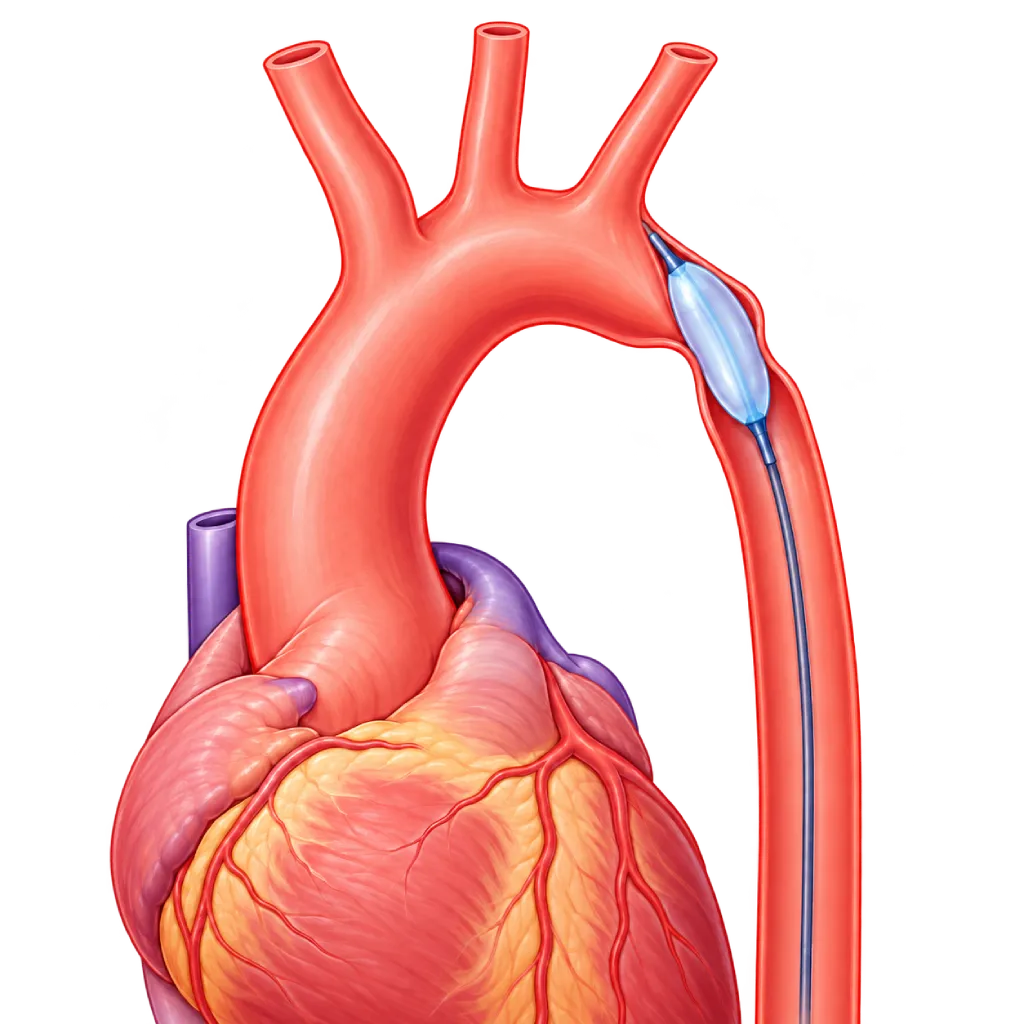
Balloon angioplasty for aortic coarctation is a procedure that widens the narrowed part of the aorta using a balloon inserted through a catheter from a blood vessel in the groin. It is more often used in children with a short narrowing. In teenagers and adults, doctors usually add a stent so the result lasts longer.
Sources01 / Understanding the procedure
About Balloon Angioplasty for Aortic Coarctation
What Is Aortic Coarctation
Aortic coarctation is a narrowing of the aorta that is present from birth, usually just after the aortic arch, near the origin of the blood vessel to the left arm. This narrowing makes the left side of the heart pump harder, raises blood pressure in the arms, and reduces blood flow to the lower body. Coarctation often occurs together with other abnormalities, especially an aortic valve with two leaflets (bicuspid).
How Balloon Angioplasty Works
A special balloon, still deflated, is passed through a catheter to the exact site of the narrowing, then inflated for a few seconds. The pressure of the balloon stretches the aortic wall so the narrowing widens.
After the balloon is deflated and withdrawn, the aorta stays wider with nothing left behind inside it. This approach suits children because their aorta will continue to grow.
Balloon, Stent, or Surgery
The choice of procedure depends on age, body size, and the shape of the narrowing.
- Newborns: surgery is usually preferred, because the narrowing comes back more often after balloon angioplasty. A balloon is sometimes used temporarily to stabilize a critically ill baby.
- Children: balloon angioplasty can be an option for a short narrowing, especially if the child's body is still too small for a stent.
- Teenagers and adults: stent placement is usually preferred over a balloon alone, because the result lasts longer and the risk of injury to the aortic wall is lower.
Why It Needs Treatment
Untreated coarctation can lead to persistent high blood pressure, thickening of the heart muscle, heart failure, widening or tearing of the aorta, and bleeding in the brain. Earlier treatment helps lower these risks, although blood pressure checks and imaging are still needed for life.
02 / Understanding the procedure
When Is This Procedure Considered?
A doctor may consider this procedure in the situations below. The decision is always made after a thorough assessment.
- Coarctation with a Short NarrowingA short narrowing limited to one spot, with an aortic arch of adequate size.
- Arm and Leg Blood Pressure DifferenceBlood pressure in the arm is more than 20 mmHg higher than in the leg, or there is a similar difference when pressure is measured through a catheter.
- High Blood Pressure or Strain on the HeartHypertension in the arms, thickening of the left heart muscle, or reduced pumping function caused by the narrowing.
- Renarrowing After RepairBalloons are also used for recoarctation, especially after surgery in infancy.
- Stabilizing a Critically Ill BabyIn certain situations, a balloon is used temporarily to improve blood flow before surgery.
Situations to Consider First
- Newborns in Stable ConditionSurgery is usually preferred, because the narrowing comes back more often after balloon angioplasty at this age.
- Long Narrowing or Small Aortic ArchThis type of narrowing is better suited to surgical repair.
- Teenagers and AdultsA stent is usually preferred over a balloon alone, because the result lasts longer.
- Widening of the Aorta Around the NarrowingAn aneurysm near the site of the narrowing requires special planning, for example a covered stent or surgery.
- Kidney Problems or Contrast Dye AllergyThe procedure may still be possible with special preparation. Tell the team early on.
- Infection or FeverPlanned procedures are usually postponed until the infection has resolved.
03 / Before the procedure
How Should You Prepare?
The majority of balloon angioplasty patients are children, so preparation involves the parents. The team will give you written instructions based on the procedure plan.
Tests before the procedure. These usually include blood pressure in the arms and legs, echocardiography, an ECG, and blood tests. If needed, the doctor may request CT angiography or an MRI of the aorta.
Fasting. Follow the fasting instructions from the anesthesia team. For babies and children, the cutoff times for milk and water are explained separately.
Current medications. Bring a list of all medications and supplements. Do not stop any medication without your doctor's guidance.
Allergies and health condition. Tell the team if your child has ever had an allergy to medications, contrast dye, adhesive tape, or latex, or if your child has a cough, cold, or fever.
Preparing your child. Explain in simple words what will happen. Parents can stay with the child until anesthesia is given, and the child may bring a favorite item.
Plan your time. The hospital stay is usually one night. Arrange for a companion, as well as time off from school or work for a few days.
Unsure about the preparation instructions? Ask our team before the procedure.
04 / During the procedure
How Is the Procedure Done?
The procedure is done in a catheterization lab with X-ray guidance.
Anesthesia
In children, the procedure is done under general anesthesia. In adults, it can be done under general anesthesia, or with a sedative and local anesthesia.
Blood Vessel Access
The doctor inserts a small tube (catheter) through an artery in the groin, sometimes also through another blood vessel to measure pressure. A blood thinner is given during the procedure to prevent clots from forming.
Measuring and Mapping the Narrowing
Pressure is measured above and below the narrowing, then contrast dye is injected to see the length and diameter of the aorta. The results are used to choose the balloon size.
Inflating the Balloon
The balloon is positioned exactly at the narrowed section, then inflated for a few seconds, sometimes more than once, until the narrowing widens.
Confirming the Result
Pressure is measured again and more contrast dye is injected to confirm that the aorta has widened and its wall is intact. The catheter is then removed, and pressure is applied to the puncture site until the bleeding stops.
05 / Benefits and risks
Benefits and Risks Should Be Discussed Together.
Every medical procedure has benefits and risks. Your doctor will explain both for your situation before the procedure.
Benefits You Can Expect
- No Surgery and No IncisionThe balloon is inserted through a blood vessel in the groin, without opening the chest.
- Short RecoveryThe majority of children go home the next day and quickly return to their activities.
- Nothing Left BehindUnlike a stent, the balloon is withdrawn, which suits a child's aorta that is still growing.
- Reduces Heart Strain and Blood PressureWidening the narrowing means the heart does not need to pump as hard as before.
- Can Be Repeated If NeededIf the aorta narrows again, a balloon or stent can be placed again through a catheter without surgery.
The benefits of a procedure are not a promise of a cure. Ask how the results will affect your care plan.
Risks You Should Know
- RenarrowingMore common after balloon angioplasty than after a stent or surgery, especially in babies, so a repeat procedure may be needed.
- Widening of the Aortic Wall (Aneurysm)Stretching by the balloon can weaken the aortic wall at the site of the narrowing. This is why regular imaging is needed.
- Tear in the Aortic WallRare but serious. The team has a covered stent and further treatment ready in case this happens.
- Blood Vessel Problems in the GroinBleeding, bruising, or reduced blood flow to the leg, more likely in babies and young children because their blood vessels are small.
- Reaction to Contrast Dye or AnesthesiaAn allergic reaction or side effects of anesthesia, which the team monitors closely during the procedure.
Risks can differ from person to person. A full explanation and consent are given after an individual assessment.
06 / After the procedure
What Is Recovery Like?
The majority of children can go home the next day.
After the procedure. Your child lies down for a few hours with the leg kept straight. The team monitors blood pressure, the pulse in the feet, and the puncture site. In babies and young children, the color and warmth of the leg are also checked.
Activity. Light activity and school can resume within a few days. Strenuous exercise and rough play are postponed for about one week, or as advised.
Blood pressure. Blood pressure usually drops after the procedure, but some patients still need medication. Measure blood pressure regularly as advised by your doctor.
Follow-up visits and imaging. Follow-up with a cardiologist continues for life. Echocardiography is done regularly, and CT or MRI of the aorta is done to check the aortic wall and the possibility of renarrowing.
Warning signs. Contact the medical team or go to the emergency room right away if your child has:
- Swelling that keeps growing, or bleeding at the puncture site
- A leg that is cold, pale, or bluish, or that your child will not move
- Severe chest, back, or abdominal pain
- Fever, constant fussiness, or trouble feeding or eating
- Shortness of breath
Know the Signs That Need Prompt Care.
Follow the team's guidance on warning signs. If severe or sudden symptoms appear after the procedure, go to the nearest emergency department right away or call Heart Attack Center 1500 258.
07 / Team and support
Doctors and Procedure Support
The doctors below are listed for this procedure. Listed by name, not by ranking.

dr. BRM Ario S. Kuncoro, Sp.JP(K)
Echocardiography & Cardiovascular Imaging
Cardiovascular Diagnostic Center +2 centers
Clinical focusAdvanced and 3D Echocardiography · Transesophageal Echocardiography
View Profile
dr. Radityo Prakoso, Sp.JP(K)
Pediatrics & Congenital Heart Disease
Congenital and Structural Heart Center
Clinical focusPediatric Cardiology Consultation · Congenital Heart Disease Care
View Profile
dr. Salomo Purba, Sp.BTKV, Subsp.JPK(K)
Pediatric and Congenital Heart Surgery
Congenital and Structural Heart Center +2 centers
Clinical focusPediatric Heart Surgery · Congenital Heart Defect Surgery
View Profile08 / Common questions
Before You Plan the Procedure.
Questions parents and patients often ask about balloon angioplasty for aortic coarctation. The treatment plan is decided after an evaluation by the heart team.
What is the difference between balloon angioplasty and stent placement?
In balloon angioplasty, the balloon is inflated and then withdrawn, so nothing is left behind in the aorta. In stent placement, a metal mesh tube is left in place to hold the aorta open. Balloons are more often used in children whose aorta is still growing, while stents are usually preferred in teenagers and adults.
At what age can balloon angioplasty be done?
Balloon angioplasty can be done at various ages, but it is usually chosen for children older than a few months who have a short narrowing. In newborns, surgery is usually preferred because the narrowing comes back more often. In teenagers and adults, doctors usually add a stent. The team will assess the right option for your child.
Can coarctation come back after balloon angioplasty?
Yes. Renarrowing is more common after balloon angioplasty than after a stent or surgery, especially if the procedure is done in infancy. This is why your child needs regular follow-up visits and blood pressure checks. If the aorta narrows again, it can usually be repaired again through a catheter, with a balloon or a stent.
Will my child still need blood pressure medication after the procedure?
Some children no longer need medication, but others still do, especially if the narrowing has been present for a long time. The doctor will assess your child's blood pressure at follow-up visits, sometimes with 24-hour monitoring or an exercise test in older children, then adjust the medication.
When can my child go back to school and play sports?
The majority of children can go back to school within a few days. Strenuous exercise and rough play are usually postponed for about one week, or as advised by the doctor. For competitive sports, check with the cardiologist beforehand, because the advice depends on blood pressure, imaging results, and the condition of the aortic valve.
Why are lifelong follow-up visits needed?
People with coarctation remain at risk of high blood pressure, renarrowing, widening of the aorta, and aortic valve problems, even when the procedure is successful. Regular follow-up visits with blood pressure checks, echocardiography, and CT or MRI of the aorta help find these problems early, before they cause symptoms.
Sources and Medical Review
Translated from the Indonesian edition medically reviewed by dr. Suko Adiarto, Sp.JP(K), Ph.D..
Sources as cited in the Indonesian edition.
- Feltes TF, Bacha E, Beekman RH, et al. Indications for Cardiac Catheterization and Intervention in Pediatric Cardiac Disease: A Scientific Statement From the American Heart Association. Circulation. 2011;123(22):2607-2652.
- Forbes TJ, Kim DW, Du W, et al. Comparison of Surgical, Stent, and Balloon Angioplasty Treatment of Native Coarctation of the Aorta: An Observational Study by the CCISC (Congenital Cardiovascular Interventional Study Consortium). J Am Coll Cardiol. 2011;58(25):2664-2674.
- Baumgartner H, De Backer J, Babu-Narayan SV, et al. 2020 ESC Guidelines for the management of adult congenital heart disease. Eur Heart J. 2021;42(6):563-645.
- Stout KK, Daniels CJ, Aboulhosn JA, et al. 2018 AHA/ACC Guideline for the Management of Adults With Congenital Heart Disease. Circulation. 2019;139(14):e698-e800.