
Quick answer
What Is Truncus Arteriosus?
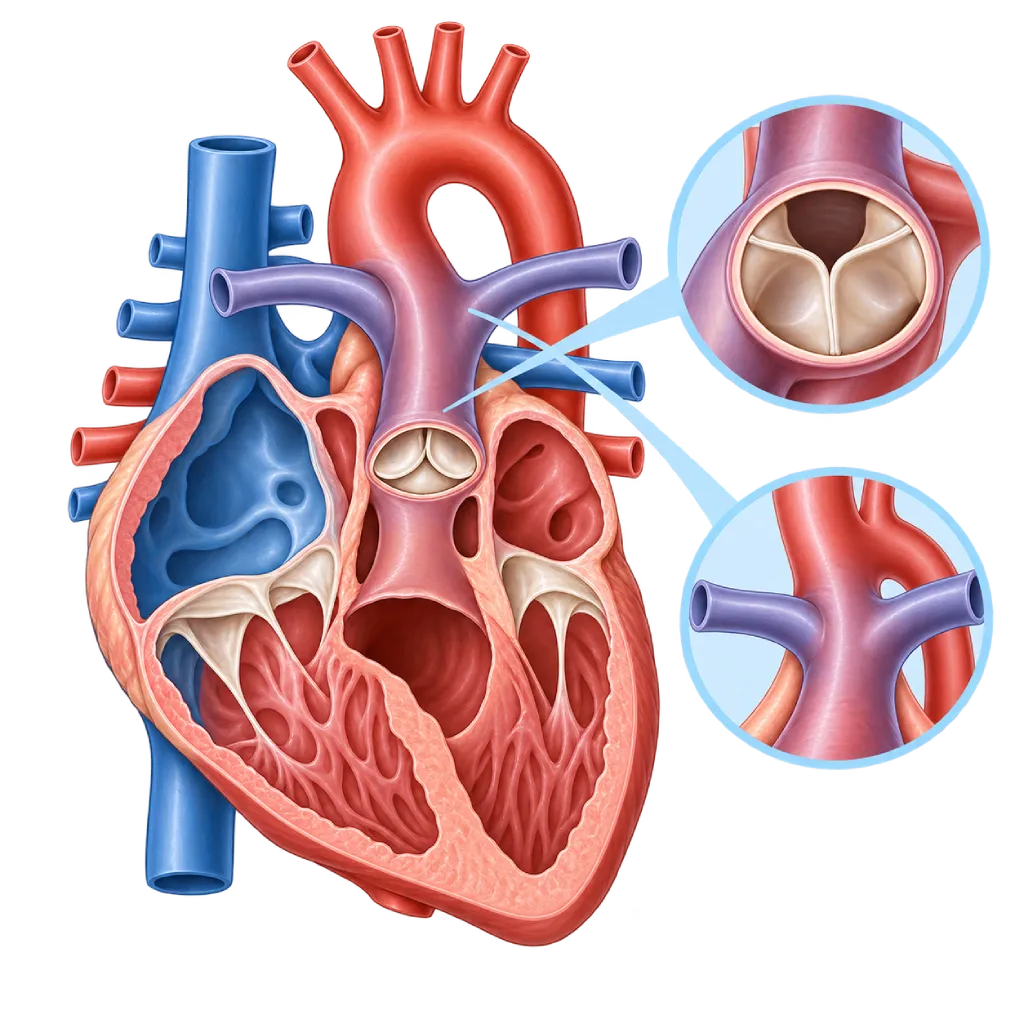
Truncus arteriosus (persistent truncus arteriosus) is a congenital heart defect in which only one large blood vessel leaves the heart, in place of the aorta and pulmonary artery. Too much blood goes to the lungs, so the baby quickly develops heart failure and needs early surgery.
SourcesSigns That Need Urgent Help
- Very fast breathing or gasping, with the chest wall pulling in
- A baby who is very limp or refuses to feed at all
- Worsening blueness
- Pale, cold, sweaty skin
- Seizures
- Fainting
If these signs appear, go to the nearest emergency department right away or call Heart Attack Center 1500 258.
01 / Understanding the condition
About Truncus Arteriosus
In the fetus, the aorta and the pulmonary artery start out as a single vessel trunk that later divides in two. In truncus arteriosus, this division does not happen. There is only one large blood vessel, called the truncus, which leaves the heart above a large hole in the wall between the ventricles. The coronary arteries, the pulmonary arteries, and the aorta all branch from this single vessel. This defect is rare, about 1 in every 100 congenital heart defects. It forms in the early weeks of pregnancy and is not caused by anything the parents did. An overview of other congenital defects is covered on the Congenital Heart Disease page.
What It Means for the Baby
Blood from both ventricles mixes in the truncus, so the baby looks slightly bluish. The main problem is blood flow to the lungs. After birth, pressure in the lungs falls and more and more blood flows into the lungs. Within a few weeks, the baby breathes fast, sweats during feeding, and has trouble gaining weight, which are signs of heart failure. If this is left for months, the walls of the lung blood vessels thicken and lung pressure becomes permanently high. That is why the pediatric heart team does not delay surgery for too long.
The Truncal Valve and Associated Conditions
The truncus has only one valve. This valve often has an unusual shape, with two to four leaflets, and it can leak or narrow. Some babies also have an interrupted aortic arch. About one third of babies with truncus have a chromosome 22q11.2 deletion (DiGeorge syndrome), which can affect calcium levels, immunity, and the child's development.
Surgery and Long-Term Monitoring
Repair surgery is usually done in the first or second month of life. The hole in the wall between the ventricles is closed so that the truncus becomes the aorta, and then the pulmonary arteries are detached and connected to the right ventricle with a valved tube called a conduit. If the truncal valve leaks severely or the aortic arch is interrupted, both are repaired in the same operation. Because the conduit does not grow with the child, the child usually needs the conduit replaced several times, through surgery or a catheter. The ESC 2020 and AHA/ACC 2018 guidelines recommend lifelong follow-up to assess the conduit, the truncal valve, the aortic root, and the heart rhythm.
02 / Understanding the condition
Symptoms to Recognize.
Common Symptoms
- Fast or labored breathing
- Sweating and tiring quickly during feeding
- Poor weight gain
- Slightly bluish lips or skin
- A heart murmur when examined by a doctor
- A pulse that feels very strong (bounding)
Symptoms in Newborns
In the first days, the baby often looks fairly well because lung pressure is still high.
- Slightly low oxygen saturation on screening
- Mild blueness of the lips
- A heart murmur at the first examination
- Jitteriness or seizures due to low calcium in babies with a 22q11.2 deletion
Symptoms in Infants
Signs of heart failure usually appear at 2 to 6 weeks of age, when lung pressure falls.
- Fast breathing at rest or during sleep
- Feeding briefly, then stopping because of tiredness
- Heavy sweating on the head during feeding
- Weight that does not increase or even drops
- Frequent coughs or respiratory infections
Symptoms in Children
After surgery, the following symptoms may signal a narrowed conduit or a leaking truncal valve.
- Tiring more quickly than before
- Shortness of breath when playing or climbing stairs
- Palpitations or a history of fainting
- Swelling in the legs or abdomen
03 / Understanding the condition
What Causes This Condition?
- The fetal vessel trunk fails to divide into the aorta and the pulmonary artery in the early weeks of pregnancy
- A problem with neural crest cells, which form the wall between the large fetal blood vessels
- A chromosome 22q11.2 deletion in about one third of cases
- In some children, the exact cause is unknown
04 / Understanding the condition
Who Is at Higher Risk?
Genetic
A chromosome 22q11.2 deletion is the main risk factor. If one parent has this deletion, the chance of passing it on to a child is about 50 percent.
Medical
Uncontrolled diabetes in the mother, as well as certain infections or medicines in the first trimester, are linked to a higher risk of congenital heart defects.
Lifestyle
Smoking and drinking alcohol during pregnancy increase the risk of congenital heart defects in general.
Other
A history of congenital heart disease in a sibling increases the chance of a heart defect in the next pregnancy.
Groups at Higher Risk
- Babies with 22q11.2 Deletion: Defects of the heart's outflow, such as truncus, are often found in this syndrome, so every baby with this diagnosis needs a heart check.
- Babies with an Interrupted Aortic Arch: This combination makes blood flow to the lower body depend on the ductus arteriosus, so treatment needs to be more urgent.
- Children with a Pulmonary Artery Conduit: The conduit narrows or leaks as the child grows, so it usually needs to be replaced several times before adulthood.
- Adult Survivors of Truncus: A leaking truncal valve, widening of the aortic root, and arrhythmias can appear in adulthood, so checkups are still needed.
05 / Understanding the condition
How Is It Diagnosed?
Truncus arteriosus can be seen on a pregnancy ultrasound and confirmed with fetal echocardiography. After birth, the clues are a heart murmur, slightly low oxygen saturation on screening, or signs of heart failure in the first weeks.
Echocardiography confirms the diagnosis by showing a single large vessel above the hole in the ventricular wall, where the pulmonary artery branches arise, the shape and function of the truncal valve, and the aortic arch. A cardiac CT scan or MRI is used if the pulmonary artery branches or the aortic arch need to be mapped in more detail. A chest X-ray shows an enlarged heart and excess blood flow to the lungs, while an ECG assesses the strain on both ventricles. Cardiac catheterization is rarely needed in babies, but it is useful in older children to measure lung pressure or treat a narrowed conduit.
Because the condition is often linked to a 22q11.2 deletion, doctors usually recommend genetic testing, calcium level checks, and an immune system assessment before surgery.
Fetal echocardiography and newborn oxygen saturation screening help detect the defect before signs of heart failure appear.
Echocardiography
The main test to see a single large vessel above the hole in the ventricular wall, where the pulmonary artery branches arise, the truncal valve, and the aortic arch.
Chest X-Ray
Shows an enlarged heart and excess blood flow to the lungs.
Cardiac CT Scan
Maps the pulmonary artery branches and the aortic arch if the echocardiography images are not clear enough.
Cardiac Catheterization
Measures lung pressure in older children, and widens or places a valve in a narrowed conduit.
Genetic testing for 22q11.2 deletion, along with blood calcium and immune system tests, because these affect preparation for surgery.
Cardiac MRI
Assesses the conduit, truncal valve, aortic root, and ventricular function during long-term monitoring without X-rays.
06 / Understanding the condition
Treatment Options.
Treatment is decided by a doctor after an assessment. The categories below can help you follow the conversation with your doctor.
Heart Failure Medicines and Nutritional Support
Before surgery, the doctor may give diuretics and other medicines to ease the strain on the heart, plus high-calorie milk if needed.
Complete Repair Surgery
The hole in the ventricular wall is closed, and the pulmonary arteries are detached from the truncus and then connected to the right ventricle with a conduit. Covered on the Congenital Heart Surgery page.
Truncal Valve Repair or Replacement
Done if the truncal valve leaks or narrows severely, either during the first operation or later on.
Conduit Replacement Through a Catheter or Surgery
A narrowed conduit can be widened with a balloon or stent, fitted with a valve through a catheter, or replaced with surgery. Covered on the Transcatheter Pulmonary Valve Replacement page.
Care Related to 22q11.2 Deletion
Special transfusion preparation for surgery, calcium monitoring, immunizations as advised by the doctor, and developmental therapy if needed.
Lifelong Follow-Up
Regular echocardiography, MRI or CT, ECG, and exercise testing to assess the conduit, truncal valve, aortic root, and heart rhythm.
07 / Understanding the condition
Complications to Watch For.
Heart Failure in Infancy
Excess blood flow to the lungs makes the heart work hard from the first weeks, so the baby is short of breath, has difficulty feeding, and grows poorly.
Pulmonary Hypertension
Long-standing excess flow damages the lung blood vessels. Once this damage is permanent, surgery can no longer reverse it. Covered on the Pulmonary Hypertension page.
Truncal Valve Leakage or Narrowing
This single valve can leak or narrow from birth or over time, and it sometimes needs to be repaired or replaced.
Conduit Narrowing
The conduit becomes relatively small as the child grows, or it calcifies, so it needs to be widened, fitted with a valve through a catheter, or replaced.
Heart Rhythm Disorders
Arrhythmias can appear after repeated surgery, especially in teenagers and adults. Covered on the Heart Rhythm Disorders / Arrhythmia page.
Problems Related to 22q11.2 Deletion
Low calcium, recurrent infections, and delays in speech and learning need to be managed together with a pediatrician and other specialists.
08 / Understanding the condition
What Can You Do?
- Truncus cannot be reliably prevented, but a healthy pregnancy helps lower the risk of congenital heart defects
- Control diabetes before pregnancy, take folic acid as advised, and avoid smoking and alcohol
- If a parent has a 22q11.2 deletion, get genetic counseling before or early in pregnancy
- Have your scheduled pregnancy ultrasounds, and fetal echocardiography if there is a family history
- Watch your baby's breathing, feeding, and weight in the first weeks
- Keep the teeth and mouth clean to lower the risk of infection of the valve and conduit
- Keep up lifelong checkups and conduit assessments even if your child seems healthy
09 / Understanding the condition
When Should You See a Doctor?
Take your baby to the emergency room right away if your baby breathes very fast with the chest wall pulling in, looks very limp, refuses to feed, becomes bluer, or has a seizure. Make an appointment with a pediatric cardiologist if:
- A pregnancy ultrasound shows an abnormality of the baby's large blood vessels.
- Your baby breathes fast, sweats during feeding, or does not gain weight in the first weeks.
- A doctor finds a heart murmur or low oxygen saturation on screening.
- Your baby or child is diagnosed with a 22q11.2 deletion.
- A child with a conduit tires more quickly, is short of breath when playing, has palpitations, or has fainted.
Don't Wait in an Emergency.
If symptoms are severe or come on suddenly, go to the nearest emergency department right away or call Heart Attack Center 1500 258, rather than waiting for an appointment.
10 / Common questions
Questions You May Have.
Frequently asked questions about truncus arteriosus.
When does a baby with truncus arteriosus need surgery?
Surgery is generally done in the first or second month of life, before heart failure worsens and before the lung blood vessels are permanently damaged. The exact timing is set by the pediatric heart team based on the baby's condition, the function of the truncal valve, whether the aortic arch is interrupted, and the baby's readiness. Delaying surgery too long can make lung pressure permanently high and increase the risk of surgery.
Why does a child need more surgery after the repair?
The conduit that connects the right ventricle to the pulmonary artery does not grow with the child. Over time, the conduit becomes relatively small, calcifies, or its valve leaks. That is why the majority of children need the conduit replaced once or more before adulthood. Some replacements can now be done through a catheter, so the time between open surgeries can be longer. The doctor tracks the timing through regular checkups.
What is the link between truncus and DiGeorge syndrome?
DiGeorge syndrome is caused by the loss of a small part of chromosome 22, called a 22q11.2 deletion. About one third of babies with truncus have this deletion. Besides the heart, it can affect calcium levels, immunity, the roof of the mouth, and speech and learning development. Knowing about it early helps doctors prepare for surgery more safely and plan monitoring of the child's growth and development.
Can a child with truncus be active normally?
Many children who have had surgery can go to school, play, and exercise according to their abilities. Physical ability depends on the condition of the conduit, the truncal valve, and heart function, so the doctor may suggest exercise testing to set safe limits. If your child suddenly tires more quickly, becomes short of breath, or has palpitations, tell the doctor, because this may mean the conduit needs to be checked.
Does conduit replacement always require open surgery?
Not always. In some children and adults, a narrowed conduit can be widened with a balloon or stent and then fitted with a new valve through a catheter from a blood vessel in the groin. Whether this is possible depends on the size and shape of the conduit, the position of the coronary arteries, and the patient's age and weight. If a catheter procedure is not suitable, the conduit is replaced with surgery.
Sources and Medical Review
Translated from the Indonesian edition medically reviewed by dr. Radityo Prakoso, Sp.JP(K).
Sources as cited in the Indonesian edition.
- Baumgartner H, De Backer J, Babu-Narayan SV, et al. 2020 ESC Guidelines for the management of adult congenital heart disease. Eur Heart J. 2021;42(6):563-645.
- Stout KK, Daniels CJ, Aboulhosn JA, et al. 2018 AHA/ACC Guideline for the Management of Adults With Congenital Heart Disease: A Report of the American College of Cardiology/American Heart Association Task Force on Clinical Practice Guidelines. Circulation. 2019;139(14):e698-e800.
- Naimo PS, Fricke TA, Yong MS, et al. Outcomes of Truncus Arteriosus Repair in Children: 35 Years of Experience From a Single Institution. Semin Thorac Cardiovasc Surg. 2016;28(2):500-511.
- Buckley JR, Amula V, Sassalos P, et al. Multicenter Analysis of Early Childhood Outcomes After Repair of Truncus Arteriosus. Ann Thorac Surg. 2019;107(2):553-559.
- McDonald-McGinn DM, Sullivan KE, Marino B, et al. 22q11.2 deletion syndrome. Nat Rev Dis Primers. 2015;1:15071.
- Martin GR, Ewer AK, Gaviglio A, et al. Updated Strategies for Pulse Oximetry Screening for Critical Congenital Heart Disease. Pediatrics. 2020;146(1):e20191650.
Doctors Who Treat This Condition

dr. Radityo Prakoso, Sp.JP(K)
Pediatrics & Congenital Heart Disease
Congenital and Structural Heart Center
Clinical focusPediatric Cardiology Consultation · Congenital Heart Disease Care
View Profile
dr. Salomo Purba, Sp.BTKV, Subsp.JPK(K)
Pediatric and Congenital Heart Surgery
Congenital and Structural Heart Center +2 centers
Clinical focusPediatric Heart Surgery · Congenital Heart Defect Surgery
View Profile
dr. Tartila, Sp.A, Subsp.ETIA(K)
Pediatric Emergency and Intensive Care
Congenital and Structural Heart Center
Clinical focusPediatric Intensive Care · Pediatric Emergency Care
View Profile