
Quick answer
What Is Cardiac Catheterization?
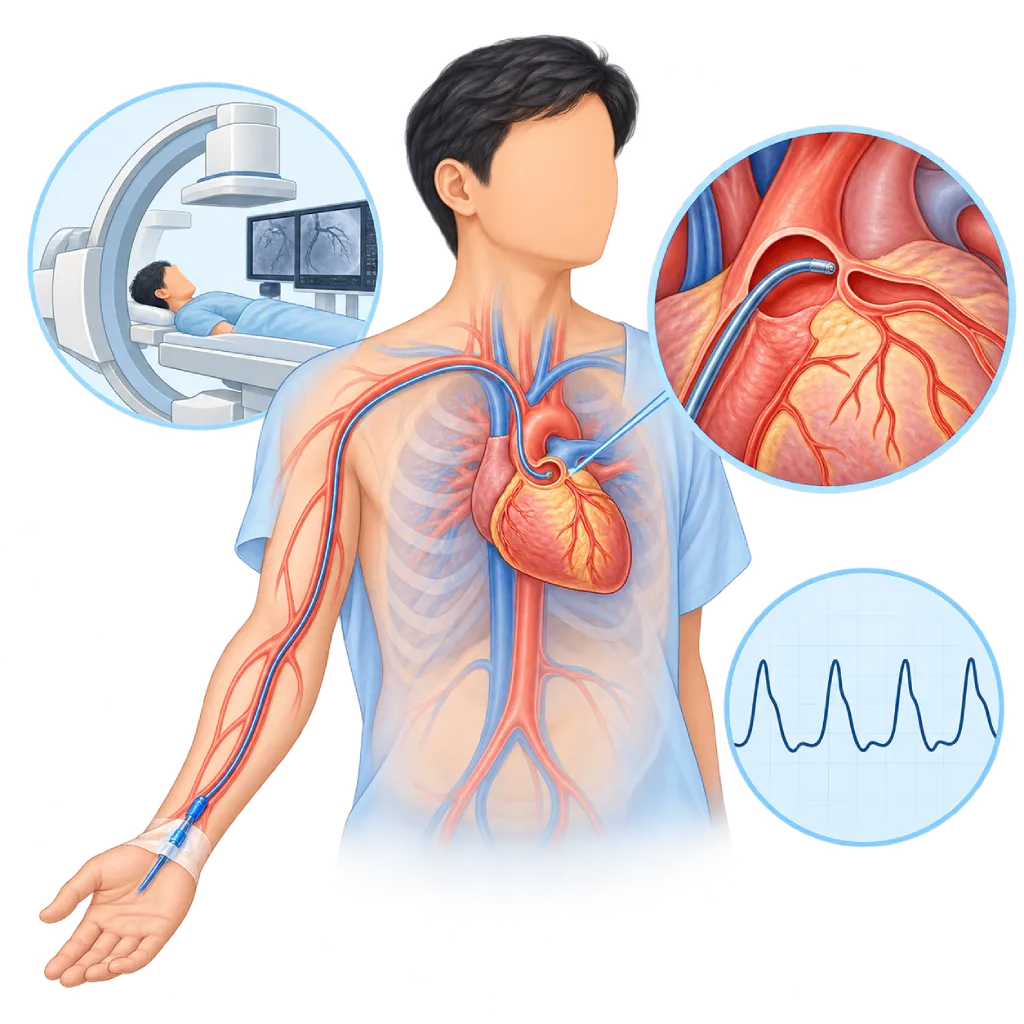
Cardiac catheterization is a procedure that passes a thin tube (catheter) through a blood vessel in the wrist, groin, or neck to the heart. Through the catheter, the doctor can image the coronary arteries, measure pressure and oxygen levels in the heart chambers, and assess the valves. It usually takes 30 minutes to 1 hour under local anesthesia.
Sources01 / Understanding the procedure
About Cardiac Catheterization
What Is Cardiac Catheterization
Cardiac catheterization is a procedure in which a catheter, a thin and flexible plastic tube, is passed through a blood vessel to the heart under X-ray guidance. Through the tip of the catheter, the doctor can inject contrast dye to image the blood vessels and heart chambers, measure the pressure in each heart chamber, and take blood samples to measure oxygen levels. The term covers several tests, which are chosen according to the question your doctor needs to answer.
Left Heart Catheterization
The catheter is inserted through an artery in the wrist or groin toward the aorta and the left side of the heart. The part commonly performed is imaging the coronary arteries with contrast dye to look for narrowings, which is covered on the Coronary Angiography page. The doctor can also measure the pressure in the left ventricle and aorta, image the movement of the left ventricle, or measure the pressure difference across the aortic valve.
Right Heart Catheterization
The catheter is inserted through a vein in the neck, arm, or groin toward the right atrium, right ventricle, and pulmonary artery. This test measures the pressure in the right side of the heart and the lung blood vessels, as well as the amount of blood the heart pumps each minute. The results are used to confirm pulmonary hypertension, assess heart failure, and look for leaks between the heart chambers, which is covered on the Right Heart Catheterization page.
Additional Tests in the Same Procedure
When needed, catheterization can be combined with measuring the pressure inside the coronary arteries (FFR) to assess whether a narrowing disrupts blood flow, or with imaging from inside the vessel using IVUS and optical coherence tomography. When inflammation or certain heart muscle diseases are suspected, a small sample of heart muscle tissue can be taken, which is covered on the Endomyocardial Biopsy page.
From Diagnosis to Treatment
Diagnostic catheterization is often a step before catheter-based treatment, such as stent placement, which is covered on the Coronary Angioplasty page, closing a hole in the wall between the heart chambers, or replacing the aortic valve through a catheter. In some patients, treatment can be done in the same procedure if it has been discussed beforehand. Catheterization results are also used by the heart team to weigh whether surgery is needed.
Catheterization and Tests Without a Catheter
Many questions about the heart can now be answered with tests that do not use a catheter, such as echocardiography, stress testing, or CT coronary angiography. Catheterization is chosen when those tests are not sufficient, their results conflict, the likelihood of disease is high, or catheter-based treatment is likely to be needed.
02 / Understanding the procedure
When Is This Procedure Considered?
A doctor may consider this procedure in the situations below. The decision is always made after a thorough assessment.
- Coronary Artery DiseaseTo find and assess narrowings of the coronary arteries, including during a heart attack.
- Heart Valve DiseaseWhen echocardiography results are unclear, or before valve surgery and valve procedures.
- Pulmonary HypertensionTo confirm high pressure in the lung blood vessels and look for its cause through right heart catheterization.
- Heart Failure and Heart Muscle DiseaseTo look for the cause, measure the heart's filling pressures, and assess eligibility for a transplant.
- Congenital Heart DiseaseTo measure leaks between the heart chambers and lung pressure before a closure procedure or surgery.
- Distinguishing Pericardial from Heart Muscle DiseaseFor example, a stiff sac around the heart (pericardium) that squeezes the heart, by measuring pressures on the left and right sides.
Situations to Consider First
- Severe Allergy to Contrast DyeAllergy-preventing medication can be given beforehand; tell the team early on.
- Severe Kidney ImpairmentContrast is limited or avoided, for example when only right heart catheterization is needed.
- Active Bleeding or Clotting DisordersThese need to be controlled first if the catheterization is not an emergency.
- Uncontrolled Infection or FeverFor a planned procedure, the infection is treated first before catheterization is scheduled.
- Unstable Heart FailurePatients who are short of breath when lying down are usually stabilized first with medication, except in an emergency.
03 / Before the procedure
How Should You Prepare?
A planned catheterization is scheduled after your doctor explains which part will be performed, for example left, right, or both. The team will give you written instructions.
Tests before the procedure. Blood tests, including kidney function and blood clotting, as well as an ECG. Bring the results of previous tests, such as echocardiography, stress tests, or coronary CT.
Medications you are taking. Bring a list of all your medications. Blood thinners, some diabetes medications, and diuretics (water pills) may need to be adjusted. Do not stop any medication without your doctor's instructions.
Fasting. Follow the fasting instructions from the team, usually for a few hours before the procedure.
Allergies. Tell the team if you have ever had an allergy to contrast dye, medications, adhesive tape, or latex.
Consent for the procedure. Your doctor explains the purpose, the risks, and the possibility of further treatment in the same procedure, such as stent placement.
Companion. Arrange for someone to take you home, because you are advised not to drive on the day of the procedure.
Unsure about the preparation instructions? Ask our team before the procedure.
04 / During the procedure
How Is the Procedure Done?
Cardiac catheterization is performed in the catheterization laboratory (cath lab) by a cardiologist together with nurses and radiographers. You stay awake under local anesthesia, and a mild sedative can be given. The procedure usually takes 30 minutes to 1 hour, and can take up to 2 hours if the left and right sides are examined together or additional tests are done.
Preparation and Local Anesthesia
You lie on the procedure table. ECG electrodes, a blood pressure monitor, and an oxygen level monitor are attached. The skin at the wrist, groin, or neck is cleaned and then numbed.
Inserting the Catheter
A short tube is inserted into an artery for left heart catheterization, or into a vein for right heart catheterization. The catheter is then advanced slowly under X-ray guidance until it reaches the heart. You cannot feel the catheter moving inside the blood vessels.
Imaging and Measuring
Following the plan, the doctor images the coronary arteries or the left ventricle with contrast dye, records the pressure in each heart chamber, and takes blood samples to check their oxygen levels. When the contrast goes in, you may feel a brief warm sensation.
Finishing and Closing the Access Site
The catheter and tube are removed. A compression band is placed on the wrist; in the groin, the site is pressed or sealed with a special closure device; in the neck, pressure is applied for a few minutes and the site is covered with a bandage.
05 / Benefits and risks
Benefits and Risks Should Be Discussed Together.
Every medical procedure has benefits and risks. Your doctor will explain both for your situation before the procedure.
Benefits You Can Expect
- Measurements Taken Directly in the HeartPressure, oxygen levels, and images of the vessels are measured directly, not estimated from outside the body.
- Several Tests in One ProcedureCoronary angiography, pressure measurements, and additional tests can be done at the same time.
- A Basis for Treatment DecisionsHelps the heart team choose medication, catheter-based treatment, or surgery.
- Can Proceed to TreatmentCertain narrowings or abnormalities can be treated right away in the same procedure.
The benefits of a procedure are not a promise of a cure. Ask how the results will affect your care plan.
Risks You Should Know
- Bruising or Bleeding at the Puncture SiteUsually mild, and less common when access is through the wrist.
- Reaction to Contrast DyeRanges from a mild rash and itching to a severe allergic reaction, which is rare and treated promptly by the team.
- Kidney Function ProblemsCaused by contrast dye, especially if kidney function is already reduced; the amount of contrast is limited.
- Heart Rhythm DisturbancesBrief irregular heartbeats when the catheter touches the heart wall, which usually go away on their own.
- Rare Serious ComplicationsSuch as a tear in a blood vessel, a heart attack, or a stroke, in fewer than 1 in 100 procedures.
Risks can differ from person to person. A full explanation and consent are given after an individual assessment.
06 / After the procedure
What Is Recovery Like?
After a planned diagnostic catheterization, most patients are monitored for a few hours and then go home on the same day. If the groin was used for access, a stent was placed right away, or your heart condition is severe, you may stay in the hospital for one night or longer.
The first few hours. Your blood pressure, heart rhythm, and puncture site are checked regularly. If the groin was used, you lie with your leg straight for a few hours.
Drink water. If contrast dye was used, drink enough water to help your kidneys clear it, unless your doctor limits your fluids.
Activity. For a few days, avoid lifting heavy objects with the arm or leg used for access. Ask when you may drive and return to work.
Results and follow-up visit. An initial overview is usually explained after the procedure. The treatment plan is discussed at your follow-up visit, sometimes after it has been reviewed with the heart team.
Warning signs to watch for. Go to the emergency room right away if you have:
- Chest pain, shortness of breath, or cold sweats
- Bleeding that does not stop with pressure, or a lump that grows quickly at the puncture site
- A hand or leg that feels cold, pale, numb, or very painful
- A racing heartbeat, fainting, or weakness on one side of the body
- Fever, or a puncture site that is red, swollen, and oozing pus
Know the Signs That Need Prompt Care.
Follow the team's guidance on warning signs. If severe or sudden symptoms appear after the procedure, go to the nearest emergency department right away or call Heart Attack Center 1500 258.
07 / Team and support
Doctors and Procedure Support
The doctors below are listed for this procedure. Listed by name, not by ranking.

dr. Adrianus Kosasih, Sp.JP(K)
Interventional Cardiology
Coronary Intervention Procedures
Clinical focusPrimary Coronary Intervention · PCI for Acute Coronary Syndrome
View Profile
Dr. dr. Dafsah A. Juzar, Sp.JP(K)
Interventional Cardiology
Coronary Intervention Procedures +1 center
Clinical focusComplex Coronary Intervention · Cardiac Catheterization
View Profile
Dr. dr. Jajang Sinardja, Sp.JP(K)
Interventional Cardiology
Coronary Intervention Procedures
Clinical focusAcute Coronary Syndrome · Primary Coronary Intervention
View ProfilePhysiologic Testing System (FFR / iFR)
Measurement of blood pressure inside the coronary artery during catheterization, using a wire with a pressure sensor, to assess…
Catheterization Laboratory (Cath Lab)
A dedicated procedure room for cardiac catheterization, coronary angiography, stent placement, and other catheter-based heart…
The availability of technology and test support is confirmed with the team. Technology is chosen according to clinical need.
08 / Common questions
Before You Plan the Procedure.
Frequently asked questions about cardiac catheterization, from how it differs from surgery to its results.
Is cardiac catheterization the same as surgery?
No. Catheterization is done through a small puncture in a blood vessel under local anesthesia, without any incision in the chest. You stay awake during the procedure, and most patients can go home on the same day or the next day. If the results show that surgery is needed, such as bypass or valve surgery, it is scheduled separately.
What is the difference between left and right heart catheterization?
Left heart catheterization goes through an artery in the wrist or groin to the coronary arteries and left ventricle, mainly to look for narrowed coronary arteries. Right heart catheterization goes through a vein in the neck, arm, or groin to the right side of the heart and the pulmonary artery, to measure lung pressure and the amount of blood the heart pumps. Both can be done together.
Will I be awake during the procedure?
Yes. Catheterization is usually done under local anesthesia at the puncture site, and a mild sedative can be given to help you relax. You can hear and talk with the team and follow instructions such as holding your breath. What you feel is usually only pressure at the puncture site and a brief warm sensation when the contrast dye goes in.
How long will I need to stay in the hospital?
For a planned diagnostic catheterization, most patients are monitored for a few hours and then go home on the same day. If the groin was used for access, additional tests were done, or a stent was placed right away, you may stay one night. After a heart attack or with severe heart failure, the length of stay depends on your heart condition.
Is cardiac catheterization safe?
Catheterization is a commonly performed procedure, and serious complications are rare, occurring in fewer than 1 in 100 procedures. The more common problem is bruising at the puncture site. The risk is slightly higher with older age, kidney problems, or a severe heart condition. Your doctor will explain the benefits and risks for you before asking for your consent.
When will I know the results?
The images and pressure readings appear on the screen right away, so your doctor can usually explain an initial overview shortly after the procedure. The full report and treatment plan are discussed before you go home or at your follow-up visit. If needed, the heart team reviews the results together with the surgeon to decide on the option that suits you.
Sources and Medical Review
Translated from the Indonesian edition medically reviewed by Dr. dr. Jajang Sinardja, Sp.JP(K).
Sources as cited in the Indonesian edition.
- Naidu SS, Abbott JD, Bagai J, et al. SCAI expert consensus update on best practices in the cardiac catheterization laboratory. Catheter Cardiovasc Interv. 2021;98(2):255-276.
- Mason PJ, Shah B, Tamis-Holland JE, et al. An Update on Radial Artery Access and Best Practices for Transradial Coronary Angiography and Intervention in Acute Coronary Syndrome: A Scientific Statement From the American Heart Association. Circ Cardiovasc Interv. 2018;11(9):e000035.
- Vrints C, Andreotti F, Koskinas KC, et al. 2024 ESC Guidelines for the management of chronic coronary syndromes. Eur Heart J. 2024;45(36):3415-3537.
- Vahanian A, Beyersdorf F, Praz F, et al. 2021 ESC/EACTS Guidelines for the management of valvular heart disease. Eur Heart J. 2022;43(7):561-632.
- Humbert M, Kovacs G, Hoeper MM, et al. 2022 ESC/ERS Guidelines for the diagnosis and treatment of pulmonary hypertension. Eur Heart J. 2022;43(38):3618-3731.
- McDonagh TA, Metra M, Adamo M, et al. 2021 ESC Guidelines for the diagnosis and treatment of acute and chronic heart failure. Eur Heart J. 2021;42(36):3599-3726.