
Quick answer
What Is Bone Scintigraphy?
Bone scintigraphy is a test in which a low dose of radioactive tracer is injected into a vein and then imaged with a special camera. In cardiology, this test helps detect transthyretin (ATTR) cardiac amyloidosis. The results are always interpreted together with blood and urine tests to rule out other types of amyloidosis.
Sources01 / Understanding the procedure
About Bone Scintigraphy
What Is Bone Scintigraphy
Bone scintigraphy is a nuclear medicine test. A low dose of radioactive tracer is injected into a vein, and a gamma camera then takes images of the parts of the body that absorb the tracer. In general, this test is used to assess the bones. In cardiology, the same tracer is used to detect cardiac amyloidosis.
Cardiac Amyloidosis and the Role of Scintigraphy
Cardiac amyloidosis occurs when misfolded proteins (amyloid) build up in the heart muscle, making the heart walls thick and stiff. One type comes from the protein transthyretin (ATTR). In ATTR, the heart muscle also absorbs the bone tracer, so the heart lights up on the scintigraphy images.
If the heart clearly absorbs the tracer and blood and urine tests do not find abnormal proteins from plasma cells, the doctor can diagnose ATTR without a heart biopsy. These blood and urine tests are mandatory, because another type of amyloidosis (AL) can also absorb the tracer and requires different treatment.
Who May Need It
Your doctor may request this test if there are signs pointing to cardiac amyloidosis, for example thickened heart walls without a clear cause, heart failure with preserved pumping function in older age, narrowing of the aortic valve in older adults, a history of carpal tunnel syndrome in both hands, or a family history of hereditary ATTR amyloidosis.
After Diagnosis
If the results point to ATTR, the doctor usually requests a genetic test to distinguish the hereditary type from the type that develops with age. An accurate diagnosis is important, because medications are now available that can slow the progression of ATTR.
02 / Understanding the procedure
When Is This Procedure Considered?
A doctor may consider this procedure in the situations below. The decision is always made after a thorough assessment.
- Suspected Cardiac AmyloidosisThickened heart walls without a clear cause on echocardiography or MRI, especially when accompanied by heart failure.
- Heart Failure with Preserved Pumping FunctionEspecially in older age, when the cause is not yet clear and the heart walls appear thick.
- Narrowing of the Aortic Valve in Older AdultsATTR amyloidosis fairly often accompanies aortic stenosis in older age and affects the treatment plan.
- Other Signs Pointing to AmyloidosisFor example carpal tunnel syndrome in both hands, narrowing of the spinal canal, or ECG and echocardiography results that do not match.
- Family History of Hereditary ATTR AmyloidosisTo assess heart involvement in family members who carry a change in the transthyretin gene.
Situations to Consider First
- PregnancyThe test is usually postponed. Tell the team if you are pregnant or might be pregnant.
- BreastfeedingBreastfeeding may need to be paused for a few hours after the injection. Ask the team for instructions.
- Other Recent Nuclear ScansLeftover radioactive material from another test can interfere with the images. Tell the team when your previous tests took place.
- Difficulty Lying StillImaging requires you to lie still for quite a long time. Tell the team if you easily become short of breath when lying down or feel anxious in enclosed spaces.
03 / Before the procedure
How Should You Prepare?
Bone scintigraphy does not require any special preparation. The team will tell you the schedule for the injection and imaging.
Food and medications. You can eat, drink, and take your routine medications as usual, unless the team gives other instructions.
Blood and urine tests. The doctor usually requests tests to look for abnormal proteins from plasma cells. These tests are important for interpreting the scintigraphy results correctly.
Pregnancy and breastfeeding. Tell the team if you are pregnant, might be pregnant, or are breastfeeding.
Clothing. Wear comfortable clothing and remove jewelry or metal objects before imaging.
Set aside time. There is a gap of about one to three hours between the injection and imaging, depending on the tracer used. Bring something to read or a companion if needed.
Previous results. Bring your previous echocardiography, cardiac MRI, ECG, and blood test results.
Unsure about the preparation instructions? Ask our team before the procedure.
04 / During the procedure
How Is the Procedure Done?
The test is performed in the nuclear medicine unit and does not require anesthesia.
Injecting the Tracer
The staff inject a low dose of radioactive tracer into a vein in your arm. Tracers used to assess cardiac amyloidosis include pyrophosphate (PYP), DPD, or HMDP. The injection feels like an ordinary injection.
Waiting for the Tracer to Spread
You wait about one to three hours so the tracer can spread and be absorbed. While waiting, you may sit, eat, and drink.
Imaging
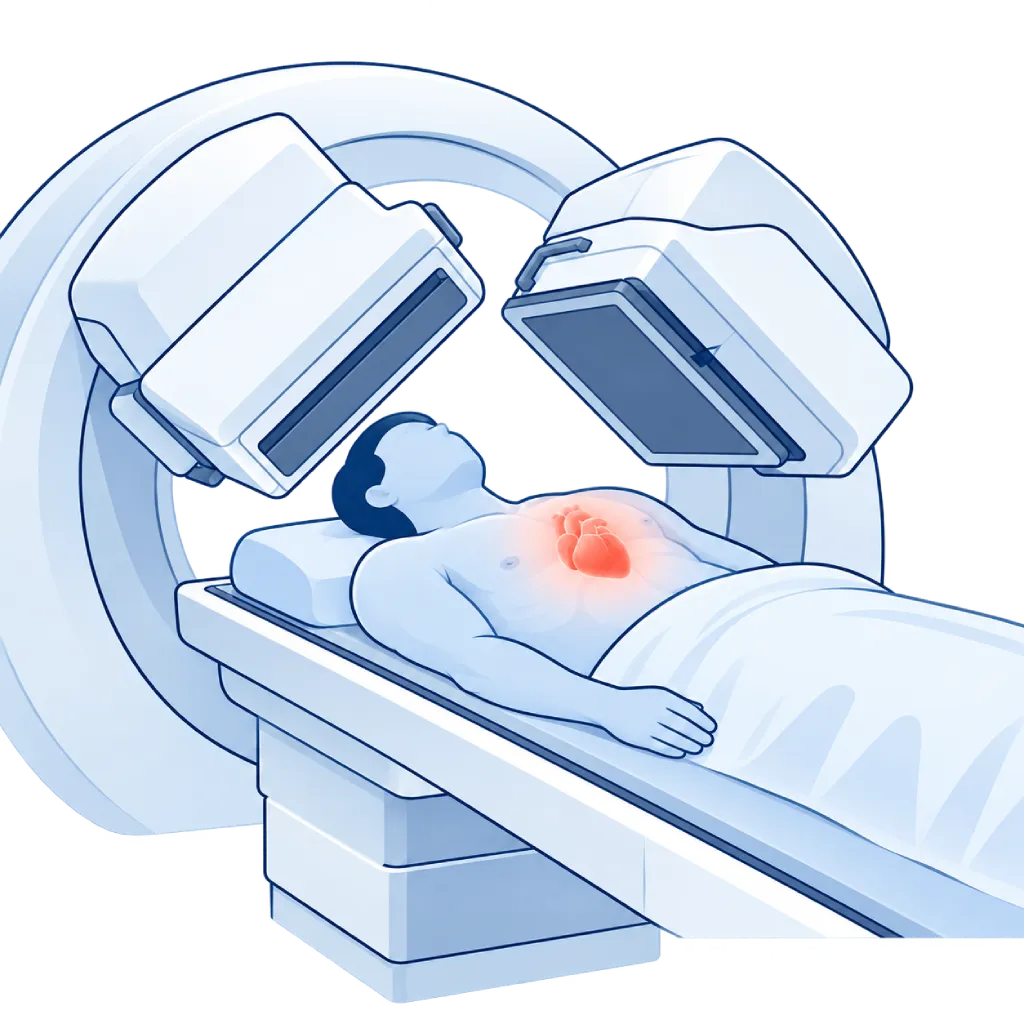
You lie on the examination table, and the gamma camera moves close to your chest without touching your body. Images are taken from the front and also while rotating around the chest (SPECT) to confirm that the tracer is truly in the heart muscle. You need to lie still during imaging.
Reading the Results
The doctor compares the tracer uptake in the heart with the uptake in the ribs, then interprets the results together with the blood and urine tests and other heart tests.
05 / Benefits and risks
Benefits and Risks Should Be Discussed Together.
Every medical procedure has benefits and risks. Your doctor will explain both for your situation before the procedure.
Benefits You Can Expect
- ATTR Diagnosis Without Biopsy in Many PatientsIf the scintigraphy results and the blood and urine tests are consistent, the diagnosis can be made without taking heart tissue.
- No Invasive Procedure NeededOnly a single injection in the arm, with no catheter and no anesthesia.
- Helps Choose the Right TreatmentDistinguishes ATTR from other causes of thickened heart walls, so the appropriate treatment can be started earlier.
- Low Radiation DoseThe tracer is used in small amounts, and the majority of it leaves the body within a day.
- No Recovery PeriodYou can return to your activities right away after the test.
The benefits of a procedure are not a promise of a cure. Ask how the results will affect your care plan.
Risks You Should Know
- Low-Dose Radiation ExposureThe dose is small and is used only when the benefit is clear. The test is usually postponed during pregnancy.
- Bruising at the Injection SiteMild and goes away on its own within a few days.
- Reaction to the TracerVery rare, for example a mild rash or itching.
- Results That Need Careful InterpretationEarly-stage amyloidosis may not yet be visible, and a positive result always needs to be interpreted together with blood and urine tests. A negative result does not rule out AL amyloidosis.
Risks can differ from person to person. A full explanation and consent are given after an individual assessment.
06 / After the procedure
What Is Recovery Like?
There is no recovery period. You can return to your activities right away after imaging.
Drink water. Drink plenty of water and urinate often that day so the remaining tracer leaves your body quickly, unless your doctor limits your fluids.
Contact with pregnant women and young children. Ask the team whether you need to limit prolonged close contact with pregnant women or young children for a few hours.
Breastfeeding. Follow the team's instructions on when you can resume breastfeeding.
Discussing the results. The doctor explains the test results together with the blood and urine tests. If they point to ATTR amyloidosis, the next steps are usually a genetic test and a treatment plan.
Warning signs. Contact the medical team if you experience:
- Increasing swelling, pain, or redness at the injection site
- A rash, itching, or shortness of breath after the injection
Know the Signs That Need Prompt Care.
Follow the team's guidance on warning signs. If severe or sudden symptoms appear after the procedure, go to the nearest emergency department right away or call Heart Attack Center 1500 258.
07 / Team and support
Doctors and Procedure Support
The doctors below are listed for this procedure. Listed by name, not by ranking.

Dr. med. dr. Denio A. Ridjab, Sp.JP(K)
Interventional Cardiology
Coronary Intervention Procedures +2 centers
Clinical focusInterventional Cardiology · Coronary Artery Disease
View Profile
dr. Sri Diniharini, Sp.JP(K)
Echocardiography & Cardiovascular Imaging
Cardiovascular Diagnostic Center +1 center
Clinical focusAdvanced Echocardiography · Transesophageal Echocardiography
View Profile08 / Common questions
Before You Plan the Procedure.
Frequently asked questions about bone scintigraphy for checking cardiac amyloidosis. Specific instructions for your test are given by the team.
Why does a cardiologist request a bone scan?
The tracer commonly used to examine bones is also absorbed by heart muscle that contains transthyretin amyloid (ATTR). For this reason, bone scintigraphy is used to detect cardiac amyloidosis. What is mainly assessed is your heart, not your bones, although the images of the ribs are also used for comparison.
Is the radioactive material dangerous?
The dose used is low, and the majority of the tracer leaves the body within a day, mainly through urine. Drinking plenty of water and urinating often help speed this up. The test is usually postponed during pregnancy, and breastfeeding mothers need to follow special instructions from the team.
How long does the whole test take?
The injection takes only a few minutes, but there is a gap of about one to three hours before imaging, depending on the tracer used. The imaging itself takes about half an hour to one hour. Set aside a few hours on the day of the test, and ask the team for the full schedule when you register.
Why do I also need blood and urine tests?
AL amyloidosis, which comes from plasma cells, can also show up on scintigraphy but requires very different treatment. Blood and urine tests look for abnormal proteins from plasma cells. If these tests are normal and the heart clearly absorbs the tracer, an ATTR diagnosis can be made without a biopsy.
If the result is positive, what is the next step?
The doctor will confirm the type of amyloidosis and will usually request a genetic test to distinguish hereditary ATTR from ATTR that develops with age. After that, a treatment plan is drawn up, including medications for heart failure and medications that can slow the progression of ATTR, as well as testing for family members if needed.
Do I need to fast?
Usually not. You can eat, drink, and take your routine medications as usual, unless the team gives other instructions. What you do need to prepare is time, because there is a gap between the injection and imaging. Also bring your previous echocardiography, cardiac MRI, ECG, and blood test results.
Sources and Medical Review
Translated from the Indonesian edition medically reviewed by dr. Sri Diniharini, Sp.JP(K).
Sources as cited in the Indonesian edition.
- Gillmore JD, Maurer MS, Falk RH, et al. Nonbiopsy Diagnosis of Cardiac Transthyretin Amyloidosis. Circulation. 2016;133(24):2404-2412.
- Garcia-Pavia P, Rapezzi C, Adler Y, et al. Diagnosis and treatment of cardiac amyloidosis: a position statement of the ESC Working Group on Myocardial and Pericardial Diseases. Eur Heart J. 2021;42(16):1554-1568.
- Kittleson MM, Ruberg FL, Ambardekar AV, et al. 2023 ACC Expert Consensus Decision Pathway on Comprehensive Multidisciplinary Care for the Patient With Cardiac Amyloidosis. J Am Coll Cardiol. 2023;81(11):1076-1126.
- Dorbala S, Ando Y, Bokhari S, et al. ASNC/AHA/ASE/EANM/HFSA/ISA/SCMR/SNMMI expert consensus recommendations for multimodality imaging in cardiac amyloidosis: Part 1 of 2: evidence base and standardized methods of imaging. J Nucl Cardiol. 2019;26(6):2065-2123.