
Quick answer
What Is Cardiac Medical Check-Up?
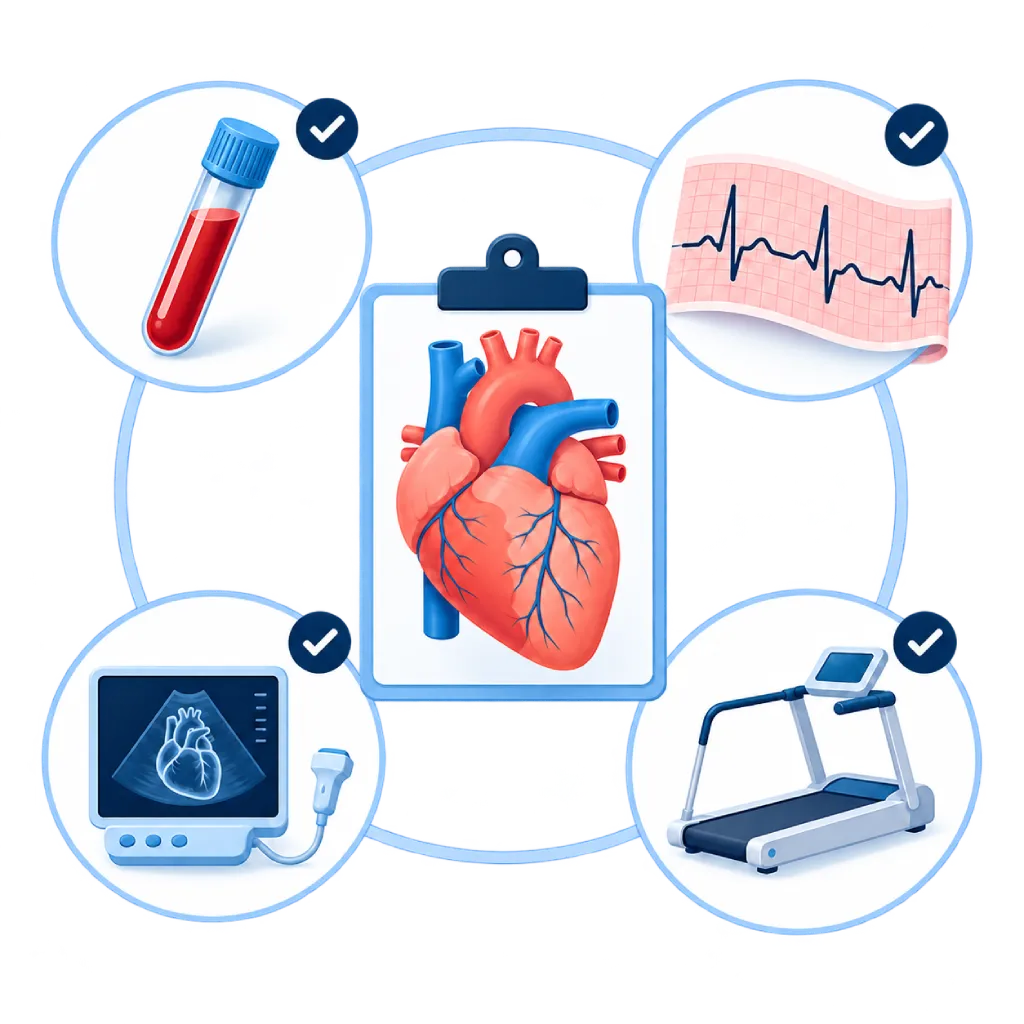
A cardiac medical check-up is a series of tests in one visit to assess your risk factors and your heart's rhythm, structure, and function. Its contents depend on the package, for example blood tests, an ECG, echocardiography, and an exercise test. The majority of packages require fasting for 10 to 12 hours, and a cardiologist explains the results.
Sources01 / Understanding the procedure
About Cardiac Medical Check-Up
What Is a Cardiac Medical Check-Up
A cardiac medical check-up (MCU) is a series of tests in one visit to assess risk factors and the rhythm, structure, and function of the heart and blood vessels. Its purpose is to find risk factors or heart problems early, before they cause serious symptoms, and then develop a prevention plan with your doctor.
How It Works in Brief
The MCU starts with an initial examination by a general practitioner, followed by a blood draw after fasting, then supporting tests according to the package, such as an ECG, echocardiography, or a cardiac exercise test. All results are then read by a cardiologist and explained in a consultation session, which in certain packages also includes a clinical nutrition specialist.
Tests Commonly Included
- Blood tests: routine blood tests, lipid profile, fasting blood sugar or HbA1c, kidney function, and uric acid. Certain packages add Lp(a) and ApoB. These are covered on the Cholesterol and Lipid Profile Screening and Diabetes Screening pages.
- ECG: records the rhythm and electrical activity of the heart at rest.
- Echocardiography: an ultrasound of the heart to assess its size, valves, and pumping strength.
- Cardiac exercise test: a treadmill test or stress echocardiography to assess the heart during activity.
- Blood vessel tests: an ABI test and ultrasound of the neck or leg arteries in certain packages.
- Cardiac CT: a coronary calcium score or CT coronary angiography in certain packages.
Choosing a Package
Heartology offers several packages with different contents, for example for basic screening, blood vessel health, people who exercise actively, children, and monitoring after heart stent placement. Not everyone needs every test. In people without symptoms who are at low risk, additional tests such as an exercise test or cardiac CT rarely change treatment and can produce findings that need further testing. For this reason, choose a package based on your age, risk factors, and symptoms, and ask your doctor if you are unsure. The list of packages and their contents can be found on the Health Checkup Packages page.
Who Should Consider It
A cardiac MCU is beneficial for adults with risk factors such as hypertension, high cholesterol, diabetes, smoking, or a family history of early heart disease, as well as men aged 40 and over and women aged 50 and over who have never had their heart risk assessed. An MCU can also be considered before starting strenuous exercise. If you already have chest pain, shortness of breath, or palpitations, it is better to consult a cardiologist directly rather than take an MCU package.
02 / Understanding the procedure
When Is This Procedure Considered?
A doctor may consider this procedure in the situations below. The decision is always made after a thorough assessment.
- Hypertension, High Cholesterol, or DiabetesRisk factors that need to be assessed together with the condition of your heart.
- Smoking or Excess Body WeightOften accompanied by other risk factors that are not yet known.
- Family History of Early Heart DiseaseA parent or sibling who had a heart attack, stroke, or sudden death at a young age.
- Men Aged 40 and Over and Women Aged 50 and OverIf you have never had your heart risk assessed.
- Planning to Start Strenuous ExerciseEspecially if you are over 35 or have risk factors.
- Monitoring After Heart Stent PlacementA dedicated package helps assess recovery and risk factors after the procedure.
Situations to Consider First
- Severe Symptoms Happening NowChest pain, shortness of breath, or fainting need immediate treatment in the emergency room, not an MCU.
- Currently Having a Fever or Feeling UnwellExercise tests and some blood tests should be postponed until you recover.
- Pregnant or Possibly PregnantTests that use radiation, such as CT and X-rays, are not performed; tell the staff.
- Contrast Allergy or Kidney ProblemsImportant if the package includes CT coronary angiography with contrast agent.
- Difficulty Walking on a TreadmillYour doctor can choose another test that suits your condition.
03 / Before the procedure
How Should You Prepare?
Detailed preparation is listed in each package. In general:
Register a day ahead. Package registration is usually done the day before your scheduled examination or earlier.
Fasting. The majority of packages require fasting for 10 to 12 hours before the blood draw. You may still drink plain water.
Clothing and shoes. If the package includes a treadmill exercise test, wear comfortable clothing and athletic shoes.
Medicines. Regular medicines are usually still taken. Ask your doctor about diabetes medicines during fasting and certain heart medicines before the exercise test.
Data to bring. Your medication list, previous MCU or test results, and home blood pressure records, if any.
Unsure about the preparation instructions? Ask our team before the procedure.
04 / During the procedure
How Is the Procedure Done?
The length of the examination depends on the package, usually 1 to 3 hours and up to about 6 hours for packages with more tests. Complete results are usually available within 2 to 3 working days.
Registration and Initial Examination
The staff matches your identity and package, then a general practitioner asks about your health history and measures your blood pressure, body weight, and waist circumference.
Blood Draw
Blood is drawn after fasting for laboratory tests. After that, you can eat before continuing with the other tests.
Supporting Tests
An ECG, echocardiography, an exercise test, or other tests are done in turn according to the package. The exercise test is always supervised by medical staff.
Results Consultation
Once the results are available, a cardiologist explains the findings and your risk level, then develops a prevention plan or plans further tests. In certain packages, a clinical nutrition specialist helps plan your diet.
05 / Benefits and risks
Benefits and Risks Should Be Discussed Together.
Every medical procedure has benefits and risks. Your doctor will explain both for your situation before the procedure.
Benefits You Can Expect
- Tests in One VisitBlood tests, heart tests, and consultation are scheduled together.
- Detecting Risks and Problems EarlierBefore they cause serious symptoms.
- Results Read by a CardiologistAll results are read together to assess your risk.
- Personal Prevention PlanIncluding diet, physical activity, and whether you need medicines.
- A Baseline for Regular MonitoringResults can be compared at your next check-up.
The benefits of a procedure are not a promise of a cure. Ask how the results will affect your care plan.
Risks You Should Know
- Minor Pain or BruisingAt the needle site after the blood draw.
- Tiredness or Symptoms During the Exercise TestThe test is supervised by medical staff and stopped if symptoms appear.
- Radiation Exposure from Cardiac CTOnly in packages that include CT; the dose is kept as low as possible.
- Reaction to Contrast AgentWith CT coronary angiography; tell the staff if you have had an allergy before.
- Findings That Need Further TestingSome minor findings need additional tests even though they turn out to be harmless.
Risks can differ from person to person. A full explanation and consent are given after an individual assessment.
06 / After the procedure
What Is Recovery Like?
There is no specific recovery period. You can return to your activities right away and may eat after your blood is drawn.
After the exercise test. Brief tiredness is normal. Rest for a while before going home.
If there are findings. Your doctor explains whether a finding needs treatment, further tests, or simply monitoring.
Next check-up. The timing of your next MCU is adjusted to your results and risk level.
Warning signs. Go to the emergency room right away if you have:
- Chest pain or pressure, especially with a cold sweat
- Sudden shortness of breath
- Fainting or a very fast heartbeat
- A drooping face, arm weakness, or slurred speech
Know the Signs That Need Prompt Care.
Follow the team's guidance on warning signs. If severe or sudden symptoms appear after the procedure, go to the nearest emergency department right away or call Heart Attack Center 1500 258.
07 / Team and support
Doctors and Procedure Support
The doctors below are listed for this procedure. Listed by name, not by ranking.

dr. BRM Ario S. Kuncoro, Sp.JP(K)
Echocardiography & Cardiovascular Imaging
Cardiovascular Diagnostic Center +2 centers
Clinical focusAdvanced and 3D Echocardiography · Transesophageal Echocardiography
View Profile
Dr. med. dr. Denio A. Ridjab, Sp.JP(K)
Interventional Cardiology
Coronary Intervention Procedures +2 centers
Clinical focusInterventional Cardiology · Coronary Artery Disease
View Profile
dr. Juweni Joe, Sp.GK
Clinical Nutrition
Clinical focusMedical Nutrition Intervention · Nutrition for Cardiovascular Patients
View Profile08 / Common questions
Before You Plan the Procedure.
Frequently asked questions about the cardiac medical check-up. What the results mean for your condition is explained by your doctor.
What is the difference between a cardiac MCU and a general MCU?
A general MCU assesses your health broadly, such as liver, kidney, and lung function. A cardiac MCU focuses on the heart and blood vessels, with tests such as an ECG, echocardiography, or an exercise test, and the results are read by a cardiologist. The two can complement each other depending on your needs.
Which MCU package should I choose?
The choice of package depends on your age, risk factors, symptoms, and goals. For initial screening without symptoms, a basic package is usually enough. Packages with blood vessel tests or cardiac CT are more suitable for people at higher risk. If you are unsure, consult a doctor or our team before registering.
Do I need to fast before a cardiac MCU?
The majority of packages require fasting for 10 to 12 hours before the blood draw, especially for fasting blood sugar. You may still drink plain water. After your blood is drawn, you can eat and continue with the other tests. Ask your doctor if you take diabetes medicines, so your blood sugar does not drop too low.
How long does it take to get MCU results?
Complete results are usually available within 2 to 3 working days, because some tests need to be read and summarized by a doctor. Some results, such as the ECG and blood pressure, are known right away during the examination. A cardiologist then explains the results and the follow-up plan.
How often should I have a cardiac MCU?
There is no single schedule for everyone. People at low risk usually only need to have their risk factors reassessed every few years, while people at high risk or those receiving treatment are checked more often as advised by their doctor. Tests such as an exercise test or cardiac CT do not need to be repeated routinely without a reason.
My MCU results are normal. Does that mean my heart is definitely healthy?
Normal results are good news, but they do not guarantee that a person will be free of heart disease forever. Risk factors can change over time, and some problems only appear later. Keep up a healthy lifestyle, and get checked right away if symptoms such as chest pain, shortness of breath, or palpitations appear.
Sources and Medical Review
Translated from the Indonesian edition medically reviewed by dr. Sri Diniharini, Sp.JP(K).
Sources as cited in the Indonesian edition.
- Visseren FLJ, Mach F, Smulders YM, et al. 2021 ESC Guidelines on cardiovascular disease prevention in clinical practice. Eur Heart J. 2021;42(34):3227-3337.
- US Preventive Services Task Force, Curry SJ, Krist AH, et al. Screening for cardiovascular disease risk with electrocardiography: US Preventive Services Task Force recommendation statement. JAMA. 2018;319(22):2308-2314.
- Pelliccia A, Sharma S, Gati S, et al. 2020 ESC Guidelines on sports cardiology and exercise in patients with cardiovascular disease. Eur Heart J. 2021;42(1):17-96.
- Mach F, Baigent C, Catapano AL, et al. 2019 ESC/EAS Guidelines for the management of dyslipidaemias: lipid modification to reduce cardiovascular risk. Eur Heart J. 2020;41(1):111-188.