
Quick answer
What Is Athlete's Heart?
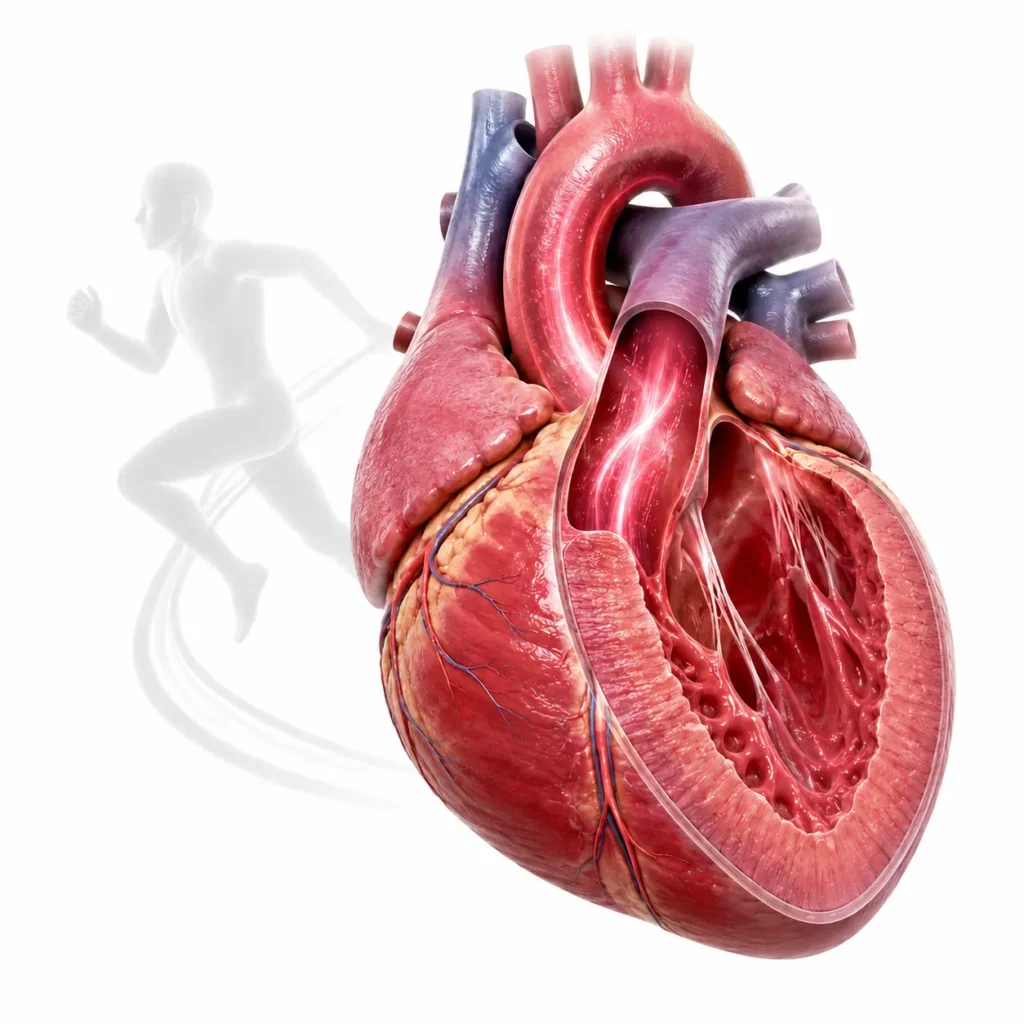
Athlete's heart is a change in the size, walls, and electrical activity of the heart that occurs as a normal response to regular, intense physical training. It is not a disease, but it needs to be told apart from heart diseases that look similar.
SourcesSigns That Need Urgent Help
- Chest pain or pressure during or after exercise
- Fainting or near-fainting during or shortly after exercise
- Shortness of breath out of proportion to the training load
- Very fast or irregular palpitations with dizziness
- Reduced exercise capacity without a clear cause
If these signs appear, go to the nearest emergency department right away or call Heart Attack Center 1500 258.
01 / Understanding the condition
About Athlete's Heart
Athlete's heart (exercise-induced cardiac remodeling) is a set of changes in the size, shape, and electrical activity of the heart that occur as a normal response to regular, intense physical training. These changes are not a disease. The heart adjusts so it can pump more blood with each beat, so the resting heart rate becomes slower and exercise capacity increases. This adaptation usually appears in people who train intensively for several hours each week over months to years.
What Changes in the Heart
The left and right ventricles can enlarge, the atria can widen as well, and the left ventricular wall can thicken slightly. In the large majority of athletes, the left ventricular wall stays under 13 millimeters thick, and the heart's pumping strength and filling remain normal. Endurance sports such as long-distance running, cycling, and rowing tend to enlarge the heart chambers more. Strength training places a pressure load on the heart, but its effect on heart size is usually smaller. The majority of sports combine both types of load. The extent of the changes is also influenced by sex, body size, and ethnicity.
Changes on the ECG
Training also changes the heart's electrical recording. A slow heart rate, a mild conduction delay between the atria and ventricles, and waves that look taller are normal findings in athletes according to the 2017 international criteria for interpreting athletes' ECGs. In contrast, some patterns, such as inverted T waves in many leads or signs of an extra electrical pathway, are not caused by training and need further evaluation.
Why It Needs to Be Distinguished from Disease
Some changes in an athlete's heart resemble early signs of heart muscle disease, especially hypertrophic cardiomyopathy, covered on the Hypertrophic Cardiomyopathy page. A wall thickness of about 13 to 16 millimeters is called the gray zone because it can result from either adaptation or disease. Telling them apart matters: a missed disease can trigger dangerous rhythm problems during exercise, while a normal adaptation mistaken for disease can lead an athlete to stop exercising unnecessarily. Heart chambers that are enlarged as well, good filling, high fitness, and thickening that decreases after a break from training support normal adaptation.
The ESC 2020 sports cardiology guidelines recommend that competitive athletes be considered for a heart assessment before competing, consisting of a medical history, physical examination, and ECG. Athletes over 35 years of age are also assessed for their risk of coronary artery disease.
02 / Understanding the condition
Symptoms to Recognize.
Common Symptoms
This adaptation usually causes no symptoms. It is usually found as the following signs during a checkup.
- Slow resting pulse, often 40 to 60 beats per minute
- Improved fitness and endurance
- A soft heart murmur heard by the doctor without any valve abnormality
- ECG showing a slow heart rate or taller waves
- Slightly larger heart chambers on echocardiography
03 / Understanding the condition
What Causes This Condition?
- Regular endurance training, such as long-distance running, cycling, swimming, or rowing, which increases the volume of blood pumped
- Strength training, such as weightlifting, which increases pressure on the heart walls while lifting
- Mixed sports, such as soccer, badminton, or basketball, which combine both types of load
- A more active vagus nerve after years of training, which slows the resting heart rate
- Increased blood volume and heart muscle mass as a response to sustained training
04 / Understanding the condition
Who Is at Higher Risk?
Lifestyle
Training volume and intensity determine the extent of adaptation. Changes usually appear in people who train intensively for several hours per week over months to years, especially in endurance sports.
Genetic
Ethnicity and family background influence the extent of adaptation. Athletes of African or Afro-Caribbean descent often show thicker heart walls and different ECG patterns. A family history of cardiomyopathy or sudden death should be shared with your doctor because it changes how test results are interpreted.
Age
In teenagers, ECG patterns typical of young age may be seen. In athletes over 35 years of age, heart problems during exercise more often come from coronary artery disease, so a risk assessment should be included.
Other
Sex and body size. Male athletes and athletes with larger bodies generally have larger hearts, while the heart walls of female athletes rarely thicken as much as in male athletes.
Groups at Higher Risk
- Endurance Athletes: Long-distance runners, cyclists, swimmers, and rowers generally show more pronounced enlargement of the heart chambers, so test results need to be read using athlete-specific references.
- Adolescent Athletes: Inverted T waves in the front (anterior) leads before age 16 can be normal. Screening helps find congenital heart disease that has not yet caused symptoms.
- Athletes Over 35 Years of Age: In this group, heart problems during exercise more often come from coronary disease, so a risk factor assessment and sometimes an exercise test are recommended.
- Athletes with a Family History of Heart Disease: A family history of cardiomyopathy, inherited rhythm disorder syndromes, or sudden death at a young age means test results need to be assessed more carefully.
05 / Understanding the condition
How Is It Diagnosed?
The evaluation starts with questions about the type, duration, and intensity of your training, symptoms during exercise, and any family history of cardiomyopathy, fainting, or sudden death at a young age. The doctor then performs a physical examination and records an ECG, which is read using athlete-specific criteria so that normal training-related findings are not mistaken for disease. If the ECG or symptoms raise questions, echocardiography measures chamber size, wall thickness, pumping strength, and filling of the heart. For results in the gray zone, cardiac MRI helps show the pattern of thickening and look for scar tissue, while an exercise test assesses fitness and heart rhythm as the workload increases. A rhythm recording over several days is used if you have palpitations or extra beats are found. If results remain unclear, the doctor may recommend a planned break from training of about three months and then repeat the tests. Thickening that decreases supports normal adaptation. Genetic testing is considered if an inherited heart muscle disease is suspected.
Physical Examination
Questions about the type and intensity of training, symptoms, and family history, followed by checking blood pressure, pulse, and heart sounds.
Electrocardiogram (ECG)
Read using the 2017 international athlete-specific criteria to separate normal training-related changes from patterns that need further evaluation.
Echocardiography
Measures chamber size, wall thickness and shape, pumping strength, and filling of the heart.
Cardiac MRI
Used when results fall in the gray zone, to assess the pattern of thickening and look for scar tissue that does not fit with adaptation.
Treadmill Stress Test
Assesses fitness and how heart rhythm and blood pressure respond as the workload increases. High fitness supports normal adaptation.
Holter Monitoring
Rhythm recording for 24 to 48 hours, including during training, if there are palpitations or extra beats on the ECG.
A planned break from training of about three months followed by repeat testing, to see whether thickening or enlargement decreases.
06 / Understanding the condition
Treatment Options.
Treatment is decided by a doctor after an assessment. The categories below can help you follow the conversation with your doctor.
No Medication Needed
Athlete's heart is a normal response, so it is not treated and athletes can train as usual. Repeat tests are done if symptoms or changes in test results appear.
Planned Break from Training
If results fall in the gray zone, the doctor may recommend reducing or stopping training for about three months, then repeating echocardiography or MRI. Thickening that decreases supports normal adaptation.
Adjusting the Training Program
During the evaluation, the intensity and type of training can be adjusted together with the doctor and coach so the athlete stays active safely.
Treating Any Disease Found
If tests find heart disease, treatment follows that disease. The ESC 2020 guidelines recommend that decisions about sports be made together with the athlete based on an individual risk assessment.
Controlling Risk Factors
Athletes over 35 years of age still need to control blood pressure, cholesterol, blood sugar, and smoking, because fitness does not eliminate the risk of coronary disease.
07 / Understanding the condition
Complications to Watch For.
Misinterpretation as Heart Disease
Normal changes mistaken for disease can lead to an athlete being barred from sports or undergoing unnecessary repeated tests. Reading ECGs and echocardiograms using athlete-specific references helps prevent this.
Missed Heart Disease
Cardiomyopathy, inherited rhythm disorder syndromes, or coronary disease can be overlooked if all findings are assumed to be adaptation. A missed disease can trigger cardiac arrest during exercise, although this is rare.
Atrial Fibrillation
Middle-aged endurance athletes who have trained hard for years are more likely to develop atrial fibrillation than people who exercise moderately. Symptoms include an irregular heartbeat or reduced performance.
Excessively Slow Heart Rate
In a small number of veteran endurance athletes, a very slow heart rate or electrical conduction delays can cause dizziness or fainting and need to be evaluated.
08 / Understanding the condition
What Can You Do?
- Have a heart checkup before taking part in competitive sports or starting intensive training
- Tell your doctor about any family history of cardiomyopathy, fainting, or sudden death at a young age
- Stop training and get checked if you develop chest pain, fainting, or unusual palpitations
- Do not train hard when you have a fever or have just recovered from a viral infection
- Increase your training load gradually and allow enough recovery time
- Avoid anabolic steroids, stimulants, and other doping substances that strain the heart
- Learn chest compressions (CPR) and know where the AED is at the place you train
09 / Understanding the condition
When Should You See a Doctor?
Athlete's heart does not cause symptoms. If you notice symptoms during exercise, do not assume they are caused by training: stop training and see a cardiologist. Fainting with chest pain, or a teammate who suddenly collapses, needs emergency help right away.
- Chest pain, excessive shortness of breath, or unusual palpitations during exercise
- Fainting or near-fainting during or shortly after exercise
- Reduced exercise capacity without a clear cause
- ECG or echocardiography results described as abnormal during a health checkup
- A relative with cardiomyopathy or sudden death before age 50
- You are over 35 years old and have just started intensive training
Don't Wait in an Emergency.
If symptoms are severe or come on suddenly, go to the nearest emergency department right away or call Heart Attack Center 1500 258, rather than waiting for an appointment.
10 / Common questions
Questions You May Have.
Frequently asked questions about athlete's heart.
Is an enlarged athlete's heart dangerous?
No, if the changes are truly a normal adaptation. An athlete's heart enlarges so it can pump more blood, while its pumping strength and filling stay good. This adaptation does not need treatment, and athletes can keep training. What needs to be confirmed is that there is no hidden heart disease, especially if there are symptoms, unusual ECG results, or a family history of heart disease.
How do doctors tell athlete's heart apart from hypertrophic cardiomyopathy?
Doctors combine several clues. In athlete's heart, the left ventricle is usually enlarged as well, the thickening is even, heart filling is good, fitness is high, and MRI shows no scar tissue. In hypertrophic cardiomyopathy, the thickening is often uneven, the heart chamber is small, and filling is impaired. If doubt remains, the tests are repeated after a break from training of about three months, and genetic testing may be considered.
Is a heart rate below 50 beats per minute normal in athletes?
In trained athletes, a resting heart rate of 40 to 50 beats per minute, or even lower during sleep, is common and considered normal as long as there are no symptoms. This slow rate happens because the nerves that slow the heart are more active and each beat pumps more blood. Get checked if a slow heart rate comes with dizziness, unusual tiredness, or fainting, or if your resting heart rate is below 30 beats per minute.
Does the heart return to normal after stopping exercise?
Largely, yes. Wall thickening usually starts to decrease within a few weeks to about three months after training stops, while chamber enlargement decreases more slowly and in some athletes does not fully return to normal. This reversibility is what doctors use to tell adaptation apart from disease. Stopping training for testing purposes should be done on your doctor's advice.
Do recreational runners or gym members also need to be checked?
People who exercise for general fitness usually do not need special tests if they have no symptoms. A checkup is recommended if you are going to take part in races or heavy training, are over 35 with risk factors such as hypertension, diabetes, smoking, or high cholesterol, have a family history of heart disease, or have had symptoms during exercise. Your doctor decides which tests suit your situation.
Can years of endurance exercise harm the heart?
For most people, the benefits of regular exercise far outweigh the risks. However, research shows that middle-aged endurance athletes who train very hard for years are more likely to develop atrial fibrillation than people who exercise moderately. For this reason, an irregular heartbeat or reduced performance in veteran athletes should be checked rather than dismissed as ordinary tiredness. Atrial fibrillation is covered on the Atrial Fibrillation page.
Sources and Medical Review
Translated from the Indonesian edition medically reviewed by dr. BRM Ario S. Kuncoro, Sp.JP(K) on June 22, 2026.
Sources as cited in the Indonesian edition.
- Pelliccia A, Sharma S, Gati S, Bäck M, Börjesson M, Caselli S, et al. 2020 ESC Guidelines on sports cardiology and exercise in patients with cardiovascular disease. Eur Heart J. 2021;42(1):17-96.
- Drezner JA, Sharma S, Baggish A, Papadakis M, Wilson MG, Prutkin JM, et al. International recommendations for electrocardiographic interpretation in athletes. J Am Coll Cardiol. 2017;69(8):1057-75.
- Pelliccia A, Caselli S, Sharma S, Basso C, Bax JJ, Corrado D, et al. European Association of Preventive Cardiology (EAPC) and European Association of Cardiovascular Imaging (EACVI) joint position statement: recommendations for the indication and interpretation of cardiovascular imaging in the evaluation of the athlete's heart. Eur Heart J. 2018;39(21):1949-69.
- Prior DL, La Gerche A. The athlete's heart. Heart. 2012;98(12):947-55.
- Sharma S, Merghani A, Mont L. Exercise and the heart: the good, the bad, and the ugly. Eur Heart J. 2015;36(23):1445-53.
- Newman W, Parry-Williams G, Wiles J, Edwards J, Hulbert S, Kipourou K, et al. Risk of atrial fibrillation in athletes: a systematic review and meta-analysis. Br J Sports Med. 2021;55(21):1233-8.
Doctors Who Treat This Condition

Dr. med. dr. Denio A. Ridjab, Sp.JP(K)
Interventional Cardiology
Coronary Intervention Procedures +2 centers
Clinical focusInterventional Cardiology · Coronary Artery Disease
View Profile
dr. BRM Ario S. Kuncoro, Sp.JP(K)
Echocardiography & Cardiovascular Imaging
Cardiovascular Diagnostic Center +2 centers
Clinical focusAdvanced and 3D Echocardiography · Transesophageal Echocardiography
View Profile
Dr. dr. Dicky A. Hanafy, Sp.JP(K)
Arrhythmia and Electrophysiology
Arrhythmia and Device Center +1 center
Clinical focusElectrophysiology and Arrhythmia Ablation · Pacemaker and ICD Implantation
View Profile