
Quick answer
What Is Advanced Heart Screening?
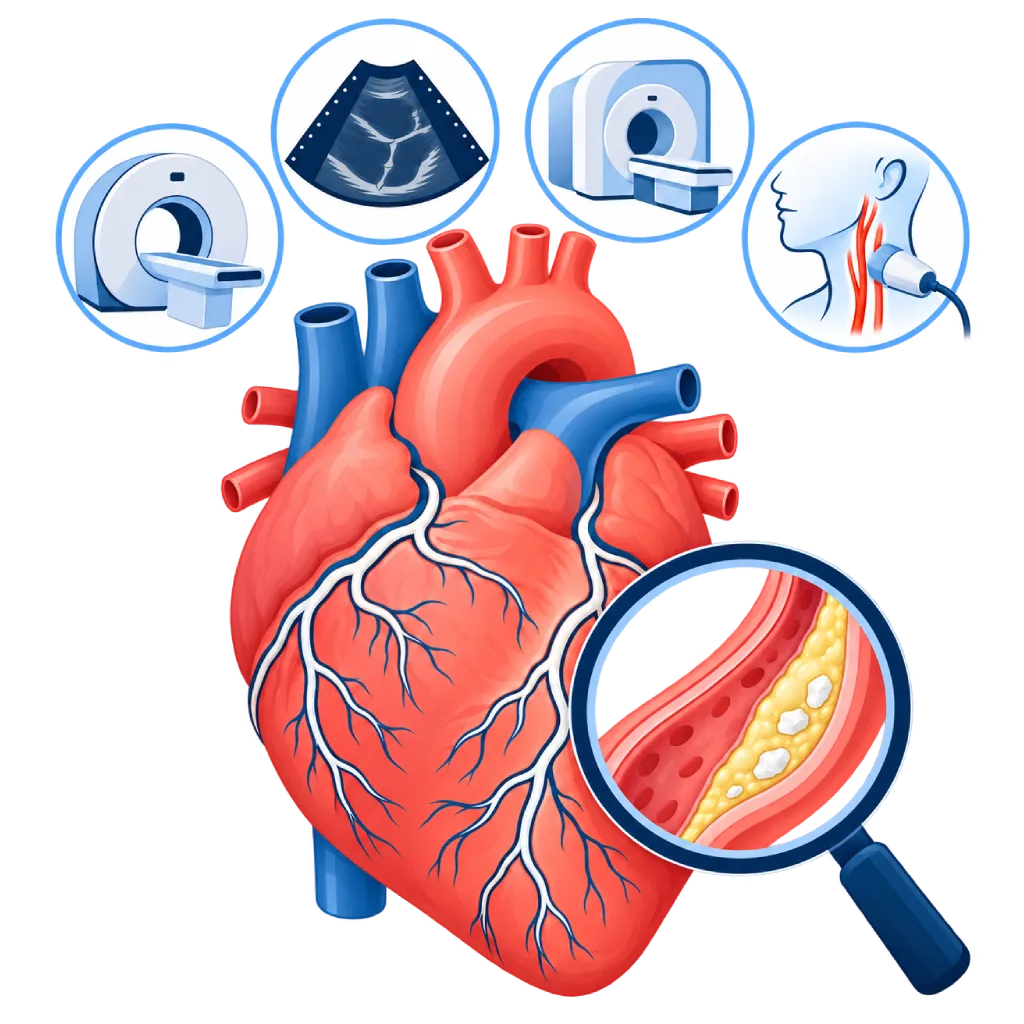
Advanced heart screening means additional tests for people without symptoms whose risk is high or unclear after basic screening. The doctor chooses tests based on the reason, such as a coronary calcium score to look for hidden plaque, or echocardiography and cardiac MRI if there is a family history of sudden death. The results are used to tailor prevention.
Sources01 / Understanding the procedure
About Advanced Heart Screening
What Is Advanced Heart Screening
Advanced heart screening means additional tests after basic screening, such as blood pressure, cholesterol, blood sugar, and ECG measurements. These tests are intended for people without symptoms whose risk is high or unclear, or who have a specific reason such as a family history. The aim is to find hidden signs of disease so that prevention can be tailored.
How It Works in Brief
Basic screening estimates risk from risk factors. Advanced screening looks directly at the condition of the blood vessels and heart, for example the amount of calcium in the coronary arteries, plaque in the neck arteries, or the structure and function of the heart muscle. The results can raise or lower the risk estimate, especially when you and your doctor are still weighing whether preventive medication is needed.
Tests That May Be Chosen
- Coronary calcium score: a CT scan without contrast that measures calcium in the coronary arteries. This is the main test for clarifying risk in people without symptoms.
- Echocardiography or cardiac MRI: assesses the heart muscle and valves, for example when there is a family history of sudden death or heart muscle disease, or an unusual ECG finding.
- Exercise test or stress echocardiography: for some people, for example athletes or people at high risk who are about to start strenuous exercise.
- Neck artery ultrasound and ankle-brachial index: looks for plaque in the neck arteries and narrowing of the leg arteries. This is covered on the Vascular Disease Screening page.
- Additional blood tests: such as lipoprotein(a) or hs-CRP, depending on the situation.
Not for Everyone
In people at low risk, advanced tests rarely change decisions and can lead to confusing findings. CT coronary angiography and stress testing are also not recommended routinely for people without symptoms. If you have symptoms such as chest pain or breathlessness, the tests are no longer screening but an examination to find the cause.
02 / Understanding the procedure
When Is This Procedure Considered?
A doctor may consider this procedure in the situations below. The decision is always made after a thorough assessment.
- Moderate or Unclear Risk After Basic ScreeningHelps decide whether preventive medication is needed.
- Family History of Early Heart DiseaseA heart attack in a father or brother before age 55, or in a mother or sister before age 65.
- Family History of Sudden Death or CardiomyopathyChecking the heart muscle and rhythm in family members.
- Athletes or Starting Strenuous ExerciseEspecially if there are risk factors or an unusual ECG.
- Very High Cholesterol or High Lipoprotein(a)Assesses whether plaque is already present in the blood vessels.
- Diabetes with Other Risk FactorsHelps determine how intensive prevention needs to be.
Situations to Consider First
- Current Heart SymptomsChest pain or breathlessness requires diagnostic tests, not screening.
- Low Risk Without a Specific ReasonAdvanced tests are rarely useful and can trigger unnecessary tests.
- PregnancyTests using X-rays are generally postponed; let the staff know.
- Metal in the Body or Fear of Enclosed SpacesNeeds to be discussed if cardiac MRI is planned.
03 / Before the procedure
How Should You Prepare?
Preparation depends on the tests your doctor chooses.
Basic screening results. Bring your recent blood pressure, cholesterol, blood sugar, and ECG results, as well as notes on any history of heart disease in your family.
Medications. Bring a list of your medications and supplements. Regular medications are generally taken as usual.
Exercise test. If one is scheduled, wear sports clothing and shoes, and avoid coffee and smoking for a few hours beforehand.
Pregnancy and implants. Tell the staff if you are pregnant, may be pregnant, or have a metal implant or a pacemaker.
Unsure about the preparation instructions? Ask our team before the procedure.
04 / During the procedure
How Is the Procedure Done?
The duration depends on the tests chosen. A coronary calcium score takes only a few minutes on the CT table, while a combination of several tests is usually completed in about 3 hours. Cardiac MRI is usually scheduled separately.
Consultation and Risk Assessment
The doctor reviews your basic screening results, family history, and habits, then calculates your estimated risk of heart disease.
Choosing the Tests
The doctor explains which tests are useful for your reason and which are not needed.
Having the Tests
For example, a calcium score CT while holding your breath for a few seconds, an ultrasound of the heart or neck arteries using gel, or walking on a treadmill while being monitored.
Discussing the Results
The doctor recalculates your risk and puts together a prevention plan, including cholesterol and blood pressure targets and a follow-up schedule.
05 / Benefits and risks
Benefits and Risks Should Be Discussed Together.
Every medical procedure has benefits and risks. Your doctor will explain both for your situation before the procedure.
Benefits You Can Expect
- Finding Hidden PlaqueBefore symptoms or a heart attack occur.
- More Targeted PreventionMedications and targets are adjusted to your actual risk.
- Avoiding Unnecessary MedicationA good result can be reassuring and allow preventive medication to be postponed.
- Testing for Family MembersHelps recognize inherited heart disease early.
- Largely Contrast-FreeCalcium scoring, ultrasound, and exercise tests do not require a contrast injection.
The benefits of a procedure are not a promise of a cure. Ask how the results will affect your care plan.
Risks You Should Know
- Radiation Exposure from CTThe dose for a calcium score is low and kept as low as possible.
- Incidental FindingsMay require further tests that turn out to show no problem.
- Confusing ResultsAt low risk, minor results can cause anxiety; your doctor helps interpret them.
- Symptoms During the Exercise TestRare, and the team monitors you throughout the test.
Risks can differ from person to person. A full explanation and consent are given after an individual assessment.
06 / After the procedure
What Is Recovery Like?
There is no recovery period. You can return to your activities right away, and any tiredness after an exercise test goes away with rest.
Follow the prevention plan. Recommended lifestyle changes and medications bring greater benefit when followed consistently.
Incidental findings. A CT scan sometimes shows other things in the lungs or chest. Your doctor will explain whether follow-up is needed.
Warning signs to watch for. Go to the emergency room right away if you experience:
- Chest pain or shortness of breath
- A very fast or irregular heartbeat
- Fainting, especially during exercise
- Weakness or numbness on one side of the body
Know the Signs That Need Prompt Care.
Follow the team's guidance on warning signs. If severe or sudden symptoms appear after the procedure, go to the nearest emergency department right away or call Heart Attack Center 1500 258.
07 / Team and support
Doctors and Procedure Support
The doctors below are listed for this procedure. Listed by name, not by ranking.

dr. BRM Ario S. Kuncoro, Sp.JP(K)
Echocardiography & Cardiovascular Imaging
Cardiovascular Diagnostic Center +2 centers
Clinical focusAdvanced and 3D Echocardiography · Transesophageal Echocardiography
View Profile
Dr. med. dr. Denio A. Ridjab, Sp.JP(K)
Interventional Cardiology
Coronary Intervention Procedures +2 centers
Clinical focusInterventional Cardiology · Coronary Artery Disease
View Profile
dr. Sri Diniharini, Sp.JP(K)
Echocardiography & Cardiovascular Imaging
Cardiovascular Diagnostic Center +1 center
Clinical focusAdvanced Echocardiography · Transesophageal Echocardiography
View Profile08 / Common questions
Before You Plan the Procedure.
Frequently asked questions about advanced heart screening. The right tests for you are chosen together with your doctor.
How is it different from a standard cardiac medical check-up?
A cardiac medical check-up usually includes basic tests such as blood pressure, blood tests, an ECG, and sometimes echocardiography or a treadmill test. Advanced screening adds tests that look directly at the blood vessels or heart muscle, such as a coronary calcium score or cardiac MRI, and is chosen only when there is a clear reason.
Does everyone need advanced screening?
No. In people at low risk, additional tests rarely change decisions and can lead to worrying findings. Advanced screening is mainly useful if your risk is moderate or unclear, if there is a family history of early heart disease or sudden death, or if you are about to start strenuous exercise and have risk factors.
What does a coronary calcium score of zero mean?
A score of zero means no calcium is visible in the coronary arteries. For the majority of people, the risk of a heart attack over the next few years becomes very low, so preventive medication can sometimes be postponed. However, a score of zero does not completely rule out soft plaque, especially in smokers, people with diabetes, or those with a strong family history.
Does a calcium score CT use contrast or high radiation?
A calcium score CT does not use contrast, and the scan takes only a few seconds. The radiation dose is low, roughly comparable to the natural background radiation from the environment over a few months. This is different from CT coronary angiography, which uses contrast and is not recommended routinely for people without symptoms.
What happens if plaque is found?
Plaque found without symptoms is generally managed with stricter prevention, for example cholesterol-lowering medication, control of blood pressure and blood sugar, quitting smoking, and regular exercise. Finding plaque does not automatically mean you need catheterization or a stent. A procedure is considered only if there are symptoms or signs of reduced blood flow.
Should a family history of sudden death be checked?
Yes, especially if the death occurred at a young age. Some causes are inherited heart diseases, such as heart muscle disorders or problems with the heart's electrical system. The doctor may request an ECG, echocardiography, cardiac MRI, or other tests for family members, and sometimes genetic testing, depending on the history.
Sources and Medical Review
Translated from the Indonesian edition medically reviewed by dr. BRM Ario S. Kuncoro, Sp.JP(K).
Sources as cited in the Indonesian edition.
- Visseren FLJ, Mach F, Smulders YM, et al. 2021 ESC Guidelines on cardiovascular disease prevention in clinical practice. Eur Heart J. 2021;42(34):3227-3337.
- Arnett DK, Blumenthal RS, Albert MA, et al. 2019 ACC/AHA Guideline on the Primary Prevention of Cardiovascular Disease. Circulation. 2019;140(11):e596-e646.
- Hecht H, Blaha MJ, Berman DS, et al. Clinical indications for coronary artery calcium scoring in asymptomatic patients: expert consensus statement from the Society of Cardiovascular Computed Tomography. J Cardiovasc Comput Tomogr. 2017;11(2):157-168.
- Pelliccia A, Sharma S, Gati S, et al. 2020 ESC Guidelines on sports cardiology and exercise in patients with cardiovascular disease. Eur Heart J. 2021;42(1):17-96.
- Arbelo E, Protonotarios A, Gimeno JR, et al. 2023 ESC Guidelines for the management of cardiomyopathies. Eur Heart J. 2023;44(37):3503-3626.