
Quick answer
What Is Atherosclerosis?
Atherosclerosis is a buildup of plaque made of fat, cholesterol, and calcium in the artery walls, which makes the arteries thicker, stiffer, and narrower. This process underlies coronary artery disease, stroke, and peripheral artery disease, and often causes no symptoms for years.
SourcesSigns That Need Urgent Help
- Severe chest pain that does not ease with rest and may spread to the arm, neck, or jaw
- Chest pain with cold sweats, nausea, or shortness of breath
- Sudden facial drooping, weakness of the arm or leg on one side, or slurred speech
- Sudden loss of vision, or spinning dizziness with difficulty walking
- A foot that suddenly becomes cold, pale, numb, and very painful
- Fainting or reduced consciousness
If these signs appear, go to the nearest emergency department right away or call Heart Attack Center 1500 258.
01 / Understanding the condition
About Atherosclerosis
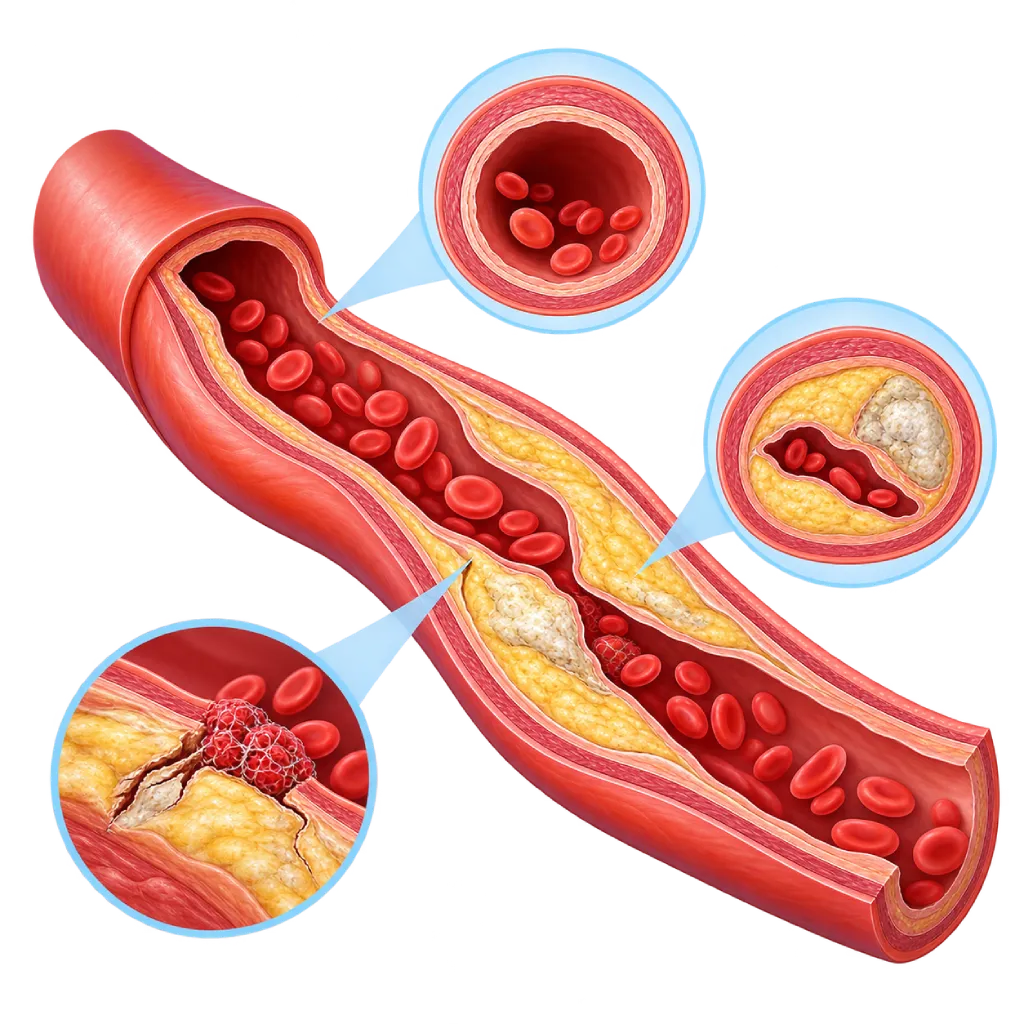
Atherosclerosis is the process of plaque building up on the inner walls of the arteries, the vessels that carry oxygen-rich blood from the heart to the rest of the body. Plaque is made up of fat (especially LDL cholesterol), inflammatory cells, connective tissue, and calcium. Over time, plaque makes the artery wall thicker and stiffer and narrows the channel through which blood flows. This process can begin at a young age and progress slowly over many years without symptoms.
How Plaque Forms
The innermost layer of an artery can be damaged by high blood pressure, substances in cigarette smoke, high blood sugar, or high LDL cholesterol. LDL particles then enter the artery wall and trigger inflammation. Inflammatory cells engulf this fat and then accumulate together with connective tissue to form plaque, whose surface is covered by a layer of connective tissue. In older plaque, calcium is also deposited.
Two Ways Plaque Causes Problems
First, plaque that keeps growing narrows the artery, so blood flow is not enough when an organ has to work harder. Examples include chest pain during activity or calf pain when walking. Second, the surface of a plaque can suddenly crack or wear away. Blood then clots on top of it and can block the artery within minutes. This is what usually happens in a heart attack and in many ischemic strokes, sometimes at a plaque that had not previously narrowed the artery very much.
One Process, Many Forms of Disease
Atherosclerosis can affect arteries anywhere in the body, and the disease that develops depends on where it occurs. In the heart arteries, plaque causes the disease covered on the Coronary Artery Disease page. In the arteries of the neck and brain, plaque can trigger a stroke, covered on the Stroke page. In the leg arteries, plaque causes the disease covered on the Peripheral Artery Disease page. Plaque can also weaken the wall of the aorta so that it widens, or narrow the arteries to the kidneys and intestines. An overview of narrowing by artery location is summarized on the Arterial Stenosis page. People who have plaque in one place often have it in other places as well.
It Can Be Slowed
Plaque that has already formed generally does not disappear completely, but its growth can be slowed and the plaque can become more stable so it is less likely to rupture. The ESC 2021 and ACC/AHA 2019 prevention guidelines emphasize quitting smoking, staying active, eating a healthy diet, and controlling LDL cholesterol, blood pressure, and blood sugar. The lower your LDL cholesterol and the longer it stays under control, the lower your risk of heart attack and stroke.
02 / Understanding the condition
Symptoms to Recognize.
Common Symptoms
Many people have no symptoms until the artery has narrowed considerably. Symptoms depend on which artery is affected.
- Pain, heaviness, or pressure in the chest during physical activity or emotional stress, easing with rest
- Shortness of breath or tiring quickly during activities that are usually light
- Pain, cramping, or aching in the calf or thigh when walking, easing after you stop
- Brief weakness, numbness, or slurred speech that recovers on its own within a few minutes
- Brief darkening of vision in one eye, like a curtain coming down
- Wounds on the feet that heal slowly
- Erectile dysfunction in men
03 / Understanding the condition
What Causes This Condition?
- High LDL cholesterol that, over time, enters and builds up in the artery walls
- High blood pressure that damages the inner lining of the arteries
- Substances in cigarette smoke, including in passive smokers
- High blood sugar in diabetes, which speeds up damage to the artery walls
- Chronic inflammation, for example in autoimmune diseases or HIV infection, which speeds up plaque formation
- Inherited factors, such as inherited high cholesterol (familial hypercholesterolemia) or high lipoprotein(a)
04 / Understanding the condition
Who Is at Higher Risk?
Lifestyle
Smoking, lack of physical activity, a diet high in saturated fat, salt, and sugar, excess weight (especially belly fat), and drinking too much alcohol.
Medical
High LDL cholesterol, hypertension, diabetes, chronic kidney disease, and chronic inflammatory diseases such as rheumatoid arthritis, lupus, and psoriasis.
Genetic
A heart attack or stroke in a father or brother before age 55, or in a mother or sister before age 65, inherited high cholesterol, and high lipoprotein(a).
Age
Risk increases with age. Men generally develop disease caused by atherosclerosis earlier, while the risk in women rises after menopause.
Other
Long-term stress, lack of sleep, exposure to air pollution, and a history of radiation therapy to the chest area are associated with a higher risk.
Groups at Higher Risk
- People with Diabetes: Diabetes speeds up plaque formation in the arteries of the heart, brain, and legs, often without clear symptoms.
- Smokers: Cigarette smoke damages the inner lining of the arteries and makes clots form more easily. The risk falls gradually after quitting smoking.
- Families with Inherited High Cholesterol: LDL cholesterol that is high from birth makes plaque form earlier, so family members are advised to have their cholesterol checked.
- People with Hypertension: Blood pressure that stays uncontrolled for a long time damages the artery walls and speeds up plaque buildup.
- People with Chronic Kidney Disease: Kidney problems speed up calcification and narrowing of the arteries, which raises the risk of heart attack and stroke.
05 / Understanding the condition
How Is It Diagnosed?
No single test can assess atherosclerosis throughout the whole body at once. Your doctor starts by asking about your symptoms, smoking habits, and family history, then measures your blood pressure, weight, and waist circumference, and feels the pulses in your neck and feet. Blood tests assess cholesterol, blood sugar, and kidney function. The results are used to estimate your risk of heart attack and stroke over the next 10 years.
In people without symptoms whose risk falls in the intermediate range, the doctor may recommend tests to look at plaque directly, such as a coronary calcium score with CT, an ultrasound of the neck arteries, or an Ankle-Brachial Index (ABI) of the legs. The results help decide how intensively cholesterol needs to be lowered. If you have symptoms, tests are tailored to the artery that is suspected, for example CT coronary angiography or coronary angiography for chest pain, and duplex ultrasound for leg symptoms.
Individual Heart Risk Screening
Assesses blood pressure, cholesterol, blood sugar, smoking habits, and family history to estimate the risk of heart attack and stroke over the next 10 years.
Cholesterol and Lipid Profile Screening
Measures LDL cholesterol, HDL, triglycerides, and, if needed, lipoprotein(a), as the basis for setting treatment targets.
Cardiac CT Scan
A non-contrast coronary calcium score to look for calcified plaque in the heart arteries in people without symptoms whose risk is uncertain.
Vascular Ultrasound
Radiation-free ultrasound to look for plaque and narrowing in the arteries of the neck, abdomen, and legs.
Ankle-Brachial Index (ABI) Test
Compares blood pressure at the ankle and the arm to look for narrowing of the leg arteries.
CT Coronary Angiography
CT with contrast to look for plaque and narrowing of the coronary arteries in chest pain or suspected coronary artery disease.
Coronary Angiography
A test using a catheter and contrast when symptoms are severe or other tests show narrowing that may need to be opened.
06 / Understanding the condition
Treatment Options.
Treatment is decided by a doctor after an assessment. The categories below can help you follow the conversation with your doctor.
Lifestyle Changes
Quitting smoking, staying active, eating a balanced and nutritious diet, and maintaining a healthy weight are the foundation of all treatment, whatever medicines are given.
Cholesterol-Lowering Medicines
Statins are the first-line choice, and ezetimibe or a PCSK9 inhibitor may be added if the LDL target has not been reached. Your doctor determines the type, dose, and target.
Antiplatelet Medicines
Medicines such as aspirin prevent clots in people who have already had a heart attack, stroke, or peripheral artery disease. They are not recommended routinely for people without these conditions.
Blood Pressure and Blood Sugar Control
Medicines and monitoring to reach the targets set by your doctor. Some classes of diabetes medicines have also been shown to protect the heart and blood vessels.
Procedures to Open Arteries
Placement of a stent through a catheter, or bypass surgery, for arteries that are severely narrowed and cause symptoms. These procedures do not replace medicines and lifestyle changes.
07 / Understanding the condition
Complications to Watch For.
Coronary Artery Disease
Plaque in the heart arteries causes chest pain during activity and reduces blood flow to the heart muscle. Covered on the Coronary Artery Disease page.
Heart Attack
A ruptured plaque triggers a clot that suddenly blocks a coronary artery. Covered on the Myocardial Infarction / Heart Attack page.
Ischemic Stroke
A clot on top of plaque in a neck or brain artery can stop blood flow to part of the brain. Covered on the Ischemic Stroke page.
Peripheral Artery Disease
Narrowing of the leg arteries causes pain when walking and foot wounds that are slow to heal. Covered on the Peripheral Artery Disease page.
Aortic Aneurysm
A damaged aortic wall can weaken and slowly widen, often without symptoms. Covered on the Aortic Aneurysm page.
Renal Artery Stenosis
It can raise blood pressure that is hard to control and reduce kidney function. Covered on the Secondary Hypertension page.
08 / Understanding the condition
What Can You Do?
- Do not smoke, and avoid other people's cigarette smoke
- Be physically active for 150 to 300 minutes per week at moderate intensity, for example brisk walking
- Eat more vegetables, fruit, nuts and legumes, fish, and whole grains; limit saturated fat, salt, and sugar
- Keep your weight and waist circumference within a healthy range
- Have your blood pressure, cholesterol, and blood sugar checked regularly, starting earlier if you have a family history
- Take cholesterol, blood pressure, and diabetes medicines as recommended, and do not stop them on your own
- Manage stress and try to get enough sleep every night
09 / Understanding the condition
When Should You See a Doctor?
Make an appointment with a doctor to assess your risk if you are 40 or older, smoke, have hypertension, diabetes, or high cholesterol, or have a close family member who had a heart attack or stroke at a young age. If chest pain does not ease with rest, or your face, arm, or speech is suddenly affected, call an ambulance (119) right away or go to the nearest emergency room. Also get checked if you experience:
- Pain or heaviness in the chest during activity that eases with rest
- Calf or thigh pain when walking that eases after you stop
- Brief weakness, numbness, or slurred speech that recovers on its own
- New shortness of breath or tiring easily
- A wound on the foot that does not improve within two weeks
Don't Wait in an Emergency.
If symptoms are severe or come on suddenly, go to the nearest emergency department right away or call Heart Attack Center 1500 258, rather than waiting for an appointment.
10 / Common questions
Questions You May Have.
Frequently asked questions about atherosclerosis.
Is atherosclerosis the same as high cholesterol?
No. High cholesterol is one of the main causes of atherosclerosis, while atherosclerosis is plaque that has already formed in the artery walls. People with high cholesterol do not necessarily have plaque yet, and, conversely, plaque can form because of other factors such as smoking, hypertension, or diabetes. That is why your doctor assesses all risk factors together, not just your cholesterol numbers.
Can plaque in the blood vessels go away?
Plaque generally does not disappear completely. However, lowering LDL cholesterol intensively and over the long term can stop plaque from growing, shrink it slightly in some people, and make it more stable so it is less likely to rupture. Quitting smoking and controlling blood pressure and blood sugar also help protect the arteries. The main goal is to prevent heart attack and stroke.
Does atherosclerosis only affect older people?
No. Early fatty streaks in the artery walls can already be found in teenagers and young adults. Plaque usually only causes symptoms after middle age, but it can appear earlier in smokers, people with diabetes, or people with inherited high cholesterol. That is why healthy habits and risk factor checks should start at a young age.
Can thin people develop atherosclerosis?
Yes. Body weight is only one risk factor. Thin people can still have high LDL cholesterol because of inherited factors, and they can also smoke, have hypertension or diabetes, or be physically inactive. Belly fat can also be high even when body weight looks normal. Checks of blood pressure, cholesterol, and blood sugar are still recommended for all adults.
Do I need to take aspirin to prevent atherosclerosis?
Not necessarily. Aspirin is beneficial for people who have already had a heart attack, stroke, or peripheral artery disease. In people without these conditions, the benefit often does not outweigh the risk of bleeding, so guidelines do not recommend it routinely. Do not start or stop aspirin on your own. Discuss it with your doctor, who will assess your risk of heart attack and your risk of bleeding.
What is a coronary calcium score?
A coronary calcium score is a number from a non-contrast CT scan of the heart that shows how much calcified plaque is in the heart arteries. The test is quick and uses a low dose of radiation. A score of zero means no calcified plaque is visible, while a higher score indicates more plaque. Doctors use it in people without symptoms whose risk is uncertain, to decide whether cholesterol-lowering medicine is needed.
Sources and Medical Review
Translated from the Indonesian edition medically reviewed by Dr. med. dr. Denio A. Ridjab, Sp.JP(K).
Sources as cited in the Indonesian edition.
- Libby P, Buring JE, Badimon L, Hansson GK, Deanfield J, Bittencourt MS, et al. Atherosclerosis. Nat Rev Dis Primers. 2019;5(1):56.
- Visseren FLJ, Mach F, Smulders YM, Carballo D, Koskinas KC, Bäck M, et al. 2021 ESC Guidelines on cardiovascular disease prevention in clinical practice. Eur Heart J. 2021;42(34):3227-3337.
- Mach F, Baigent C, Catapano AL, Koskinas KC, Casula M, Badimon L, et al. 2019 ESC/EAS Guidelines for the management of dyslipidaemias: lipid modification to reduce cardiovascular risk. Eur Heart J. 2020;41(1):111-188.
- Arnett DK, Blumenthal RS, Albert MA, Buroker AB, Goldberger ZD, Hahn EJ, et al. 2019 ACC/AHA Guideline on the Primary Prevention of Cardiovascular Disease: A Report of the American College of Cardiology/American Heart Association Task Force on Clinical Practice Guidelines. Circulation. 2019;140(11):e596-e646.
- Vrints C, Andreotti F, Koskinas KC, Rossello X, Adamo M, Ainslie J, et al. 2024 ESC Guidelines for the management of chronic coronary syndromes. Eur Heart J. 2024;45(36):3415-3537.
- Mazzolai L, Teixido-Tura G, Lanzi S, Boc V, Bossone E, Brodmann M, et al. 2024 ESC Guidelines for the management of peripheral arterial and aortic diseases. Eur Heart J. 2024;45(36):3538-3700.
Doctors Who Treat This Condition

Dr. med. dr. Denio A. Ridjab, Sp.JP(K)
Interventional Cardiology
Coronary Intervention Procedures +2 centers
Clinical focusInterventional Cardiology · Coronary Artery Disease
View Profile
dr. Adrianus Kosasih, Sp.JP(K)
Interventional Cardiology
Coronary Intervention Procedures
Clinical focusPrimary Coronary Intervention · PCI for Acute Coronary Syndrome
View Profile
Dr. dr. Jajang Sinardja, Sp.JP(K)
Interventional Cardiology
Coronary Intervention Procedures
Clinical focusAcute Coronary Syndrome · Primary Coronary Intervention
View Profile