
Quick answer
What Is Ankle-Brachial Index (ABI) Test?
The ankle-brachial index (ABI) test is a needle-free test that compares the blood pressure at your ankle with the blood pressure in your arm. A low value indicates peripheral artery disease and also signals a higher risk of heart attack and stroke. The test is quick, and the results can be explained right away.
Sources01 / Understanding the procedure
About Ankle-Brachial Index (ABI) Test
What Is the ABI Test
The ankle-brachial index test, or ABI, compares the blood pressure at the ankle with the blood pressure in the arm. In healthy people, the pressure at the ankle is the same as or slightly higher than in the arm. When the leg arteries narrow because of plaque, the pressure at the ankle drops, so the ABI value becomes smaller.
How It Works at a Glance
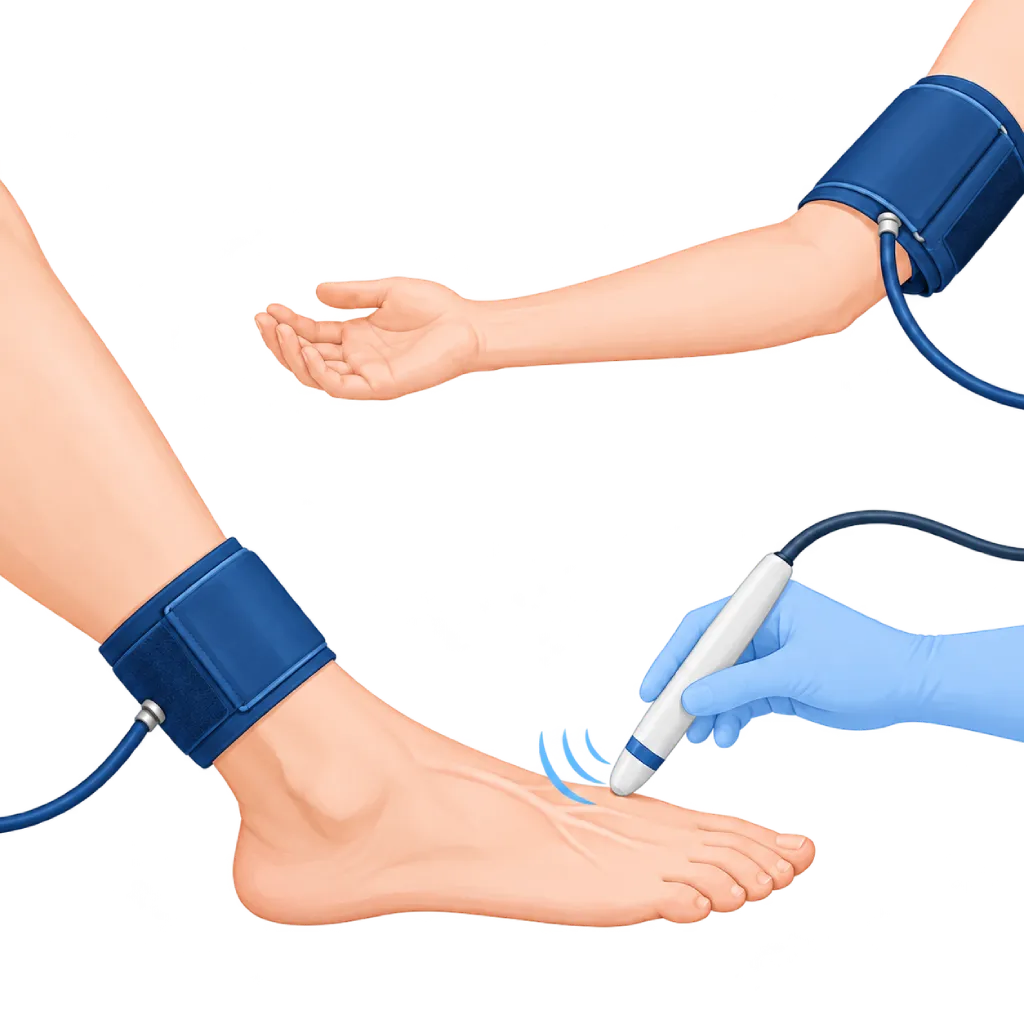
Blood pressure cuffs are placed on both upper arms and both ankles. Each cuff is inflated and then slowly deflated while a small Doppler device listens to blood flow in the artery. The higher pressure at each ankle is divided by the higher of the two arm pressures to obtain the ABI value.
Reading ABI Results
- 1.00 to 1.40: normal.
- 0.91 to 0.99: borderline, to be assessed together with symptoms and risk factors.
- 0.90 or lower: indicates peripheral artery disease. The lower the value, the more severe the narrowing.
- Above 1.40: the ankle arteries are stiff and hard for the cuff to compress, so another test such as the TBI is needed.
These thresholds are general guidance. Your doctor interprets the results together with your symptoms, physical examination, and other test results.
More Than Just the Legs
The plaque that narrows leg arteries usually also forms in the arteries of the heart and brain. For this reason, a low ABI value signals a higher risk of heart attack and stroke, and helps your doctor decide how strictly risk factors need to be controlled.
ABI After Exercise
If leg pain when walking is quite clear but the resting ABI is normal, your doctor may request a repeat measurement after you walk on a treadmill. A drop in the value after exercise can reveal narrowing that is not apparent at rest.
02 / Understanding the procedure
When Is This Procedure Considered?
A doctor may consider this procedure in the situations below. The decision is always made after a thorough assessment.
- Leg Pain When WalkingPain, aching, or cramping in the calf when walking that improves with rest.
- Slow-Healing Foot WoundsTo assess whether blood flow to the foot is enough for the wound to heal.
- Weak Foot PulsesWhen the doctor has difficulty feeling the pulse in the foot during a physical examination.
- High-Risk ProfileFor example, age 65 or older, or a younger age with diabetes, smoking, or chronic kidney disease.
- Coronary Artery Disease or StrokePlaque in the arteries of the heart or brain is often accompanied by plaque in the leg arteries.
- Monitoring After a ProcedureTo assess the results of artery widening or leg bypass surgery over time.
Situations to Consider First
- Open Wound in the Cuff AreaThe cuff is not placed over a wound. Your doctor chooses another site or another test.
- Suspected Blood Clot in a Leg VeinThe cuff is not inflated on that leg until the clot has been treated.
- Recent Leg Bypass SurgeryThe cuff is not placed over a new bypass graft. The team adjusts the measurement method.
- Severe Pain When the Cuff Is InflatedThe test can be stopped at any time if you feel very uncomfortable.
- Dialysis Access or Previous Breast Surgery on One ArmBlood pressure is measured on the other arm to avoid injury or swelling.
03 / Before the procedure
How Should You Prepare?
This test requires no special preparation.
Food and medication. You can eat and drink as usual, and keep taking your regular medications.
Smoking and exercise. Avoid smoking for at least two hours before the test, as well as strenuous exercise beforehand, because both can affect blood pressure.
Clothing. Wear loose clothing so your upper arms and ankles can be uncovered easily, such as pants that roll up easily.
Previous results. Bring any previous ABI or duplex ultrasound results, or records of blood vessel procedures, if you have them.
Conditions to mention. Tell the staff if you have a wound on your foot, a history of blood clots in the leg, leg blood vessel surgery, dialysis access in your arm, or previous breast surgery.
Unsure about the preparation instructions? Ask our team before the procedure.
04 / During the procedure
How Is the Procedure Done?
The test usually takes about 15 to 20 minutes.
Resting
You lie on your back for 5 to 10 minutes so your blood pressure stabilizes. Your upper arms and ankles are uncovered.
Placing the Cuffs
Blood pressure cuffs are placed on both upper arms and both ankles, just above the ankle bones.
Measuring with Doppler
Gel is applied to the skin, then a small pen-shaped Doppler device is placed over the arteries of the arm and foot so the sound of blood flow can be heard. The cuff is inflated until the sound stops, then slowly deflated until the sound returns. Some devices measure all four cuffs automatically.
Calculating the Result
The higher pressure at each ankle is divided by the higher of the two arm pressures. Results for the right and left legs can be explained right after the test.
05 / Benefits and risks
Benefits and Risks Should Be Discussed Together.
Every medical procedure has benefits and risks. Your doctor will explain both for your situation before the procedure.
Benefits You Can Expect
- Quick, Simple, and Needle-FreeIt uses only cuffs and a Doppler device, with no radiation.
- Early Detection of Peripheral Artery DiseaseIncluding in people who do not yet have symptoms.
- A Picture of Heart and Stroke RiskA low ABI value helps your doctor assess your overall cardiovascular risk.
- Immediate ResultsABI values for the right and left legs can be explained right after the test.
- Easy to Repeat for MonitoringUseful for tracking disease progression or the results of a procedure.
The benefits of a procedure are not a promise of a cure. Ask how the results will affect your care plan.
Risks You Should Know
- Discomfort from the CuffsThe arms and ankles may briefly feel squeezed or tingly.
- Pain in a Leg with Very Poor Blood FlowThe cuff is inflated for as short a time as possible, and the test can be stopped at any time.
- Less Accurate Results in Stiff ArteriesIn diabetes or kidney disease, the value may appear normal or too high, so a TBI test is needed.
- A Normal Result Does Not Always Rule Out NarrowingIf symptoms are clear, your doctor may request an exercise ABI or a duplex ultrasound.
Risks can differ from person to person. A full explanation and consent are given after an individual assessment.
06 / After the procedure
What Is Recovery Like?
There is no recovery period. You can go home right away and carry on with your usual activities.
Sensations in the arms and legs. Mild pressure or tingling from the cuffs fades within a few minutes. Any leftover gel can simply be wiped off.
Results. Your doctor explains what your ABI value means and the next steps, such as risk factor control, medication, walking exercise, or further tests such as a duplex ultrasound.
Risk factors. If your ABI value is low, quitting smoking and controlling your blood pressure, cholesterol, and blood sugar become very important to protect your legs, heart, and brain.
Warning signs. Go to the emergency room right away or contact the medical team if you have:
- A foot that suddenly turns cold, pale, numb, or very painful
- Foot pain at rest that keeps getting worse, especially at night
- A foot wound that worsens, oozes pus, or turns black
Know the Signs That Need Prompt Care.
Follow the team's guidance on warning signs. If severe or sudden symptoms appear after the procedure, go to the nearest emergency department right away or call Heart Attack Center 1500 258.
07 / Team and support
Doctors and Procedure Support
The doctors below are listed for this procedure. Listed by name, not by ranking.

Dr. med. dr. Denio A. Ridjab, Sp.JP(K)
Interventional Cardiology
Coronary Intervention Procedures +2 centers
Clinical focusInterventional Cardiology · Coronary Artery Disease
View Profile
dr. Emanoel Oepangat, Sp.JP(K)
Interventional Cardiology
Vascular Diagnostic and Therapeutic Center +1 center
Clinical focusCoronary Intervention · Peripheral Vascular Intervention
View Profile
dr. Suko Adiarto, Sp.JP(K), Ph.D.
Interventional Cardiology
Vascular Diagnostic and Therapeutic Center +1 center
Clinical focusCoronary Intervention · Peripheral Vascular Intervention
View ProfileAnkle-Brachial Index (ABI) Testing System
A needle-free test that compares blood pressure at the ankles and arms. The result is an index number that helps doctors detect…
The availability of technology and test support is confirmed with the team. Technology is chosen according to clinical need.
08 / Common questions
Before You Plan the Procedure.
Frequently asked questions about the ABI test. Your doctor will explain what the results mean for your condition.
What does my ABI value mean?
In general, a value of 1.00 to 1.40 is normal, 0.91 to 0.99 is borderline, and 0.90 or lower indicates peripheral artery disease. A value above 1.40 means the arteries are stiff, so the result is less reliable. These thresholds are only general guidance. Your doctor interprets the results together with your symptoms and other tests, so discuss your results with your doctor.
Is the ABI test painful?
It is not painful. It feels similar to a regular blood pressure measurement, only done on the arms and ankles. The cuff feels tight for a few seconds, then deflates. The Doppler gel feels cool on the skin. If you have a wound or pain in your leg, tell the staff so the cuff can be placed carefully.
Why can a test on the legs show heart risk?
The plaque that narrows leg arteries forms in the same way as plaque in the arteries of the heart and brain. For this reason, people with a low ABI value have a higher risk of heart attack and stroke, even if they do not yet have symptoms. ABI results help your doctor decide how strictly blood pressure, cholesterol, and blood sugar need to be controlled.
What is the difference between the ABI test and the TBI test?
The ABI test measures blood pressure at the ankle, while the TBI measures pressure at the big toe. In diabetes, kidney disease, or older age, the ankle arteries can become stiff, so the ABI appears normal or above 1.40 even though blood flow is reduced. In this situation, your doctor adds a TBI test.
Who should have an ABI test?
This test is recommended for people with leg pain when walking, slow-healing foot wounds, or weak foot pulses. It may also be considered for people at high risk, such as those aged 65 or older, people with diabetes, smokers, or people with chronic kidney disease. Your doctor will assess whether this test is suitable for you.
What if my ABI value is normal but my legs still hurt when I walk?
The resting ABI is sometimes normal even when there is mild to moderate narrowing. Your doctor may request a repeat ABI after you walk on a treadmill, because a drop in the value after exercise can reveal narrowing. Leg pain can also come from nerves, joints, or muscles, so your doctor will look for other causes if needed.
Sources and Medical Review
Translated from the Indonesian edition medically reviewed by dr. Emanoel Oepangat, Sp.JP(K).
Sources as cited in the Indonesian edition.
- Aboyans V, Criqui MH, Abraham P, et al. Measurement and Interpretation of the Ankle-Brachial Index: A Scientific Statement From the American Heart Association. Circulation. 2012;126(24):2890-2909.
- Ankle Brachial Index Collaboration. Ankle Brachial Index Combined With Framingham Risk Score to Predict Cardiovascular Events and Mortality: A Meta-analysis. JAMA. 2008;300(2):197-208.
- Gornik HL, Aronow HD, Goodney PP, et al. 2024 ACC/AHA/AACVPR/APMA/ABC/SCAI/SVM/SVN/SVS/SIR/VESS Guideline for the Management of Lower Extremity Peripheral Artery Disease. Circulation. 2024;149(24):e1313-e1410.
- Mazzolai L, Teixido-Tura G, Lanzi S, et al. 2024 ESC Guidelines for the management of peripheral arterial and aortic diseases. Eur Heart J. 2024;45(36):3538-3700.
- Fitridge R, Chuter V, Mills J, et al. The intersocietal IWGDF, ESVS, SVS guidelines on peripheral artery disease in people with diabetes and a foot ulcer. Diabetes Metab Res Rev. 2024;40(3):e3686.