
Quick answer
What Is Arterial Stenosis?
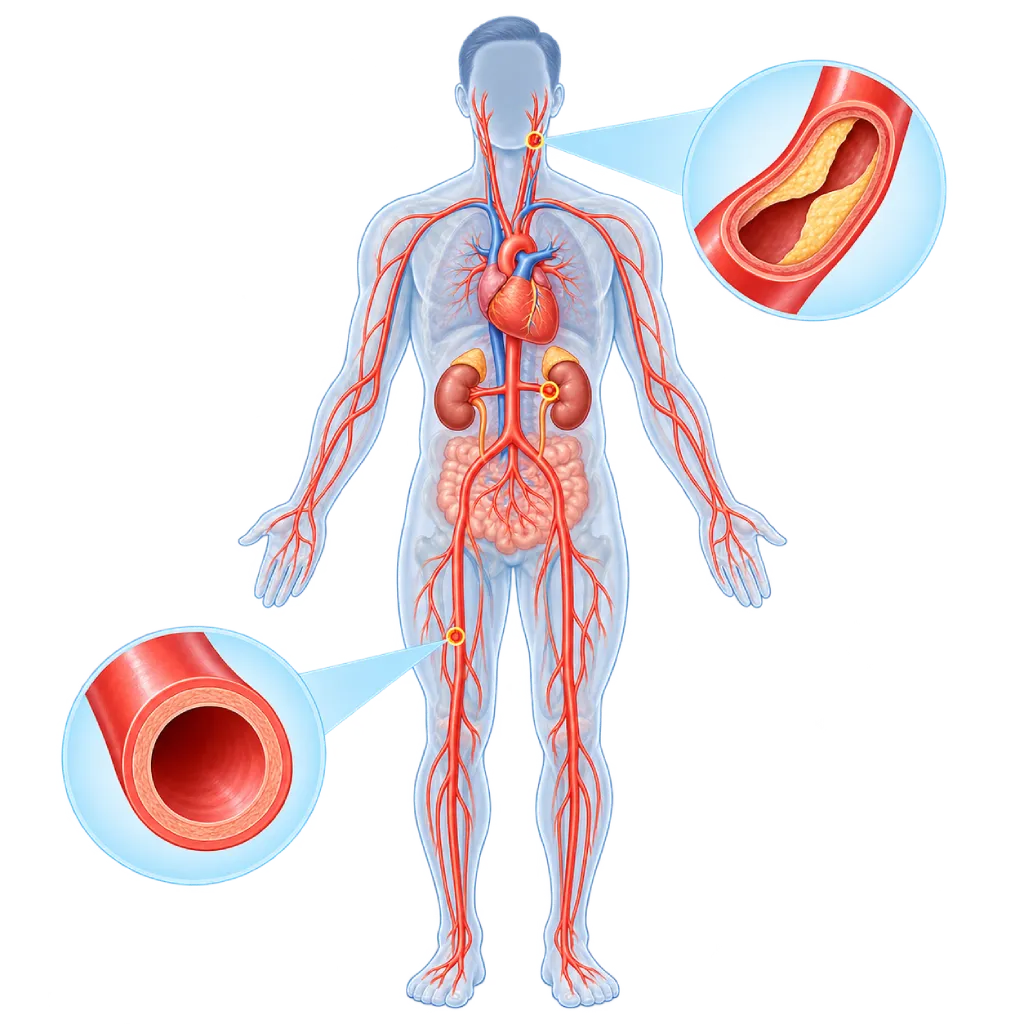
Arterial stenosis is a narrowing of the channel inside an artery that reduces blood flow to an organ. The common cause is atherosclerotic plaque, and symptoms depend on where the artery is: the heart, neck and brain, kidneys, intestines, arms, or legs.
SourcesSigns That Need Urgent Help
- Severe chest pain that does not ease with rest
- A drooping face, weakness in the arm or leg on one side, or sudden slurred speech
- Sudden loss of vision in one eye
- Severe abdominal pain that comes on suddenly
- A leg or arm that suddenly becomes cold, pale, numb, and very painful
- Very high blood pressure with a severe headache, shortness of breath, or confusion
If these signs appear, go to the nearest emergency department right away or call Heart Attack Center 1500 258.
01 / Understanding the condition
About Arterial Stenosis
Arterial narrowing, medically called arterial stenosis, means the channel inside an artery becomes smaller, so less blood can pass through. This term often appears in test results, for example "70 percent narrowing". This page helps you understand what that finding means based on where the artery is. The process that usually causes it, plaque buildup, is covered on the Atherosclerosis page.
Symptoms Depend on the Location
Narrowing in the heart arteries causes pain or heaviness in the chest during activity, covered on the Coronary Artery Disease page. Narrowing of the carotid artery in the neck can release clots to the brain and trigger a stroke or a transient ischemic attack (mini-stroke). Narrowing of the kidney arteries can make blood pressure hard to control, covered on the Secondary Hypertension page. Narrowing of the intestinal arteries causes abdominal pain after eating and weight loss. Narrowing of the arm arteries makes the arm tire quickly and causes a difference in blood pressure between the two arms. Narrowing of the leg arteries causes calf pain when walking, covered on the Peripheral Artery Disease page.
Not Always Caused by Plaque
In the majority of cases, arterial narrowing is caused by atherosclerosis. Other causes include fibromuscular dysplasia, an abnormality of the artery wall that often affects the kidney and neck arteries in young to middle-aged women; inflammation of the artery wall, covered on the Systemic Vasculitis page; past radiation therapy; compression by surrounding tissue; narrowing present from birth, such as coarctation of the aorta; and renarrowing after stent placement, covered on the In-Stent Restenosis page.
What the Percentage Means
Doctors express how severe a narrowing is as the percentage by which the artery's diameter is reduced. However, treatment decisions do not depend on that number alone. Your doctor also considers whether the narrowing causes symptoms, how much it affects blood flow, and the risks of a procedure compared with its benefits. In the heart arteries, for example, measuring the pressure inside the artery can show that a narrowing that looks moderate does not actually reduce blood flow much.
Medication for Everyone, Procedures for Some
Everyone with narrowing caused by plaque needs blood vessel protective medication and control of risk factors, because narrowing in one place signals plaque elsewhere. Procedures to open the artery, such as widening with a balloon and stent or surgery, are considered based on the location, for example for a carotid artery narrowing that has already caused symptoms, or a heart artery narrowing that keeps limiting activity despite medication.
02 / Understanding the condition
Symptoms to Recognize.
Common Symptoms
Many narrowings cause no symptoms. Symptoms appear when blood flow is not enough, and their form depends on which artery is narrowed.
- Pain or heaviness in the chest during activity that eases with rest (heart arteries)
- Brief weakness, numbness, or slurred speech that goes away on its own (neck and brain arteries)
- Brief darkening of vision in one eye, like a curtain coming down (neck arteries)
- Blood pressure that stays high despite taking several medications (kidney arteries)
- Abdominal pain after eating, fear of eating, and weight loss (intestinal arteries)
- An arm that tires quickly when raised or used for work (arm arteries)
- Calf or thigh pain when walking that eases after stopping (leg arteries)
03 / Understanding the condition
What Causes This Condition?
- Atherosclerosis, plaque made of fat, cholesterol, and calcium in the artery wall, which is the common cause
- A blood clot that forms on top of plaque and worsens the narrowing
- Fibromuscular dysplasia, an artery wall abnormality that often affects the kidney and neck arteries
- Inflammation of the artery wall (vasculitis), such as Takayasu arteritis or giant cell arteritis
- Past radiation therapy to the neck, chest, or abdomen
- Compression of an artery by surrounding muscle, bone, or other tissue
- Narrowing present from birth, such as coarctation of the aorta, or renarrowing after stent placement
04 / Understanding the condition
Who Is at Higher Risk?
Lifestyle
Smoking, lack of physical activity, a diet high in saturated fat and salt, and excess weight speed up plaque formation in all arteries.
Medical
High LDL cholesterol, hypertension, diabetes, and chronic kidney disease. A history of coronary artery disease or stroke signals possible narrowing in other arteries.
Genetic
Inherited high cholesterol, high lipoprotein(a), and a family history of heart disease or stroke at a young age increase susceptibility.
Age
Narrowing caused by plaque becomes more common after age 50, while fibromuscular dysplasia and Takayasu arteritis are more common in young women.
Other
A history of radiation therapy, autoimmune disease, and previous stent placement increase the likelihood of narrowing in certain arteries.
Groups at Higher Risk
- People with Coronary Artery Disease or Stroke: Plaque in one arterial region is often accompanied by plaque in other regions, so the neck and leg arteries also need to be assessed if there are symptoms.
- Smokers and People with Diabetes: Both speed up narrowing in many arteries at once, including the small arteries in the calves and feet.
- People with Hard-to-Control Hypertension: Blood pressure that stays high despite taking several medications can indicate narrowing of the kidney arteries.
- Young Women with Hypertension: Hypertension at a young age with no clear cause can be linked to fibromuscular dysplasia of the kidney artery.
- Cancer Survivors with a History of Radiation: Radiation to the neck, chest, or abdomen can speed up arterial narrowing in that area, even years later.
05 / Understanding the condition
How Is It Diagnosed?
Your doctor asks about your symptoms and risk factors, then feels the pulses in your neck, arms, groin, and feet, measures blood pressure in both arms, and listens with a stethoscope for a whooshing sound of blood flow in the neck, abdomen, or groin. A clear difference in blood pressure between the two arms can indicate narrowing of an arm artery.
Further tests are chosen based on the suspected location. Doppler ultrasound, which uses no radiation, is the first step for the neck, kidney, and leg arteries, while the Ankle-Brachial Index (ABI) is used for the legs. CT angiography or MR angiography maps the narrowing in more detail, especially before a procedure. For the heart arteries, doctors use a stress test, CT coronary angiography, or coronary angiography. Catheter angiography is generally done when a procedure to open the artery is being considered, and it is often performed together with that procedure.
Physical Examination
Feels the pulses at several sites, measures blood pressure in both arms, and listens for a whooshing sound of blood flow in the neck, abdomen, and groin.
Vascular Ultrasound
A first step, with no radiation and no needles, to look for narrowing in the neck, kidney, abdominal, arm, and leg arteries.
Ankle-Brachial Index (ABI) Test
Compares blood pressure at the ankle and arm to detect narrowing of the leg arteries.
CT Coronary Angiography
Shows plaque and narrowing in the heart arteries without a catheter in cases of chest pain or suspected coronary artery disease.
Peripheral CT Angiography
Maps arterial narrowing from the abdomen down to the feet using CT and contrast dye, especially before a procedure.
Aortic Angiography
Shows the aorta and its branches, including the kidney and intestinal arteries, using a catheter and contrast dye when a procedure to open the artery is being considered.
06 / Understanding the condition
Treatment Options.
Treatment is decided by a doctor after an assessment. The categories below can help you follow the conversation with your doctor.
Blood Vessel Protective Medications
Cholesterol-lowering statins and antiplatelet medications to slow plaque growth and prevent clots. Your doctor decides the type and dose.
Risk Factor Control
Quitting smoking, controlling blood pressure, blood sugar, and weight, and staying active according to your ability and your doctor's advice.
Angioplasty and Stenting
Widening the artery with a balloon through a catheter, usually with a stent, for the heart, leg, neck, kidney, or intestinal arteries in certain situations.
Vascular Surgery
Removing plaque from the carotid artery (endarterectomy) or creating a detour (bypass) for long or severe narrowing.
Treatment Based on Other Causes
For example, medications that suppress inflammation for vasculitis, or balloon widening without a stent for fibromuscular dysplasia of the kidney artery.
07 / Understanding the condition
Complications to Watch For.
Heart Attack
A narrowed coronary artery can suddenly be blocked by a clot. Covered on the Myocardial Infarction / Heart Attack page.
Stroke
A clot or plaque fragment from a neck artery can travel to the brain and block blood flow there. Covered on the Stroke page.
Impaired Kidney Function
Severe narrowing of a kidney artery can reduce kidney function, raise blood pressure, and cause fluid buildup.
Intestinal Ischemia
Greatly reduced blood flow to the intestines causes pain after eating and weight loss. If the artery is suddenly blocked, the intestines can be damaged and need emergency treatment.
Critical Limb Ischemia
Severe narrowing of the leg arteries causes pain at rest and wounds that are hard to heal. Covered on the Critical Limb Ischemia page.
Sudden Blockage
An already narrowed artery can be closed off by a clot, so a leg or organ suddenly lacks blood. Covered on the Arterial Embolism page.
08 / Understanding the condition
What Can You Do?
- Quit smoking and avoid secondhand smoke
- Control your cholesterol, blood pressure, and blood sugar according to the targets set by your doctor
- Stay active for at least 150 minutes per week, such as brisk walking
- Choose a diet rich in vegetables, fruit, fish, and whole grains, and limit salt and saturated fat
- Take your blood vessel protective medications regularly, especially after stent placement
- Attend regular checkups if you have been told you have arterial narrowing
09 / Understanding the condition
When Should You See a Doctor?
Make an appointment with a doctor if your test results mention arterial narrowing and you want to understand the next steps, or if you have symptoms that suggest reduced blood flow. If symptoms appear suddenly and are severe, call an ambulance (119) or go to the nearest emergency room right away.
- Pain or heaviness in the chest during activity
- Brief weakness, numbness, slurred speech, or darkening of vision that goes away on its own
- Blood pressure that stays high despite taking several medications
- Abdominal pain after every meal along with weight loss
- Calf pain when walking, or an arm that tires quickly with use
- A clear difference in blood pressure between your two arms when measured
Don't Wait in an Emergency.
If symptoms are severe or come on suddenly, go to the nearest emergency department right away or call Heart Attack Center 1500 258, rather than waiting for an appointment.
10 / Common questions
Questions You May Have.
Frequently asked questions about arterial narrowing.
What does 50 or 70 percent narrowing mean in my test results?
The number shows how much the artery's diameter has shrunk compared with the normal section. In general, narrowing below 50 percent is considered mild, while 70 percent or more is considered severe. However, the thresholds differ for each artery, and the number alone does not determine whether a procedure is needed. Your doctor combines it with your symptoms, the effect of the narrowing on blood flow, and your overall condition.
Does every narrowed artery need a stent?
No. Many narrowings can be treated with medication and risk factor control alone. A stent or surgery is considered if the narrowing causes symptoms that remain bothersome despite medication, threatens an organ, or carries a high risk of triggering a stroke. For narrowing of a kidney artery caused by plaque, for example, research shows that routine stent placement adds no benefit compared with medication alone.
What is the difference between arterial narrowing and atherosclerosis?
Atherosclerosis is the process of plaque building up in the artery wall. Arterial narrowing is a result that can be seen on tests, namely a smaller artery channel. The majority of narrowing is indeed caused by atherosclerosis, but there are other causes such as fibromuscular dysplasia and vasculitis. Conversely, atherosclerotic plaque does not always narrow the artery, but it can still rupture and trigger a clot.
If the arteries in my legs are narrowed, are other arteries narrowed too?
Possibly. Plaque is rarely found in just one place. People with narrowed leg arteries more often also have plaque in the heart and neck arteries, even without symptoms. That is why your doctor usually assesses your risk factors as a whole and asks about symptoms in other parts of the body. Additional tests are done if there are symptoms or if the results would change your treatment.
Can a narrowed artery return to normal?
Narrowing caused by plaque rarely returns completely to normal with medication alone, but its growth can be stopped and the risk of complications lowered. If needed, the artery can be opened with a balloon, stent, or surgery. After that, medication and risk factor control are still needed so the artery does not narrow again. Narrowing caused by inflammation can improve once the inflammation is controlled.
Does a narrowed neck artery need surgery?
It depends on how severe the narrowing is and whether it causes symptoms. If carotid artery narrowing has already caused a minor stroke or a transient ischemic attack (mini-stroke), plaque removal or stent placement is considered as soon as possible. If there are no symptoms yet, most people can be managed with medication and regular ultrasound monitoring. The decision is made together with a team of neurologists and vascular specialists.
Sources and Medical Review
Translated from the Indonesian edition medically reviewed by dr. Adrianus Kosasih, Sp.JP(K).
Sources as cited in the Indonesian edition.
- Mazzolai L, Teixido-Tura G, Lanzi S, Boc V, Bossone E, Brodmann M, et al. 2024 ESC Guidelines for the management of peripheral arterial and aortic diseases. Eur Heart J. 2024;45(36):3538-3700.
- Aboyans V, Ricco JB, Bartelink MEL, Björck M, Brodmann M, Cohnert T, et al. 2017 ESC Guidelines on the Diagnosis and Treatment of Peripheral Arterial Diseases, in collaboration with the European Society for Vascular Surgery (ESVS): Document covering atherosclerotic disease of extracranial carotid and vertebral, mesenteric, renal, upper and lower extremity arteries. Eur Heart J. 2018;39(9):763-816.
- Naylor R, Rantner B, Ancetti S, de Borst GJ, De Carlo M, Halliday A, et al. Editor's Choice: European Society for Vascular Surgery (ESVS) 2023 Clinical Practice Guidelines on the Management of Atherosclerotic Carotid and Vertebral Artery Disease. Eur J Vasc Endovasc Surg. 2023;65(1):7-111.
- Björck M, Koelemay M, Acosta S, Bastos Goncalves F, Kölbel T, Kolkman JJ, et al. Editor's Choice: Management of the Diseases of Mesenteric Arteries and Veins: Clinical Practice Guidelines of the European Society of Vascular Surgery (ESVS). Eur J Vasc Endovasc Surg. 2017;53(4):460-510.
- Gornik HL, Persu A, Adlam D, Aparicio LS, Azizi M, Boulanger M, et al. First International Consensus on the diagnosis and management of fibromuscular dysplasia. Vasc Med. 2019;24(2):164-189.
- Cooper CJ, Murphy TP, Cutlip DE, Jamerson K, Henrich W, Reid DM, et al. Stenting and Medical Therapy for Atherosclerotic Renal-Artery Stenosis. N Engl J Med. 2014;370(1):13-22.
Doctors Who Treat This Condition

dr. Emanoel Oepangat, Sp.JP(K)
Interventional Cardiology
Vascular Diagnostic and Therapeutic Center +1 center
Clinical focusCoronary Intervention · Peripheral Vascular Intervention
View Profile
Dr. dr. Jajang Sinardja, Sp.JP(K)
Interventional Cardiology
Coronary Intervention Procedures
Clinical focusAcute Coronary Syndrome · Primary Coronary Intervention
View Profile
dr. Adrianus Kosasih, Sp.JP(K)
Interventional Cardiology
Coronary Intervention Procedures
Clinical focusPrimary Coronary Intervention · PCI for Acute Coronary Syndrome
View Profile