
Quick answer
What Is Coronary Angioplasty?
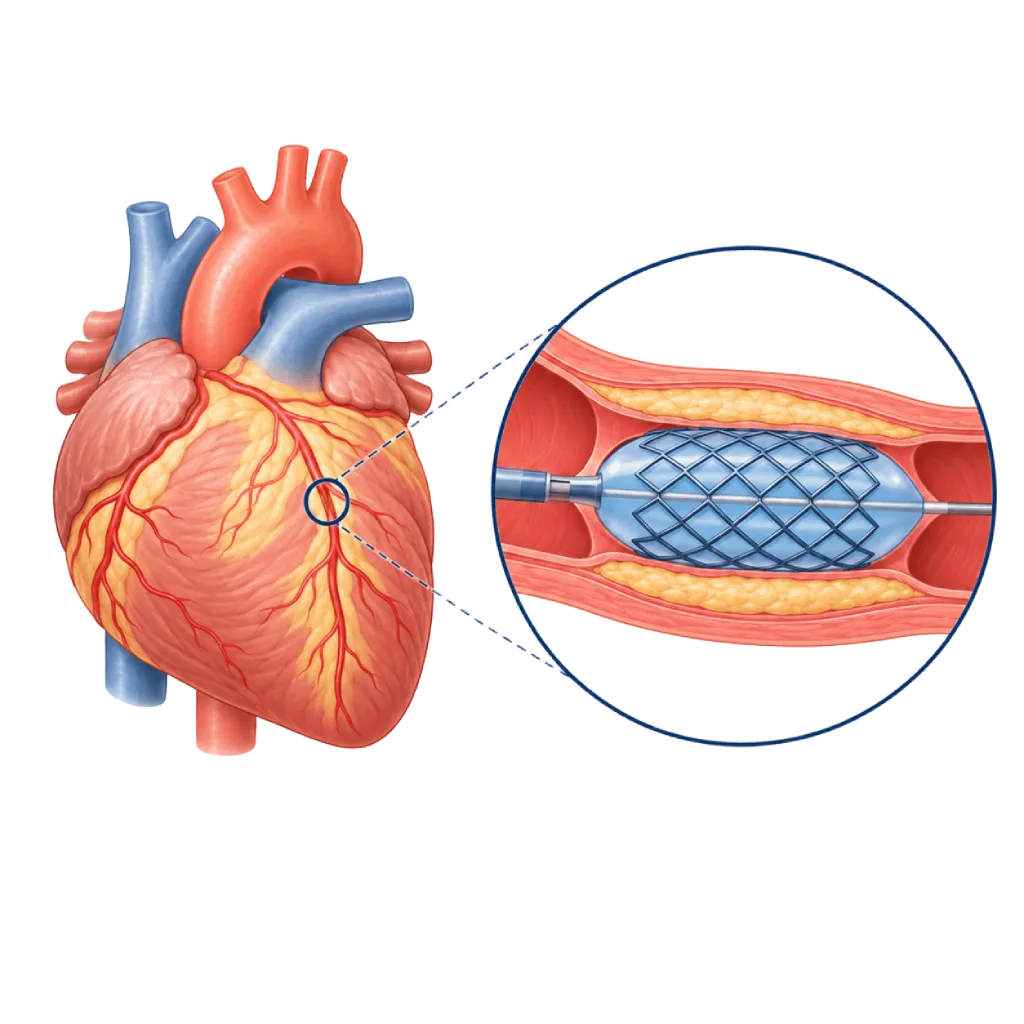
Coronary angioplasty is a procedure to open a narrowed or blocked coronary artery without open surgery. The doctor inserts a thin catheter through a blood vessel in the wrist or groin, inflates a small balloon at the narrowed section, and then usually places a stent to keep the vessel open and restore blood flow to the heart muscle.
Sources01 / Understanding the procedure
About Coronary Angioplasty
Understanding the Coronary Arteries and How They Narrow
The coronary arteries are the blood vessels that carry oxygen-rich blood to the heart muscle. Over time, fat, cholesterol, and other substances can build up in the artery walls and form plaque (atherosclerosis). Plaque narrows the arteries so that blood flow to the heart muscle decreases, especially during activity, and can cause chest pain (angina). If plaque ruptures and a blood clot forms that blocks the artery, a heart attack occurs.
What Happens in Coronary Angioplasty
Coronary angioplasty, known in medical terms as percutaneous coronary intervention (PCI), is performed from inside the blood vessel. Through a thin catheter, the doctor guides a guidewire across the narrowed section, then inflates a small balloon to press the plaque against the artery wall. In the majority of patients, the doctor then places a stent, a small metal mesh tube that many people in Indonesia call a "ring", to support the artery wall and keep it open.
The stents commonly used today are drug-eluting stents. The drug in their coating is released slowly to reduce the risk of the artery narrowing again inside the stent.
Planned and Emergency Procedures
In stable coronary artery disease, angioplasty can be scheduled after tests such as coronary angiography show a significant narrowing, usually when symptoms persist even though medications have been taken properly. In a heart attack, angioplasty is often performed right away as an emergency procedure to open the blocked artery as quickly as possible, because the sooner blood flow is restored, the less heart muscle is damaged.
Additional Tools During the Procedure
In certain situations, the doctor may use additional tools inside the artery, for example imaging from inside the vessel (IVUS or OCT) to see the size and makeup of the plaque, flow pressure measurement (FFR or iFR) to assess whether a narrowing truly limits blood flow, or devices to shave and break up very hard plaque caused by calcification. Their use is decided by the doctor based on the condition of your arteries.
Angioplasty and Other Treatment Options
Angioplasty is one of several options. Many patients with stable coronary artery disease can be treated with medications and lifestyle changes. For narrowings in many vessels or in the left main coronary artery, especially in patients with diabetes, coronary bypass surgery may be a more suitable option. The decision is made together with the heart team based on your test results and your condition.
02 / Understanding the procedure
When Is This Procedure Considered?
A doctor may consider this procedure in the situations below. The decision is always made after a thorough assessment.
- Heart Attack with Total Blockage (STEMI)In a heart attack with ST-segment elevation, emergency angioplasty is recommended to open the blocked artery as quickly as possible and limit damage to the heart muscle.
- Other Acute Coronary SyndromesIn NSTEMI and unstable angina, the doctor may recommend catheterization within a few hours to a few days, followed by angioplasty if a suitable narrowing is found.
- Stable Angina That Remains TroublesomeIf chest pain keeps occurring and limits your activities even though medications have been taken properly, angioplasty can help reduce symptoms.
- Narrowing Proven to Limit Blood FlowAn exercise test, imaging, or FFR or iFR measurement shows that the narrowing deprives the heart muscle of blood (ischemia).
- Narrowing in a Location That Affects a Large Area of Heart MuscleFor example, in the left main coronary artery or another major vessel, when the heart team considers angioplasty more suitable than bypass surgery.
- Renarrowing After a Stent or BypassAn artery that narrows again inside an old stent or in a bypass graft can be treated with repeat angioplasty.
Situations to Consider First
- Narrowing That Does Not Limit Blood FlowA mild narrowing, or one shown not to limit blood flow, can usually be managed with medications and lifestyle changes.
- Disease in Many Vessels or the Left Main Coronary ArteryEspecially in people with diabetes or reduced heart pumping function, coronary bypass surgery may be more suitable. The heart team will discuss this with you.
- Unable to Take Antiplatelet Medication RegularlyAfter stent placement, medication to prevent clotting needs to be taken regularly for several months. A high risk of bleeding or planned surgery in the near future needs to be discussed first.
- Contrast Dye Allergy or Kidney ProblemsContrast dye can trigger an allergic reaction or strain the kidneys. These conditions do not always rule out the procedure, but they require special preparation.
- Bleeding Disorders or Active InfectionFor planned procedures, blood clotting disorders, severe anemia, or an active infection usually need to be treated first.
03 / Before the procedure
How Should You Prepare?
For a planned procedure, the heart team will explain the preparation that suits your condition. In an emergency such as a heart attack, preparation is done as quickly as possible by the hospital team.
Tests before the procedure. Blood tests, including kidney function and blood clotting, an ECG, and if needed an echocardiogram. Results of a previous coronary angiography or coronary CT help the doctor plan the procedure.
Medications you are taking. Bring a complete list of your medications and supplements. The doctor will give instructions about blood thinners, diabetes medications such as metformin, and other medications. You will usually be asked to start taking antiplatelet medication before the procedure. Do not stop or change any medication on your own.
History of allergies and kidney disease. Tell the team if you have ever had an allergy to contrast dye, iodine, or certain medications, and if you have kidney disease, so that anti-allergy medication or IV fluids to protect your kidneys can be prepared.
Fasting. Follow the fasting instructions from the team, usually for a few hours before the procedure. Your regular medications may be taken with a little water if your doctor allows.
Hygiene and clothing. Shower before you come, remove jewelry, and wear comfortable clothing. The wrist or groin area will be cleaned, and shaved if needed, by the team.
Consent to the procedure. The doctor will explain the purpose, benefits, risks, and alternatives, including the possibility that angioplasty is performed immediately after catheterization if a narrowing is found. Make sure your questions are answered before you sign the consent form.
Companion. Arrange for a family member or companion to come with you, because you must not drive yourself after the procedure.
Unsure about the preparation instructions? Ask our team before the procedure.
04 / During the procedure
How Is the Procedure Done?
Coronary angioplasty is performed in the catheterization room (cath lab) by an interventional cardiologist together with nurses and radiographers. You remain awake under local anesthesia, and if needed you are given a mild sedative. The procedure usually takes about half an hour to two hours, depending on the number and complexity of the narrowings.
Preparation in the Procedure Room
You lie on the procedure table. ECG electrodes, a blood pressure monitor, and an oxygen level monitor are attached, along with an IV line in your hand.
Creating the Access Point
After the skin is numbed, the doctor inserts a short tube (sheath) into an artery in the wrist (radial) or groin (femoral). Access through the wrist is now widely chosen because its risk of bleeding is lower and you can move around sooner.
Mapping the Coronary Arteries
The catheter is guided to the origin of the coronary arteries under X-ray guidance. Contrast dye is injected to show the location and severity of the narrowing on the screen (coronary angiography). You may feel a brief warm sensation as the contrast goes in.
Crossing the Narrowing with a Guidewire
A very thin wire is passed across the narrowed section. This wire serves as a track for the balloon and stent.
Inflating the Balloon and Placing the Stent
A small balloon is inflated at the narrowed section to press the plaque against the artery wall. The stent, mounted on a balloon, is then expanded and stays pressed against the artery wall. As the balloon inflates, you may feel brief chest pain; tell the team if you do.
Confirming the Result
The doctor repeats the angiography to make sure the artery is open and the stent sits firmly against the artery wall. If needed, imaging from inside the vessel (IVUS or OCT) is used to check the position and expansion of the stent.
Closing the Access Point
The catheter and sheath are removed. A compression band is placed on the wrist. In the groin, the wound is pressed or closed with a special closure device, and then you need to lie down for several hours.
05 / Benefits and risks
Benefits and Risks Should Be Discussed Together.
Every medical procedure has benefits and risks. Your doctor will explain both for your situation before the procedure.
Benefits You Can Expect
- Blood Flow to the Heart Muscle Is RestoredA narrowed or blocked artery is reopened so the heart muscle gets enough blood.
- Limits Damage During a Heart AttackIn a heart attack, angioplasty performed right away limits the extent of heart muscle damage and lowers the risk of death.
- Reduces Chest PainIn stable coronary artery disease, angioplasty helps reduce angina and improve your ability to be active. Medications and a healthy lifestyle are still needed.
- No Large IncisionPerformed through a small puncture in the wrist or groin under local anesthesia, without opening the chest.
- Relatively Short RecoveryAfter a planned procedure, many patients can go home the next day and return to light activities within a few days.
- Can Be Done Right After CatheterizationIf catheterization finds a suitable narrowing and you have already given consent, angioplasty can be performed in the same session.
The benefits of a procedure are not a promise of a cure. Ask how the results will affect your care plan.
Risks You Should Know
- Bleeding or Bruising at the Puncture SiteThis is common and usually mild. Major bleeding is rare but may require additional treatment.
- Problems with the Access VesselThe artery in the wrist can become blocked, usually without significant symptoms because the hand also receives blood from other arteries. In the groin, a pocket of blood (pseudoaneurysm) can form and need treatment.
- Reaction to Contrast DyeAllergic reactions are usually mild, such as itching or a rash. Severe reactions are rare and are treated right away by the team.
- Reduced Kidney FunctionContrast dye can temporarily reduce kidney function, especially in patients with kidney disease or diabetes.
- Heart Rhythm DisturbancesThe heart rhythm can be briefly disturbed during the procedure and is usually treated right away in the procedure room.
- Injury to the Coronary ArteryThe artery wall can tear (dissection) or, very rarely, be perforated. This can usually be managed during the procedure, but sometimes requires emergency surgery.
- Heart Attack or StrokeA blood clot or plaque debris can block a vessel during or after the procedure. This is rare.
- Clot Inside the StentA stent can become blocked by a blood clot, especially if antiplatelet medication is stopped too early. This is serious and can cause a heart attack.
- RenarrowingThe artery can narrow again inside the stent (restenosis). Drug-eluting stents reduce this risk but do not eliminate it completely.
- Risk of DeathRare in planned procedures, and higher in emergencies such as a severe heart attack, because the disease itself is already life-threatening. The doctor will explain your estimated risk.
Risks can differ from person to person. A full explanation and consent are given after an individual assessment.
06 / After the procedure
What Is Recovery Like?
Recovery after planned angioplasty is usually quick. After a heart attack, the length of care depends more on the condition of your heart.
The first few hours. You are monitored in the recovery room or the cardiac intensive care unit. Your blood pressure, heart rhythm, and puncture site are checked regularly. The compression band on your wrist is loosened gradually. If the puncture was in the groin, you will be asked to lie with your leg straight for several hours.
Hospital stay. After a planned procedure, many patients can go home the next day. After a heart attack, the hospital stay is usually several days.
The first week at home. Keep the puncture site clean and dry. For a few days, avoid lifting heavy objects and putting your body weight on the hand that was used, or avoid strenuous activity if the puncture was in the groin. Many people can return to work about one week after a planned procedure, while after a heart attack it takes longer and is decided by the doctor. Ask when you can drive again.
Antiplatelet medication. After stent placement, you need to take two clot-preventing medications (dual antiplatelet therapy) for several months as advised by your doctor, then usually one medication long term. Do not stop this medication without your cardiologist's approval, including before a tooth extraction or other surgery, because stopping it can trigger a clot inside the stent.
Cardiac rehabilitation. An exercise program supervised by the medical team helps restore your fitness safely, especially after a heart attack.
Keeping your arteries healthy. A stent opens the narrowed section, but it does not cure atherosclerosis. Take your cholesterol medication and other medications as prescribed, stop smoking, control your blood pressure and blood sugar, maintain your weight, and keep to your follow-up visit schedule.
Warning signs to watch for. Contact the medical team or go to the emergency room right away if you experience:
- Chest pain, pressure, or shortness of breath like before the procedure or worse
- Bleeding from the puncture site that does not stop after pressing for a few minutes, or a lump that grows quickly
- The hand or leg used for access becomes cold, pale, tingly, or very painful
- Fever, or the puncture site becomes red, swollen, and filled with pus
- Black stools, vomiting blood, or widespread bruising while taking antiplatelet medication
- Fainting, an irregular pounding heartbeat, or weakness on one side of the body
Know the Signs That Need Prompt Care.
Follow the team's guidance on warning signs. If severe or sudden symptoms appear after the procedure, go to the nearest emergency department right away or call Heart Attack Center 1500 258.
07 / Team and support
Doctors and Procedure Support
The doctors below are listed for this procedure. Listed by name, not by ranking.

dr. Adrianus Kosasih, Sp.JP(K)
Interventional Cardiology
Coronary Intervention Procedures
Clinical focusPrimary Coronary Intervention · PCI for Acute Coronary Syndrome
View Profile
Dr. dr. Jajang Sinardja, Sp.JP(K)
Interventional Cardiology
Coronary Intervention Procedures
Clinical focusAcute Coronary Syndrome · Primary Coronary Intervention
View Profile
dr. Puti S. Saus, Sp.JP(K)
Interventional Cardiology
Coronary Intervention Procedures
Clinical focusAcute Coronary Syndrome · Primary Coronary Intervention
View ProfileRotational Atherectomy System
A system for treating calcified plaque in the coronary arteries. A small diamond-coated burr spins at high speed over a guidewire…
Physiologic Testing System (FFR / iFR)
Measurement of blood pressure inside the coronary artery during catheterization, using a wire with a pressure sensor, to assess…
Intravascular Lithotripsy (IVL) System
A special balloon catheter that emits pulses of sonic pressure waves to crack calcium in the coronary artery wall. It is used…
Intracoronary Imaging System (IVUS / OCT)
Imaging from inside the coronary artery using ultrasound (IVUS) or near-infrared light (OCT). It is used during catheterization…
The availability of technology and test support is confirmed with the team. Technology is chosen according to clinical need.
08 / Common questions
Before You Plan the Procedure.
Questions patients and families often ask about coronary angioplasty and stent placement. Answers specific to your situation are given by the doctor during a consultation.
What is the difference between angioplasty, PCI, and getting a "ring"?
All three refer to the same procedure. Coronary angioplasty is the widening of a coronary artery with a balloon, while percutaneous coronary intervention (PCI) is the medical term for the whole procedure of opening a coronary artery from inside the blood vessel, including stent placement. In Indonesia, people often call a stent a "ring". In the majority of angioplasty procedures today, a stent is also placed.
Will I stay awake during the procedure?
Yes. Angioplasty is usually performed under local anesthesia at the puncture site, and if needed you are given a mild sedative to help you relax. You can talk with the team during the procedure. Brief chest discomfort may occur when the balloon is inflated. Tell the team if you feel it so it can be addressed right away.
How long does a stent last, and can it be removed?
A stent is placed permanently and, within a few months, becomes covered by a layer of tissue from the artery wall. It does not need to be replaced periodically. However, the artery can narrow again inside the stent or in other sections, especially if you smoke or if cholesterol, blood pressure, and blood sugar are not controlled. That is why regular follow-up visits and a healthy lifestyle remain important.
How long do I need to take blood thinners?
After stent placement, two antiplatelet medications are usually taken together for several months up to about one year, followed by one medication long term. The duration is decided by your doctor based on the reason for the procedure, the type of stent, and your bleeding risk. Do not stop this medication without your cardiologist's approval.
Is a stent safe for MRI scans and airport metal detectors?
Modern coronary stents are generally safe for MRI scans and do not set off airport metal detectors. Still, tell the staff or radiologist that you have a stent before any scan, and keep the stent record from the hospital, including the date and type of stent, so you can show it when needed.
After getting a stent, do I still need to take medication?
Yes. A stent only opens the narrowed section of the artery, while atherosclerosis can continue to develop in other areas. Medications such as antiplatelets, cholesterol-lowering drugs, and blood pressure medications are still needed as prescribed, along with lifestyle changes. This combination helps prevent heart attacks and new narrowings.
Sources and Medical Review
Translated from the Indonesian edition medically reviewed by Dr. dr. Jajang Sinardja, Sp.JP(K).
Sources as cited in the Indonesian edition.
- Lawton JS, Tamis-Holland JE, Bangalore S, et al. 2021 ACC/AHA/SCAI Guideline for Coronary Artery Revascularization. Circulation. 2022;145(3):e18-e114.
- Vrints C, Andreotti F, Koskinas KC, et al. 2024 ESC Guidelines for the management of chronic coronary syndromes. Eur Heart J. 2024;45(36):3415-3537.
- Byrne RA, Rossello X, Coughlan JJ, et al. 2023 ESC Guidelines for the management of acute coronary syndromes. Eur Heart J. 2023;44(38):3720-3826.
- Maron DJ, Hochman JS, Reynolds HR, et al. Initial Invasive or Conservative Strategy for Stable Coronary Disease (ISCHEMIA). N Engl J Med. 2020;382(15):1395-1407.