
Quick answer
What Is Myocardial Infarction / Heart Attack?
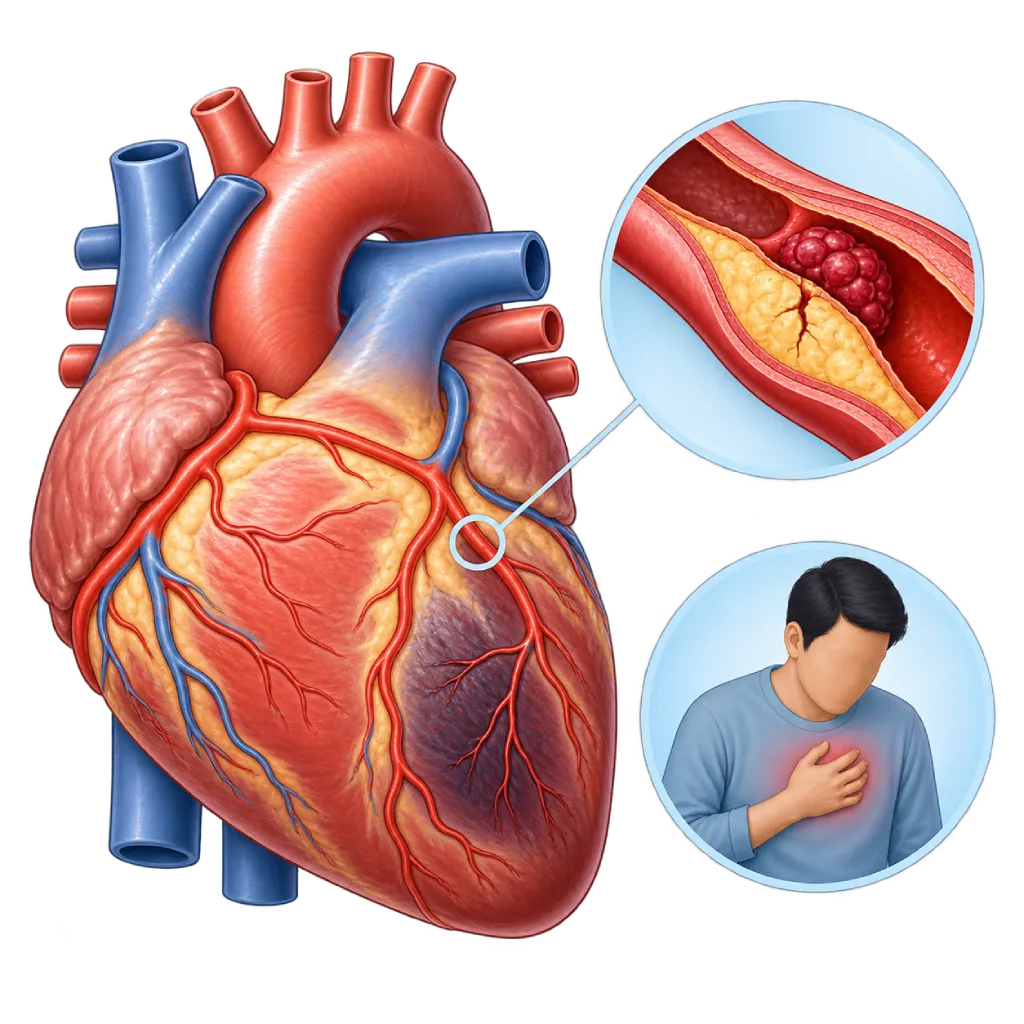
A myocardial infarction, or heart attack, happens when blood flow to part of the heart muscle drops sharply or stops suddenly, damaging the heart muscle. It is an emergency: the sooner blood flow is restored, the more heart muscle can be saved.
Sources01 / Understanding the condition
About Myocardial Infarction / Heart Attack
Myocardial infarction, commonly known as a heart attack, is the death of part of the heart muscle because blood flow to that area drops sharply or stops. The heart muscle works nonstop and needs a constant supply of oxygen from the coronary arteries, the blood vessels that wrap around the surface of the heart. If that supply is cut off for more than a few minutes, heart muscle cells start to be damaged, and the damage spreads for as long as blood flow is not restored.
How a Heart Attack Happens
In most cases, a heart attack starts with coronary artery disease. Over many years, fat, cholesterol, and inflammatory cells build up in the walls of the coronary arteries and form plaque. At some point, the surface of the plaque can crack or wear away. The body treats this as a wound and forms a blood clot at that spot, and it is this clot that suddenly blocks the artery. In some people, a heart attack happens without a plaque blockage, for example because of a coronary artery spasm, a tear in the artery wall, or the heart's need for oxygen far exceeding its supply, such as during heavy bleeding or a very fast heart rhythm.
According to the fourth universal definition of myocardial infarction (2018), the diagnosis requires two things: evidence of heart muscle damage in the form of a rise in troponin levels in the blood, and signs that the damage was caused by a lack of blood flow, whether from the symptoms, the ECG recording, or heart imaging.
Types of Heart Attack
Doctors classify heart attacks mainly based on the ECG recording. ST-elevation myocardial infarction (STEMI) usually signals a complete blockage, and the artery needs to be opened as soon as possible. Non-ST-elevation myocardial infarction (NSTEMI) usually results from a partial blockage. Together with unstable angina, both fall under acute coronary syndrome. There are also heart attacks without significant narrowing of the coronary arteries (MINOCA) and heart attacks that go unnoticed because the symptoms are vague. Problems that can arise afterward are covered on the Post-Myocardial Infarction Complications page. A list of all the types appears on this page.
Why Time Is So Critical
Cardiologists use the phrase "time is muscle": every minute of delay means more heart muscle dies. That is why the 2023 ESC guidelines emphasize an ECG within 10 minutes of the patient first being seen by medical staff and opening the artery as soon as possible, usually with percutaneous coronary intervention. Muscle that has already died is replaced by scar tissue and can no longer contract. The extent of this scar tissue determines the risk of heart failure and rhythm problems later on. With prompt treatment, long-term medication, and cardiac rehabilitation, many people can return to work and their usual activities.
02 / Understanding the condition
Types and Related Conditions
The following conditions belong to the Myocardial Infarction / Heart Attack group. Open each one for a full explanation.
03 / Understanding the condition
Symptoms to Recognize.
Common Symptoms
- Pain, heaviness, pressure, or burning in the chest that lasts more than a few minutes
- Pain spreading to the arm, shoulder, neck, jaw, back, or upper abdomen
- Shortness of breath, with or without chest pain
- Cold sweats
- Nausea, vomiting, or a feeling of fullness in the upper abdomen
- Dizziness, sudden weakness, or feeling like you are about to faint
- Strong anxiety or fear for no clear reason
Symptoms in Adult Women
Chest pain is still the main symptom in women, but the following symptoms more often accompany it or appear without clear chest pain.
- Shortness of breath or extreme tiredness for no clear reason
- Pain in the upper back, shoulder, neck, or jaw
- Nausea, vomiting, or discomfort in the upper abdomen
- Pressure in the chest that is not very painful
- Unusual tiredness or trouble sleeping in the days before
Symptoms in Older Adults
In older adults, and also in people with diabetes, symptoms are often vague, so they are easily mistaken for another problem.
- Sudden shortness of breath without chest pain
- New confusion or disorientation
- Severe weakness or sudden difficulty with daily activities
- Fainting or falling for no clear reason
- Nausea or loss of appetite with cold sweats
04 / Understanding the condition
What Causes This Condition?
- A cholesterol plaque in a coronary artery that cracks or wears away and is then covered by a blood clot (type 1 infarction)
- The heart muscle's need for oxygen exceeding its supply, for example in severe anemia, bleeding, or a very fast rhythm (type 2 infarction)
- A spasm of a coronary artery that suddenly narrows the vessel
- A spontaneous tear in the wall of a coronary artery, covered on the Spontaneous Coronary Artery Dissection page.
- A blood clot from a heart chamber or elsewhere that travels to a coronary artery (embolism)
- Procedures on the coronary arteries or heart surgery, although this is rare (type 4 and 5 infarction)
05 / Understanding the condition
Who Is at Higher Risk?
Lifestyle
Smoking, including frequent exposure to other people's smoke. A diet high in saturated fat, salt, and sugar, too little physical activity, and excess weight, especially fat around the belly.
Medical
High blood pressure, high LDL cholesterol, diabetes, chronic kidney disease, and a history of coronary artery disease or stroke. The risk rises further when several of these factors are present together and not under control.
Genetic
A history of heart attack in a father or brother before age 55, or in a mother or sister before age 65, and inherited high cholesterol (familial hypercholesterolemia).
Age
The risk rises in men from about age 45 and in women from about age 55 or after menopause.
Other
Long-lasting severe stress, depression, lack of sleep, autoimmune diseases such as lupus and rheumatoid arthritis, and a history of preeclampsia or diabetes during pregnancy.
Groups at Higher Risk
- People with Diabetes: Diabetes speeds up hardening of the arteries and can dull the sense of pain, so a heart attack sometimes feels only like shortness of breath or weakness.
- Smokers: Smoking damages the inner lining of blood vessels and makes blood clot more easily. The risk falls gradually after you quit smoking.
- People with Coronary Artery Disease: People who have had angina, a stent, or bypass surgery already have plaque in their coronary arteries and need regular checkups.
- Postmenopausal Women: The natural protection of the hormone estrogen decreases after menopause, and heart attack symptoms in women are more often atypical.
- Older Adults: The risk of a heart attack increases with age, and the symptoms are often vague, for example only shortness of breath, weakness, or confusion.
06 / Understanding the condition
How Is It Diagnosed?
In the emergency room, testing happens at the same time as first aid. The doctor briefly asks about your symptoms and health history, checks your blood pressure, pulse, and oxygen level, and then records an ECG within 10 minutes of first seeing you. If the ECG shows ST-segment elevation, the team immediately prepares to open the artery without waiting for blood test results.
If the ECG is not typical, the doctor relies on high-sensitivity cardiac troponin, checked on arrival and repeated 1 to 2 hours later. A rise or fall in troponin shows ongoing heart muscle damage. Echocardiography helps show which parts of the heart wall are weak and look for complications. Coronary angiography shows where the blockage is and is usually followed straight away by a procedure to open the artery. In certain situations, cardiac MRI is used to tell a heart attack apart from inflammation of the heart muscle or other conditions with similar symptoms.
Electrocardiogram (ECG)
A recording of the heart's electrical activity within 10 minutes of the patient being seen by medical staff, to tell STEMI apart from NSTEMI and decide the next step.
Cardiac Troponin Test
A high-sensitivity troponin blood test on arrival, repeated 1 to 2 hours later, to confirm or rule out heart muscle damage.
Coronary Angiography
Imaging of the coronary arteries with a catheter and contrast dye to see where the blockage is and how severe it is, which also guides the procedure to open the artery.
Echocardiography
An ultrasound of the heart to assess pumping strength, areas of the wall that move weakly, the valves, and complications such as fluid in the sac around the heart.
Cardiac MRI
Used in certain situations to assess the extent of scar tissue and to tell a heart attack apart from myocarditis or Takotsubo cardiomyopathy.
07 / Understanding the condition
Treatment Options.
Treatment is decided by a doctor after an assessment. The categories below can help you follow the conversation with your doctor.
Opening the Artery with a Catheter
Percutaneous coronary intervention opens the blockage with a balloon and places a stent. In STEMI, this procedure is done as soon as possible as the main option.
Clot-Dissolving Medicines
Fibrinolytics are given in STEMI when a catheter procedure cannot be done in time, and the patient is then referred for coronary angiography.
Antiplatelet and Anticoagulant Medicines
These prevent new clots. Usually two antiplatelet medicines are taken together for several months to one year; your doctor decides the type and duration.
Coronary Bypass Surgery
Chosen when the blockage affects many vessels or is hard to reach with a catheter, by creating a detour using a blood vessel from another part of the body.
Long-Term Heart-Protecting Medicines
Statins to lower LDL cholesterol, as well as beta blockers, ACE inhibitors or ARBs, and other medicines suited to pumping function, chosen and monitored by your doctor.
Cardiac Rehabilitation
A program of supervised exercise, education, and risk factor control that starts during the hospital stay and continues after you go home.
08 / Understanding the condition
Complications to Watch For.
Heart Rhythm Problems
Damaged muscle can trigger a rhythm that is too fast, too slow, or chaotic. A chaotic rhythm in the ventricles can stop the heart, so an electric shock is needed right away.
Heart Failure
Dead muscle no longer helps pump. If the damaged area is large, the heart cannot meet the body's needs and fluid builds up in the lungs or legs.
Cardiogenic Shock
The heart's pumping weakens severely, so blood pressure drops and organs do not get enough blood. This condition requires intensive care.
Mechanical Complications
A tear in the heart wall, the wall between the ventricles, or the muscle that supports the mitral valve. These are now rare thanks to fast opening of the artery, but they need immediate treatment.
Blood Clot in the Left Ventricle
Can form on a part of the heart wall that does not move and may break loose into the blood vessels of the brain, causing a stroke.
Pericarditis
Inflammation of the sac around the heart that causes sharp chest pain, usually a few days to a few weeks after the attack.
Repeat Heart Attack
The risk is higher in the first year, especially if medicines are not taken regularly and risk factors are not controlled.
09 / Understanding the condition
What Can You Do?
- Stop smoking and avoid other people's smoke.
- Have your blood pressure, cholesterol, and blood sugar checked regularly as your doctor advises.
- If you have high blood pressure, diabetes, or high cholesterol, take your medicines as prescribed and go to regular checkups.
- Stay active for at least 150 minutes a week at moderate intensity, such as brisk walking.
- Choose foods rich in vegetables, fruit, nuts and legumes, fish, and whole grains; limit salt, sugar, and saturated fat.
- Keep your weight and waist size within a healthy range.
- Learn the signs of a heart attack and save an emergency number so you and your family can act quickly.
10 / Understanding the condition
When Should You See a Doctor?
Do not wait if you feel chest pain or pressure for more than 5 minutes, especially if it comes with cold sweats, shortness of breath, or nausea. Call an ambulance (119) or ask someone to take you to a nearby emergency room, and do not drive yourself. It is better to be checked and find out it is not a heart attack than to be treated too late.
Make an appointment with a cardiologist if:
- Chest pain or shortness of breath appears during activity and goes away with rest.
- You have had a heart attack and need follow-up, medication adjustments, or rehabilitation.
- You have several risk factors, such as diabetes, high blood pressure, high cholesterol, or a family history.
- New symptoms appear after you go home from the hospital, such as tiring easily, swollen legs, or palpitations.
11 / Common questions
Questions You May Have.
Frequently asked questions about heart attacks and recovery.
What is the difference between a heart attack and cardiac arrest?
A heart attack is a blood flow problem: a coronary artery is blocked, so the heart muscle is damaged, but the heart usually keeps beating. Cardiac arrest is an electrical problem: the heart suddenly stops pumping because of a chaotic rhythm, so the person is unresponsive and not breathing normally. A heart attack can trigger cardiac arrest. If someone is unresponsive and not breathing normally, call for help, call an ambulance, and start chest compressions.
Is a heart attack always marked by severe chest pain?
Not always. Some people only feel shortness of breath, nausea, extreme tiredness, or pain in the back, jaw, or upper abdomen. Vague symptoms like these are more common in women, older adults, and people with diabetes. Some heart attacks also go completely unnoticed and are only found later on an ECG or imaging, which is covered on the Silent Myocardial Infarction page.
Can the heart muscle recover after a heart attack?
Muscle that has died is replaced by scar tissue and does not grow back. However, the surrounding muscle that is only temporarily weakened by the lack of blood often recovers within a few weeks after blood flow is restored. That is why doctors usually reassess the heart's pumping strength with echocardiography a few weeks after the attack to decide on further medication and the need for additional devices.
How long do I need to take medicines after a heart attack?
Some medicines, such as statins and one type of antiplatelet, are usually taken long term. A combination of two antiplatelets is usually given for several months to one year, depending on your bleeding risk and the procedure you had. Do not stop or change your medicines on your own, especially in the first months after a stent is placed, as this can trigger a clot inside the stent. Discuss any side effects with your doctor.
When can I go back to work, drive, and resume sexual activity?
The timing differs for each person, depending on the extent of the damage, the procedure you had, and the type of work you do. Many people can return to work within a few weeks. Your doctor will assess whether you are ready, often with an exercise stress test. A cardiac rehabilitation program helps you gradually return to your activities, including sexual activity. Also ask your doctor when you can drive again.
What should family members do if they suspect a heart attack?
Call an ambulance or take the person to a nearby emergency room right away, and do not wait for the symptoms to ease. Ask the person to stop what they are doing and sit or lie down comfortably. Do not give medicines that have not been prescribed unless a medical professional tells you to. If the person is unresponsive and not breathing normally, start chest compressions in the center of the chest and use an AED if one is available there.
Sources and Medical Review
Translated from the Indonesian edition medically reviewed by Dr. dr. Jajang Sinardja, Sp.JP(K).
Sources as cited in the Indonesian edition.
- Byrne RA, Rossello X, Coughlan JJ, et al. 2023 ESC Guidelines for the management of acute coronary syndromes. Eur Heart J. 2023;44(38):3720-3826.
- Thygesen K, Alpert JS, Jaffe AS, et al. Fourth universal definition of myocardial infarction (2018). Eur Heart J. 2019;40(3):237-269.
- Rao SV, O'Donoghue ML, Ruel M, et al. 2025 ACC/AHA/ACEP/NAEMSP/SCAI Guideline for the Management of Patients With Acute Coronary Syndromes: A Report of the American College of Cardiology/American Heart Association Joint Committee on Clinical Practice Guidelines. Circulation. 2025;151(13):e771-e862.
- Mehta LS, Beckie TM, DeVon HA, et al. Acute Myocardial Infarction in Women: A Scientific Statement From the American Heart Association. Circulation. 2016;133(9):916-947.
- Visseren FLJ, Mach F, Smulders YM, et al. 2021 ESC Guidelines on cardiovascular disease prevention in clinical practice. Eur Heart J. 2021;42(34):3227-3337.
- Ambrosetti M, Abreu A, Corra U, et al. Secondary prevention through comprehensive cardiovascular rehabilitation: From knowledge to implementation. 2020 update. A position paper from the Secondary Prevention and Rehabilitation Section of the European Association of Preventive Cardiology. Eur J Prev Cardiol. 2021;28(5):460-495.
Doctors Who Treat This Condition

Dr. dr. Jajang Sinardja, Sp.JP(K)
Interventional Cardiology
Coronary Intervention Procedures
Clinical focusAcute Coronary Syndrome · Primary Coronary Intervention
View Profile
dr. Puti S. Saus, Sp.JP(K)
Interventional Cardiology
Coronary Intervention Procedures
Clinical focusAcute Coronary Syndrome · Primary Coronary Intervention
View Profile
Dr. med. dr. Denio A. Ridjab, Sp.JP(K)
Interventional Cardiology
Coronary Intervention Procedures +2 centers
Clinical focusInterventional Cardiology · Coronary Artery Disease
View Profile