
Quick answer
What Is Coronary Artery Bypass Grafting?
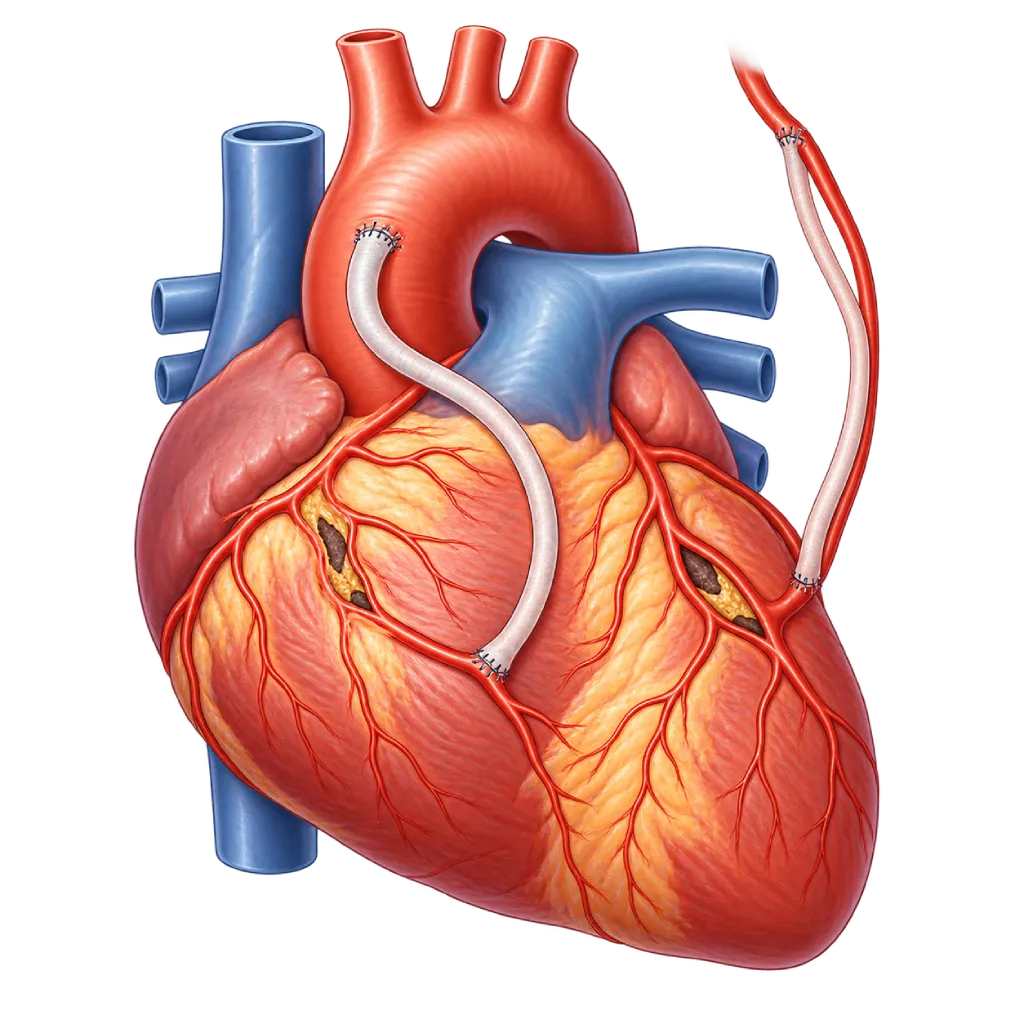
Coronary artery bypass grafting (CABG) is heart surgery that creates a detour for blood around a narrowed coronary artery, using a blood vessel from the chest, arm, or leg. It is usually chosen for narrowings in multiple vessels or in the left main coronary artery. The operation takes about 3 to 6 hours under general anesthesia.
Sources01 / Understanding the procedure
About Coronary Artery Bypass Grafting
What Is Coronary Artery Bypass Grafting
Coronary artery bypass grafting (CABG) is an operation to create a detour for blood around a narrowed or blocked coronary artery. The coronary arteries are the vessels that carry blood to the heart muscle. The surgeon takes a blood vessel from another part of the body and connects it to the coronary artery below the narrowing, so oxygen-rich blood reaches the heart muscle again. The narrowing itself is not removed. People often call it heart bypass surgery.
Vessels Used as Grafts
The graft that is almost always used is the left internal mammary artery, an artery behind the breastbone, which is connected to the left anterior descending (LAD) artery. This graft can remain open for many years. For the other coronary arteries, the surgeon may use the radial artery from the forearm or the saphenous vein from the leg. Research shows that radial artery grafts become blocked less often than vein grafts in the long term.
When Bypass Is Chosen
Bypass is usually recommended when the narrowing is in the left main coronary artery or in all three main coronary vessels, especially in people with diabetes, reduced heart pumping function, or complex narrowings. In these situations, bypass reduces the need for repeat procedures and, in some patients, extends life expectancy compared with stent placement. The stent option is covered on the Coronary Angioplasty page. The decision is made by the heart team, namely the cardiologist and the cardiac surgeon, together with you.
With or Without a Heart-Lung Machine
In many operations, the heart is stopped temporarily and its work is taken over by a heart-lung machine while the grafts are sewn in place. In some patients, the surgeon can connect the grafts to a beating heart using a special stabilizing device, known as the off-pump technique. Both methods give good results when performed by an experienced team, and the choice is tailored to the condition of the arteries and the patient.
Smaller Incision Options
Bypass surgery is usually performed through an incision in the middle of the chest by dividing the breastbone. In certain patients, especially when only the left anterior descending artery needs a graft, the operation can be done through a small incision between the left ribs, sometimes combined with stent placement for other arteries. These techniques are covered on the Minimally Invasive Heart Surgery and Hybrid Heart Procedure pages.
After Bypass Surgery
Bypass does not stop the process of plaque buildup (atherosclerosis). Antiplatelet medication, cholesterol medication, stopping smoking, and controlling blood pressure and blood sugar help keep the grafts and other arteries open. An exercise program supervised by the medical team is covered on the Structured Cardiac Rehabilitation Program page.
02 / Understanding the procedure
When Is This Procedure Considered?
A doctor may consider this procedure in the situations below. The decision is always made after a thorough assessment.
- Narrowing of the Left Main Coronary ArteryThis artery supplies blood to the majority of the left heart muscle, so bypass is often recommended.
- Narrowing in Three Main VesselsEspecially when the narrowings are complex or long, making them difficult to treat with stents.
- Extensive Coronary Disease with DiabetesIn people with diabetes and narrowings in multiple vessels, bypass reduces heart attacks and death.
- Reduced Heart Pumping FunctionIn ischemic cardiomyopathy, bypass can extend life expectancy in selected patients.
- Alongside Other Heart SurgeryFor example, during valve surgery, a severe coronary narrowing can be treated at the same time.
Situations to Consider First
- Target Artery Too Small or Extensively DiseasedA graft is hard to connect well if the artery below the narrowing is very small or diseased along its length.
- Heart Muscle Already ScarredIf the targeted area of muscle is no longer alive, the benefit of bypass to that area is limited.
- Very High Surgical RiskVery advanced age with frailty, or severe lung, kidney, or liver disease, needs to be weighed carefully.
- Mild or Simple NarrowingA narrowing that does not limit blood flow, or a simple one in a single vessel, can usually be treated with medications or a stent.
03 / Before the procedure
How Should You Prepare?
Planned bypass surgery is preceded by several tests and visits. The surgical team, cardiologist, and anesthesia team give instructions based on your condition. In urgent situations, preparation is done more quickly in the hospital.
Tests. Coronary angiography to map the narrowings, echocardiography, blood tests, an ECG, a chest X-ray, and if needed lung function tests and an ultrasound of the neck or leg vessels.
Medications. Aspirin is usually continued. Other antiplatelet medications such as clopidogrel or ticagrelor, as well as blood thinners, are usually stopped a few days beforehand according to your doctor's instructions. Do not stop any medication on your own.
Teeth and infections. Infections of the teeth, skin, or urinary tract should be treated first.
Stop smoking. Stopping as early as possible helps your lungs and wounds recover.
Day of surgery. Follow the fasting instructions, shower with antiseptic soap, and remove jewelry and nail polish.
Consent and companion. The doctor explains the benefits, risks, and other options. Arrange for family members to help during your hospital stay and for several weeks after you go home.
Unsure about the preparation instructions? Ask our team before the procedure.
04 / During the procedure
How Is the Procedure Done?
Bypass surgery is performed in the operating room by the cardiac surgery team under general anesthesia, so you are asleep throughout the operation. The operation usually takes 3 to 6 hours, depending on the number of grafts. Afterward, you are cared for in the intensive care unit (ICU).
Anesthesia and Monitoring
A breathing tube, IV lines, blood pressure monitors, and a urinary catheter are placed. Echocardiography through the esophagus (TEE) is often used to monitor the heart.
Harvesting the Graft Vessels
The artery behind the breastbone is carefully freed. If needed, the forearm artery or leg vein is harvested through small incisions or with the help of a camera.
Opening the Chest and Preparing the Heart
The breastbone is divided (sternotomy). The heart is stopped temporarily with the help of a heart-lung machine, or kept beating with a stabilizing device in the off-pump technique.
Connecting the Grafts
Each graft is sewn to the coronary artery below the narrowing with very fine thread, and the other end to the aorta if needed. Flow in the grafts can be measured before the chest is closed.
Closing the Chest
The heart is restarted, drainage tubes and temporary pacing wires are placed, and then the breastbone is joined with wires and the skin is stitched.
05 / Benefits and risks
Benefits and Risks Should Be Discussed Together.
Every medical procedure has benefits and risks. Your doctor will explain both for your situation before the procedure.
Benefits You Can Expect
- New Blood Flow to the Heart MuscleThe graft carries blood past the narrowing so the heart muscle gets enough oxygen again.
- Reduces Chest PainThe majority of patients experience less angina and an improved ability to be active.
- Longer Life Expectancy in Certain PatientsEspecially with left main coronary artery narrowing, three-vessel disease with diabetes, or reduced pumping function.
- Long-Lasting Arterial GraftsAn internal mammary artery graft to the left anterior descending artery usually stays open for many years.
- Fewer Repeat ProceduresIn extensive coronary artery disease, the need for repeat procedures is lower than with stent placement.
The benefits of a procedure are not a promise of a cure. Ask how the results will affect your care plan.
Risks You Should Know
- BleedingMay require a blood transfusion and, in a small number of patients, another operation to stop it.
- Heart Rhythm DisturbancesAtrial fibrillation is fairly common in the first days after surgery and usually improves with medication.
- StrokeA clot or debris can travel to the brain; the team takes preventive steps and monitors you.
- Wound or Breastbone InfectionMore likely with diabetes, obesity, or smoking; prevented with wound care and blood sugar control.
- Kidney, Lung, or Memory ProblemsUsually temporary, for example reduced kidney function, pneumonia, or forgetfulness in the first few weeks.
- Risk of DeathDepends on age, heart function, and other conditions; the doctor will explain your estimated risk.
Risks can differ from person to person. A full explanation and consent are given after an individual assessment.
06 / After the procedure
What Is Recovery Like?
Recovery happens gradually and differs from person to person, depending on age, your condition before surgery, and whether the operation was planned or an emergency.
In the ICU. Usually one to two days. The breathing tube is removed once you are awake and breathing well.
On the ward. You start sitting up, walking, and practicing deep breathing and effective coughing. The total hospital stay is usually about 5 to 7 days.
At home. The breastbone needs about 6 to 8 weeks to heal. Avoid lifting heavy objects or pushing hard during that time, and ask when you can drive. Keep the wounds on your chest and on your arm or leg clean and dry.
Medications and follow-up visits. Aspirin, cholesterol medication, and other medications are usually taken long term. Keep to your follow-up visit schedule.
Cardiac rehabilitation. A supervised exercise program helps restore your fitness and prevent another heart attack.
Warning signs to watch for. Contact the medical team or go to the emergency room right away if you experience:
- Fever, or a wound that becomes more red, swollen, filled with pus, or opens up
- New chest pain, shortness of breath, or an irregular pounding heartbeat
- A breastbone that feels like it is shifting or clicking when you move
- Facial drooping, weakness on one side of the body, or slurred speech
- Leg swelling or rapid weight gain over a few days
Know the Signs That Need Prompt Care.
Follow the team's guidance on warning signs. If severe or sudden symptoms appear after the procedure, go to the nearest emergency department right away or call Heart Attack Center 1500 258.
07 / Team and support
Doctors and Procedure Support
The doctors below are listed for this procedure. Listed by name, not by ranking.

dr. Adrianus Kosasih, Sp.JP(K)
Interventional Cardiology
Coronary Intervention Procedures
Clinical focusPrimary Coronary Intervention · PCI for Acute Coronary Syndrome
View Profile
Dr. dr. Dudy A. Hanafy, Sp.BTKV, Subsp. JD(K), MARS
Adult Cardiac Surgery
Advanced Cardiovascular Surgical Care +1 center
Clinical focusMinimally Invasive Cardiac Surgery · Coronary Artery Bypass Surgery
View Profile
dr. Rr. Pasati Lintangella, Sp.BTKV
Thoracic & Cardiovascular Surgery
Advanced Cardiovascular Surgical Care +1 center
Clinical focusAdult Cardiac Surgery · Coronary Artery Bypass Surgery
View ProfileOperating Theatre (Cardiac Operating Room)
An operating room dedicated to heart and blood vessel surgery, where the surgical, anesthesia, perfusion, and nursing teams work…
Minimally Invasive Cardiac Surgery (MICS) Technology
A way of performing heart surgery through a small incision between the ribs or through part of the breastbone, using long-shafted…
Live Surgery Facility
Cameras and an audio-video link in the operating room that allow an operation to be broadcast for education and discussion among…
Cardiovascular Intensive Care Unit (ICU)
An intensive care unit for heart and blood vessel patients who need close monitoring and prompt treatment, for example after…
The availability of technology and test support is confirmed with the team. Technology is chosen according to clinical need.
08 / Common questions
Before You Plan the Procedure.
Questions patients and families often ask before coronary artery bypass surgery.
What is the difference between bypass surgery and getting a "ring"?
A stent, often called a "ring" in Indonesia, opens the narrowing from inside the artery through a catheter, without opening the chest. Bypass surgery does not open the narrowing, but creates a detour with a graft vessel so blood flows around it. Bypass is more often chosen for narrowings in multiple vessels or in the left main coronary artery, while a stent is used for simpler narrowings.
How long does a bypass graft last?
Grafts from the artery behind the breastbone usually stay open for many years, in many patients for more than ten years. Vein grafts from the leg narrow more easily over time. How long a graft lasts depends greatly on taking medications as prescribed, controlling cholesterol, blood pressure, and blood sugar, and stopping smoking.
How long will I stay in the hospital, and when can I return to work?
Usually one to two days in the ICU, with a total hospital stay of about 5 to 7 days. The breastbone heals in 6 to 8 weeks. Many people can return to office work after about 6 to 12 weeks, while heavy physical work takes longer. The doctor decides the timing at your follow-up visit.
Why is there a wound on my arm or leg?
That wound is where the graft vessel was taken, either the radial artery in the forearm or the saphenous vein in the leg. The area still gets blood flow from other vessels nearby. This wound may be swollen or numb for a few weeks. Raise your leg when sitting and keep the wound clean and dry.
Can bypass be done without dividing the breastbone?
In certain patients, especially when only the left anterior descending artery needs a graft, the graft can be placed through a small incision between the left ribs. This technique can be combined with stent placement for other arteries. This option is covered on the Minimally Invasive Heart Surgery and Hybrid Heart Procedure pages.
Do I still need to take medication after bypass surgery?
Yes. Bypass creates a detour, but it does not stop plaque from forming in the arteries and grafts. Aspirin is usually taken for life, along with cholesterol medication and other medications based on your condition. Stopping smoking, regular exercise through cardiac rehabilitation, and controlling blood pressure and blood sugar help the grafts last longer.
Sources and Medical Review
Translated from the Indonesian edition medically reviewed by Dr. dr. Dudy A. Hanafy, Sp.BTKV, Subsp. JD(K), MARS.
Sources as cited in the Indonesian edition.
- Lawton JS, Tamis-Holland JE, Bangalore S, et al. 2021 ACC/AHA/SCAI Guideline for Coronary Artery Revascularization: A Report of the American College of Cardiology/American Heart Association Joint Committee on Clinical Practice Guidelines. Circulation. 2022;145(3):e18-e114.
- Neumann FJ, Sousa-Uva M, Ahlsson A, et al. 2018 ESC/EACTS Guidelines on myocardial revascularization. Eur Heart J. 2019;40(2):87-165.
- Farkouh ME, Domanski M, Sleeper LA, et al. Strategies for Multivessel Revascularization in Patients with Diabetes. N Engl J Med. 2012;367(25):2375-2384.
- Thuijs DJFM, Kappetein AP, Serruys PW, et al. Percutaneous coronary intervention versus coronary artery bypass grafting in patients with three-vessel or left main coronary artery disease: 10-year follow-up of the multicentre randomised controlled SYNTAX trial. Lancet. 2019;394(10206):1325-1334.
- Gaudino M, Benedetto U, Fremes S, et al. Radial-Artery or Saphenous-Vein Grafts in Coronary-Artery Bypass Surgery. N Engl J Med. 2018;378(22):2069-2077.
- Velazquez EJ, Lee KL, Jones RH, et al. Coronary-Artery Bypass Surgery in Patients with Ischemic Cardiomyopathy. N Engl J Med. 2016;374(16):1511-1520.