
Quick answer
What Is Structured Cardiac Rehabilitation Program?
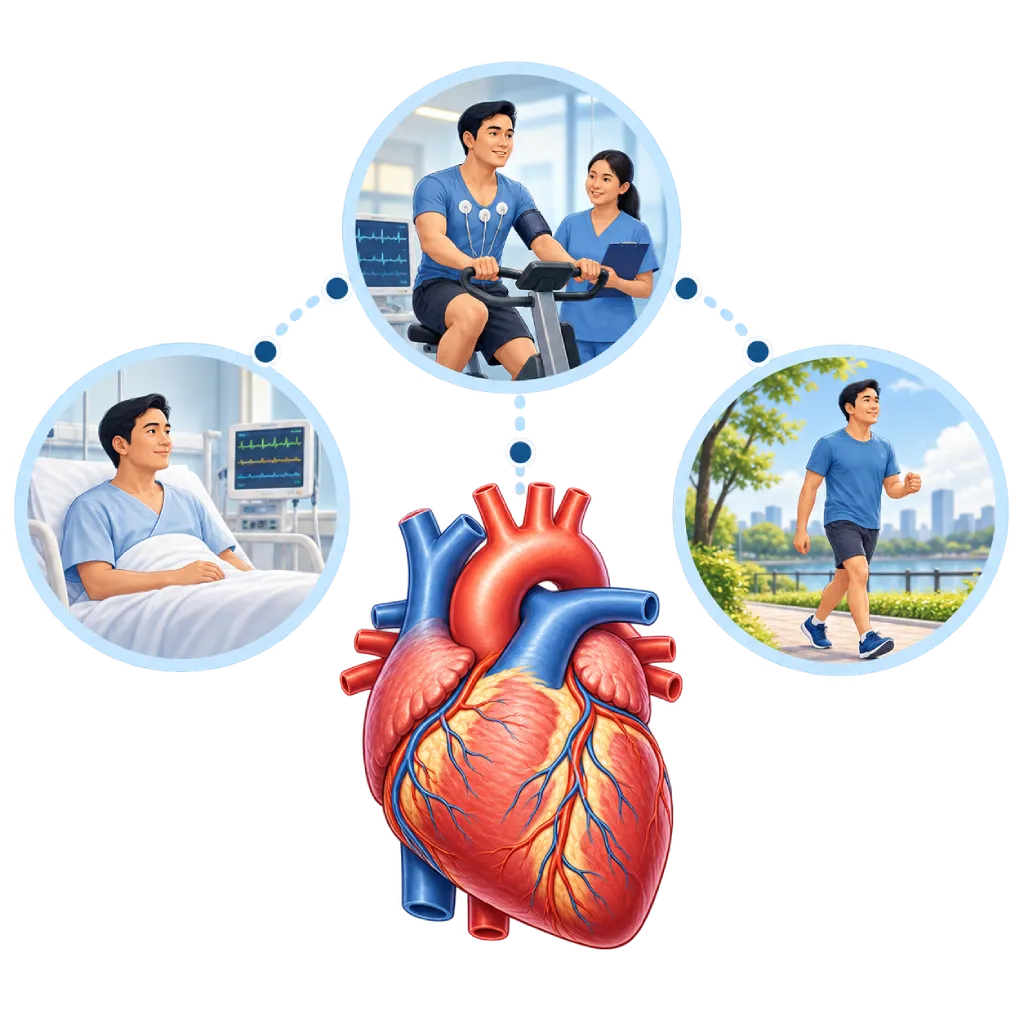
A structured cardiac rehabilitation program is a step-by-step recovery program after a heart event or procedure. It has three phases: during your hospital stay, supervised outpatient exercise, and long-term maintenance. It includes physical exercise, education on diet and medicines, quitting smoking, stress management, and risk factor control.
Sources01 / Understanding the procedure
About Structured Cardiac Rehabilitation Program
What Is a Structured Cardiac Rehabilitation Program
Cardiac rehabilitation is a recovery program designed and supervised by a health care team to help patients return to their activities safely after a heart attack, stent placement, heart surgery, or with stable heart failure. The program is not just exercise; it combines physical exercise, education, risk factor control, and psychological support. Cardiology guidelines recommend cardiac rehabilitation for all eligible patients.
How It Works in Brief
Regular, measured exercise improves fitness, so the heart works more efficiently during daily activities. Education and risk factor control help slow the progression of the disease and prevent repeat events. Combined analyses of many studies show that exercise-based rehabilitation lowers the risk of repeat heart attacks and hospital stays, and improves quality of life.
Three Phases of Rehabilitation
- Phase I, during your hospital stay: gradual mobilization, education about medicines and warning signs, and preparation for going home. This is covered on the Cardiac Rehabilitation Phase I page.
- Phase II, supervised outpatient exercise: two to three times a week for 8 to 12 weeks, with ECG and blood pressure monitoring. This is covered on the Cardiac Rehabilitation Phase II page.
- Phase III, maintenance: more independent exercise for the long term, with regular evaluations. This is covered on the Cardiac Rehabilitation Phase III page.
Program Components
- Initial assessment: your heart condition, medicines, risk factors, and an exercise test to plan the program. This is covered on the Treadmill Stress Test page.
- Physical exercise: aerobic and strength exercises tailored to your ability.
- Diet and body weight: a heart-healthy diet planned with a clinical nutrition physician.
- Risk factors: blood pressure, cholesterol, blood sugar, and quitting smoking. This is covered on the Lifestyle Counseling and Risk Management page and the Cardiovascular Risk Management Program page.
- Psychological support and returning to work: help with anxiety or sadness, and planning your return to daily activities and work.
The Team Involved
The program is run by a multidisciplinary team, including cardiologists, physical medicine and rehabilitation specialists, physiotherapists, nurses, and clinical nutrition physicians. Treatment of the heart disease itself is covered on the Coronary Artery Disease Management page and the Heart Failure Management page.
02 / Understanding the procedure
When Is This Procedure Considered?
A doctor may consider this procedure in the situations below. The decision is always made after a thorough assessment.
- After a Heart AttackIncluding heart attacks treated with medicines alone.
- After Stent Placement or Bypass SurgeryFor recovery and to prevent repeat events.
- After Heart Valve SurgeryOnce the surgical wound has healed sufficiently.
- Stable Heart FailureEspecially with reduced ejection fraction.
- Stable AnginaExercise is adjusted to the level at which symptoms appear.
- After Heart Device ImplantationSuch as an ICD or CRT, with a tailored program.
Situations to Consider First
- Unstable AnginaChest pain that is new, becoming more frequent, or occurring at rest needs to be treated beforehand.
- Worsening Heart FailureIncreasing shortness of breath or swelling; exercise is postponed.
- Uncontrolled ArrhythmiaThe heart rhythm needs to be stabilized before exercise.
- Severe Aortic Valve Narrowing with SymptomsRequires valve treatment beforehand.
- Very High Blood Pressure or FeverExercise is postponed until the condition is under control.
03 / Before the procedure
How Should You Prepare?
Preparation takes place before the program starts.
Doctor's referral. Ask for a cardiac rehabilitation referral before you leave the hospital or at a follow-up visit.
Care summary. Bring your hospital discharge summary, procedure reports, and recent test results.
List of medicines. Bring all the medicines you are currently taking.
Clothing and shoes. Prepare comfortable exercise clothing and well-fitting lace-up shoes.
Personal goals. Think about the activities you want to return to, such as working, exercising, or playing with your grandchildren.
Unsure about the preparation instructions? Ask our team before the procedure.
04 / During the procedure
How Is the Procedure Done?
Each exercise session usually lasts about 1 hour. The length of the program depends on the phase: Phase I during your hospital stay, Phase II about 8 to 12 weeks, and Phase III long term.
Referral and Assessment
Your doctor refers you, then the team assesses your heart condition, risk factors, and physical ability, including an exercise test when possible.
Personal Plan
The team sets targets for exercise, diet, and risk factor control based on your condition and goals.
Exercise and Education
Exercise is done gradually with monitoring, along with education about your disease, medicines, diet, and stress management.
Evaluation and Next Steps
Your progress is evaluated at the end of Phase II, then a maintenance program is set up for Phase III.
05 / Benefits and risks
Benefits and Risks Should Be Discussed Together.
Every medical procedure has benefits and risks. Your doctor will explain both for your situation before the procedure.
Benefits You Can Expect
- Lower Risk of Repeat EventsRehabilitation helps lower the risk of repeat heart attacks and hospital stays.
- Better Fitness and Quality of LifeDaily activities feel easier.
- Better Control of Risk FactorsSupported by education and routine monitoring.
- Greater ConfidenceReturning to activities and work safely.
- Support from a Multidisciplinary TeamDoctors, physiotherapists, nurses, and nutrition physicians work together.
The benefits of a procedure are not a promise of a cure. Ask how the results will affect your care plan.
Risks You Should Know
- Heart Symptoms During ExerciseThis is rare; exercise is supervised and stopped if warning signs appear.
- Muscle or Joint PainUsually mild; the intensity is adjusted.
- Drop in Blood Pressure or Blood SugarMonitored before and after exercise.
- Stopping Partway ThroughMany patients do not complete the program; a suitable schedule and family support help.
Risks can differ from person to person. A full explanation and consent are given after an individual assessment.
06 / After the procedure
What Is Recovery Like?
There is no special recovery period. The program brings greater benefits when you complete it and continue with healthy habits.
Attend sessions regularly. Come as scheduled and stay active on days without a session.
Keep taking your medicines. Rehabilitation complements, but does not replace, the medicines from your doctor.
Involve your family. Family support helps you keep up new habits at home.
Report changes. Tell the team if you have new symptoms, a change in medicines, or a hospital stay.
Warning signs. Stop the activity and go to the emergency room right away if you have:
- Chest pain or pressure that does not go away with rest
- Severe or sudden shortness of breath
- Fainting or nearly fainting
- A very fast or irregular heartbeat
Know the Signs That Need Prompt Care.
Follow the team's guidance on warning signs. If severe or sudden symptoms appear after the procedure, go to the nearest emergency department right away or call Heart Attack Center 1500 258.
07 / Team and support
Doctors and Procedure Support
The doctors below are listed for this procedure. Listed by name, not by ranking.

dr. Ayu Amalia U. Putri, Sp.KFR
Physical Medicine & Rehabilitation
Clinical focusCardiac Rehabilitation · Postoperative Rehabilitation
View Profile
Dr. med. dr. Denio A. Ridjab, Sp.JP(K)
Interventional Cardiology
Coronary Intervention Procedures +2 centers
Clinical focusInterventional Cardiology · Coronary Artery Disease
View Profile
dr. Juweni Joe, Sp.GK
Clinical Nutrition
Clinical focusMedical Nutrition Intervention · Nutrition for Cardiovascular Patients
View ProfileTreadmill Test System
A testing system that records your ECG, heart rate, and blood pressure while you walk on a treadmill as the workload increases in…
The availability of technology and test support is confirmed with the team. Technology is chosen according to clinical need.
08 / Common questions
Before You Plan the Procedure.
Frequently asked questions about cardiac rehabilitation programs. Your program is planned together with the rehabilitation team.
Who should take part in cardiac rehabilitation?
Patients after a heart attack, stent placement, or bypass or valve surgery, as well as people with stable heart failure and stable angina. Cardiology guidelines recommend a rehabilitation referral for all of these patients, including older adults and women, who are in fact often referred less frequently. Ask your doctor whether you are eligible.
Is cardiac rehabilitation the same as regular exercise?
No. Exercise in cardiac rehabilitation is planned based on your assessment and exercise test results, increased gradually, and supervised by the team with monitoring. Besides exercise, the program includes education on medicines and diet, risk factor control, and psychological support. This combination is what sets it apart from regular exercise.
How long does the program last?
Phase I takes place while you are still in the hospital, Phase II is usually two to three times a week for 8 to 12 weeks, and Phase III continues long term with more independent exercise. Each exercise session usually lasts about 1 hour. The schedule is adjusted to your condition and activities.
Is cardiac rehabilitation safe?
Yes. Before you start, your heart condition is assessed and an exercise test is usually done to set safe limits. During supervised exercise, your ECG, blood pressure, and symptoms are monitored, and exercise is stopped if warning signs appear. Serious events during supervised cardiac rehabilitation are very rare.
What if I live far from the hospital?
Talk to the team. For patients at low to moderate risk, part of the program can be done at home with guidance and regular monitoring, because studies show the results are comparable to center-based rehabilitation. What matters is to keep exercising regularly and safely.
Do I still need to take my medicines?
Yes. Cardiac rehabilitation complements, but does not replace, the medicines your doctor prescribes. Medicines such as antiplatelets, statins, and beta blockers remain important to prevent repeat events. In fact, the rehabilitation team helps you understand your medicines, take them regularly, and report side effects to the doctor treating you.
Sources and Medical Review
Translated from the Indonesian edition medically reviewed by dr. Ayu Amalia U. Putri, Sp.KFR.
Sources as cited in the Indonesian edition.
- Ambrosetti M, Abreu A, Corrà U, et al. Secondary prevention through comprehensive cardiovascular rehabilitation: From knowledge to implementation. 2020 update. A position paper from the Secondary Prevention and Rehabilitation Section of the European Association of Preventive Cardiology. Eur J Prev Cardiol. 2021;28(5):460-495.
- Vrints C, Andreotti F, Koskinas KC, et al. 2024 ESC Guidelines for the management of chronic coronary syndromes. Eur Heart J. 2024;45(36):3415-3537.
- Dibben G, Faulkner J, Oldridge N, et al. Exercise-based cardiac rehabilitation for coronary heart disease. Cochrane Database Syst Rev. 2021;11:CD001800.
- Long L, Mordi IR, Bridges C, et al. Exercise-based cardiac rehabilitation for adults with heart failure. Cochrane Database Syst Rev. 2019;1:CD003331.
- Thomas RJ, Balady G, Banka G, et al. 2018 ACC/AHA Clinical Performance and Quality Measures for Cardiac Rehabilitation. J Am Coll Cardiol. 2018;71(16):1814-1837.