
Quick answer
What Is Lung Disease Caused by Heart Disease?
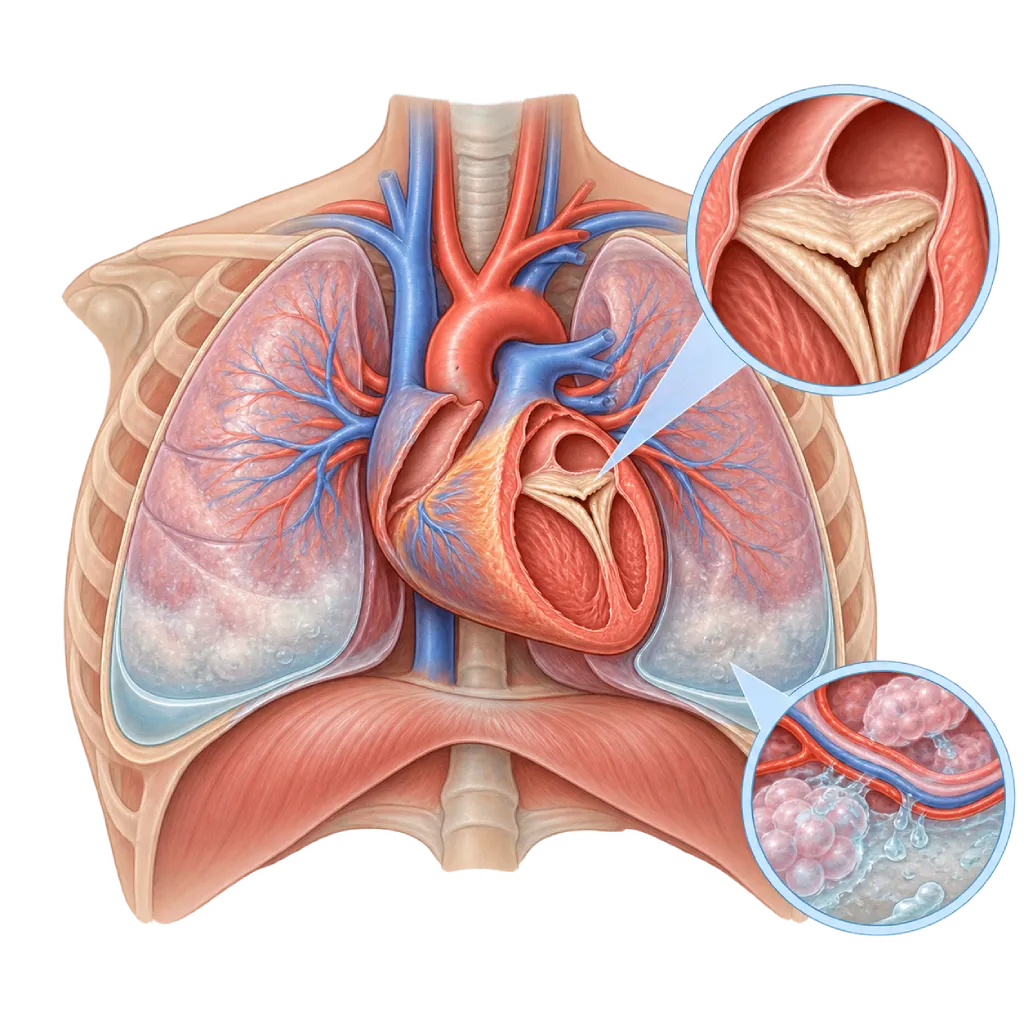
Lung disease caused by heart disease is a lung problem that develops because the heart does not pump or move blood well, so pressure in the lung blood vessels rises. As a result, fluid builds up, lung pressure increases, and shortness of breath appears.
SourcesSigns That Need Urgent Help
- Sudden severe shortness of breath, especially when lying down
- Coughing up white or pink frothy sputum
- Gurgling or bubbling breathing sounds
- Bluish lips or fingertips
- Cold sweats, restlessness, or confusion
- Chest pain or a very fast heartbeat with shortness of breath
- A baby who looks blue, is limp, or refuses to feed
If these signs appear, go to the nearest emergency department right away or call Heart Attack Center 1500 258.
01 / Understanding the condition
About Lung Disease Caused by Heart Disease
Blood that has picked up oxygen in the lungs flows back to the heart's left atrium and left ventricle through the pulmonary veins. If the left side of the heart becomes weak or stiff, or the mitral and aortic valves narrow or leak, blood backs up and pressure in the veins and small blood vessels of the lungs rises. Fluid then seeps into the lung tissue, the lungs become heavy and stiff, and shortness of breath appears. In this situation, the lungs themselves are actually healthy; the source of the problem is in the heart. Lung symptoms are often the first sign that heart disease is getting worse, so they deserve attention.
Types of Lung Problems That Develop
- Pulmonary congestion. Fluid fills the tissue between the air sacs, so shortness of breath appears during activity or when lying down.
- Pulmonary edema. Fluid has flooded the air sacs; it usually appears suddenly and needs treatment in the emergency room. Covered on the Cardiogenic Pulmonary Edema page.
- Pleural effusion. Fluid collects between the lung and the chest wall, often on both sides, so the lungs cannot fully expand.
- Pulmonary hypertension due to left heart disease. Long-lasting high pressure causes the lung blood vessels to thicken and strains the right side of the heart. Covered on the Secondary Pulmonary Hypertension page.
- Cardiac asthma. Airway walls swollen with fluid cause wheezing like asthma, especially at night.
- Excess blood flow to the lungs. In some congenital heart diseases, blood leaks from the left side to the right side through a hole in the heart's dividing wall, so the lungs receive too much blood. Covered on the Congenital Heart Disease page.
Why Treatment Focuses on the Heart
Because the source is the heart, lung symptoms usually improve when the heart disease is treated: fluid is reduced with water pills (diuretics), the heart's pumping is supported with heart failure medicines, and damaged valves are repaired. The ESC/ERS 2022 guidelines do not recommend specific pulmonary arterial hypertension medicines for high lung pressure that comes from the left side of the heart, because they have not been shown to help and can make things worse. If shortness of breath persists after the heart has been treated, your doctor looks for another accompanying lung disease, which is covered on the Cardiopulmonary Syndrome page.
02 / Understanding the condition
Symptoms to Recognize.
Common Symptoms
- Shortness of breath during activity, brought on by lighter and lighter effort
- Shortness of breath when lying flat, so you need to sleep propped up on high pillows
- Waking at night because of breathlessness or coughing
- A dry cough or wheezing that gets worse when lying down
- Swelling in the ankles or legs
- Rapid weight gain over a few days due to fluid
- Tiring easily during daily activities
Symptoms in Infants
In babies with a congenital heart defect that sends too much blood to the lungs, signs usually appear within the first weeks to months.
- Fast breathing, especially during feeding
- Heavy sweating during feeding
- Tiring quickly during feeding, so the baby drinks little
- Poor weight gain
- Repeated coughs and colds or lung infections
03 / Understanding the condition
What Causes This Condition?
- Heart failure, whether from a weakened heart pump or a stiff heart muscle
- Narrowing or leaking of the mitral valve that hinders blood flow from the lungs to the left side of the heart
- Narrowing or leaking of the aortic valve that raises pressure in the left side of the heart
- Cardiomyopathy, a disease of the heart muscle, from various causes
- Coronary artery disease or a heart attack that damages the heart muscle
- Long-standing high blood pressure that makes the heart muscle thick and stiff
- Heart rhythm disorders, especially atrial fibrillation with a fast heart rate
- Congenital heart defects that send too much blood to the lungs, such as a hole in the heart's dividing wall
04 / Understanding the condition
Who Is at Higher Risk?
Medical
Long-standing hypertension, coronary artery disease and a history of heart attack, diabetes, atrial fibrillation, chronic kidney disease, and heart valve disease.
Lifestyle
High salt intake, not taking heart medicines regularly, smoking, excessive alcohol use, and excess body weight.
Age
The risk increases in older age, when the heart muscle is stiffer and heart failure with preserved ejection fraction is more common.
Genetic
Cardiomyopathies that run in families and congenital heart defects increase the chance of lung problems caused by the heart.
Other
A history of rheumatic fever in childhood that damaged the mitral valve, and pregnancy in women with valve disease or heart failure.
Groups at Higher Risk
- People with Heart Failure: A weak pump or stiff heart muscle lets fluid build up easily in the lungs, especially if medicines are not taken regularly or salt intake is high.
- People with Mitral or Aortic Valve Disease: A narrowed or leaking valve raises pressure in the left side of the heart and in the lungs, sometimes before other symptoms are felt.
- Older Adults with Long-Standing Hypertension: Years of high blood pressure make the heart muscle thick and stiff, so fluid in the lungs can appear even when the pump looks normal.
- Babies and Children with Congenital Heart Disease: A hole in the heart's dividing wall or a blood vessel channel that stays open sends too much blood to the lungs and can raise lung pressure if not treated.
05 / Understanding the condition
How Is It Diagnosed?
Your doctor needs to confirm that the lung problem comes from the heart, not from a disease of the lungs themselves. A physical examination may find crackles (rales) at the base of the lungs, bulging neck veins, and leg swelling. A chest X-ray shows an enlarged heart, pulmonary congestion, or fluid in the chest cavity. A high NT-proBNP level signals strain on the heart, while an ECG looks for rhythm disorders or signs of a previous heart attack.
Echocardiography is the key test because it assesses the heart's pumping, heart muscle stiffness, the valves, and estimated lung pressure. A bedside lung ultrasound can show signs of fluid in the lungs. If lung pressure is high and the cause is not yet clear, right heart catheterization measures the pulmonary wedge pressure; a value above 15 mmHg indicates that the source is the left side of the heart. Spirometry should be repeated after the fluid has decreased, because pulmonary congestion can make the results look like lung disease.
Physical Examination
Listening for crackles at the base of the lungs and checking the neck veins, leg swelling, and body weight as signs of excess fluid.
Chest X-Ray
Shows the size of the heart, congestion in the lung blood vessels, and fluid in the chest cavity.
NT-proBNP and BNP Test
High levels signal strain on the heart and support that the breathlessness comes from the heart; also used to monitor treatment.
Echocardiography
The key test to assess the heart's pumping and muscle stiffness, the mitral and aortic valves, congenital holes, and estimated lung pressure.
Electrocardiogram (ECG)
Looks for atrial fibrillation, signs of a previous heart attack, or thickened heart muscle underlying the pulmonary congestion.
Right Heart Catheterization
Measures lung pressure and pulmonary wedge pressure directly to confirm that high lung pressure comes from the left side of the heart.
Lung Function Test (Spirometry)
Repeated after the fluid has decreased to look for an accompanying lung disease, because congestion can distort the results.
06 / Understanding the condition
Treatment Options.
Treatment is decided by a doctor after an assessment. The categories below can help you follow the conversation with your doctor.
Water Pills (Diuretics)
Reduce fluid in the lungs and legs so that shortness of breath eases. Your doctor adjusts the type and dose based on your daily weight and kidney function.
Long-Term Heart Failure Treatment
A combination of the main heart failure medicines, increased gradually to strengthen and protect the heart. Covered on the Heart Failure Management page.
Valve Repair or Replacement
A damaged mitral or aortic valve is repaired or replaced through surgery or a catheter, so pressure in the lungs falls. Covered on the Heart Valve Surgery page.
Rhythm and Blood Pressure Control
A fast heart rate in atrial fibrillation and high blood pressure are controlled so that the left side of the heart is not overloaded.
Pleural Fluid Drainage
A large amount of fluid in the chest cavity that causes breathlessness can be drained with a needle while the underlying heart cause is treated.
Closure of Congenital Defects
A hole in the heart's dividing wall or a blood vessel channel that stays open is closed through a catheter or surgery if the criteria are met. Covered on the Heart Defect Closure page.
Cardiac Rehabilitation
Supervised exercise once your condition is stable, to improve your ability to be active. Covered on the Structured Cardiac Rehabilitation Program page.
07 / Understanding the condition
Complications to Watch For.
Acute Pulmonary Edema
Fluid floods the air sacs within a short time, causing severe shortness of breath and a frothy cough. It needs treatment in the emergency room. Covered on the Cardiogenic Pulmonary Edema page.
Persistent Pulmonary Hypertension
Long-standing high pressure thickens the walls of the lung blood vessels, so lung pressure stays high even after the fluid has decreased.
Right Heart Failure
The right ventricle is strained by high lung pressure and gradually weakens, causing swelling of the legs, abdomen, and liver.
Recurrent Pleural Effusion
Fluid in the chest cavity can return if heart failure is not yet under control, and it sometimes needs to be drained with a needle.
Lung Infection
Congested lungs are more prone to pneumonia, and infection can make heart failure worse.
Coughing Up Blood
In severe mitral stenosis, high pressure in the pulmonary veins can rupture small blood vessels and cause you to cough up blood. Covered on the Mitral Stenosis page.
08 / Understanding the condition
What Can You Do?
- Take your heart medicines on schedule and do not stop them on your own.
- Limit salt, and follow your doctor's advice on how much fluid to drink if you have heart failure.
- Weigh yourself every morning; a gain of more than 2 kg in three days should be reported to your doctor.
- Control your blood pressure, blood sugar, and cholesterol.
- See your cardiologist regularly, including for echocardiography when recommended.
- Get your flu and pneumococcal vaccines as your doctor advises.
- Stop smoking and limit alcohol.
- Treat bacterial throat infections in children fully to prevent rheumatic heart disease.
09 / Understanding the condition
When Should You See a Doctor?
Get checked if you start to feel short of breath with light activity or when lying down, especially if you have heart disease, valve disease, or long-standing high blood pressure. If you have already been diagnosed, contact your doctor when your symptoms change, and go to the emergency room right away if shortness of breath is severe or sudden.
- Needing higher pillows to be able to sleep, or waking at night because of breathlessness
- Weight gain of more than 2 kg in three days, or increasing leg swelling
- A cough or wheezing that gets worse when lying down
- A baby who breathes fast, sweats, or tires quickly during feeding
- Sudden severe shortness of breath, coughing up pink frothy sputum, or bluish lips: go to the emergency room right away
Don't Wait in an Emergency.
If symptoms are severe or come on suddenly, go to the nearest emergency department right away or call Heart Attack Center 1500 258, rather than waiting for an appointment.
10 / Common questions
Questions You May Have.
Frequently asked questions about lung problems caused by heart disease.
Why can heart disease cause fluid in the lungs?
The left side of the heart receives blood from the lungs and pumps it to the rest of the body. If the heart's pump weakens, the heart muscle is stiff, or a valve is narrowed or leaking, blood backs up and pressure in the lung blood vessels rises. This pressure pushes fluid out of the vessels into the lung tissue, so the lungs become heavy and shortness of breath appears. That is why reducing fluid and improving heart function usually relieves the lung symptoms.
Is shortness of breath when lying down always caused by the heart?
Not always, but breathlessness when lying flat and waking at night short of breath are strong clues to heart-related pulmonary congestion. Similar symptoms can also occur with severe COPD, asthma, obesity, or acid reflux. Your doctor confirms the cause with a physical examination, chest X-ray, NT-proBNP test, and echocardiography. Do not wait until symptoms become severe; get checked if you start needing higher pillows to sleep.
What is cardiac asthma, and is it the same as regular asthma?
Cardiac asthma is a term for wheezing and shortness of breath caused by fluid in the lungs due to heart failure, not by narrowing of the airways as in asthma. Symptoms often appear at night when lying down. The treatment is different: cardiac asthma improves with water pills (diuretics) and heart medicines, while asthma relievers alone do not solve the problem. That is why wheezing that first appears in adulthood needs to be checked.
Can the fluid in the lungs go away?
For many people, the fluid decreases within a few days after treatment begins, especially with the right water pills (diuretics) and heart medicines. A large amount of fluid in the chest cavity sometimes needs to be drained with a needle. To keep the fluid from coming back, the underlying heart disease needs long-term control. Take your medicines regularly, limit salt, and weigh yourself every day to spot signs that fluid is building up again.
Why do I need to weigh myself every day?
Fluid that starts to build up in the body often shows first as weight gain, before you feel short of breath. Weigh yourself every morning after urinating and before eating, wearing similar clothes. A gain of more than 2 kg in three days should be reported to your doctor, because your water pills (diuretics) may need adjusting. Do not change your medicines on your own without your doctor's guidance. Write down your weight and bring the record to your checkups.
Can specific pulmonary hypertension medicines be used if high lung pressure is caused by the heart?
Generally not. The ESC/ERS 2022 guidelines do not recommend medicines made for pulmonary arterial hypertension when high lung pressure comes from left heart disease, because they have not been shown to help and can make things worse. The right treatment is to address the heart, for example by reducing fluid, treating heart failure, or repairing a valve. The final decision is made by your doctor after a full evaluation, sometimes including right heart catheterization.
Sources and Medical Review
Translated from the Indonesian edition medically reviewed by dr. Santi R. Dewayanti, Sp.P.
Sources as cited in the Indonesian edition.
- McDonagh TA, Metra M, Adamo M, Gardner RS, Baumbach A, Böhm M, et al. 2021 ESC Guidelines for the diagnosis and treatment of acute and chronic heart failure. Eur Heart J. 2021;42(36):3599-726.
- McDonagh TA, Metra M, Adamo M, Gardner RS, Baumbach A, Böhm M, et al. 2023 Focused Update of the 2021 ESC Guidelines for the diagnosis and treatment of acute and chronic heart failure. Eur Heart J. 2023;44(37):3627-39.
- Humbert M, Kovacs G, Hoeper MM, Badagliacca R, Berger RMF, Brida M, et al. 2022 ESC/ERS Guidelines for the diagnosis and treatment of pulmonary hypertension. Eur Heart J. 2022;43(38):3618-731.
- Maron BA, Bortman G, De Marco T, Huston JH, Lang IM, Rosenkranz SH, et al. Pulmonary hypertension associated with left heart disease. Eur Respir J. 2024;64(4):2401344.
- Vahanian A, Beyersdorf F, Praz F, Milojevic M, Baldus S, Bauersachs J, et al. 2021 ESC/EACTS Guidelines for the management of valvular heart disease. Eur Heart J. 2022;43(7):561-632.
- Mullens W, Damman K, Harjola VP, Mebazaa A, Brunner-La Rocca HP, Martens P, et al. The use of diuretics in heart failure with congestion: a position statement from the Heart Failure Association of the European Society of Cardiology. Eur J Heart Fail. 2019;21(2):137-55.
Doctors Who Treat This Condition

dr. Siska S. Danny, Sp.JP(K)
Interventional Cardiology
Coronary Intervention Procedures
Clinical focusPCI for Acute Coronary Syndrome · Primary Coronary Intervention
View Profile
dr. BRM Ario S. Kuncoro, Sp.JP(K)
Echocardiography & Cardiovascular Imaging
Cardiovascular Diagnostic Center +2 centers
Clinical focusAdvanced and 3D Echocardiography · Transesophageal Echocardiography
View Profile
dr. Santi R. Dewayanti, Sp.P
Pulmonology
Clinical focusLung and Respiratory Disease · Asthma and COPD
View Profile