
Quick answer
What Is Heart Failure Management?
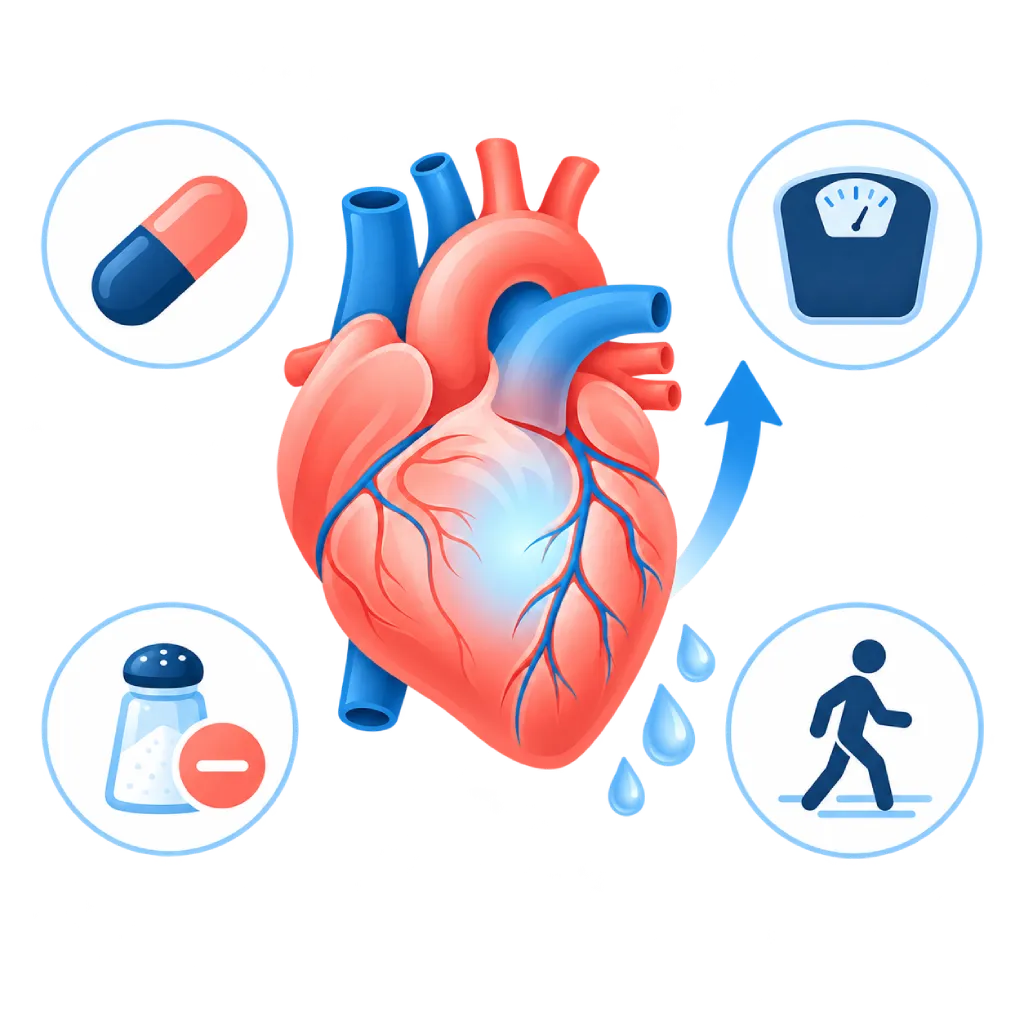
Heart failure management is long-term care to reduce symptoms, prevent hospital stays, and prolong life. It is based on a combination of medications increased step by step, self-care such as weighing yourself every day and limiting salt, cardiac rehabilitation, and devices such as CRT or an ICD in some patients.
Sources01 / Understanding the procedure
About Heart Failure Management
What Is Heart Failure Management
Heart failure is a condition in which the heart cannot pump or fill with blood well enough to meet the body's needs. Symptoms include shortness of breath, tiring easily, and swelling in the legs. Heart failure is usually chronic, but with the right treatment, many people with it can live longer, be hospitalized less often, and stay active. Heart failure management is a series of long-term treatments to reach that goal.
How It Works in Brief
When the heart's pumping weakens, the body activates hormones that retain salt and water and push the heart to work harder. In the short term this helps, but over time it actually worsens heart damage and causes fluid buildup. Heart failure medications block these hormones and reduce the heart's workload, diuretics remove excess fluid, and self-care prevents fluid from building up again.
Types of Heart Failure
The doctor assesses the ejection fraction, which is the percentage of blood pumped by the left ventricle with each beat, using echocardiography. This is covered on the Echocardiography page. Heart failure with reduced ejection fraction, meaning 40 percent or less, has many medication options that have been shown to help. Heart failure with mildly reduced (41 to 49 percent) and preserved (50 percent or more) ejection fraction also benefits from some medications, along with control of coexisting conditions.
Pillars of Treatment
- Four core medications: an ARNI or ACE inhibitor, a beta blocker, a mineralocorticoid receptor antagonist, and an SGLT2 inhibitor, started and then increased step by step to a beneficial dose. This is covered on the Integrated Medication Therapy page.
- Diuretics: remove excess fluid to relieve breathlessness and swelling; the dose is adjusted to your condition.
- Treating causes and coexisting conditions: such as coronary artery disease, valve disease, hypertension, arrhythmia, and iron deficiency, which often occurs alongside heart failure.
- Devices and procedures: CRT to synchronize the heartbeat, an ICD to prevent sudden death, and in advanced heart failure, a ventricular assist device (mechanical heart pump) or a transplant. These are covered on the Cardiac Resynchronization Therapy (CRT) and Implantable Cardioverter Defibrillator (ICD) pages.
- Self-care and rehabilitation: weighing yourself every day, limiting salt, staying physically active, and joining cardiac rehabilitation. This is covered on the Structured Cardiac Rehabilitation Program page.
Monitoring
The level of NT-proBNP in the blood helps assess the strain on the heart and the response to treatment. This is covered on the NT-proBNP and BNP Test page. Echocardiography is repeated to assess improvement in the heart's pumping after the medications reach their target doses.
02 / Understanding the procedure
When Is This Procedure Considered?
A doctor may consider this procedure in the situations below. The decision is always made after a thorough assessment.
- Newly Diagnosed Heart FailureTo start and adjust the core medications.
- After a Hospital Stay for Heart FailureThe period after discharge is a vulnerable time; early follow-up visits prevent readmission.
- Increasing Breathlessness, Fatigue, or SwellingSigns of heart failure that is not yet under control.
- Reduced Ejection Fraction on EchocardiographyEven if there are no symptoms yet.
- Cardiomyopathy or Heart Failure After a Heart AttackCauses that require specific treatment.
- Advanced Heart FailureTo assess the need for a ventricular assist device or a transplant.
Situations to Consider First
- Severe Breathlessness, Chest Pain, or FaintingThis is an emergency; go to the emergency room right away, not to a scheduled follow-up visit.
- Very Low Blood Pressure or Very Slow Heart RateMedication adjustments are made more carefully.
- Kidney Problems or High PotassiumSome medications need dose adjustments.
- Pregnant or Planning a PregnancySome heart failure medications must not be used during pregnancy.
- Taking Anti-Inflammatory Drugs or Certain Cold and Flu MedicinesThese can cause fluid retention and worsen heart failure; tell the team about all your medications.
03 / Before the procedure
How Should You Prepare?
The main preparation is bringing your health records and data.
Weight log. Weigh yourself every morning after urinating and before breakfast, then bring the record.
Medication list. Bring all your medications in their packaging, including over-the-counter medicines and herbal remedies.
Test results. Bring your echocardiography, ECG, and blood test results, and the summary of your last hospital stay if available.
Symptom notes. Notice whether your breathlessness is getting worse, you need to be propped up higher on pillows to sleep, or your legs are more swollen.
Unsure about the preparation instructions? Ask our team before the procedure.
04 / During the procedure
How Is the Procedure Done?
Each consultation visit generally takes about 30 minutes. At the start of treatment or after a hospital stay, follow-up visits are usually more frequent.
Assessing Your Condition
The doctor asks about your symptoms, checks your weight, blood pressure, pulse, breathing, and swelling, then looks for signs of fluid buildup.
Supporting Tests
Blood tests for kidney function, potassium, iron, and NT-proBNP, as well as an ECG and echocardiography if needed.
Adjusting Medications
The doses of the core medications are increased step by step, usually every 1 to 2 weeks, while monitoring blood pressure, pulse, and kidney function. Diuretics are adjusted to your weight and symptoms.
Education and Follow-Up Plan
You and your family learn about self-care, signs of worsening, and when to contact the team. If needed, the doctor refers you to cardiac rehabilitation or assesses the need for a device.
05 / Benefits and risks
Benefits and Risks Should Be Discussed Together.
Every medical procedure has benefits and risks. Your doctor will explain both for your situation before the procedure.
Benefits You Can Expect
- Living LongerThe combination of core medications has been shown to lower the death rate.
- Fewer Hospital StaysMonitoring and medication adjustments prevent worsening.
- Less Breathlessness and SwellingYour ability to be active improves.
- Heart Pumping Can ImproveIn some patients, the ejection fraction increases with treatment.
- Long-Term SupportPatients and families understand how to care for themselves.
The benefits of a procedure are not a promise of a cure. Ask how the results will affect your care plan.
Risks You Should Know
- Low Blood Pressure or DizzinessEspecially when doses are increased; doses are adjusted step by step.
- Changes in Kidney Function and PotassiumMonitored with regular blood tests.
- Dehydration from DiureticsIf you are vomiting, have diarrhea, or are drinking very little, contact your doctor about your diuretic dose.
- Urinary or Genital Tract InfectionsCan occur with SGLT2 inhibitors; good hygiene helps prevent them.
Risks can differ from person to person. A full explanation and consent are given after an individual assessment.
06 / After the procedure
What Is Recovery Like?
There is no recovery period for a consultation. The key is daily self-care.
Weigh yourself every morning. Contact your doctor if your weight goes up by more than 2 kg in 3 days, as this can signal fluid buildup.
Limit salt. Cut down on salty foods, processed foods, and flavor enhancers. Limit fluids only if your doctor advises it.
Stay active. Regular physical activity and cardiac rehabilitation improve your ability to be active and reduce hospital stays.
Vaccinations and other medications. Get vaccinated against influenza and pneumonia, and avoid anti-inflammatory pain relievers without your doctor's approval.
Warning signs to watch for. Go to the emergency room right away if you experience:
- Shortness of breath at rest, or waking up at night short of breath
- Chest pain or a very fast heartbeat
- Fainting or nearly fainting
- Coughing up pink, frothy sputum
Know the Signs That Need Prompt Care.
Follow the team's guidance on warning signs. If severe or sudden symptoms appear after the procedure, go to the nearest emergency department right away or call Heart Attack Center 1500 258.
07 / Team and support
Doctors and Procedure Support
The doctors below are listed for this procedure. Listed by name, not by ranking.

dr. Ayu Amalia U. Putri, Sp.KFR
Physical Medicine & Rehabilitation
Clinical focusCardiac Rehabilitation · Postoperative Rehabilitation
View Profile
Dr. dr. Dafsah A. Juzar, Sp.JP(K)
Interventional Cardiology
Coronary Intervention Procedures +1 center
Clinical focusComplex Coronary Intervention · Cardiac Catheterization
View Profile
dr. Siska S. Danny, Sp.JP(K)
Interventional Cardiology
Coronary Intervention Procedures
Clinical focusPCI for Acute Coronary Syndrome · Primary Coronary Intervention
View ProfileCardiovascular Intensive Care Unit (ICU)
An intensive care unit for heart and blood vessel patients who need close monitoring and prompt treatment, for example after…
The availability of technology and test support is confirmed with the team. Technology is chosen according to clinical need.
08 / Common questions
Before You Plan the Procedure.
Frequently asked questions about heart failure management. Your treatment plan is developed together with your doctor.
Does heart failure mean the heart has stopped working?
No. Heart failure means the heart does not pump or fill as well as it should, not that it stops beating. The term does sound frightening. With today's treatment, many people with heart failure can stay active, work, and live for many years. The keys are the right medications, self-care, and regular follow-up visits.
Why do I have to take so many medications?
Each core medication works on a different pathway, and their benefits add up in lowering the risk of death and hospital stays. That is why guidelines recommend starting all four core medications as early as possible unless there is a reason not to. If the side effects or the number of tablets feel burdensome, discuss it with your doctor.
How much water am I allowed to drink?
The majority of people with stable heart failure do not need to strictly limit fluids. A limit of about 1.5 to 2 liters per day is usually recommended only in severe heart failure or when blood sodium levels are low. Follow your doctor's advice and keep an eye on your daily weight.
Can people with heart failure exercise?
Yes, and it is recommended. Regular physical activity, especially through a supervised cardiac rehabilitation program, improves your ability to be active and your quality of life, and reduces hospital stays. Start slowly, for example by walking, and avoid sudden strenuous exercise before consulting your doctor. A rehabilitation program also teaches you the exercise limits that are safe for you.
Why do I need to weigh myself every day?
Rapid weight gain is often the initial sign of fluid buildup, even before you feel breathless or swollen. If your weight goes up by more than 2 kg in 3 days, contact your doctor so your diuretic dose can be adjusted before your condition worsens and requires a hospital stay.
Can a weak heart pump improve?
In some patients, yes. With the core medications at the right doses and treatment of the underlying cause, the ejection fraction can increase within a few months, and a repeat echocardiogram helps assess this improvement. Even so, the medications are usually continued, because stopping them can cause the heart's pumping to weaken again.
Sources and Medical Review
Translated from the Indonesian edition medically reviewed by Dr. dr. Dafsah A. Juzar, Sp.JP(K).
Sources as cited in the Indonesian edition.
- McDonagh TA, Metra M, Adamo M, et al. 2021 ESC Guidelines for the diagnosis and treatment of acute and chronic heart failure. Eur Heart J. 2021;42(36):3599-3726.
- McDonagh TA, Metra M, Adamo M, et al. 2023 Focused Update of the 2021 ESC Guidelines for the diagnosis and treatment of acute and chronic heart failure. Eur Heart J. 2023;44(37):3627-3639.
- Heidenreich PA, Bozkurt B, Aguilar D, et al. 2022 AHA/ACC/HFSA Guideline for the Management of Heart Failure. Circulation. 2022;145(18):e895-e1032.
- Mebazaa A, Davison B, Chioncel O, et al. Safety, tolerability and efficacy of up-titration of guideline-directed medical therapies for acute heart failure (STRONG-HF): a multinational, open-label, randomised, trial. Lancet. 2022;400(10367):1938-1952.
- Long L, Mordi IR, Bridges C, et al. Exercise-based cardiac rehabilitation for adults with heart failure. Cochrane Database Syst Rev. 2019;1:CD003331.