
Quick answer
What Is Hyperthyroidism?
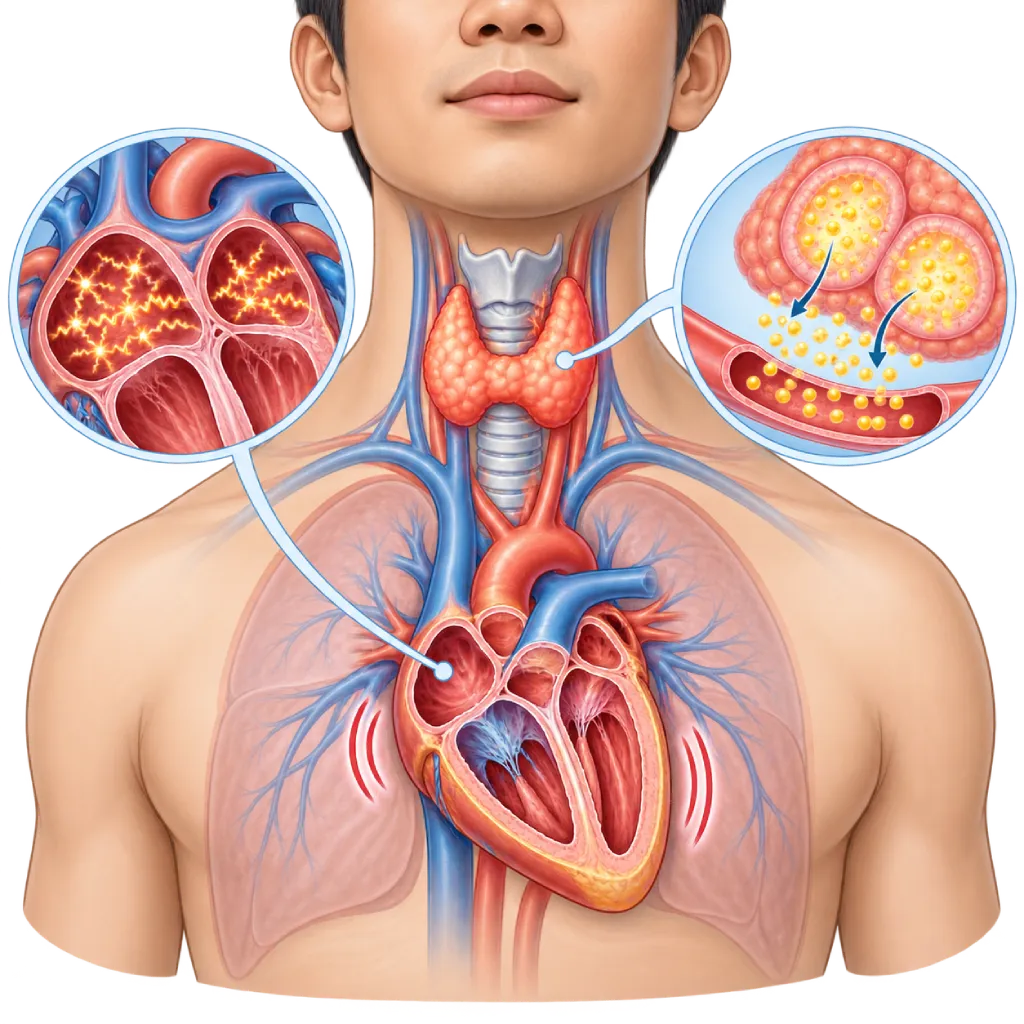
Hyperthyroidism is a condition in which the thyroid gland makes too much hormone, causing the body and the heart to work too fast. Symptoms include palpitations, shaky hands, weight loss, and sweating easily.
SourcesSigns That Need Urgent Help
- A very fast or irregular heartbeat with dizziness or near fainting
- Chest pain, or shortness of breath at rest or when lying down
- High fever with severe restlessness, confusion, or delirium
- Vomiting, severe diarrhea, or yellowing of the skin and eyes
- Sudden muscle weakness in both legs, to the point of being unable to stand
- Weakness on one side of the body, a drooping face, or slurred speech
If these signs appear, go to the nearest emergency department right away or call Heart Attack Center 1500 258.
01 / Understanding the condition
About Hyperthyroidism
Hyperthyroidism is a condition in which the thyroid gland at the front of the neck makes more thyroid hormone (T4 and T3) than the body needs. Because this hormone controls how fast cells work, an excess makes the body feel as if it is constantly being pushed: the heart beats fast, energy burns quickly, weight drops, and the body overheats easily. The term thyrotoxicosis is used for any state of excess thyroid hormone, including those that do not come from an overactive gland, for example from thyroid inflammation or taking too much thyroid hormone medicine. Hyperthyroidism belongs to the group of thyroid disorders, which is covered on the Thyroid Disorders page.
Common Causes
A frequently seen cause is Graves' disease, an autoimmune disease in which antibodies keep stimulating the thyroid gland. Graves' disease can come with eye problems, such as bulging eyes, a gritty feeling in the eyes, or double vision. Other causes are thyroid nodules that work on their own (toxic adenoma or toxic multinodular goiter), thyroid inflammation that makes stored hormone leak into the blood, excess iodine, and medicines such as amiodarone.
Effects on the Heart
Excess thyroid hormone directly affects the heart. The resting heart rate is often above 100 beats per minute, and palpitations may be felt all day. Some people, especially older adults, develop atrial fibrillation: an irregular rhythm of the upper chambers of the heart that can lead to stroke. This condition is covered on the Atrial Fibrillation page. The upper (systolic) blood pressure tends to rise, while the lower (diastolic) pressure stays the same or falls. A heart that is pushed for a long time can eventually become exhausted, leading to heart failure, and in people with coronary artery disease chest pain appears more easily.
A Controllable Condition
Hyperthyroidism can usually be controlled with antithyroid medicines, radioactive iodine therapy, or surgery. While waiting for hormone levels to fall, beta blockers help relieve palpitations and tremor. If TSH is low but FT4 and FT3 are still normal, the condition is called subclinical hyperthyroidism; your doctor weighs your age, heart condition, and bone density before deciding whether treatment is needed. Once hormone levels are normal, many people with atrial fibrillation caused by hyperthyroidism return to a normal rhythm, and the heart's pumping strength can recover. For this reason, recognizing and treating hyperthyroidism early also helps protect the heart.
02 / Understanding the condition
Symptoms to Recognize.
Common Symptoms
- Palpitations or a fast heartbeat, even at rest
- Shaky hands
- Weight loss despite an increased appetite
- Feeling hot easily and sweating a lot
- Anxiety, restlessness, irritability, or trouble sleeping
- Weak arm and thigh muscles and tiring easily
- More frequent bowel movements
- An enlarged neck or bulging eyes
Symptoms in Adult Women
- Lighter, less frequent, or stopped periods
- Difficulty getting pregnant
- Palpitations, restlessness, and weight loss within a few months after giving birth
Symptoms in Older Adults
In older adults, palpitations and tremor may not stand out; complaints are more often weakness and heart problems.
- Weakness, sluggishness, and low motivation
- Loss of weight and appetite
- An irregular pulse due to atrial fibrillation
- Shortness of breath or leg swelling due to heart failure
- Chest pain that is new or getting worse
- Confusion or trouble concentrating
03 / Understanding the condition
What Causes This Condition?
- Graves' disease: antibodies stimulate the thyroid gland to make hormone continuously
- Toxic multinodular goiter, in which several thyroid nodules make hormone on their own
- Toxic adenoma, a single overactive thyroid nodule
- Thyroiditis, an inflammation of the thyroid after a viral infection, after giving birth, or without pain, which makes hormone leak into the blood
- Excess iodine, for example from the medicine amiodarone, contrast dye, or supplements
- Taking more thyroid hormone medicine than needed
- A pituitary gland tumor that makes too much TSH (rare)
04 / Understanding the condition
Who Is at Higher Risk?
Medical
Other autoimmune diseases such as type 1 diabetes, vitiligo, or pernicious anemia, existing thyroid nodules, and use of amiodarone or iodine-containing contrast dye.
Genetic
A history of Graves' disease or autoimmune thyroiditis in a parent or sibling.
Lifestyle
Smoking increases the risk of Graves' disease and worsens Graves' eye disease. Too much iodine from supplements can trigger hyperthyroidism in a gland with nodules.
Age
Graves' disease often appears in young to middle-aged adults, while toxic multinodular goiter is more common after age 60.
Other
Women have hyperthyroidism more often than men. The first year after giving birth can also trigger thyroiditis or a relapse of Graves' disease.
Groups at Higher Risk
- Women of Childbearing Age: Graves' disease and thyroiditis after childbirth are more common in women, so palpitations after giving birth should be checked.
- Older Adults: Hyperthyroidism in older adults is often subtle, but it more easily triggers atrial fibrillation and heart failure.
- People Taking Amiodarone: This heart rhythm medicine contains a lot of iodine and can make the thyroid overactive, so thyroid function needs regular monitoring.
- People with Thyroid Nodules: Thyroid nodules can become overactive, especially after exposure to large amounts of iodine, for example from contrast dye.
- People with Heart Disease: Excess thyroid hormone can worsen existing angina, heart failure, and rhythm disorders.
05 / Understanding the condition
How Is It Diagnosed?
Your doctor asks about your symptoms, how long you have had them, the medicines and supplements you take, your pregnancy history, and your family history, then checks your pulse, blood pressure, neck, eyes, skin, and any tremor in your hands. The diagnosis is confirmed with blood tests: a low TSH with a high FT4 or FT3 indicates hyperthyroidism.
The next step is to find the cause, because Graves' disease, overactive nodules, and thyroiditis are treated differently. A TRAb antibody test, a thyroid ultrasound, and a thyroid scan help tell them apart. At the same time, the heart is assessed with an ECG, rhythm monitoring if palpitations come and go, and echocardiography if there is shortness of breath or atrial fibrillation. In atrial fibrillation, your doctor also calculates the stroke risk to decide whether blood thinners (anticoagulants) are needed.
Thyroid Function Test
Blood tests for TSH, FT4, and FT3. A low TSH with a high FT4 or FT3 confirms hyperthyroidism; a low TSH with normal FT4 and FT3 is called subclinical hyperthyroidism.
A TSH receptor antibody test (TRAb) to confirm Graves' disease.
A thyroid ultrasound with Doppler to assess the size of the gland, its blood flow, and any nodules.
A nuclear medicine thyroid scan to distinguish Graves' disease, overactive nodules, and thyroiditis. This test is not done during pregnancy or breastfeeding.
Electrocardiogram (ECG)
An ECG to look for a fast heart rate, atrial fibrillation, or other rhythm disorders.
Holter Monitoring
Rhythm recording for 24 to 48 hours when palpitations come and go, to capture rhythm disorders that a standard ECG does not record.
Echocardiography
Echocardiography to assess pumping strength, the size of the upper chambers, and lung pressure when there is atrial fibrillation, shortness of breath, or signs of heart failure.
06 / Understanding the condition
Treatment Options.
Treatment is decided by a doctor after an assessment. The categories below can help you follow the conversation with your doctor.
Beta Blockers
Relieve palpitations, tremor, and restlessness by slowing the heart rate while other treatments lower hormone levels. Your doctor chooses the medicine based on the condition of your heart and lungs.
Antithyroid Medicines
Medicines of the thionamide class suppress thyroid hormone production. In Graves' disease they are usually taken for 12 to 18 months with regular blood tests. Contact your doctor the same day if you develop a fever or sore throat.
Radioactive Iodine Therapy
A capsule or liquid containing radioactive iodine is swallowed to shrink overactive thyroid tissue. Afterward, hypothyroidism often develops and is treated with replacement hormone. It is not given during pregnancy or breastfeeding.
Thyroid Surgery
Removal of part or all of the gland, considered for a large goiter, a suspicious nodule, moderate to severe Graves' eye disease, or when medicines are not suitable.
Rhythm Treatment and Stroke Prevention
In atrial fibrillation, the cardiologist controls the heart rate and assesses the need for blood thinners. If the rhythm does not return to normal after hormone levels are controlled, cardioversion or ablation may be considered.
07 / Understanding the condition
Complications to Watch For.
Atrial Fibrillation
An irregular rhythm of the upper chambers, more common in older adults. Many cases return to a normal rhythm once hormone levels are controlled, but some persist and need rhythm treatment.
Stroke
Blood clots can form in the upper chambers during atrial fibrillation and travel to the brain. Your doctor assesses this risk to decide whether blood thinners are needed.
Heart Failure
A heartbeat that stays fast wears out the heart muscle. The heart's pumping often improves once hormone levels are normal and the heart rate is controlled.
Thyroid Storm
An extreme surge of hormone, usually triggered by infection, surgery, childbirth, or suddenly stopping antithyroid medicine. It is marked by high fever, a very fast heartbeat, and severe restlessness, and it needs intensive care.
Bone Loss
Excess hormone over a long time speeds up the loss of bone density, especially in women after menopause, so bones break more easily.
Graves' Eye Disease
Inflammation of the tissue behind the eyeball that makes the eyes bulge, turn red, or water, or causes double vision. Smoking makes this condition worse.
Thyrotoxic Periodic Paralysis
Sudden attacks of muscle weakness due to low blood potassium, more common in Asian men. Low potassium can also disturb the heart rhythm.
08 / Understanding the condition
What Can You Do?
- Do not take iodine supplements, seaweed capsules, or glandular supplements without your doctor's advice
- Quit smoking to lower the risk of Graves' disease and protect your eyes
- If you take thyroid hormone medicine, follow the dose from your doctor and check your TSH regularly
- Tell your doctor about any thyroid nodules before a test with contrast dye
- Have your thyroid function checked regularly if you take amiodarone
- Do not stop antithyroid medicine on your own, because this can trigger a relapse or a thyroid storm
- Get checked if you have palpitations and weight loss within a year after giving birth
09 / Understanding the condition
When Should You See a Doctor?
Make an appointment with a doctor if you have several of the following complaints for more than two weeks, or if they interfere with your activities.
- Palpitations or a heartbeat that feels fast at rest
- Weight loss without dieting
- Shaky hands, sweating easily, and trouble sleeping
- A lump or swelling in the neck
- Bulging eyes, a gritty feeling in the eyes, or double vision
- Fever or sore throat while taking antithyroid medicine: contact your doctor the same day
Go to the emergency room right away if you have a very fast heartbeat with chest pain, shortness of breath, or near fainting, a high fever with restlessness or confusion, or if you suddenly cannot move your legs.
Don't Wait in an Emergency.
If symptoms are severe or come on suddenly, go to the nearest emergency department right away or call Heart Attack Center 1500 258, rather than waiting for an appointment.
10 / Common questions
Questions You May Have.
Frequently asked questions about hyperthyroidism and its effects on the heart.
Can hyperthyroidism cause atrial fibrillation?
Yes. Excess thyroid hormone makes the upper chambers of the heart prone to an irregular rhythm, especially in older adults and people who already have heart disease. For this reason, thyroid function is checked in every newly found case of atrial fibrillation. Once hormone levels are normal, many people return to a normal rhythm within a few months. In the meantime, your doctor assesses the stroke risk and the need for blood thinners.
Will the palpitations go away after the thyroid is treated?
For most people, yes. Beta blockers usually relieve palpitations within a few days, while antithyroid medicines lower hormone levels within a few weeks. If palpitations continue after hormone levels are normal, the cardiologist will look for another rhythm disorder with an ECG or rhythm recording over several days, because the cause may not be the thyroid alone.
How do I choose between medicines, radioactive iodine, and surgery?
No single option suits everyone. Antithyroid medicines are often tried first in Graves' disease and can put the disease into remission. Radioactive iodine and surgery give more permanent results, but they usually mean you will need replacement hormone for life. Your doctor considers the cause, your age, the size of the goiter, the condition of your eyes, any pregnancy plans, and your preferences.
Can hyperthyroidism come back?
Yes, especially in Graves' disease. About half of people with Graves' disease relapse after antithyroid medicine is stopped, usually within the first one to two years. The risk of relapse is higher with a large goiter, high TRAb antibody levels, and in smokers. For this reason, blood tests continue regularly after treatment ends, and palpitations that return should be checked promptly.
Is it okay to exercise while hyperthyroidism is not yet controlled?
It is better to postpone strenuous exercise until your heart rate and hormone levels are under control, because your heart is already working harder than usual. Light activity such as leisurely walking is usually fine as long as it does not cause strong palpitations, chest pain, or shortness of breath. Ask your doctor when you can return to your usual exercise.
What if hyperthyroidism occurs during pregnancy?
Hyperthyroidism during pregnancy needs to be managed together by an internal medicine specialist and an obstetrician. The choice of antithyroid medicine is adjusted to the stage of pregnancy, and radioactive iodine must not be given. Severe nausea and vomiting in early pregnancy sometimes raise thyroid hormone levels temporarily without any thyroid disease. If you have a history of Graves' disease and are planning a pregnancy, consult your doctor first.
Sources and Medical Review
Translated from the Indonesian edition medically reviewed by dr. Debby C. Soemitha, Sp.PD.
Sources as cited in the Indonesian edition.
- Ross DS, Burch HB, Cooper DS, Greenlee MC, Laurberg P, Maia AL, et al. 2016 American Thyroid Association guidelines for diagnosis and management of hyperthyroidism and other causes of thyrotoxicosis. Thyroid. 2016;26(10):1343-421.
- Kahaly GJ, Bartalena L, Hegedüs L, Leenhardt L, Poppe K, Pearce SH. 2018 European Thyroid Association guideline for the management of Graves' hyperthyroidism. Eur Thyroid J. 2018;7(4):167-86.
- Wiersinga WM, Poppe KG, Effraimidis G. Hyperthyroidism: aetiology, pathogenesis, diagnosis, management, complications, and prognosis. Lancet Diabetes Endocrinol. 2023;11(4):282-98.
- Lee SY, Pearce EN. Hyperthyroidism: a review. JAMA. 2023;330(15):1472-83.
- Van Gelder IC, Rienstra M, Bunting KV, Casado-Arroyo R, Caso V, Crijns HJGM, et al. 2024 ESC Guidelines for the management of atrial fibrillation developed in collaboration with the European Association for Cardio-Thoracic Surgery (EACTS). Eur Heart J. 2024;45(36):3314-414.
- Razvi S, Jabbar A, Pingitore A, Danzi S, Biondi B, Klein I, et al. Thyroid hormones and cardiovascular function and diseases. J Am Coll Cardiol. 2018;71(16):1781-96.
Doctors Who Treat This Condition

dr. Debby C. Soemitha, Sp.PD
Internal Medicine
Clinical focusDiabetes and Diabetes Complications · Obesity and Metabolic Disease
View Profile
dr. Sunu B. Raharjo, Sp.JP(K), Ph.D.
Arrhythmia and Electrophysiology
Arrhythmia and Device Center
Clinical focusClinical and Interventional Electrophysiology · Cardiac Arrhythmia Ablation
View Profile
dr. Siska S. Danny, Sp.JP(K)
Interventional Cardiology
Coronary Intervention Procedures
Clinical focusPCI for Acute Coronary Syndrome · Primary Coronary Intervention
View Profile