
Quick answer
What Is Thyroid Disorders?
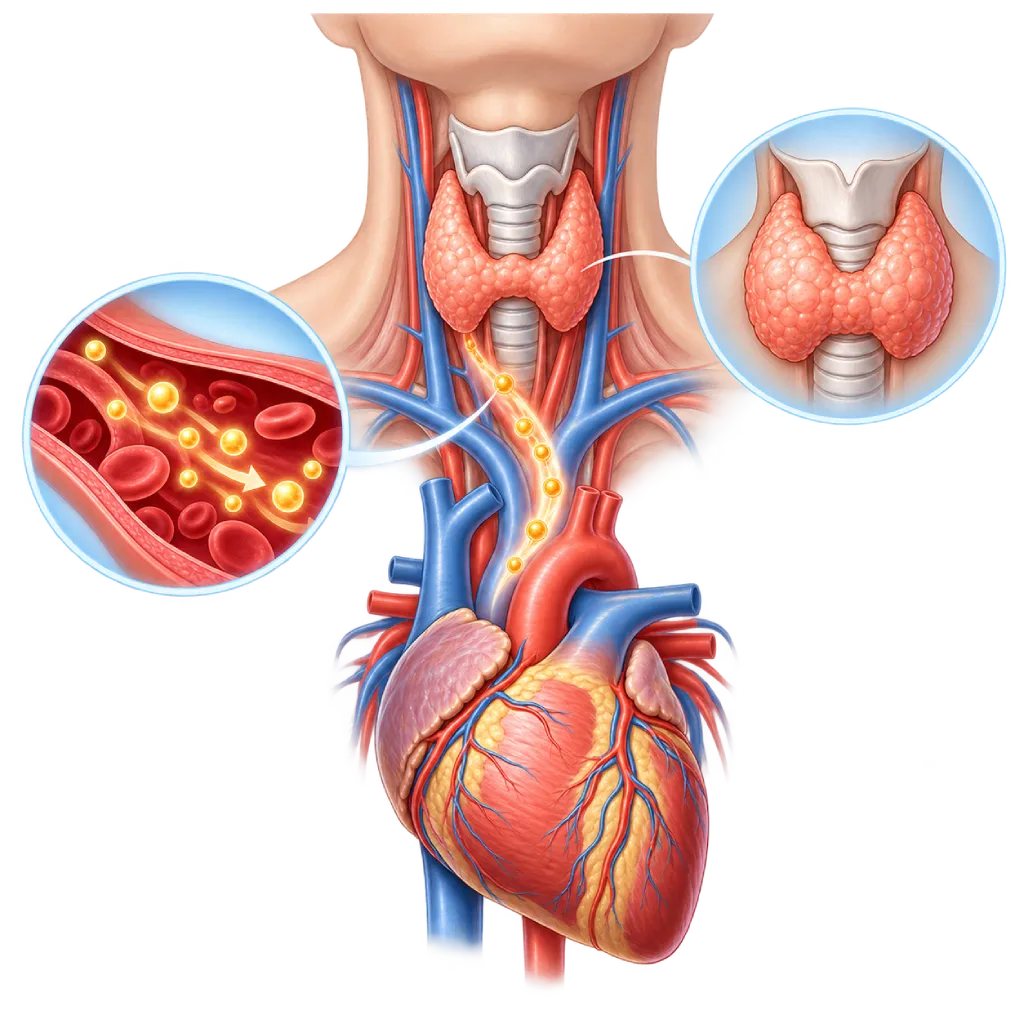
Thyroid disorders are problems with the thyroid gland in the neck: it makes too much or too little hormone, or the gland becomes enlarged and lumpy. Thyroid hormone helps regulate the rate, rhythm, and pumping action of the heart.
SourcesSigns That Need Urgent Help
- A very fast or irregular heartbeat with dizziness or weakness
- Chest pain, or shortness of breath at rest
- High fever with severe restlessness, confusion, vomiting, or diarrhea
- Extreme sleepiness to the point of being hard to wake, with the body feeling very cold
- Fainting or nearly fainting
- Sudden muscle weakness to the point of being unable to stand
If these signs appear, go to the nearest emergency department right away or call Heart Attack Center 1500 258.
01 / Understanding the condition
About Thyroid Disorders
The thyroid is a small, butterfly-shaped gland at the front of the neck, just below the Adam's apple. It makes thyroid hormones, mainly thyroxine (T4) and triiodothyronine (T3), which set the working pace of almost every cell in the body: energy use, body temperature, body weight, digestion, and even the heart rate. Their production is controlled by TSH (thyroid stimulating hormone), a regulating hormone from the pituitary gland in the brain.
Types of Thyroid Disorders
Thyroid disorders are grouped by how the gland works and by its shape. When there is too much hormone, the body works too fast, which is covered on the Hyperthyroidism page. When there is too little hormone, the body slows down, which is covered on the Hypothyroidism page. There are also goiter (an enlarged gland), thyroid lumps or nodules, inflammation of the gland (thyroiditis), and thyroid cancer. Changes in shape do not always come with changes in hormone levels.
How the Thyroid Affects the Heart
The heart is sensitive to changes in thyroid hormone, because this hormone affects the heart rate, the strength of the heart muscle, and the flexibility of the blood vessels. When there is too much hormone, the heart beats fast and works harder. Some people develop atrial fibrillation, an irregular rhythm of the upper heart chambers, which is covered on the Atrial Fibrillation page. The upper (systolic) blood pressure can rise, and heart failure can develop in a heart that is already weak.
When there is too little hormone, the heart rate slows and the heart's pumping weakens. LDL cholesterol tends to rise, the lower (diastolic) blood pressure can increase, and fluid sometimes collects in the sac around the heart. That is why cardiologists often check thyroid function in people with atrial fibrillation, heart failure, or high cholesterol without a clear cause.
Common Causes
Many thyroid disorders come from an autoimmune process, in which the immune system mistakenly attacks the thyroid gland. Graves' disease drives the gland to overwork, while Hashimoto's thyroiditis slowly damages the gland so that hormone levels fall. Too little or too much iodine, certain medicines such as amiodarone and lithium, and a history of neck surgery or radiation to the neck can also play a role.
Symptoms of thyroid disorders often appear gradually and resemble other complaints, such as tiredness, stress, or aging. A simple blood test can confirm the diagnosis, and the majority of thyroid function disorders can be controlled with regular treatment.
02 / Understanding the condition
Types and Related Conditions
The following conditions belong to the Thyroid Disorders group. Open each one for a full explanation.
03 / Understanding the condition
Symptoms to Recognize.
Common Symptoms
- A pounding heart and a heartbeat that feels fast, or instead slow
- Tiring easily and feeling weak for no clear reason
- Weight loss or weight gain without a change in eating habits
- Not tolerating heat and sweating a lot, or the opposite, feeling cold easily
- A lump or swelling at the front of the neck
- Anxiety, irritability, or low mood
- Menstrual periods that become irregular, lighter, or heavier
- Dry skin, hair loss, or thinning hair
Symptoms in Older Adults
In older adults, symptoms are often vague and easily mistaken for signs of aging.
- Weakness, sleepiness, or low energy
- Forgetfulness, difficulty concentrating, or appearing confused
- An irregular heartbeat that is only found during a checkup
- Shortness of breath or leg swelling that is new or getting worse
- Loss of weight and appetite
04 / Understanding the condition
What Causes This Condition?
- Autoimmune disease, in which the immune system attacks the thyroid gland, such as Graves' disease and Hashimoto's thyroiditis
- Thyroid lumps or nodules that make too much hormone
- Inflammation of the thyroid gland (thyroiditis), for example after a viral infection or after giving birth
- Too little iodine in the diet, or too much iodine intake
- Certain medicines, such as amiodarone (a heart rhythm medicine), lithium, and some cancer medicines
- Surgery to remove the thyroid, radioactive iodine therapy, or radiation to the neck area
- A disorder of the pituitary gland in the brain, which regulates the thyroid (rare)
05 / Understanding the condition
Who Is at Higher Risk?
Medical
Other autoimmune diseases, such as type 1 diabetes, vitiligo, rheumatoid arthritis, or lupus, increase the likelihood of a thyroid disorder. Use of amiodarone or lithium and a history of radiation to the neck also add to the risk.
Genetic
A history of thyroid disorders in a parent or sibling, especially Graves' disease or Hashimoto's thyroiditis.
Lifestyle
Smoking increases the risk of Graves' disease and worsens the eye problems caused by Graves' disease. Too little iodine intake, or excessive iodine supplements, can also disrupt how the gland works.
Age
The risk of thyroid disorders increases with age, especially after 60, when the symptoms also become more vague.
Other
Women have thyroid disorders several times more often than men. Pregnancy and the first year after giving birth can trigger changes in thyroid function.
Groups at Higher Risk
- Women of Childbearing Age: Thyroid disorders are more common in women. Thyroid inflammation after giving birth can make hormone levels rise and then fall over a few months.
- Older Adults: Symptoms are often vague, even though the effects on heart rhythm and pumping are greater. A TSH test helps when new symptoms appear.
- People with Autoimmune Diseases: People with type 1 diabetes, vitiligo, or other autoimmune diseases are more prone to autoimmune thyroiditis.
- People Taking Amiodarone or Lithium: Both medicines can make the thyroid overactive or underactive, so thyroid function is usually checked regularly.
- People with Heart Disease: People with atrial fibrillation, heart failure, or high cholesterol need their thyroid function checked, because a thyroid disorder can be a trigger or make the condition worse.
06 / Understanding the condition
How Is It Diagnosed?
Diagnosis starts with questions about your symptoms, the medicines and supplements you take, your pregnancy history, and your family history, followed by a physical examination of the neck, pulse, and blood pressure. Because the symptoms resemble many other conditions, certainty comes from a blood test. TSH is the first test: a low TSH with a high FT4 points to hyperthyroidism, while a high TSH with a low FT4 points to hypothyroidism. If TSH is abnormal but FT4 is still normal, the condition is called subclinical, and the doctor usually repeats the test within a few months before deciding on treatment.
Antibody tests, thyroid ultrasound, and a thyroid scan help find the cause. If there are heart symptoms, the doctor adds an ECG, a heart rhythm recording over several days, echocardiography, and a cholesterol test to assess the effects on the heart and blood vessels.
Physical Examination
The doctor feels the neck to assess the size of the thyroid and any lumps, counts the pulse, measures blood pressure, and checks the skin, eyes, and reflexes.
Thyroid Function Test
A TSH blood test as the first step, followed by FT4 and, if needed, FT3, to determine whether the thyroid is overactive or underactive.
Thyroid antibody tests, such as anti-TPO and TSH receptor antibodies (TRAb), to look for an autoimmune cause such as Hashimoto's thyroiditis or Graves' disease.
Thyroid ultrasound to see the size of the gland and any lumps; if needed, followed by a nuclear medicine thyroid scan or a fine-needle biopsy of a nodule.
Electrocardiogram (ECG)
An ECG recording to detect a heartbeat that is too fast or too slow, or atrial fibrillation caused by a thyroid disorder.
Echocardiography
A heart ultrasound to assess pumping strength, the size of the heart chambers, and fluid in the sac around the heart when there are heart symptoms.
Cholesterol and Lipid Profile Screening
A cholesterol test, because an underactive thyroid can raise LDL cholesterol and triglycerides.
07 / Understanding the condition
Treatment Options.
Treatment is decided by a doctor after an assessment. The categories below can help you follow the conversation with your doctor.
Antithyroid Medicines
Thionamide medicines reduce hormone production in an overactive thyroid. Your doctor decides the type of medicine and the length of treatment, and monitors for side effects.
Radioactive Iodine Therapy
Radioactive iodine taken by mouth shrinks overactive thyroid tissue. Afterward, many people need thyroid hormone replacement for life.
Thyroid Surgery
Removal of part or all of the gland is considered for a large goiter pressing on the airway, a suspicious nodule, or when medicines are not suitable.
Thyroid Hormone Replacement
For an underactive thyroid, synthetic thyroid hormone tablets (levothyroxine) replace the missing hormone. Your doctor adjusts the dose based on regular TSH results.
Managing the Effects on the Heart
Beta blockers to ease palpitations, rhythm control, blood thinners when the stroke risk is high, and control of blood pressure and cholesterol, as assessed by a cardiologist.
08 / Understanding the condition
Complications to Watch For.
Atrial Fibrillation and Stroke
Too much thyroid hormone can trigger an irregular rhythm in the upper chambers. A blood clot can form in the upper chamber, travel to the brain, and cause a stroke.
Heart Failure
Both too much and too little hormone can weaken the heart's pumping, especially in older adults or people who already have heart disease.
High Cholesterol and Atherosclerosis
An underactive thyroid raises LDL cholesterol, which over time can speed up plaque buildup in the blood vessels.
High Blood Pressure
Too much hormone tends to raise the upper (systolic) blood pressure, while too little hormone can raise the lower (diastolic) blood pressure.
Thyroid Storm and Myxedema Coma
Rare emergencies: an extreme surge of hormone in thyroid storm, or a severe shortage of hormone in myxedema coma. Both need treatment in the emergency room.
Bone Loss
Too much thyroid hormone over a long period, including thyroid hormone medicine beyond what the body needs, speeds up the loss of bone density.
Pregnancy Complications
Uncontrolled hormone levels during pregnancy are associated with miscarriage, premature birth, and problems with the baby's growth and development.
09 / Understanding the condition
What Can You Do?
- Use iodized salt for cooking, in reasonable amounts in line with advice to limit salt
- Do not take iodine supplements or gland supplements without your doctor's advice
- Quit smoking, especially if Graves' disease runs in your family
- Have your thyroid function checked before pregnancy if you have a history of thyroid disorders
- Take your thyroid medicine on schedule and have follow-up blood tests as your doctor advises
- Ask whether you need regular thyroid checks if you take amiodarone or lithium
- Bring your thyroid test results when you see your cardiologist
10 / Understanding the condition
When Should You See a Doctor?
See a doctor if the following symptoms last for several weeks or become more bothersome. A simple blood test can show whether your thyroid plays a role.
- A pounding heart, a heartbeat that feels fast or irregular, or a slow heartbeat with weakness
- Weight changes with no clear cause
- A lump or swelling in the neck
- Always feeling hotter or colder than other people
- Irregular periods or difficulty getting pregnant
- Cholesterol or blood pressure rising with no clear cause
Go to the emergency room right away if your heartbeat is very fast with chest pain, shortness of breath, or fainting, if you have a high fever with severe restlessness, or if you are so sleepy that you are hard to wake.
Don't Wait in an Emergency.
If symptoms are severe or come on suddenly, go to the nearest emergency department right away or call Heart Attack Center 1500 258, rather than waiting for an appointment.
11 / Common questions
Questions You May Have.
Frequently asked questions about thyroid disorders and their effects on the heart.
Can thyroid disorders cause heart disease?
Yes. Thyroid hormone regulates the rate and strength of the heart. Too much hormone can trigger a fast heartbeat, atrial fibrillation, high upper blood pressure, and heart failure. Too little hormone can slow the heartbeat, raise LDL cholesterol, and cause fluid in the sac around the heart. Many of these changes improve once hormone levels return to normal, so a thyroid check is often part of a heart evaluation.
What is the difference between a goiter and a thyroid function disorder?
A goiter is an enlargement of the thyroid gland that can be seen or felt in the neck. A goiter can come with normal, high, or low hormone levels. On the other hand, a thyroid function disorder can occur without any neck swelling at all. That is why doctors assess the shape of the gland by feeling it and with ultrasound, and assess its function with TSH and FT4 blood tests.
Can thyroid disorders be cured?
It depends on the cause. Thyroid inflammation after an infection or after giving birth often gets better on its own within a few months. Graves' disease can go into remission after treatment with antithyroid medicines, although some people relapse. Hashimoto's thyroiditis usually persists, but it can be controlled with daily thyroid hormone replacement. With regular treatment and checkups, most people can go about their activities as usual.
Should people with heart disease have their thyroid function checked?
Thyroid function testing is recommended for newly diagnosed atrial fibrillation, heart failure, high cholesterol without a clear cause, and before and during amiodarone use. A thyroid disorder can be a trigger that can be corrected, so that heart treatment becomes more effective. Your doctor will decide when the test is needed and how often it should be repeated.
Are there foods I should avoid?
In general, there are no special food restrictions. Use iodized salt in moderation and avoid iodine supplements without your doctor's advice, because too much iodine can also disrupt the thyroid. If you take thyroid hormone replacement, space it apart from calcium supplements, iron supplements, and soy milk, because they can reduce how well the medicine is absorbed. Ask your doctor about the timing.
Do thyroid disorders affect pregnancy?
Yes. During pregnancy, the baby depends on thyroid hormone from the mother's body, especially for brain development in early pregnancy. Levels that are too high or too low are associated with miscarriage, premature birth, and high blood pressure during pregnancy. If you have a thyroid disorder and are planning a pregnancy, talk to your doctor first so your medicine can be adjusted from the start.
Sources and Medical Review
Translated from the Indonesian edition medically reviewed by dr. Debby C. Soemitha, Sp.PD.
Sources as cited in the Indonesian edition.
- Razvi S, Jabbar A, Pingitore A, Danzi S, Biondi B, Klein I, et al. Thyroid hormones and cardiovascular function and diseases. J Am Coll Cardiol. 2018;71(16):1781-96.
- Taylor PN, Albrecht D, Scholz A, Gutierrez-Buey G, Lazarus JH, Dayan CM, et al. Global epidemiology of hyperthyroidism and hypothyroidism. Nat Rev Endocrinol. 2018;14(5):301-16.
- Ross DS, Burch HB, Cooper DS, Greenlee MC, Laurberg P, Maia AL, et al. 2016 American Thyroid Association guidelines for diagnosis and management of hyperthyroidism and other causes of thyrotoxicosis. Thyroid. 2016;26(10):1343-421.
- Jonklaas J, Bianco AC, Bauer AJ, Burman KD, Cappola AR, Celi FS, et al. Guidelines for the treatment of hypothyroidism: prepared by the American Thyroid Association Task Force on Thyroid Hormone Replacement. Thyroid. 2014;24(12):1670-751.
- Cappola AR, Desai AS, Medici M, Cooper LS, Egan D, Sopko G, et al. Thyroid and cardiovascular disease: research agenda for enhancing knowledge, prevention, and treatment. Circulation. 2019;139(25):2892-909.
- Alexander EK, Pearce EN, Brent GA, Brown RS, Chen H, Dosiou C, et al. 2017 Guidelines of the American Thyroid Association for the diagnosis and management of thyroid disease during pregnancy and the postpartum. Thyroid. 2017;27(3):315-89.
Doctors Who Treat This Condition

dr. Debby C. Soemitha, Sp.PD
Internal Medicine
Clinical focusDiabetes and Diabetes Complications · Obesity and Metabolic Disease
View Profile
dr. Sunu B. Raharjo, Sp.JP(K), Ph.D.
Arrhythmia and Electrophysiology
Arrhythmia and Device Center
Clinical focusClinical and Interventional Electrophysiology · Cardiac Arrhythmia Ablation
View Profile
dr. Siska S. Danny, Sp.JP(K)
Interventional Cardiology
Coronary Intervention Procedures
Clinical focusPCI for Acute Coronary Syndrome · Primary Coronary Intervention
View Profile