
Quick answer
What Is Heart Failure with Mildly Reduced Ejection Fraction?
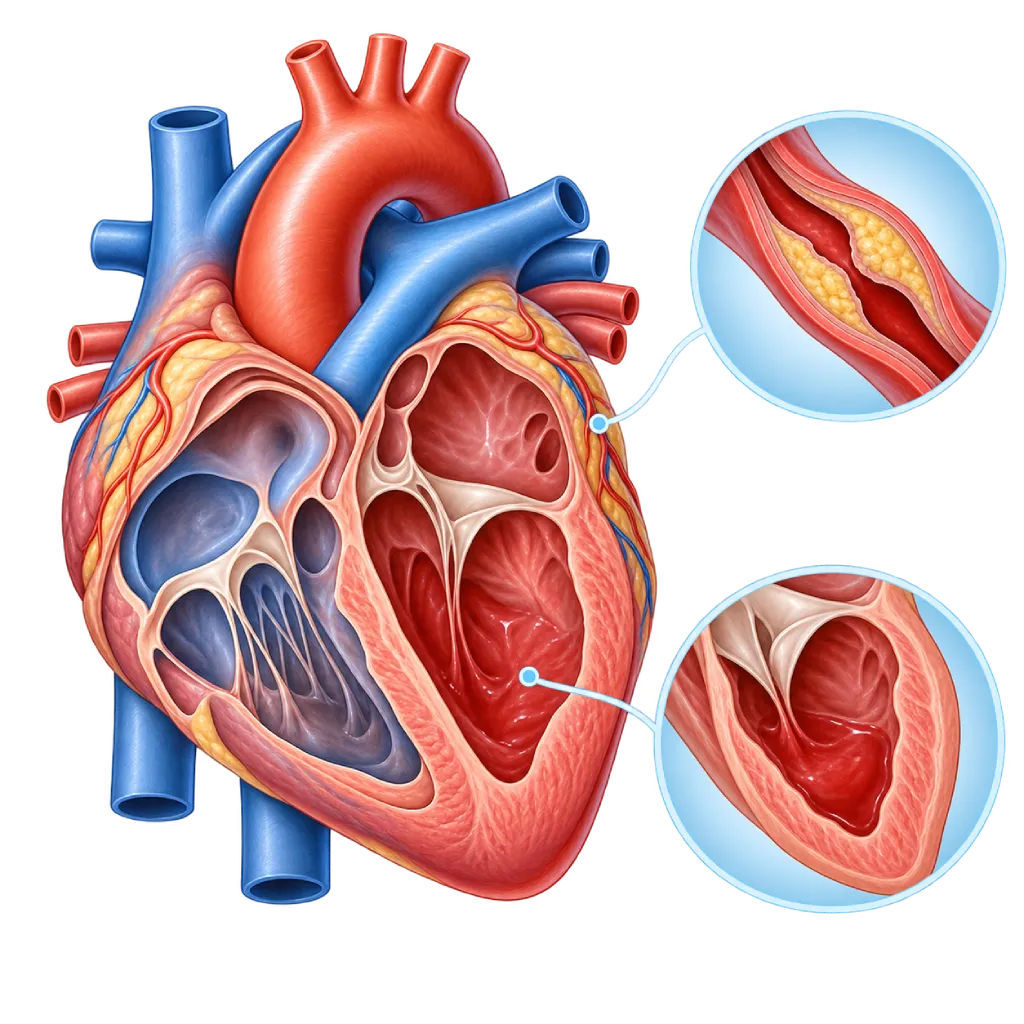
Heart failure with mildly reduced ejection fraction is heart failure with an ejection fraction of 41 to 49%: the left ventricle's pumping is slightly reduced, between the reduced and preserved types. Before the 2021 ESC guidelines, this type was called heart failure with mid-range ejection fraction.
SourcesSigns That Need Urgent Help
- Severe shortness of breath at rest or being unable to lie down
- Frothy white or pink sputum
- Chest pain that does not go away with rest
- Fainting or nearly fainting
- A very fast pulse with dizziness or severe weakness
- Cold, pale skin or bluish lips
If these signs appear, go to the nearest emergency department right away or call Heart Attack Center 1500 258.
01 / Understanding the condition
About Heart Failure with Mildly Reduced Ejection Fraction
Heart failure with mildly reduced ejection fraction is a type of heart failure with a left ventricular ejection fraction of 41 to 49%. Ejection fraction is the percentage of blood in the left ventricle that is pumped out each time the heart beats; in a healthy heart, it is usually 50% or higher. A value of 41 to 49% lies between heart failure with reduced ejection fraction (40% or lower) and heart failure with preserved ejection fraction (50% or higher). The heart's pumping strength is already reduced, but not as low as in the reduced type.
This type used to be called mid-range, meaning in the middle range. Since the 2021 ESC guidelines and the universal definition of heart failure, it has been called mildly reduced. This name change reflects findings that this type is more similar to reduced ejection fraction, including in its response to some medicines.
Features and Causes
As with the reduced type, coronary artery disease is a common cause, and this type is found more often in men. Other causes include long-standing hypertension, valve disease, atrial fibrillation, and cardiomyopathy. The symptoms are the same as in other types of heart failure: shortness of breath, tiring easily, and swelling in the legs. The diagnosis becomes stronger when there is evidence of structural heart changes, such as an enlarged left atrium or a thickened ventricular wall.
An Ejection Fraction That Can Change
The ejection fraction in this type often changes over time. Some people previously had an ejection fraction of 40% or lower that then improved with treatment, a state called improved ejection fraction. Others instead drop into the reduced group, for example after a new heart attack. For this reason, your doctor repeats echocardiography regularly, and the history of your ejection fraction values also helps determine the choice of medicines.
Treatment Approach
The 2023 ESC guideline update recommends SGLT2 inhibitors for this type, based on the DELIVER and EMPEROR-Preserved trials, because they reduce the combined outcome of hospitalization for heart failure and cardiovascular death. Diuretics are used to relieve fluid congestion. Medicines used in reduced ejection fraction, such as beta blockers, ACE inhibitors, ARBs, ARNIs, and MRAs, may be considered by your doctor depending on your situation. The underlying cause and coexisting conditions are also treated, because both affect how the disease progresses.
02 / Understanding the condition
Symptoms to Recognize.
Common Symptoms
- Shortness of breath during activities that used to feel light
- Tiring easily and reduced stamina
- Swelling in the ankles or legs
- Shortness of breath when lying down, or waking at night because of breathlessness
- Rapid weight gain due to fluid buildup
- A pounding heart or an irregular pulse
03 / Understanding the condition
What Causes This Condition?
- Coronary artery disease, including damage from a past heart attack
- Long-standing hypertension that thickens the heart muscle and makes it work harder
- Heart valve disease
- Atrial fibrillation or other rhythm disorders
- Cardiomyopathy, including inherited forms
- A shift from another type: an ejection fraction that has improved after treatment, or one that is slowly declining
04 / Understanding the condition
Who Is at Higher Risk?
Medical
Coronary artery disease, hypertension, diabetes, atrial fibrillation, and chronic kidney disease often accompany this type.
Lifestyle
Smoking, excess weight, lack of physical activity, excessive alcohol, and high-salt foods add to the heart's workload.
Age
The risk of heart failure, including this type, increases with age, especially after 65.
Other
Men develop this type more often than women, similar to heart failure with reduced ejection fraction.
Groups at Higher Risk
- Heart Attack Survivors: Damage from a heart attack can partly reduce the ejection fraction, so repeat echocardiography is needed after recovery.
- People with Hypertension and Diabetes: Blood pressure and blood sugar that stay uncontrolled for a long time slowly damage the heart muscle.
- People with Heart Failure Whose Ejection Fraction Has Improved: Those whose ejection fraction has risen from 40% or lower still need medicines and monitoring because the value can drop again.
05 / Understanding the condition
How Is It Diagnosed?
The first steps are the same as for other types of heart failure: questions about your symptoms, a physical examination, an ECG, and an NT-proBNP or BNP test. Echocardiography determines the ejection fraction. If the value is 41 to 49%, your doctor also looks for signs of structural heart changes, such as an enlarged left atrium or a thickened wall, and reviews previous echocardiography results to see which way the ejection fraction is moving: improving or declining.
Because coronary artery disease is often the cause, your doctor may recommend CT coronary angiography, a stress test, or coronary angiography. Cardiac MRI helps assess scar tissue and other causes. Echocardiography is repeated after treatment has been underway for a few months or if your symptoms change.
Echocardiography
Measures the ejection fraction, left atrial size, wall thickness, and valve function. Repeated regularly because the ejection fraction can change.
NT-proBNP and BNP Test
High levels support a diagnosis of heart failure and help monitor how the disease progresses.
Electrocardiogram (ECG)
Looks for damage from a past heart attack, atrial fibrillation, and signs of thickening of the heart muscle.
CT Coronary Angiography
Shows narrowing of the coronary arteries without a catheter when coronary artery disease is suspected as the cause.
Coronary Angiography
Performed when the likelihood of coronary disease is high or when a procedure to open an artery is needed.
Cardiac MRI
Assesses scar tissue, inflammation, or other heart muscle diseases when the cause is not yet clear.
06 / Understanding the condition
Treatment Options.
Treatment is decided by a doctor after an assessment. The categories below can help you follow the conversation with your doctor.
SGLT2 Inhibitors
Recommended by the 2023 ESC guideline update to reduce hospitalization for heart failure and cardiovascular death. Your doctor assesses your kidney function and whether this medicine suits you.
Diuretics
Water pills that relieve shortness of breath and swelling when there is fluid congestion.
Other Medicines as Needed
Beta blockers, ACE inhibitors, ARBs, ARNIs, or MRAs may be considered, especially if the ejection fraction is close to 40% or has been lower before.
Treating the Cause
Revascularization when suitable coronary disease is present, blood pressure control, treatment of atrial fibrillation, and valve repair if needed.
Rehabilitation and Self-Care
Supervised exercise, salt restriction, daily weighing, and regular checkups.
07 / Understanding the condition
Complications to Watch For.
Declining Ejection Fraction
Some people move into the reduced ejection fraction type, especially if a new heart attack occurs or the cause is not treated.
Acute Worsening and Hospitalization
Symptoms can worsen quickly and require hospital care, covered on the Acute Heart Failure page.
Atrial Fibrillation and Stroke
An enlarged left atrium makes atrial fibrillation more likely, which worsens symptoms and increases the risk of stroke.
Reduced Kidney Function
The heart and kidneys affect each other, so kidney function and potassium are monitored, especially when medicines are started or changed.
08 / Understanding the condition
What Can You Do?
- Take your medicines as prescribed and do not stop them even if you feel better.
- Have repeat echocardiography as scheduled by your doctor.
- Control your blood pressure, blood sugar, and cholesterol.
- Limit salt and alcohol, and stop smoking.
- Weigh yourself every morning and record any changes.
- Stay physically active as advised by your rehabilitation team.
09 / Understanding the condition
When Should You See a Doctor?
See a cardiologist if you start tiring quickly, become short of breath during activities that used to be light, or have swelling in your legs, especially if you have coronary artery disease or hypertension. If you have already been diagnosed, contact your doctor early if any of the following occur.
- Your weight goes up by 2 kg or more in 3 days.
- Shortness of breath or swelling gets worse, or you need higher pillows to sleep.
- Your heart pounds or your pulse feels irregular.
- You feel dizzy or weak after a change in medicines.
- Go to the emergency room right away if you have severe shortness of breath at rest, chest pain, or fainting.
Don't Wait in an Emergency.
If symptoms are severe or come on suddenly, go to the nearest emergency department right away or call Heart Attack Center 1500 258, rather than waiting for an appointment.
10 / Common questions
Questions You May Have.
Frequently asked questions about heart failure with mildly reduced ejection fraction.
Why was the name of this type changed from mid-range to mildly reduced?
The term mid-range had been used since 2016. Later research showed that this type is more similar to reduced ejection fraction, including in its response to some medicines. For this reason, the universal definition of heart failure and the 2021 ESC guidelines changed its name to mildly reduced. The numerical range was also adjusted to 41 to 49%. The condition is the same; only the name has been updated.
Does an ejection fraction of 45% mean you definitely have heart failure?
Not necessarily. An ejection fraction of 45% means the left ventricle's pumping is slightly below normal, but this number alone is not enough for a diagnosis. Heart failure is diagnosed when there are symptoms or signs of heart failure plus supporting evidence, such as a high NT-proBNP or an enlarged left atrium. Your doctor also looks at whether the value is improving from a lower number or declining from a higher one.
What medicines are usually used?
The 2023 ESC guideline update recommends SGLT2 inhibitors to reduce hospitalization and death from heart failure. Diuretics are used when there is excess fluid. Other medicines used for reduced ejection fraction may be considered depending on your situation, especially if your ejection fraction has been lower before. Your doctor decides the combination and doses after assessing your blood pressure, kidney function, and potassium.
How often do you need echocardiography?
There is no single schedule for everyone. Echocardiography is usually repeated after treatment has been underway for a few months, then at regular intervals depending on your condition, and right away if symptoms change or a new event such as a heart attack occurs. Repeated results help your doctor see whether the ejection fraction is improving, stable, or declining, so your medicine plan can be adjusted.
Is this type milder than other types?
Not always. The symptoms and risk of hospitalization in this type are similar to other types of heart failure. In some people the condition is stable or improves, but in others the ejection fraction can decline. What matters more is the cause, coexisting conditions, and how consistently you follow your treatment. For this reason, regular checkups are still needed even if you feel well.
Sources and Medical Review
Translated from the Indonesian edition medically reviewed by dr. BRM Ario S. Kuncoro, Sp.JP(K).
Sources as cited in the Indonesian edition.
- McDonagh TA, Metra M, Adamo M, Gardner RS, Baumbach A, Böhm M, et al. 2021 ESC Guidelines for the diagnosis and treatment of acute and chronic heart failure. Eur Heart J. 2021;42(36):3599-3726.
- McDonagh TA, Metra M, Adamo M, Gardner RS, Baumbach A, Böhm M, et al. 2023 Focused Update of the 2021 ESC Guidelines for the diagnosis and treatment of acute and chronic heart failure. Eur Heart J. 2023;44(37):3627-3639.
- Heidenreich PA, Bozkurt B, Aguilar D, Allen LA, Byun JJ, Colvin MM, et al. 2022 AHA/ACC/HFSA Guideline for the Management of Heart Failure: A Report of the American College of Cardiology/American Heart Association Joint Committee on Clinical Practice Guidelines. Circulation. 2022;145(18):e895-e1032.
- Bozkurt B, Coats AJS, Tsutsui H, Abdelhamid CM, Adamopoulos S, Albert N, et al. Universal definition and classification of heart failure: a report of the Heart Failure Society of America, Heart Failure Association of the European Society of Cardiology, Japanese Heart Failure Society and Writing Committee of the Universal Definition of Heart Failure. Eur J Heart Fail. 2021;23(3):352-380.
- Savarese G, Stolfo D, Sinagra G, Lund LH. Heart failure with mid-range or mildly reduced ejection fraction. Nat Rev Cardiol. 2022;19(2):100-116.
- Solomon SD, McMurray JJV, Claggett B, de Boer RA, DeMets D, Hernandez AF, et al. Dapagliflozin in heart failure with mildly reduced or preserved ejection fraction. N Engl J Med. 2022;387(12):1089-1098.
- Wilcox JE, Fang JC, Margulies KB, Mann DL. Heart failure with recovered left ventricular ejection fraction: JACC Scientific Expert Panel. J Am Coll Cardiol. 2020;76(6):719-734.
Doctors Who Treat This Condition

dr. Siska S. Danny, Sp.JP(K)
Interventional Cardiology
Coronary Intervention Procedures
Clinical focusPCI for Acute Coronary Syndrome · Primary Coronary Intervention
View Profile
dr. BRM Ario S. Kuncoro, Sp.JP(K)
Echocardiography & Cardiovascular Imaging
Cardiovascular Diagnostic Center +2 centers
Clinical focusAdvanced and 3D Echocardiography · Transesophageal Echocardiography
View Profile
Dr. med. dr. Denio A. Ridjab, Sp.JP(K)
Interventional Cardiology
Coronary Intervention Procedures +2 centers
Clinical focusInterventional Cardiology · Coronary Artery Disease
View Profile