
Quick answer
What Is Fabry Disease?
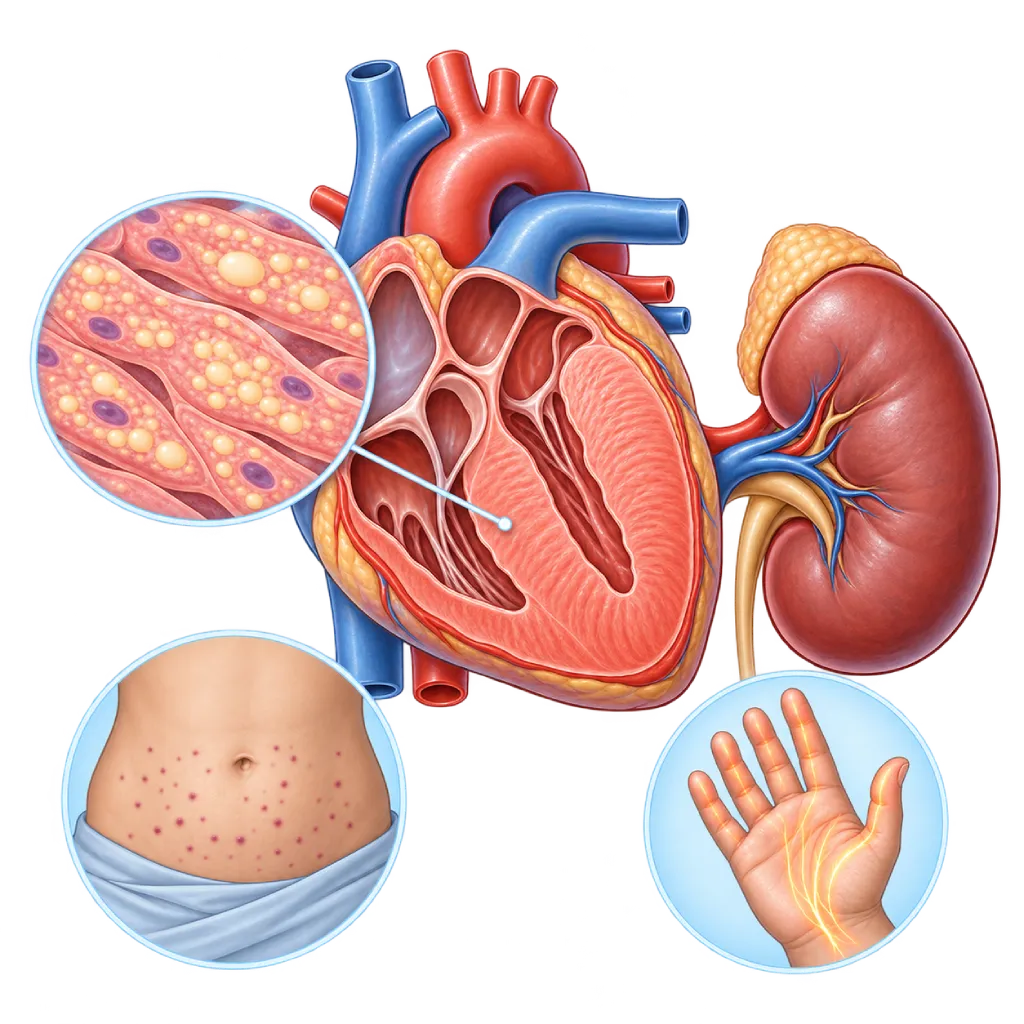
Fabry disease is a rare inherited disease caused by a lack of the enzyme alpha-galactosidase A, which leads to fatty substances building up in the heart, kidneys, nerves, and blood vessels. Both men and women can be affected.
SourcesSigns That Need Urgent Help
- A drooping face, slurred speech, or weakness on one side of the body
- Severe chest pain that does not improve with rest
- Fainting or nearly fainting
- A very slow or very fast pulse with dizziness
- Severe shortness of breath at rest or being unable to lie flat
- Passing very little urine, with swelling and shortness of breath
If these signs appear, go to the nearest emergency department right away or call Heart Attack Center 1500 258.
01 / Understanding the condition
About Fabry Disease
Fabry disease is a rare inherited disease that belongs to the group of lysosomal storage diseases. Lysosomes are the parts of a cell that work like a recycling center. In Fabry disease, a change in the GLA gene causes the enzyme alpha-galactosidase A to work poorly or not at all. As a result, a fatty substance called globotriaosylceramide (Gb3) and its derivative, lyso-Gb3, build up slowly in the cells of small blood vessels, nerves, kidneys, and heart muscle.
Two Forms of the Disease
In the classic form, which mainly affects males whose enzyme barely works, symptoms begin in childhood. They include burning pain in the hands and feet, difficulty sweating, heat intolerance, abdominal complaints, and small dark red spots on the skin. The cornea of the eye often shows fine whorl-like lines, although these usually do not affect vision. Kidney problems, heart problems, and stroke appear in adulthood. In the later-onset form, the enzyme still partly works, and symptoms are often limited to the heart, in the form of thickened heart muscle in middle age or later.
Women Can Also Be Affected
The GLA gene is located on the X chromosome. Males have only one X chromosome, so they usually have more severe symptoms. Females have two X chromosomes but can still have mild to severe symptoms, including heart problems, kidney problems, and stroke. The severity depends on how many cells use the X chromosome that carries the changed gene. For this reason, women with this gene change are not considered mere carriers and still need monitoring.
Effects on the Heart
Gb3 buildup thickens the wall of the left ventricle, so it is often mistaken for hypertrophic cardiomyopathy, covered on the Hypertrophic Cardiomyopathy page. Over time, scar tissue, electrical conduction problems, rhythm disturbances, and heart failure can develop. Fabry disease is also often discussed together with infiltrative cardiomyopathy because the picture is similar. That group of diseases is covered on the Infiltrative Cardiomyopathy page. The 2023 European Society of Cardiology (ESC) guideline recommends considering Fabry disease in people with unexplained thickening of the heart muscle. Specific therapy, in the form of enzyme replacement therapy or chaperone medicine, plus treatment for the kidneys, heart, and pain, can slow organ damage, especially if started before scar tissue forms.
02 / Understanding the condition
Symptoms to Recognize.
Common Symptoms
- Recurring burning pain or tingling in the palms and soles
- Sweating very little and being unable to tolerate heat
- Small dark red spots on the skin (angiokeratomas)
- Ringing in the ears or reduced hearing
- Recurring abdominal complaints: pain, bloating, or diarrhea after eating
- Shortness of breath, palpitations, or chest pain during activity
- Foamy urine due to protein leaking from the kidneys
- In the later-onset form, only thickened heart muscle without other symptoms
Symptoms in Children
In the classic form, especially in boys, symptoms often begin at school age and are often mistaken for growing pains.
- Burning pain in the hands and feet, especially during a fever, in hot weather, or after exercise
- Difficulty sweating and quickly overheating while playing
- Abdominal pain, nausea, or diarrhea after eating
- Tiring easily and avoiding sports
- Small dark red spots on the skin around the navel, hips, or thighs
Symptoms in Adult Women
Symptoms in women vary widely and tend to appear later, so they are often recognized late.
- Anything from no symptoms to symptoms as severe as in men
- Burning pain in the hands and feet or persistent tiredness
- Thickened heart muscle that appears at an older age than in men
- Palpitations or shortness of breath during activity
- Stroke or minor stroke at a young age
- Protein in the urine or slowly declining kidney function
03 / Understanding the condition
What Causes This Condition?
- A change in the GLA gene, which is located on the X chromosome
- A lack of the enzyme alpha-galactosidase A, which breaks down certain fatty substances inside cells
- Buildup of globotriaosylceramide (Gb3) and lyso-Gb3 in the cells of the heart, kidneys, nerves, and blood vessels
- An affected father passes the gene to all of his daughters but not to his sons
- A woman with the gene change passes it on to half of her children on average, both sons and daughters
04 / Understanding the condition
Who Is at Higher Risk?
Genetic
Having a family member with Fabry disease or a GLA gene change. A family history of kidney failure, stroke at a young age, thickened heart muscle, or sudden death with no clear cause should also be shared with your doctor.
Medical
Unexplained thickening of the heart muscle, protein in the urine or kidney disease of unclear cause, and stroke at a young age can be clues to undiagnosed Fabry disease.
Age
In the classic form, symptoms begin in childhood and organ damage increases with age. In the later-onset form, thickening of the heart muscle usually becomes visible only in middle age or later.
Other
Males with the gene change usually have more severe symptoms that start earlier. Fever, hot weather, strenuous exercise, and fatigue can trigger pain attacks, although they do not cause the disease.
Groups at Higher Risk
- Families of People with Fabry Disease: One diagnosis can lead to several family members with the same gene change, including those who do not have symptoms yet.
- People with Unexplained Heart Muscle Thickening: Fabry disease is found in a small proportion of people with heart wall thickening that cannot be explained by hypertension or valve disease.
- People with Unexplained Kidney Disease: Protein in the urine or declining kidney function at a young age without diabetes or severe hypertension should be considered as a possible clue.
- People with Stroke at a Young Age: Stroke or minor stroke at a young age without clear risk factors can be a clue to Fabry disease.
- Women Carrying a GLA Gene Change: They can still develop heart problems, kidney problems, and stroke, so they need regular monitoring.
05 / Understanding the condition
How Is It Diagnosed?
Doctors suspect Fabry disease from a set of clues: burning pain since childhood, difficulty sweating, dark red spots on the skin, protein in the urine, stroke at a young age, or unexplained thickening of the heart muscle, especially if similar problems run in the family. In males, the first step is to measure alpha-galactosidase A enzyme activity in the blood; very low activity is then confirmed with a GLA gene test. In females, enzyme levels are often normal, so the gene test is the main test. The level of lyso-Gb3 in the blood helps assess the severity of the disease.
Heart tests include an ECG, echocardiography, cardiac MRI, and rhythm recording. On MRI, a low T1 value is a characteristic clue of fat buildup in the heart muscle. The kidneys are assessed with eGFR and urine protein. An eye doctor may find a whorl-like pattern of lines in the cornea, and a hearing test looks for hearing loss. Once the gene change is found, family members can be tested in a targeted way.
Laboratory Tests
Measures alpha-galactosidase A enzyme activity, especially in males, and the level of lyso-Gb3 in the blood as a marker of disease severity.
GLA gene test from a blood sample, required in females because enzyme levels are often normal, and used to test family members.
Electrocardiogram (ECG)
May show a short PR interval in the early stage, signs of wall thickening, conduction problems, or rhythm disturbances.
Echocardiography
Measures the thickness of the left ventricular wall, filling and pumping function, and the heart valves.
Cardiac MRI
A low T1 value is a characteristic clue of fat buildup, and a scarring pattern in the lower side wall (inferolateral wall) of the left ventricle helps assess the stage of the disease.
Urine Protein Test
Looks for albumin and protein in the urine as an early sign of kidney damage, together with an eGFR test.
Long-Term Heart Rhythm Monitoring
Rhythm recording over several days or longer to detect atrial fibrillation, a slow heartbeat, or ventricular rhythm disturbances.
06 / Understanding the condition
Treatment Options.
Treatment is decided by a doctor after an assessment. The categories below can help you follow the conversation with your doctor.
Enzyme Replacement Therapy
A manufactured enzyme is given by infusion every two weeks to reduce Gb3 buildup. Your doctor decides the type of enzyme and when to start.
Oral Chaperone Therapy
A medicine taken by mouth that helps the patient's own enzyme work better. It is suitable only for certain GLA gene changes that have been shown to respond.
Kidney Protection
ACE inhibitors or ARBs to reduce protein in the urine, along with blood pressure control.
Treatment of Heart Problems
Heart failure and heart rhythm medicines as needed, blood thinners if atrial fibrillation is present, and a pacemaker or ICD if needed.
Nerve Pain Management
Avoiding triggers such as heat and fatigue, plus anticonvulsant medicines that help relieve nerve pain, as prescribed by your doctor.
Genetic Counseling and Family Testing
Helps families understand inheritance through the X chromosome and decide who needs a gene test.
07 / Understanding the condition
Complications to Watch For.
Thickened Heart Muscle
The wall of the left ventricle becomes thick and stiff, so the heart has difficulty filling with blood. The picture resembles hypertrophic cardiomyopathy.
Rhythm Disorders and Heart Block
Atrial fibrillation, an overly slow heartbeat, and electrical conduction problems can occur, sometimes requiring a pacemaker.
Heart Failure
Scar tissue in the heart muscle can reduce the heart's filling and pumping function over time.
Chronic Kidney Disease
Protein leaks into the urine and kidney function declines gradually, especially in males with the classic form. This is covered on the Chronic Kidney Disease page.
Stroke at a Young Age
Disease of the small blood vessels in the brain increases the risk of stroke and minor stroke. This is covered on the Stroke page.
Chronic Nerve Pain
Damage to small nerves causes long-lasting burning pain and pain attacks triggered by heat or fever.
Hearing Loss
Ringing in the ears and reduced hearing can develop gradually or suddenly.
08 / Understanding the condition
What Can You Do?
- Tell your doctor about any family history of Fabry disease, kidney failure, stroke at a young age, or a thickened heart
- Encourage close family members to have counseling and a GLA gene test if one family member is diagnosed
- Follow your specific therapy on schedule and do not stop it without your doctor's guidance
- Avoid excessive heat, drink enough water, and adjust exercise intensity to reduce pain attacks
- Have your blood pressure, kidney function, and urine protein checked regularly
- Have an ECG, echocardiography, and cardiac MRI according to your monitoring schedule
- Do not smoke, and keep your cholesterol under control to lower the risk of stroke
- Know the signs of stroke and go to the emergency room right away if they appear
09 / Understanding the condition
When Should You See a Doctor?
Get checked if you have several of the following symptoms, especially if they started in childhood or a family member has similar symptoms. If you develop a drooping face, slurred speech, weakness on one side of the body, severe chest pain, or fainting, go to the emergency room right away.
- Burning pain in the hands and feet that flares up with fever, heat, or exercise
- Difficulty sweating and overheating easily
- Small dark red spots on the skin of the hips, navel area, or thighs
- Foamy urine or a positive urine protein test with no clear cause
- Thickening of the heart muscle with no clear cause
- Stroke at a young age
- A family member diagnosed with Fabry disease
Don't Wait in an Emergency.
If symptoms are severe or come on suddenly, go to the nearest emergency department right away or call Heart Attack Center 1500 258, rather than waiting for an appointment.
10 / Common questions
Questions You May Have.
Frequently asked questions about Fabry disease.
Can women get Fabry disease?
Yes. Women were once thought to be only carriers, but it is now known that many women with a GLA gene change have symptoms, ranging from nerve pain and tiring easily to thickened heart muscle, kidney problems, and stroke. Their symptoms tend to appear later and vary widely. Because enzyme levels in women are often normal, the diagnosis is confirmed with a gene test, followed by regular monitoring.
Can Fabry disease be cured?
Fabry disease cannot yet be cured because it comes from a gene change. However, enzyme replacement therapy, and chaperone medicine for certain gene changes, can reduce the buildup of fatty substances and slow damage to the kidneys and heart. The benefit is greater when treatment starts before scar tissue forms in the heart or before kidney function has declined a lot. Treatment for the heart, kidneys, and pain is still needed alongside specific therapy.
How is Fabry disease inherited?
The GLA gene is on the X chromosome. An affected father passes the gene to all of his daughters but not to his sons. A woman with the gene change passes it on to half of her children on average, both sons and daughters. For this reason, one diagnosis often leads to several other family members who need testing, including those who do not have symptoms yet.
Why do cardiologists check for possible Fabry disease?
Some people with the disease, especially the later-onset form, have only thickened heart muscle without other symptoms. This thickening is easily mistaken for the effect of hypertension or for hypertrophic cardiomyopathy. Studies have found Fabry disease in a small proportion of people with unexplained thickening of the heart muscle. Because Fabry disease has specific therapy, the ESC 2023 guideline recommends enzyme or gene testing in this group.
What can I do to reduce pain attacks?
Learn your triggers, such as hot weather, fever, strenuous exercise, fatigue, and sudden temperature changes. Drink enough water, wear cool clothing, and rest in a cool room during hot weather. When you have a fever, bring your body temperature down promptly as advised by your doctor. If pain still occurs often, your doctor may prescribe a specific medicine for nerve pain. Note the time and trigger of each attack to discuss at your checkup.
How often are heart checkups needed?
The schedule is adjusted to your age, sex, form of the disease, and previous findings. The 2020 European expert consensus recommends regular ECG, echocardiography, and rhythm recording, as well as cardiac MRI at diagnosis, repeated as needed. If new symptoms appear, such as palpitations, dizziness, or shortness of breath, tests can be brought forward. The kidneys, nerves, eyes, and hearing are also monitored regularly.
Sources and Medical Review
Translated from the Indonesian edition medically reviewed by dr. Radityo Prakoso, Sp.JP(K).
Sources as cited in the Indonesian edition.
- Arbelo E, Protonotarios A, Gimeno JR, Arbustini E, Barriales-Villa R, Basso C, et al. 2023 ESC Guidelines for the management of cardiomyopathies. Eur Heart J. 2023;44(37):3503-626.
- Linhart A, Germain DP, Olivotto I, Akhtar MM, Anastasakis A, Hughes D, et al. An expert consensus document on the management of cardiovascular manifestations of Fabry disease. Eur J Heart Fail. 2020;22(7):1076-96.
- Pieroni M, Moon JC, Arbustini E, Barriales-Villa R, Camporeale A, Vujkovac AC, et al. Cardiac Involvement in Fabry Disease: JACC Review Topic of the Week. J Am Coll Cardiol. 2021;77(7):922-36.
- Ortiz A, Germain DP, Desnick RJ, Politei J, Mauer M, Burlina A, et al. Fabry disease revisited: Management and treatment recommendations for adult patients. Mol Genet Metab. 2018;123(4):416-27.
- Germain DP, Hughes DA, Nicholls K, Bichet DG, Giugliani R, Wilcox WR, et al. Treatment of Fabry's Disease with the Pharmacologic Chaperone Migalastat. N Engl J Med. 2016;375(6):545-55.
- Wanner C, Arad M, Baron R, Burlina A, Elliott PM, Feldt-Rasmussen U, et al. European expert consensus statement on therapeutic goals in Fabry disease. Mol Genet Metab. 2018;124(3):189-203.
Doctors Who Treat This Condition

dr. BRM Ario S. Kuncoro, Sp.JP(K)
Echocardiography & Cardiovascular Imaging
Cardiovascular Diagnostic Center +2 centers
Clinical focusAdvanced and 3D Echocardiography · Transesophageal Echocardiography
View Profile
dr. Radityo Prakoso, Sp.JP(K)
Pediatrics & Congenital Heart Disease
Congenital and Structural Heart Center
Clinical focusPediatric Cardiology Consultation · Congenital Heart Disease Care
View Profile
dr. Khaira U. Yusrie, Sp.PD-KGEH
Gastroenterology & Hepatology
Clinical focusInternal Medicine · Gastroenterology and Hepatology
View Profile