
Quick answer
What Is Pacemaker Implantation?
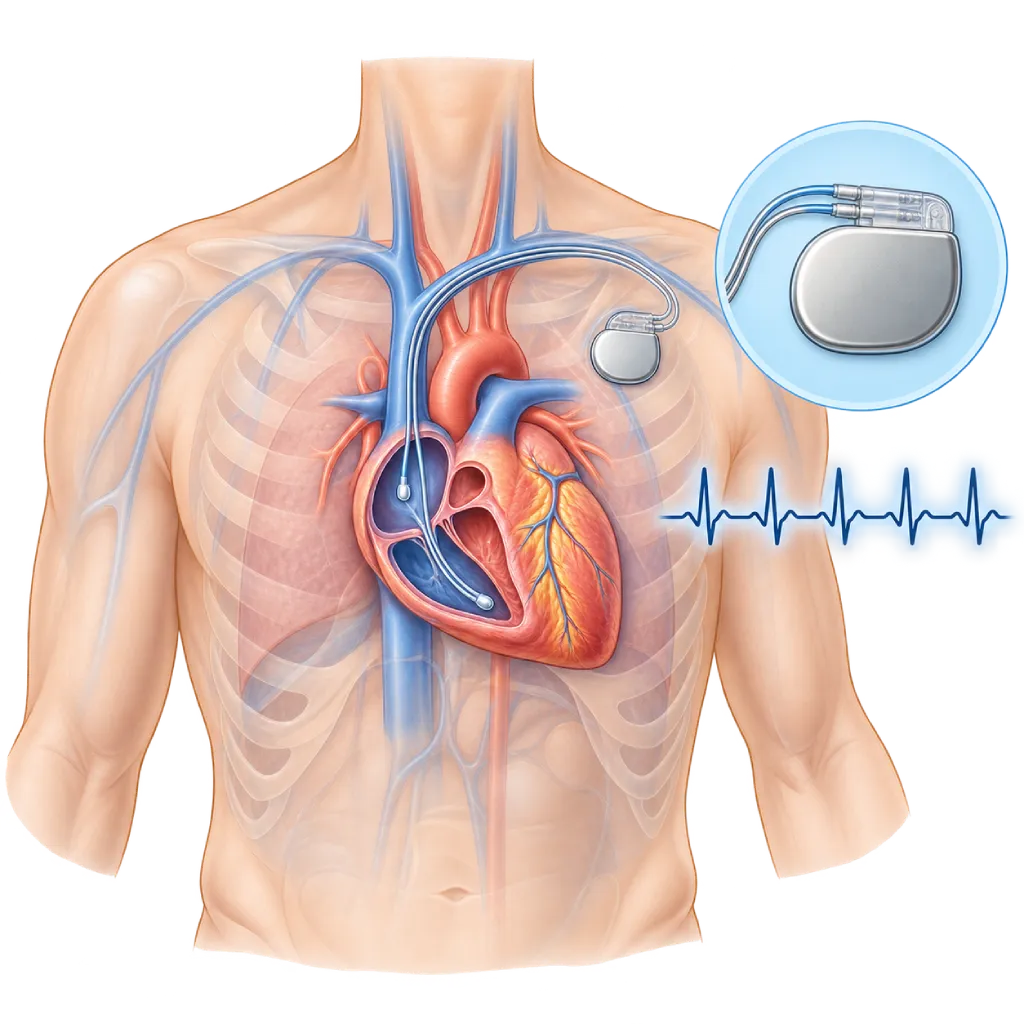
Pacemaker implantation places a small pacemaker under the skin of the chest, below the collarbone. The device is connected to the heart by thin wires and sends electrical signals when the heartbeat is too slow or pauses briefly. It is done under local anesthesia, takes about 1 to 2 hours, and usually involves a one-night hospital stay.
Sources01 / Understanding the procedure
About Pacemaker Implantation
What Is Pacemaker Implantation
A pacemaker is a small battery-powered device that keeps your heartbeat from becoming too slow. It is used when the heart's natural pacemaker weakens or when the electrical signal from the atria to the ventricles is blocked, which is called heart block. As a result, the heartbeat becomes slow or pauses briefly, so you may feel weak, dizzy, short of breath, or faint.
How It Works in Brief
The device consists of a small generator containing a battery and electronic circuitry, plus one or two thin wires, called leads, whose tips attach to the right atrium, the right ventricle, or both. The device continuously monitors your heartbeat and only sends electrical signals when the natural heartbeat is too slow. Many devices also have a sensor that raises the heart rate when you move.
Temporary Pacing and Implanted Pacemakers
In an emergency, the doctor may place a temporary pacemaker, which is a lead inserted through a vein and connected to a device outside the body. This is used for a few days until the cause resolves, for example a medicine effect or a potassium disorder, or until an implanted pacemaker can be placed. Long-term pacing means the device is implanted under the skin and used over the long term; this is what is covered here.
Types of Devices
A single-lead pacemaker is used, for example, in atrial fibrillation with a slow heartbeat, while a dual-lead pacemaker keeps the atria and ventricles working in sequence. In some patients, the lead tip is placed directly in the heart's conduction pathway so that contractions are more natural. There are also leadless pacemakers, small capsules inserted through a vein in the groin and implanted directly in the right ventricle. If the heart's pump is weak, the doctor may choose a resynchronization device, which is covered on the Cardiac Resynchronization Therapy (CRT) page.
Living with a Pacemaker
The battery usually lasts about 7 to 12 years, depending on the type of device and how often it works. When the battery is running low, the generator is replaced in a minor procedure, while the leads are usually kept. The device is checked regularly at the clinic or from home, which is covered on the Remote Heart Monitoring page.
A pacemaker treats a heartbeat that is too slow, but it does not stop a rhythm that is too fast and dangerous. An ICD is used for that, which is covered on the Sudden Cardiac Death and Implantable Cardioverter Defibrillator (ICD) pages.
02 / Understanding the procedure
When Is This Procedure Considered?
A doctor may consider this procedure in the situations below. The decision is always made after a thorough assessment.
- High-Grade Heart BlockSignals from the atria to the ventricles are mostly or completely blocked, with or without symptoms.
- Sinus Node Dysfunction with SymptomsA slow heartbeat or long pauses that cause weakness, dizziness, or fainting.
- Tachycardia-Bradycardia SyndromeThe heartbeat alternates between fast and slow; the device maintains the heart rate when medicines that slow the heart are needed.
- Atrial Fibrillation with a Slow HeartbeatA very slow heartbeat that causes symptoms, or after AV node ablation.
- Conduction Problems After a Heart ProcedureFor example, after valve surgery or transcatheter aortic valve implantation, if conduction does not recover.
- Recurrent Reflex FaintingIn some adults with long heart pauses recorded during fainting.
Situations to Consider First
- Reversible CauseFor example, medicine effects, high potassium, or an underactive thyroid; the cause is treated first.
- Slow Heartbeat Without SymptomsFor example, in athletes or during sleep, which usually does not require a device.
- Active InfectionImplantation is postponed; if needed, a temporary pacemaker is used until the infection is treated.
- Uncontrolled BleedingThe risk of a blood-filled swelling in the device pocket increases; medicines and blood clotting are managed first.
03 / Before the procedure
How Should You Prepare?
Implantation is usually scheduled, but it can be done urgently if the heartbeat is very slow. The team explains the type of device chosen and the reasons for it.
Fasting. Usually no food or drink for about 6 hours before the procedure.
Blood thinners. Warfarin is often continued with a specific INR target, while direct oral anticoagulants may be stopped for 1 to 2 days. Follow your doctor's instructions and do not stop them on your own.
Tests before the procedure. Blood tests, including kidney function and potassium, an ECG, and echocardiography if needed.
Preventing infection. The skin of your chest is cleaned and antibiotics are given through an IV line about 1 hour before the procedure. Tell the team if you have a fever or are unwell.
Information for the team. Tell the team about any allergies and which hand you use more often, because the device is usually placed on the other side.
Unsure about the preparation instructions? Ask our team before the procedure.
04 / During the procedure
How Is the Procedure Done?
Implantation is done in the catheterization lab or a procedure room and takes about 1 to 2 hours. The skin below the collarbone is numbed with local anesthesia and a mild sedative may be given, so you stay awake. For a leadless pacemaker, the capsule is inserted through a vein in the groin without an incision in the chest.
Creating the Device Pocket
The doctor makes an incision of about 4 to 6 centimeters below the collarbone, then forms a small pocket under the skin for the generator.
Inserting the Leads
The leads are advanced through a vein below the collarbone to the heart under X-ray guidance. Their tips are attached to the wall of the right atrium or right ventricle.
Testing and Connecting the Device
The doctor measures the heart's signals and the strength of stimulation needed. Once the results are good, the leads are connected to the generator and the device is placed in the pocket.
Closing the Wound and Programming the Device
The wound is stitched, often with dissolvable stitches. The device is programmed to suit your needs, then a chest X-ray is taken to check the position of the leads and the condition of the lungs.
05 / Benefits and risks
Benefits and Risks Should Be Discussed Together.
Every medical procedure has benefits and risks. Your doctor will explain both for your situation before the procedure.
Benefits You Can Expect
- Fewer Symptoms of a Slow HeartbeatWeakness, dizziness, shortness of breath, and feeling faint caused by a slow heartbeat usually improve.
- Preventing Fainting from Heart PausesReduces the risk of falls and injuries from sudden fainting.
- Heart Rate Adjusts to ActivityThe device's sensor can raise your heart rate when you walk or climb stairs.
- Rate-Slowing Medicines Can Be UsedIn tachycardia-bradycardia syndrome, medicines for fast rhythms can be taken more safely.
- Procedure Under Local AnesthesiaA small incision below the collarbone, with recovery within days.
The benefits of a procedure are not a promise of a cure. Ask how the results will affect your care plan.
Risks You Should Know
- Bruising or Blood-Filled SwellingMore likely in people taking blood thinners; usually improves with pressure.
- Lead DisplacementA repeat procedure is sometimes needed to correct the lead position, especially in the first weeks.
- Device InfectionRare; if it occurs, the entire device and leads usually need to be removed.
- Air in the Chest CavityRare; this happens if the lung is punctured while finding the vein, and a chest tube is sometimes needed.
- Perforation of the Heart WallVery rare; it can cause fluid around the heart that needs to be drained.
- Arm Swelling from a Vein ClotRare; usually treated with blood thinners.
Risks can differ from person to person. A full explanation and consent are given after an individual assessment.
06 / After the procedure
What Is Recovery Like?
Patients usually stay one night. Before you go home, the device is checked and you receive a device identification card.
Wound. Keep the wound dry for about 1 week and follow the team's instructions for bathing. Mild bruising around the wound is normal.
Arm movement. Avoid raising the arm on the device side above your shoulder and avoid heavy lifting for about 4 to 6 weeks, so the leads do not shift.
Activity and driving. Light activities can be resumed within a few days. Driving is usually allowed again after about 1 week if you have had no fainting, as advised by your doctor.
Device checks. The first check is about 1 to 3 months after implantation, then regularly every 6 to 12 months at the clinic or from home.
Everyday equipment. Mobile phones are safe to use; keep them about 15 centimeters away from the device. Show your device card at airport security checks. An MRI can be done with some devices using special settings.
Warning signs to watch for. Go to the emergency room right away if you experience:
- A wound that is red, swollen, warm, or oozing pus, or accompanied by fever
- Swelling at the device pocket that keeps getting bigger
- Severe dizziness, fainting, or a heartbeat that becomes very slow again
- Shortness of breath or chest pain
- Persistent hiccups or twitching of the chest or abdominal muscles
- Swelling of the arm on the device side
Know the Signs That Need Prompt Care.
Follow the team's guidance on warning signs. If severe or sudden symptoms appear after the procedure, go to the nearest emergency department right away or call Heart Attack Center 1500 258.
07 / Team and support
Doctors and Procedure Support
The doctors below are listed for this procedure. Listed by name, not by ranking.

Dr. dr. Dicky A. Hanafy, Sp.JP(K)
Arrhythmia and Electrophysiology
Arrhythmia and Device Center +1 center
Clinical focusElectrophysiology and Arrhythmia Ablation · Pacemaker and ICD Implantation
View Profile
Dr. dr. Faris Basalamah, Sp.JP(K)
Interventional Cardiology
Coronary Intervention Procedures +1 center
Clinical focusComplex Coronary Intervention · Cardiac Electrophysiology
View Profile
dr. Sunu B. Raharjo, Sp.JP(K), Ph.D.
Arrhythmia and Electrophysiology
Arrhythmia and Device Center
Clinical focusClinical and Interventional Electrophysiology · Cardiac Arrhythmia Ablation
View ProfileHolter Monitoring System
A small ECG recorder that you wear during daily activities to monitor your heart rhythm continuously for 24 to 48 hours or…
Electrophysiology (EP) Laboratory
A dedicated procedure room for electrophysiology studies, catheter ablation, and implantation of heart rhythm devices such as…
The availability of technology and test support is confirmed with the team. Technology is chosen according to clinical need.
08 / Common questions
Before You Plan the Procedure.
Frequently asked questions about pacemaker implantation and living with a pacemaker.
Is pacemaker implantation painful?
The skin is numbed with local anesthesia, so you usually feel only the initial needle prick and some pressure while the device pocket is made. A mild sedative may be given to help you relax. After the anesthesia wears off, the wound feels mildly sore for a few days, and ordinary pain relievers are usually enough.
How long does a pacemaker battery last?
Usually about 7 to 12 years, depending on the type of device, its settings, and how often it works. The remaining battery life is checked at every follow-up visit. When it is running low, the generator is replaced in a minor procedure under local anesthesia, and leads that are still in good condition are kept. The battery does not run out suddenly, so the replacement can be planned.
Are mobile phones, household appliances, and airport security checks safe?
Generally, yes. Hold your phone to the ear on the opposite side and do not keep it in a chest pocket near the device. Ordinary household appliances do not interfere when used normally. At the airport, show your device card; walking through the security gate does not damage the device, but avoid a handheld detector wand being held over the device for a long time. Keep strong magnets away from your chest.
Can I have an MRI after getting a pacemaker?
Many of the devices and leads used today are designed to be safe for MRI under certain conditions. An MRI can be done if the entire device system meets those conditions, the device is switched to a special mode before the scan, and you are monitored during the scan. Always tell staff that you have a pacemaker and bring your device card before having an MRI or any other test.
What is the difference between a pacemaker and an ICD?
A pacemaker treats a heartbeat that is too slow by sending small electrical signals that you do not feel. An ICD can do the same, but it can also stop a very fast and dangerous rhythm from the heart's ventricles with rapid pacing or an electrical shock. An ICD is used in people at risk of sudden cardiac arrest, while a pacemaker is not designed to prevent this.
Will I need a pacemaker for the rest of my life?
In the majority of patients, an implanted pacemaker is used long term because conduction or sinus node problems usually do not recover. If the slow heartbeat has a reversible cause, such as a medicine effect or a potassium disorder, the doctor treats the cause first and may use a temporary pacemaker. For this reason, the decision to implant is made after reversible causes have been ruled out.
Sources and Medical Review
Translated from the Indonesian edition medically reviewed by Dr. dr. Dicky A. Hanafy, Sp.JP(K).
Sources as cited in the Indonesian edition.
- Glikson M, Nielsen JC, Kronborg MB, et al. 2021 ESC Guidelines on cardiac pacing and cardiac resynchronization therapy. Eur Heart J. 2021;42(35):3427-3520.
- Kusumoto FM, Schoenfeld MH, Barrett C, et al. 2018 ACC/AHA/HRS Guideline on the Evaluation and Management of Patients With Bradycardia and Cardiac Conduction Delay: A Report of the American College of Cardiology/American Heart Association Task Force on Clinical Practice Guidelines and the Heart Rhythm Society. Circulation. 2019;140(8):e382-e482.
- Kirkfeldt RE, Johansen JB, Nohr EA, et al. Complications after cardiac implantable electronic device implantations: an analysis of a complete, nationwide cohort in Denmark. Eur Heart J. 2014;35(18):1186-1194.
- Blomström-Lundqvist C, Traykov V, Erba PA, et al. European Heart Rhythm Association (EHRA) international consensus document on how to prevent, diagnose, and treat cardiac implantable electronic device infections, endorsed by the Heart Rhythm Society (HRS), the Asia Pacific Heart Rhythm Society (APHRS), the Latin American Heart Rhythm Society (LAHRS), International Society for Cardiovascular Infectious Diseases (ISCVID) and the European Society of Clinical Microbiology and Infectious Diseases (ESCMID) in collaboration with the European Association for Cardio-Thoracic Surgery (EACTS). Europace. 2020;22(4):515-549.
- Indik JH, Gimbel JR, Abe H, et al. 2017 HRS expert consensus statement on magnetic resonance imaging and radiation exposure in patients with cardiovascular implantable electronic devices. Heart Rhythm. 2017;14(7):e97-e153.
- Reynolds D, Duray GZ, Omar R, et al. A Leadless Intracardiac Transcatheter Pacing System. N Engl J Med. 2016;374(6):533-541.