
Quick answer
What Is Cardiac Hemochromatosis?
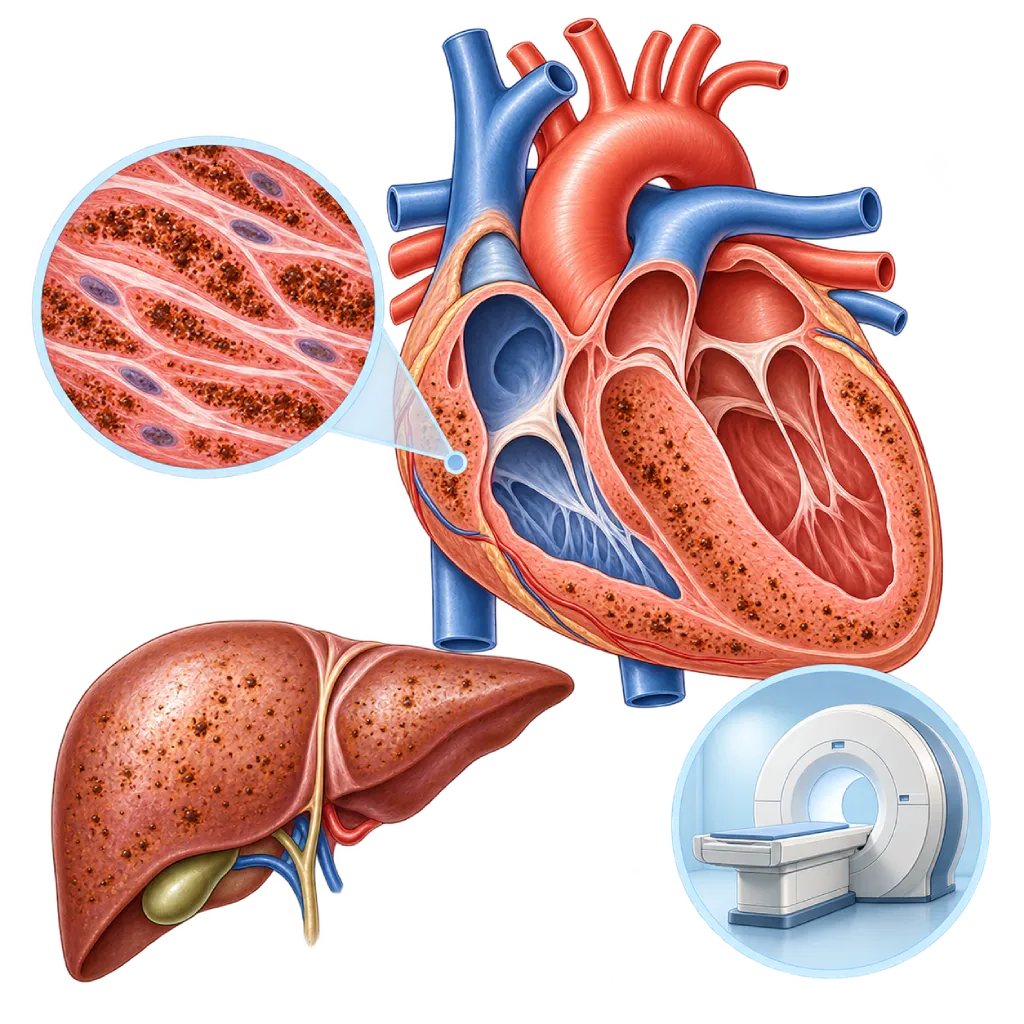
Cardiac hemochromatosis is damage to the heart muscle caused by excess iron building up in heart cells, due to a genetic abnormality or repeated blood transfusions. It can lead to heart failure and rhythm problems, but often improves when iron is reduced.
SourcesSigns That Need Urgent Help
- Severe shortness of breath at rest or being unable to lie down
- A very fast, pounding heartbeat with dizziness, chest pain, or shortness of breath
- Fainting or nearly fainting
- Swelling that increases quickly over a few days
- Severe weakness with cold, pale skin
If these signs appear, go to the nearest emergency department right away or call Heart Attack Center 1500 258.
01 / Understanding the condition
About Cardiac Hemochromatosis
Cardiac hemochromatosis, also called iron overload cardiomyopathy, occurs when iron builds up inside heart muscle cells. The body has no natural way to get rid of excess iron, so iron that keeps coming in is stored in organs such as the liver, heart, pancreas, and hormone glands. In the heart, unbound iron triggers cell damage through oxidation. As a result, the heart muscle first becomes stiff, then can weaken and enlarge, and its electrical system is disrupted. This condition belongs to the group covered on the Infiltrative Cardiomyopathy page.
Two Paths to Iron Overload
The first path is hereditary hemochromatosis. A gene change, usually in the HFE gene, makes the intestine absorb more iron from food than the body needs. This form is common in people of northern European descent and less common in Asia. Symptoms usually appear after age 40 in men and later in women, because menstruation removes some iron. The second path is secondary iron overload, mainly from repeated blood transfusions in thalassemia major, other anemias, or bone marrow disorders. Each unit of blood carries a lot of iron, so without iron-binding medicines, iron overload in the heart can develop at a young age. In Indonesia, secondary iron overload is seen largely in people with thalassemia.
Why Early Testing Matters
Iron in the heart often builds up without symptoms for years, and pumping function only drops after a considerable amount has accumulated. Cardiac MRI with the T2* technique can measure the iron level in the heart muscle before pumping function declines. In thalassemia, using T2* MRI to guide iron-binding treatment has been associated with lower rates of heart failure and heart-related death. When treated early, heart function can often recover partly or fully.
Principles of Treatment
Treatment has two parts: reducing iron and managing its effects on the heart. In hereditary hemochromatosis, blood is removed regularly (phlebotomy) in a way similar to blood donation. In iron overload from transfusions, your doctor prescribes iron-binding medicines (chelation), and for severe buildup in the heart, your doctor may combine two types of chelation medicines. At the same time, your doctor treats heart failure and rhythm problems.
02 / Understanding the condition
Symptoms to Recognize.
Common Symptoms
Heart symptoms often appear later, after symptoms in the liver, joints, or hormone glands.
- Tiring easily and long-lasting weakness
- Shortness of breath during activity, and over time also when lying down
- Swelling in the legs or abdomen
- A pounding or irregular-feeling heartbeat
- Dizziness or nearly fainting
- Joint pain, especially in the finger joints
- Skin that looks darker or grayish
- Lower sex drive or menstrual periods stopping
Symptoms in Teenagers
In teenagers with thalassemia who receive regular transfusions, iron overload can affect the heart and hormone glands.
- Delayed puberty or falling behind in height growth
- Tiring quickly at school or during sports
- A pounding heart or an irregular heartbeat
- New shortness of breath or swelling
03 / Understanding the condition
What Causes This Condition?
- Hereditary hemochromatosis from HFE gene changes that make the intestine absorb too much iron
- Other, rarer hereditary forms, such as changes in the hemojuvelin or hepcidin gene, which can appear at a young age
- Repeated blood transfusions in thalassemia major, sickle cell anemia, or bone marrow disorders
- Non-transfusion-dependent thalassemia, because the intestine still absorbs too much iron
- Excessive iron supplements or iron injections without a medical reason, although this is rarely the sole cause
04 / Understanding the condition
Who Is at Higher Risk?
Genetic
Carrying two copies of an HFE gene change, or a change in another iron-regulating gene, increases the risk. Brothers and sisters of people with hereditary hemochromatosis have a high risk of carrying the same gene change.
Medical
Thalassemia major and other anemias that require regular transfusions, especially when iron-binding medicines are not taken regularly.
Age
In hereditary hemochromatosis, symptoms usually appear after age 40 in men. In thalassemia, iron in the heart can build up from the teenage years.
Lifestyle
Alcohol speeds up liver damage in iron overload. Excessive iron supplements or vitamin C supplements taken without a doctor's advice can increase iron absorption.
Other
Men, and women after menopause, build up iron faster because they do not lose blood through menstruation.
Groups at Higher Risk
- People with Thalassemia: Regular blood transfusions build up iron in the heart from a young age, so chelation medicine and regular T2* MRI are needed.
- Family Members of People with Hereditary Hemochromatosis: Brothers and sisters have a high risk of carrying the same gene change and are advised to have blood tests and gene testing.
- People Receiving Repeated Transfusions: People with aplastic anemia, myelodysplastic syndrome, or sickle cell anemia who often receive transfusions can also develop iron overload.
05 / Understanding the condition
How Is It Diagnosed?
Testing starts with blood tests. High transferrin saturation shows that too much iron is circulating, and high ferritin shows that iron stores are increasing. However, the iron level in the blood does not always reflect the iron level in the heart. That is why MRI with the T2* technique is used to measure iron in the heart, and liver MRI to measure iron in the liver.
Echocardiography and an ECG assess the effects on the heart's pumping and rhythm. When hereditary hemochromatosis is suspected, HFE gene testing confirms the diagnosis, and your doctor may recommend testing your brothers and sisters. A liver or heart biopsy is now rarely needed. For people with transfusion-dependent thalassemia, the AHA consensus statement recommends regular cardiac T2* MRI starting in childhood, to find iron buildup before heart function declines.
Laboratory Tests
Ferritin and transferrin saturation to assess the body's iron stores and iron level, plus liver function and blood sugar tests to check the effects on other organs.
Cardiac MRI
The T2* technique measures the iron level in the heart muscle. A value below 20 milliseconds indicates iron overload, and below 10 milliseconds indicates severe buildup.
Echocardiography
Assesses pumping strength, wall stiffness, and the size of the heart chambers, and is repeated to monitor the response to treatment.
Electrocardiogram (ECG)
Looks for rhythm problems such as atrial fibrillation and disorders of the heart's electrical conduction.
Holter Monitoring
Records the heart rhythm for 24 to 48 hours if you have palpitations or fainting.
HFE gene testing confirms hereditary hemochromatosis and is the basis for testing brothers and sisters.
06 / Understanding the condition
Treatment Options.
Treatment is decided by a doctor after an assessment. The categories below can help you follow the conversation with your doctor.
Regular Phlebotomy
In hereditary hemochromatosis, a set amount of blood is removed regularly until ferritin reaches the target, then the schedule is spaced out for long-term maintenance.
Iron-Binding Medicines (Chelation)
For iron overload from transfusions. Your doctor chooses an oral or injectable chelation medicine and may combine them when iron in the heart is high.
Intensive Chelation During Heart Failure
If heart failure develops, chelation medicine is given continuously through an IV together with heart failure care in the hospital.
Heart Failure Treatment
Guideline-based heart failure medicine classes, including water pills (diuretics), are given by your doctor according to the condition of the heart's pump.
Rhythm Disorder Treatment
Heart rhythm medicines, blood thinners for atrial fibrillation, and a pacemaker or ICD when needed.
Heart Transplant
Considered for selected patients with severe damage that does not recover, sometimes together with a liver transplant.
07 / Understanding the condition
Complications to Watch For.
Heart Failure
Iron damages the heart muscle so the pump weakens. In thalassemia, heart failure from iron overload can worsen quickly if not treated promptly.
Heart Rhythm Disorders
Atrial fibrillation is common, and with severe buildup, dangerous fast rhythms from the ventricles can occur.
Electrical Conduction Disorders
Iron in the heart's electrical system can slow the heartbeat or cause heart block.
Liver Damage
Iron overload can cause hardening of the liver (cirrhosis) and increase the risk of liver cancer, especially when combined with drinking alcohol.
Diabetes and Hormone Disorders
Iron in the pancreas and hormone glands can cause diabetes, delayed puberty, or lower sex hormone levels.
08 / Understanding the condition
What Can You Do?
- If a close family member has hemochromatosis, get your ferritin and transferrin saturation checked and have a gene test
- If you have thalassemia: take your iron-binding medicine on schedule and do not let it lapse
- Have cardiac T2* MRI on the schedule set by your doctor
- Do not take iron supplements without testing and your doctor's advice
- Avoid or limit alcohol to protect your liver
- Avoid eating raw shellfish, because iron overload makes certain bacterial infections more likely
- Get your heart checked if you develop new tiredness, shortness of breath, or palpitations
09 / Understanding the condition
When Should You See a Doctor?
Go to the emergency room right away if you have severe shortness of breath, fainting, or a very fast, pounding heartbeat. Make an appointment with a cardiologist if:
- You have thalassemia or anemia with regular transfusions and have never had a cardiac T2* MRI
- Your ferritin or transferrin saturation is high on a blood test
- You have been diagnosed with hereditary hemochromatosis and start to feel short of breath, have palpitations, or tire easily
- A brother, sister, or parent has hemochromatosis
- Heart symptoms appear together with diabetes, liver disease, or finger joint pain without a clear cause
Don't Wait in an Emergency.
If symptoms are severe or come on suddenly, go to the nearest emergency department right away or call Heart Attack Center 1500 258, rather than waiting for an appointment.
10 / Common questions
Questions You May Have.
Frequently asked questions about cardiac hemochromatosis.
Can heart damage from iron overload recover?
Often, yes, especially when it is found before severe heart failure. After iron is reduced with phlebotomy or chelation medicine, pumping function can improve within a few months, although iron in the heart decreases more slowly than in the liver. That is why treatment needs to be followed regularly over the long term, and the results are monitored with T2* MRI and echocardiography.
What is the difference between hereditary hemochromatosis and iron overload from transfusions?
In hereditary hemochromatosis, a gene change makes the intestine absorb too much iron from food, and it is treated by removing blood regularly. In iron overload from transfusions, the iron comes from the transfused blood. Phlebotomy cannot be done because the patient is already short of blood, so it is treated with iron-binding medicines that remove iron through urine or stool.
Do I have to stop eating foods that contain iron?
A strict diet is usually not needed, because food has a much smaller effect than phlebotomy or chelation medicine. What is recommended is not taking iron supplements, limiting vitamin C supplements, cutting back on alcohol, and not eating raw shellfish. If you are unsure, discuss your eating pattern with your doctor or a clinical nutrition doctor.
How often do people with thalassemia need a cardiac T2* MRI?
The AHA consensus statement recommends regular cardiac T2* MRI for people with transfusion-dependent thalassemia, usually every one to two years if the results are good and more often if iron in the heart is high. Your doctor sets the exact schedule based on previous results, age, and how regularly chelation medicine is taken. This test does not use X-rays and does not require contrast dye.
Do my family members need to be tested?
In hereditary hemochromatosis, brothers and sisters have a high chance of carrying the same gene change, so testing of transferrin saturation and ferritin, plus a gene test, is recommended. Children and parents can also be tested as your doctor advises. In thalassemia, genetic counseling helps couples understand the chance of passing thalassemia on to their children and the testing options before or during pregnancy.
Is phlebotomy the same as donating blood?
The method is similar: a certain amount of blood is drawn through a needle in the arm. The difference is that phlebotomy is done for a medical reason, with a schedule and ferritin target set by your doctor, along with regular blood tests to prevent anemia. At the start of treatment, phlebotomy may be done every one to two weeks, then spaced out once the target is reached.
Sources and Medical Review
Translated from the Indonesian edition medically reviewed by dr. Radityo Prakoso, Sp.JP(K).
Sources as cited in the Indonesian edition.
- Kremastinos DT, Farmakis D. Iron overload cardiomyopathy in clinical practice. Circulation. 2011;124(20):2253-63.
- Pennell DJ, Udelson JE, Arai AE, Bozkurt B, Cohen AR, Galanello R, et al. Cardiovascular function and treatment in β-thalassemia major: a consensus statement from the American Heart Association. Circulation. 2013;128(3):281-308.
- European Association for the Study of the Liver. EASL Clinical Practice Guidelines on haemochromatosis. J Hepatol. 2022;77(2):479-502.
- Kowdley KV, Brown KE, Ahn J, Sundaram V. ACG Clinical Guideline: Hereditary Hemochromatosis. Am J Gastroenterol. 2019;114(8):1202-18.
- Anderson LJ, Holden S, Davis B, Prescott E, Charrier CC, Bunce NH, et al. Cardiovascular T2-star (T2*) magnetic resonance for the early diagnosis of myocardial iron overload. Eur Heart J. 2001;22(23):2171-9.
- Arbelo E, Protonotarios A, Gimeno JR, Arbustini E, Barriales-Villa R, Basso C, et al. 2023 ESC Guidelines for the management of cardiomyopathies. Eur Heart J. 2023;44(37):3503-626.
Doctors Who Treat This Condition

dr. Khaira U. Yusrie, Sp.PD-KGEH
Gastroenterology & Hepatology
Clinical focusInternal Medicine · Gastroenterology and Hepatology
View Profile
dr. BRM Ario S. Kuncoro, Sp.JP(K)
Echocardiography & Cardiovascular Imaging
Cardiovascular Diagnostic Center +2 centers
Clinical focusAdvanced and 3D Echocardiography · Transesophageal Echocardiography
View Profile
dr. Radityo Prakoso, Sp.JP(K)
Pediatrics & Congenital Heart Disease
Congenital and Structural Heart Center
Clinical focusPediatric Cardiology Consultation · Congenital Heart Disease Care
View Profile