
Quick answer
What Is Syncope?
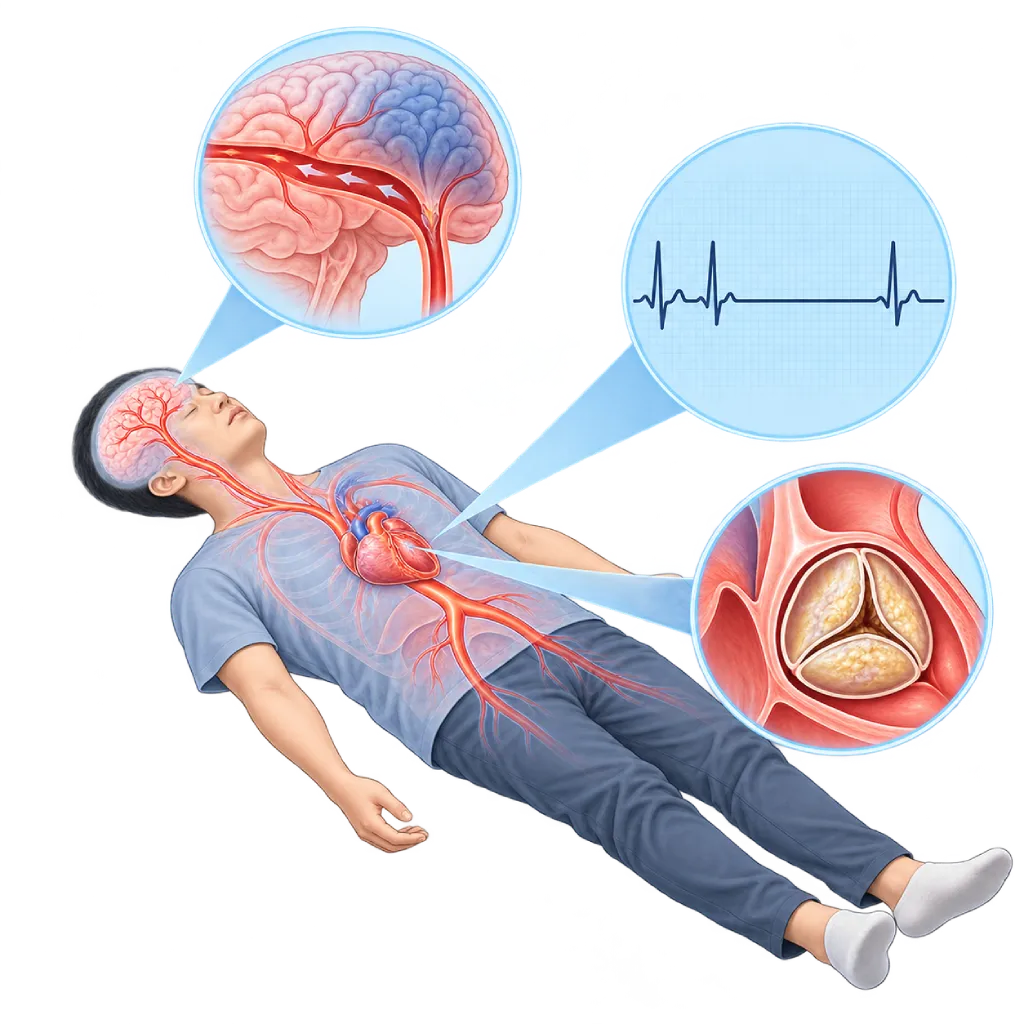
Syncope, or fainting, is a brief loss of consciousness caused by reduced blood flow to the brain, followed by a quick recovery on its own. Most cases are caused by a harmless reflex, but some come from heart problems that need to be checked.
SourcesSigns That Need Urgent Help
- Fainting during exercise or while lying down
- Sudden fainting without warning signs
- A pounding heartbeat, chest pain, or shortness of breath before or after fainting
- Not waking up quickly, or not breathing normally
- Slurred speech, weakness on one side of the body, or a severe headache after waking up
- A head injury or bleeding after a fall
- Fainting in a person with heart disease or a pacemaker
- A family member who died suddenly at a young age
If these signs appear, go to the nearest emergency department right away or call Heart Attack Center 1500 258.
01 / Understanding the condition
About Syncope
Syncope is a brief loss of consciousness caused by reduced blood flow to the brain. It happens quickly, lasts a short time, usually less than one minute, and consciousness returns fully on its own. Because the muscles lose their strength, the body falls or slumps. Fainting is different from seizures, stroke, low blood sugar, or head injury, which can also make a person unconscious but have other causes and treatments. This page helps you recognize possible causes and warning signs; it is not meant for working out the cause on your own.
Three Groups of Causes
The 2018 ESC guidelines divide syncope into three groups. The first is reflex syncope, which many people experience: a nerve reflex makes the blood vessels widen and the heart rate slow down, for example when standing for a long time, seeing blood, feeling pain, or after coughing or urinating. The type triggered by prolonged standing and emotions is covered on the Vasovagal Hypotension page. The second is syncope from a drop in blood pressure on standing, due to dehydration, blood pressure medicines, or autonomic nerve problems in diabetes and Parkinson's disease, covered on the Orthostatic Hypotension page. The third is cardiac syncope, meaning fainting caused by a heart problem, such as a heart rate that is too slow or too fast, narrowing of the aortic valve, hypertrophic cardiomyopathy, or a blood clot in the lungs.
Why Cardiac Syncope Needs to Be Recognized
Reflex and orthostatic syncope are usually not life-threatening, although they can cause injury from a fall. Cardiac syncope is different: fainting can be a warning before a more dangerous rhythm disorder. Signs that point to the heart include fainting during exercise or while lying down, fainting without warning signs, palpitations before fainting, existing heart disease, and family members who died suddenly at a young age.
For every person who faints, the doctor tries to answer two questions: was the event really syncope, and are there any high-risk signs? An account from someone who saw the event is very helpful, and an ECG is done for everyone who faints. People at low risk can usually have further evaluation as outpatients, while those at high risk need prompt testing in the hospital.
02 / Understanding the condition
Symptoms to Recognize.
Common Symptoms
- Feeling lightheaded, nauseated, or sweaty before fainting
- Vision that narrows, blurs, or goes dark
- A pale face and a limp body, then falling
- A brief loss of consciousness, usually less than one minute
- Quick recovery with immediate awareness of the surroundings
- Brief muscle jerks while unconscious
- Tiredness or weakness for a while after waking up
Symptoms in Older Adults
In older adults, fainting is often not remembered and looks like an ordinary fall, so its cause is easily missed.
- Sudden falls without remembering how they happened
- Fainting after eating, urinating, or getting up from sitting
- Very brief or no warning signs
- Injuries from falls happen more often
03 / Understanding the condition
What Causes This Condition?
- A vasovagal reflex from prolonged standing, heat, pain, fear, or seeing blood
- A situational reflex after coughing, straining, urinating, or swallowing
- A drop in blood pressure on standing due to dehydration, medicines, or autonomic nerve problems
- A heart rate that is too slow, for example from heart block or sinus node disease
- A heart rate that is too fast, for example ventricular tachycardia or supraventricular tachycardia
- Narrowing of the aortic valve, hypertrophic cardiomyopathy, or other blockages of blood flow out of the heart
- A blood clot in the lungs, a heart attack, or a tear in the aorta
- Inherited rhythm disorders, such as long QT syndrome or Brugada syndrome
04 / Understanding the condition
Who Is at Higher Risk?
Lifestyle
Not drinking enough, skipping meals, lack of sleep, alcohol, and standing for long periods without moving make reflex fainting more likely.
Medical
Structural heart disease, heart failure, rhythm disorders, diabetes, Parkinson's disease, and kidney disease raise the chance of a more serious cause.
Genetic
A family history of sudden death at a young age, cardiomyopathy, or inherited rhythm disorders.
Age
Reflex syncope often first appears in teenagers and young adults; in older adults, orthostatic and heart causes are found more often.
Other
Blood pressure medicines, diuretics, medicines that prolong the QT interval, pregnancy, and recovery after illness or bleeding.
Groups at Higher Risk
- Older Adults: More often faint because of heart problems or a drop in blood pressure on standing, and falls more easily cause broken bones.
- People with Heart Disease: Fainting in people with cardiomyopathy, valve disease, or a history of heart attack should be considered high risk until proven otherwise.
- Athletes and Active Teenagers: Fainting during exercise needs to be checked to rule out a congenital heart abnormality or a rhythm disorder.
- Drivers and Workers in High-Risk Jobs: Fainting while driving, working at heights, or working with machinery can endanger you and other people; your doctor will discuss safety with you.
- People Taking Blood Pressure Medicines: These medicines, especially in combination or after a dose increase, can trigger fainting when standing.
05 / Understanding the condition
How Is It Diagnosed?
According to the 2018 ESC guidelines, the initial evaluation consists of the history of the event, a physical exam, blood pressure measurements lying down and standing, and an ECG. The doctor asks about your position and activity when you fainted, warning signs, how long you were unconscious, how you felt after waking up, your medicines, any heart disease, and your family history. An account from someone who saw the event is very helpful. From these steps, the cause can often already be identified, and the doctor assesses whether the risk is low or high.
If a heart cause is suspected, tests are chosen based on the suspected cause: rhythm monitoring in the hospital, a Holter monitor or rhythm recorder for several days, echocardiography to assess the valves and heart muscle, an exercise test if fainting happened during exercise, and an electrophysiology study in certain situations. For fainting that is rare but recurrent, a recorder under the skin can record the rhythm for two to three years. A tilt table test helps confirm reflex syncope or orthostatic hypotension when the history is unclear.
Electrocardiogram (ECG)
Done for everyone who faints, to look for a slow heart rate, conduction problems, fast rhythms, or signs of an inherited rhythm disorder.
Physical Examination
Includes blood pressure measured lying down and then standing for up to three minutes to identify orthostatic hypotension, and listening for heart murmurs.
Echocardiography
A heart ultrasound if structural heart disease is suspected, such as narrowing of the aortic valve or cardiomyopathy.
Holter Monitoring
A rhythm recording over 24 to 48 hours if fainting or near-fainting happens fairly often.
Implantable Loop Recorder (ILR)
A recorder under the skin for rare, recurrent fainting with no clear cause yet.
Treadmill Stress Test
An exercise test if fainting happens during or right after exercise.
Electrophysiology Study
A test of the heart's electrical system from inside the heart in people with a previous heart attack or certain conduction problems, when other tests have not confirmed the cause.
06 / Understanding the condition
Treatment Options.
Treatment is decided by a doctor after an assessment. The categories below can help you follow the conversation with your doctor.
Education and Recognizing Triggers
In reflex syncope, the main step is understanding that this condition is usually not dangerous, recognizing warning signs, avoiding triggers, and drinking enough fluids.
Counterpressure Maneuvers
When warning signs appear, cross your legs while tensing your muscles, clench both fists, or squat and lie down right away.
Medication Review
Blood pressure medicines or other medicines that trigger fainting can be reduced or changed by your doctor. Do not stop your medicines on your own.
Pacemaker
If fainting is shown to be caused by a heart rate that is too slow or by recorded pauses in the heartbeat, the doctor may implant a pacemaker.
Ablation or ICD
If fainting is caused by a rhythm that is too fast, the doctor may perform ablation or implant an ICD, depending on the type of rhythm disorder and the condition of the heart.
Treating Structural Heart Disease
Narrowing of the aortic valve that causes fainting is treated with valve replacement by surgery or catheter; other causes are treated according to their type.
07 / Understanding the condition
Complications to Watch For.
Injuries from Falls
Sudden fainting can cause wounds, broken bones, or head injuries, especially in older adults and when there are no warning signs.
Accidents While Driving or Working
Fainting while driving, working at heights, or operating machinery can endanger you and other people.
Cardiac Arrest in Cardiac Syncope
Fainting caused by a rhythm disorder or structural heart disease can be a warning before cardiac arrest if the cause is not treated.
Anxiety and Limited Activity
Repeated fainting can make a person afraid to be active, stand for long periods, or leave the house, lowering their quality of life.
08 / Understanding the condition
What Can You Do?
- Learn the warning signs and sit or lie down right away when you feel them.
- Drink enough water, especially in hot weather, during exercise, or when you are ill.
- Get up slowly from lying down or sitting, especially in the morning and after meals.
- When standing for long periods, work your calf muscles or change position regularly.
- Do not change your blood pressure medicines on your own; talk to your doctor if you often feel dizzy when standing.
- Avoid excessive alcohol, especially in hot places.
- If you have fainted without a clear cause, do not drive until you have been checked by a doctor.
09 / Understanding the condition
When Should You See a Doctor?
Any first-time fainting episode should be checked by a doctor. Call an ambulance (119) or go to the emergency room right away if fainting happens during exercise or while lying down, is preceded by palpitations or chest pain, or if the person does not wake up quickly. Make an appointment with a doctor if you have any of the following.
- Repeated fainting, or fainting that is becoming more frequent
- Often nearly fainting when standing
- Fainting that causes an injury
- Fainting after starting a new medicine
- You have heart disease, diabetes, or Parkinson's disease
- You work as a driver or in a place where fainting would be dangerous
Don't Wait in an Emergency.
If symptoms are severe or come on suddenly, go to the nearest emergency department right away or call Heart Attack Center 1500 258, rather than waiting for an appointment.
10 / Common questions
Questions You May Have.
Common questions about syncope, or fainting.
What should I do if I see someone faint?
If there is no injury, lay the person on their back and raise both legs to help blood return to the brain. Loosen tight clothing, check whether they are breathing, and do not make them stand up right away. If they do not wake up within one to two minutes, are not breathing normally, or fainted during exercise, call an ambulance (119). If they are not breathing normally, start chest compressions in the center of the chest.
Does fainting mean I have a heart problem?
Not always. The majority of fainting episodes are caused by a nerve reflex or a drop in blood pressure on standing, which is usually not dangerous. However, some fainting comes from rhythm disorders or structural heart disease. Fainting during exercise, while lying down, without warning signs, or in people with heart disease needs a more careful evaluation to look for a heart cause.
How is fainting different from a seizure?
Fainting is often preceded by a floating feeling, nausea, sweating, and vision going dark, and the person becomes fully alert again within a short time. Muscle jerks can occur, but only for a few seconds. In an epileptic seizure, the jerking usually lasts longer, the side of the tongue may be bitten, and the person stays confused for quite a while afterward. A video recording or a witness account helps the doctor tell the two apart.
Can I drive after fainting?
Do not drive until you have been checked by a doctor. The decision depends on the cause of the fainting, whether there were warning signs, and whether the cause has been treated. With infrequent reflex fainting, driving a private vehicle is usually still possible, while with fainting caused by a rhythm disorder, the doctor usually asks you to wait until treatment has worked. Professional drivers require stricter consideration.
Why does the doctor need to use a rhythm recorder?
The cause of fainting often only becomes clear when the heart rhythm is recorded at the exact time of the event. Because fainting can be infrequent, a short recording at the clinic is often normal. A Holter monitor records for one to two days, a patch recorder for several weeks, and a recorder under the skin can work for two to three years. The choice of device depends on how often symptoms occur and how strongly a heart cause is suspected.
Should a child or teenager who faints see a cardiologist?
The majority of fainting episodes in children and teenagers are reflex fainting, for example during a ceremony or when seeing blood. However, a heart evaluation is needed if a child faints during exercise or swimming, when startled, while lying down, after palpitations, or if a family member died suddenly at a young age, because these signs can point to a congenital heart abnormality or a rhythm disorder.
Sources and Medical Review
Translated from the Indonesian edition medically reviewed by Dr. dr. Dicky A. Hanafy, Sp.JP(K).
Sources as cited in the Indonesian edition.
- Brignole M, Moya A, de Lange FJ, Deharo JC, Elliott PM, Fanciulli A, et al. 2018 ESC Guidelines for the diagnosis and management of syncope. Eur Heart J. 2018;39(21):1883-1948.
- Brignole M, Moya A, de Lange FJ, Deharo JC, Elliott PM, Fanciulli A, et al. Practical Instructions for the 2018 ESC Guidelines for the diagnosis and management of syncope. Eur Heart J. 2018;39(21):e43-e80.
- Shen WK, Sheldon RS, Benditt DG, Cohen MI, Forman DE, Goldberger ZD, et al. 2017 ACC/AHA/HRS guideline for the evaluation and management of patients with syncope: a report of the American College of Cardiology/American Heart Association Task Force on Clinical Practice Guidelines and the Heart Rhythm Society. Circulation. 2017;136(5):e60-e122.
- Zeppenfeld K, Tfelt-Hansen J, de Riva M, Winkel BG, Behr ER, Blom NA, et al. 2022 ESC Guidelines for the management of patients with ventricular arrhythmias and the prevention of sudden cardiac death. Eur Heart J. 2022;43(40):3997-4126.
- Freeman R, Wieling W, Axelrod FB, Benditt DG, Benarroch E, Biaggioni I, et al. Consensus statement on the definition of orthostatic hypotension, neurally mediated syncope and the postural tachycardia syndrome. Clin Auton Res. 2011;21(2):69-72.
- Thiruganasambandamoorthy V, Kwong K, Wells GA, Sivilotti MLA, Mukarram M, Rowe BH, et al. Development of the Canadian Syncope Risk Score to predict serious adverse events after emergency department assessment of syncope. CMAJ. 2016;188(12):E289-E298.
Doctors Who Treat This Condition

dr. Sunu B. Raharjo, Sp.JP(K), Ph.D.
Arrhythmia and Electrophysiology
Arrhythmia and Device Center
Clinical focusClinical and Interventional Electrophysiology · Cardiac Arrhythmia Ablation
View Profile
Dr. dr. Dicky A. Hanafy, Sp.JP(K)
Arrhythmia and Electrophysiology
Arrhythmia and Device Center +1 center
Clinical focusElectrophysiology and Arrhythmia Ablation · Pacemaker and ICD Implantation
View Profile
dr. Indah A. Putri, Sp.N, Subsp, NIOO(K), MSc
Neurovascular, Interventional, Otology, Imaging, and Ophthalmology
Clinical focusStroke and Cerebrovascular Disease · Neurosonology
View Profile