
Quick answer
What Is Implantable Cardioverter Defibrillator?
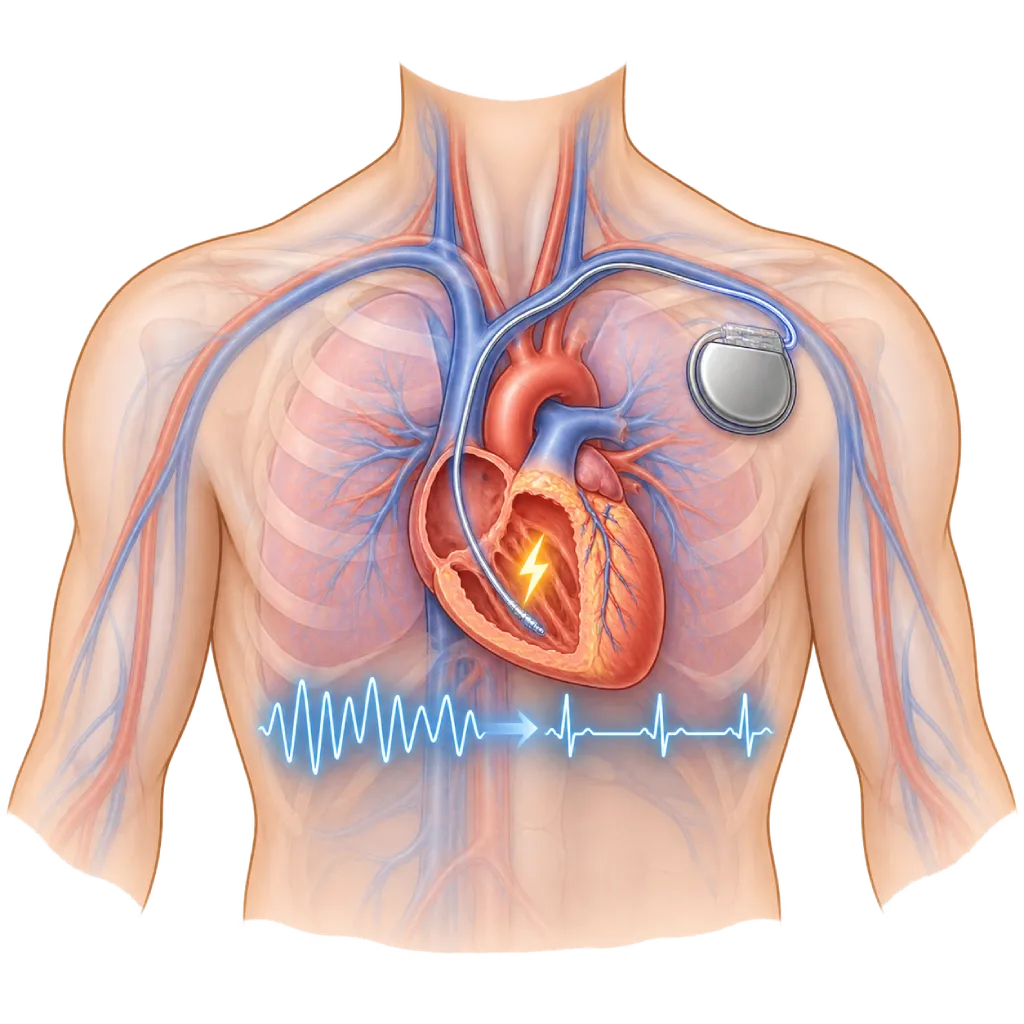
An ICD is a small device implanted under the skin of the chest and connected to the heart by a wire. It monitors the rhythm continuously and stops a very fast, dangerous ventricular rhythm with rapid pacing or an electrical shock to prevent sudden death. Implantation under local anesthesia takes about 1 to 2 hours.
Sources01 / Understanding the procedure
About Implantable Cardioverter Defibrillator
What Is an ICD
An ICD, short for implantable cardioverter defibrillator, is a battery-powered device implanted under the skin of the chest to prevent sudden cardiac death. Sudden death is usually caused by a very fast or chaotic rhythm in the ventricles, namely ventricular tachycardia or ventricular fibrillation, so the heart can no longer pump blood. An ICD recognizes these rhythms within seconds and tries to stop them. This condition is covered on the Sudden Cardiac Death page.
How It Works in Brief
The generator contains a battery and electronic circuitry, while the lead (wire), whose tip sits in the right ventricle, records every heartbeat. If a fast ventricular rhythm is detected, the ICD can first try rapid pacing, which is usually painless. If this does not work or the rhythm is very chaotic, the ICD delivers an electrical shock to restore a normal rhythm. An ICD also paces the heart when the heartbeat is too slow and stores rhythm recordings for the doctor to review.
Who Needs an ICD
There are two groups. First, people who have survived cardiac arrest or had severe ventricular tachycardia without a reversible cause; this is called secondary prevention. Second, people who have never had these events but are at high risk, especially if the heart's pumping strength, called the ejection fraction, remains 35 percent or less after about 3 months of guideline-based heart failure treatment; this is called primary prevention. Some inherited heart diseases, such as high-risk hypertrophic cardiomyopathy, long QT syndrome, or Brugada syndrome, can also be a reason.
Types of ICDs
A transvenous ICD uses a lead inserted through a vein into the right ventricle. A subcutaneous (under-the-skin) ICD uses a lead placed under the skin beside the breastbone, with no lead inside the heart, but it cannot pace the heart over the long term. In heart failure with certain conduction disorders, an ICD can be combined with a resynchronization device into a CRT-D, which is covered on the Cardiac Resynchronization Therapy (CRT) page.
What You Should Know
An ICD does not prevent arrhythmias from occurring and does not cure the underlying heart disease. Heart failure medicines and rhythm medicines are still needed, as covered on the Heart Failure Management page. The decision to implant an ICD should be made together, including discussing shocks, driving rules, and your overall health.
02 / Understanding the procedure
When Is This Procedure Considered?
A doctor may consider this procedure in the situations below. The decision is always made after a thorough assessment.
- Survived Cardiac ArrestCardiac arrest due to ventricular fibrillation or ventricular tachycardia without a reversible cause.
- Severe Ventricular TachycardiaA fast ventricular rhythm that causes fainting or a drop in blood pressure.
- Persistently Weak Heart PumpAn ejection fraction of 35 percent or less despite about 3 months of heart failure treatment.
- High-Risk CardiomyopathyFor example, hypertrophic or arrhythmogenic cardiomyopathy with risk factors for sudden death.
- Inherited Electrical Heart DisordersSuch as long QT syndrome or Brugada syndrome with fainting caused by arrhythmias.
Situations to Consider First
- Reversible CauseFor example, a heart attack within the first 48 hours or a potassium disorder; the cause is treated first.
- Recent Heart AttackFor primary prevention, implantation is usually postponed for about 6 weeks, then the pumping strength is reassessed.
- Life Expectancy of Less Than 1 YearFor example, due to another serious illness, so the benefit of an ICD is small.
- Active InfectionImplantation is postponed until the infection is treated to prevent device infection.
- Ventricular Tachycardia That Keeps RecurringA fast rhythm that keeps coming back is treated first with medicines or ablation so it does not trigger repeated shocks.
03 / Before the procedure
How Should You Prepare?
ICD implantation is usually scheduled, except after cardiac arrest while the patient is still in the hospital. The doctor explains the reason for implantation, the type of ICD, and what happens when the device delivers a shock.
Fasting. Usually no food or drink for about 6 hours before the procedure.
Blood thinners. The dose is adjusted according to your doctor's instructions; do not stop them on your own.
Tests before the procedure. Blood tests, an ECG, and echocardiography to assess the heart's pumping strength, which is covered on the Echocardiography page.
Preventing infection. The skin of your chest is cleaned and antibiotics are given through an IV line about 1 hour before the procedure. Tell the team if you have a fever or are unwell.
Work and driving. Tell the team about your job, especially if you drive a public transport vehicle, because there are driving rules after implantation.
Unsure about the preparation instructions? Ask our team before the procedure.
04 / During the procedure
How Is the Procedure Done?
Implantation is done in the catheterization lab or a procedure room and takes about 1 to 2 hours. The skin below the collarbone is numbed with local anesthesia and you are given a sedative. A subcutaneous ICD is often implanted with deeper sedation or general anesthesia.
Creating the Device Pocket
The doctor makes a small incision below the collarbone, usually on the left side, then forms a pocket under the skin or the chest muscle.
Placing the Leads
A lead is advanced through a vein to the right ventricle under X-ray guidance, sometimes with an additional lead in the right atrium. The doctor measures the heart's signals and the strength of stimulation needed.
Connecting and Programming the Device
The leads are connected to the generator, the device is placed in the pocket, and the wound is stitched. The ICD is programmed for when to deliver rapid pacing or a shock. In some patients, the doctor tests the device by triggering a fast rhythm while you are deeply sedated.
05 / Benefits and risks
Benefits and Risks Should Be Discussed Together.
Every medical procedure has benefits and risks. Your doctor will explain both for your situation before the procedure.
Benefits You Can Expect
- Lower Risk of Sudden DeathIn selected patients, ICDs have been shown to reduce deaths compared with medicines alone.
- Painless Rapid PacingMany fast ventricular rhythms can be stopped with pacing before a shock is needed.
- Also Works as a PacemakerA transvenous ICD can pace the heart when the heartbeat is too slow.
- Rhythm Recordings for Your DoctorThe device stores arrhythmia recordings so treatment can be adjusted.
The benefits of a procedure are not a promise of a cure. Ask how the results will affect your care plan.
Risks You Should Know
- Unnecessary ShocksFor example, due to atrial fibrillation or a lead problem; reduced with appropriate device programming.
- Device InfectionRare; if it occurs, the entire device and leads usually need to be removed.
- Lead Displacement or Lead ProblemsMay require a repeat procedure; the condition of the leads is checked at every follow-up visit.
- Bruising or Blood-Filled SwellingMore likely in people taking blood thinners; usually improves with pressure.
- Air in the Chest CavityRare; this happens if the lung is punctured while finding the vein, and a chest tube is sometimes needed.
- Anxiety or Fear of ShocksMay affect patients and their families; counseling and support from the team can help.
Risks can differ from person to person. A full explanation and consent are given after an individual assessment.
06 / After the procedure
What Is Recovery Like?
Patients usually stay one night. Before you go home, the device is checked, a chest X-ray is taken, and you receive a device identification card.
Wound and arm. Keep the wound dry for about 1 week. Avoid raising the arm on the device side above your shoulder and avoid heavy lifting for about 4 to 6 weeks.
If you receive a shock. A shock feels like a strong jolt in the chest for an instant. If it happens only once and you feel well, contact the team to schedule a device check.
Driving. The waiting period differs depending on the reason for implantation, usually about 1 week for primary prevention and about 3 months after cardiac arrest or after receiving a shock. Rules for public transport drivers are stricter.
Device checks. Regular checks at the clinic and from home, which are covered on the Remote Heart Monitoring page. The battery usually lasts about 6 to 10 years.
Emotional support. Feeling anxious after implantation or after a shock is normal. Talk with the team; support from family and counseling can help.
Warning signs to watch for. Go to the emergency room right away if you experience:
- Two or more shocks within 24 hours
- A shock with chest pain, shortness of breath, or fainting
- A wound that is red, swollen, or oozing pus, or accompanied by fever
- Swelling at the device pocket that keeps getting bigger
- Sudden shortness of breath or chest pain
Know the Signs That Need Prompt Care.
Follow the team's guidance on warning signs. If severe or sudden symptoms appear after the procedure, go to the nearest emergency department right away or call Heart Attack Center 1500 258.
07 / Team and support
Doctors and Procedure Support
The doctors below are listed for this procedure. Listed by name, not by ranking.

Dr. dr. Dicky A. Hanafy, Sp.JP(K)
Arrhythmia and Electrophysiology
Arrhythmia and Device Center +1 center
Clinical focusElectrophysiology and Arrhythmia Ablation · Pacemaker and ICD Implantation
View Profile
Dr. dr. Faris Basalamah, Sp.JP(K)
Interventional Cardiology
Coronary Intervention Procedures +1 center
Clinical focusComplex Coronary Intervention · Cardiac Electrophysiology
View Profile
dr. Sunu B. Raharjo, Sp.JP(K), Ph.D.
Arrhythmia and Electrophysiology
Arrhythmia and Device Center
Clinical focusClinical and Interventional Electrophysiology · Cardiac Arrhythmia Ablation
View ProfileElectrophysiology (EP) Laboratory
A dedicated procedure room for electrophysiology studies, catheter ablation, and implantation of heart rhythm devices such as…
The availability of technology and test support is confirmed with the team. Technology is chosen according to clinical need.
08 / Common questions
Before You Plan the Procedure.
Frequently asked questions about ICDs and living with this device.
What does an ICD shock feel like?
Many patients describe it as a strong jolt or kick in the chest that lasts an instant. It is startling, but it passes quickly. If you have already fainted because of a very fast rhythm, you may not feel the shock. A person touching you during a shock may feel a slight tingle, but it is not harmful to them. Rapid pacing to stop a rhythm is usually painless.
What should I do if my ICD delivers a shock?
If you receive one shock and then feel well, sit or lie down, then contact the team to schedule a device check. Go to the emergency room right away or call emergency services if you receive two or more shocks within 24 hours, or if a shock comes with chest pain, shortness of breath, or fainting. Your family should also know these steps.
What is the difference between an ICD and a pacemaker?
A pacemaker only treats a heartbeat that is too slow. An ICD can also pace a slow heartbeat, but its main job is to recognize and stop a very fast, dangerous ventricular rhythm with rapid pacing or an electrical shock. An ICD is slightly larger, and the implantation is similar. Pacemakers are covered on the Pacemaker Implantation page.
Can I still drive?
Yes, but there is a waiting period. It is usually about 1 week if the ICD was implanted for primary prevention, and about 3 months if you have had cardiac arrest, severe ventricular tachycardia, or a shock due to an arrhythmia. Drivers of public transport and goods vehicles have stricter rules. Ask your doctor, because the rules depend on your situation.
Can the ICD shock function be turned off?
Yes, without surgery, using a programming device. The shock function can be temporarily deactivated, for example during another operation that uses electrical cutting equipment. In serious illness near the end of life, patients and families can discuss deactivating the shock function with the doctor so that painful shocks do not occur. The pacing function can still be kept on.
Can I be active and exercise with an ICD?
The majority of daily activities can be done once the wound has healed. Light to moderate exercise is usually safe and beneficial, while sports with impacts to the chest or heavy arm movements need to be discussed with your doctor. Avoid activities that are dangerous if you suddenly faint, such as swimming alone or climbing to heights. Ask the team about a suitable exercise program.
Sources and Medical Review
Translated from the Indonesian edition medically reviewed by Dr. dr. Dicky A. Hanafy, Sp.JP(K).
Sources as cited in the Indonesian edition.
- Zeppenfeld K, Tfelt-Hansen J, de Riva M, et al. 2022 ESC Guidelines for the management of patients with ventricular arrhythmias and the prevention of sudden cardiac death. Eur Heart J. 2022;43(40):3997-4126.
- Al-Khatib SM, Stevenson WG, Ackerman MJ, et al. 2017 AHA/ACC/HRS Guideline for Management of Patients With Ventricular Arrhythmias and the Prevention of Sudden Cardiac Death. Circulation. 2018;138(13):e272-e391.
- McDonagh TA, Metra M, Adamo M, et al. 2021 ESC Guidelines for the diagnosis and treatment of acute and chronic heart failure. Eur Heart J. 2021;42(36):3599-3726.
- Moss AJ, Zareba W, Hall WJ, et al. Prophylactic Implantation of a Defibrillator in Patients with Myocardial Infarction and Reduced Ejection Fraction. N Engl J Med. 2002;346(12):877-883.
- Bardy GH, Lee KL, Mark DB, et al. Amiodarone or an Implantable Cardioverter-Defibrillator for Congestive Heart Failure. N Engl J Med. 2005;352(3):225-237.
- Moss AJ, Schuger C, Beck CA, et al. Reduction in Inappropriate Therapy and Mortality through ICD Programming. N Engl J Med. 2012;367(24):2275-2283.
- Knops RE, Olde Nordkamp LRA, Delnoy PPHM, et al. Subcutaneous or Transvenous Defibrillator Therapy. N Engl J Med. 2020;383(6):526-536.