
Quick answer
What Is Implantable Loop Recorder?
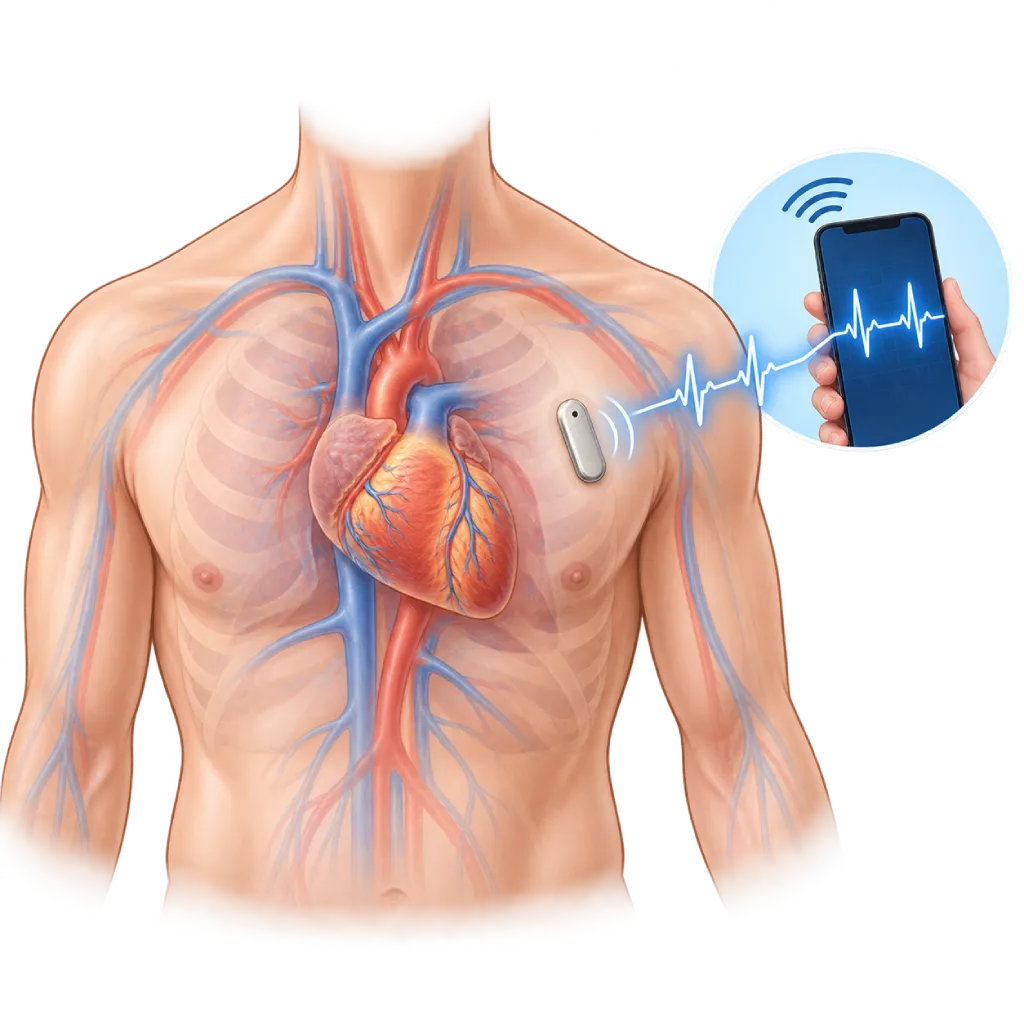
An implantable loop recorder (ILR) is a heart rhythm recorder the size of a small flash drive, placed under the skin of the chest through a small incision with local anesthesia. The procedure takes about 10 to 20 minutes. The device records your rhythm for about 3 years to find the cause of rare fainting, palpitations, or atrial fibrillation.
Sources01 / Understanding the procedure
About Implantable Loop Recorder
What Is an Implantable Loop Recorder
An implantable loop recorder, abbreviated ILR, is a very small ECG recorder placed just under the skin of the chest. It records the heart rhythm continuously for about 3 years, and some types last longer. Its purpose is to capture rhythm problems that rarely occur, for example fainting that happens only a few times a year, which are hard to capture with a standard ECG or a Holter worn for 24 to 48 hours.
How It Works in Brief
Two electrodes on the body of the device pick up the heart's electrical signals from under the skin. The device stores recordings in a rotating memory, or loop: old recordings are erased unless there is an important event. Recordings are saved automatically when the device detects a heartbeat that is too slow, a long pause, a heartbeat that is too fast, or atrial fibrillation. You can also save a recording when symptoms occur using a handheld activator or a phone app.
Who Needs It
Guidelines on syncope (fainting) recommend an ILR for recurrent fainting whose cause is still unclear after initial tests, especially if it is suspected to come from a rhythm problem. An ILR is also recommended for people at high risk whose cause of fainting has not been found after a complete evaluation and who do not yet have a reason for a pacemaker or ICD. In addition, an ILR is used for palpitations that are rare but bothersome and to look for atrial fibrillation after a stroke whose cause has not been found. Other recorder options are covered on the Long-Term Heart Rhythm Monitoring page.
A Short Procedure with Local Anesthesia
Placement is done with local anesthesia through an incision of about 1 cm on the left side of the chest, usually in a procedure room or catheterization laboratory. The device is inserted under the skin with a special insertion tool, then the wound is closed with sterile strips, skin glue, or one to two stitches. Patients generally go home the same day.
Data from Home
The majority of ILRs today send data to the clinic through a bedside transmitter or a phone app, which is covered on the Remote Heart Monitoring page. The data is reviewed according to the clinic's schedule, so an ILR is not an emergency device. When the cause of symptoms has been found or the battery runs out, the device can be removed with a similar small procedure.
02 / Understanding the procedure
When Is This Procedure Considered?
A doctor may consider this procedure in the situations below. The decision is always made after a thorough assessment.
- Recurrent Fainting with No Clear CauseWhen initial tests have not found the cause and it is suspected to come from the heart rhythm.
- Fainting in People at High RiskWhen a complete evaluation has not found the cause and there is no reason yet for a pacemaker or ICD.
- Rare but Bothersome PalpitationsWhen a Holter or external recorder has not captured the rhythm during symptoms.
- Looking for Atrial Fibrillation After a StrokeIn a stroke whose cause has not been found after standard tests.
- Seizures Suspected to Be Epilepsy That Do Not ImproveWhen seizures do not improve with epilepsy medicines, to look for a cause in the heart rhythm.
Situations to Consider First
- Skin Infection or Active InfectionPlacement is postponed until the infection clears to prevent infection of the device wound.
- Cause of Fainting Already ClearWhen the cause is known, direct treatment is more appropriate than further recording.
- Already Needs a Pacemaker or ICDWhen there is already a reason to place such a device, an ILR is usually not needed.
- Fainting That Needs Urgent CareFainting during activity, with chest pain, or with shortness of breath requires hospital care first.
- Taking Blood ThinnersThey usually do not need to be stopped, but your doctor needs to know in order to reduce the risk of bruising.
03 / Before the procedure
How Should You Prepare?
ILR placement is a minor procedure that generally does not require a hospital stay.
Eating and drinking. You generally do not need to fast because only local anesthesia is used. Follow the team's instructions if you are told otherwise.
Medicines. Bring a list of your medicines. Tell the team if you take blood thinners; they usually do not need to be stopped, but your doctor decides.
Allergies. Tell the team if you are allergic to anesthetics, antibiotics, adhesive tape, or antiseptic solutions.
Hygiene. Shower before you come and do not use lotion on your chest.
Phone. If the device uses a phone app, bring your phone fully charged so the app can be paired with the device.
Unsure about the preparation instructions? Ask our team before the procedure.
04 / During the procedure
How Is the Procedure Done?
ILR placement is done in a procedure room or catheterization laboratory with local anesthesia. The procedure itself takes about 10 to 20 minutes, and you stay awake throughout.
Choosing the Position
Your doctor chooses the position of the device on the left side of the chest, usually to the left of the breastbone, and sometimes checks the signal quality on the skin first. The skin is cleaned with antiseptic and covered with sterile drapes.
Local Anesthesia and a Small Incision
The skin is numbed with a small injection. Once the area is numb, your doctor makes an incision of about 1 cm.
Inserting the Device
The device is inserted under the skin with a special insertion tool. You may feel pressure, but not pain. The rhythm signal is checked to make sure the recording is clear.
Closing the Wound and Setting Up the Device
The wound is closed with sterile strips, skin glue, or small stitches. The device is set up and paired with the transmitter or phone app, then you are shown how to save a recording when symptoms occur.
05 / Benefits and risks
Benefits and Risks Should Be Discussed Together.
Every medical procedure has benefits and risks. Your doctor will explain both for your situation before the procedure.
Benefits You Can Expect
- Records for YearsThe chance of capturing rare symptoms is much greater than with a Holter or external recorder.
- No Wires or AdhesiveThe device sits under the skin, so you can still shower, exercise, and sleep as usual.
- A Short Procedure with Local AnesthesiaA small incision, no hospital stay, and the device can be removed when it is no longer needed.
- Guides TreatmentThe recordings help decide on a pacemaker, ablation, medicines, or blood thinners.
- Data Can Be Sent from HomeThe majority of devices send recordings to the clinic without you having to come in.
The benefits of a procedure are not a promise of a cure. Ask how the results will affect your care plan.
Risks You Should Know
- Bruising or Pain at the WoundGenerally mild and goes away within a few days.
- Wound InfectionRare; if it happens, the device may need to be removed and antibiotics given.
- Device Shifting or Pushing Through the SkinRare; the device needs to be removed or placed again.
- False RecordingsThe device sometimes misreads the rhythm, for example because of muscle movement; your doctor checks every recording.
- Not an Emergency DeviceThe device records and sends data, but does not call for help in an emergency.
Risks can differ from person to person. A full explanation and consent are given after an individual assessment.
06 / After the procedure
What Is Recovery Like?
You can generally go home shortly after the procedure and return to light activities on the same day.
Wound. Keep the wound dry and covered as instructed, usually for a few days. Mild bruising and slight pain around the wound are normal and can be relieved with ordinary pain relievers.
Activity. Avoid lifting heavy objects and movements that press on the wound for a few days. You can resume normal showering as advised by the team.
Saving recordings. When you feel symptoms, use the activator or app as instructed, then note the time and your activity.
Follow-up visit. The wound is checked about 1 to 2 weeks after the procedure. Make sure the transmitter or app stays active so the data is sent.
Other tests. Carry your device ID card. The majority of ILRs are safe for MRI under certain conditions and safe to pass through airport metal detectors.
Warning signs to watch for. Go to the emergency room right away if you experience:
- Fainting, especially with injury or during activity
- Chest pain or severe shortness of breath
- Pus from the wound, increasing redness and swelling, or fever
- Bleeding from the wound that does not stop with pressure
Know the Signs That Need Prompt Care.
Follow the team's guidance on warning signs. If severe or sudden symptoms appear after the procedure, go to the nearest emergency department right away or call Heart Attack Center 1500 258.
07 / Team and support
Doctors and Procedure Support
The doctors below are listed for this procedure. Listed by name, not by ranking.

Dr. dr. Dicky A. Hanafy, Sp.JP(K)
Arrhythmia and Electrophysiology
Arrhythmia and Device Center +1 center
Clinical focusElectrophysiology and Arrhythmia Ablation · Pacemaker and ICD Implantation
View Profile
Dr. dr. Faris Basalamah, Sp.JP(K)
Interventional Cardiology
Coronary Intervention Procedures +1 center
Clinical focusComplex Coronary Intervention · Cardiac Electrophysiology
View Profile
dr. Sunu B. Raharjo, Sp.JP(K), Ph.D.
Arrhythmia and Electrophysiology
Arrhythmia and Device Center
Clinical focusClinical and Interventional Electrophysiology · Cardiac Arrhythmia Ablation
View ProfileElectrophysiology (EP) Laboratory
A dedicated procedure room for electrophysiology studies, catheter ablation, and implantation of heart rhythm devices such as…
The availability of technology and test support is confirmed with the team. Technology is chosen according to clinical need.
08 / Common questions
Before You Plan the Procedure.
Frequently asked questions about the implantable loop recorder (ILR).
Is ILR placement painful?
Placement uses local anesthesia, so all you feel is a small sting from the anesthetic injection and pressure when the device is inserted. You stay awake, and the procedure takes only about 10 to 20 minutes. After the anesthesia wears off, the wound may feel slightly sore and bruised for a few days, which can usually be managed with ordinary pain relievers.
Can the device be seen or felt from the outside?
The device sits just under the skin, so in some people it shows as a small bump or can be felt, especially in people with a slim build. The incision scar is small, about 1 cm. Most people do not notice the device in daily activities, and it does not interfere with clothing, showering, exercise, or sleep.
Is an ILR the same as a pacemaker?
No. An ILR only records the heart rhythm and does not deliver electrical stimulation or shocks. Pacemakers and ICDs are connected to the heart with wires and can treat rhythm problems. If the ILR finds a heartbeat that is too slow or a long pause that explains your fainting, your doctor may suggest a pacemaker, which is covered on the Pacemaker Implantation page.
Can I have an MRI or go through airport security?
The majority of ILRs used today are safe for MRI under certain conditions. Tell the MRI staff and show your device ID card so the type and settings can be checked first. Airport metal detectors are safe to walk through; show your card if asked. Mobile phones and household appliances generally do not interfere with the device.
How long does an ILR stay in place, and what happens when it is no longer needed?
The battery generally lasts about 3 years, and some types last longer. The device can be removed when the cause of symptoms has been found, the battery runs out, or your doctor decides that recording is no longer needed. Removal also uses local anesthesia and a similar small incision. In some people, an inactive device can be left in place if it causes no problems, after discussing it with your doctor.
What is the difference between an ILR and a Holter?
A Holter is an external recorder with wires and electrodes on the chest that is worn for 24 to 48 hours, suitable if symptoms occur almost every day. An ILR is placed under the skin and records for years, suitable if symptoms are rare but serious, such as fainting. Your doctor chooses the device based on how often symptoms occur. The Holter is covered on the Holter Monitoring page.
Sources and Medical Review
Translated from the Indonesian edition medically reviewed by Dr. dr. Dicky A. Hanafy, Sp.JP(K).
Sources as cited in the Indonesian edition.
- Brignole M, Moya A, de Lange FJ, et al. 2018 ESC Guidelines for the diagnosis and management of syncope. Eur Heart J. 2018;39(21):1883-1948.
- Shen WK, Sheldon RS, Benditt DG, et al. 2017 ACC/AHA/HRS Guideline for the Evaluation and Management of Patients With Syncope: A Report of the American College of Cardiology/American Heart Association Task Force on Clinical Practice Guidelines and the Heart Rhythm Society. Circulation. 2017;136(5):e60-e122.
- Brignole M, Vardas P, Hoffman E, et al. Indications for the use of diagnostic implantable and external ECG loop recorders. Europace. 2009;11(5):671-687.
- Sanna T, Diener HC, Passman RS, et al. Cryptogenic Stroke and Underlying Atrial Fibrillation. N Engl J Med. 2014;370(26):2478-2486.
- Van Gelder IC, Rienstra M, Bunting KV, et al. 2024 ESC Guidelines for the management of atrial fibrillation developed in collaboration with the European Association for Cardio-Thoracic Surgery (EACTS). Eur Heart J. 2024;45(36):3314-3414.
- Ferrick AM, Raj SR, Deneke T, et al. 2023 HRS/EHRA/APHRS/LAHRS expert consensus statement on practical management of the remote device clinic. Heart Rhythm. 2023;20(9):e92-e144.