
Quick answer
What Is Minor Stroke and TIA?
Minor stroke covers a transient ischemic attack (TIA), whose symptoms go away on their own, and an ischemic stroke with mild symptoms. Both are warning signs of a more severe stroke and need to be checked in the emergency room right away.
Sources01 / Understanding the condition
About Minor Stroke and TIA
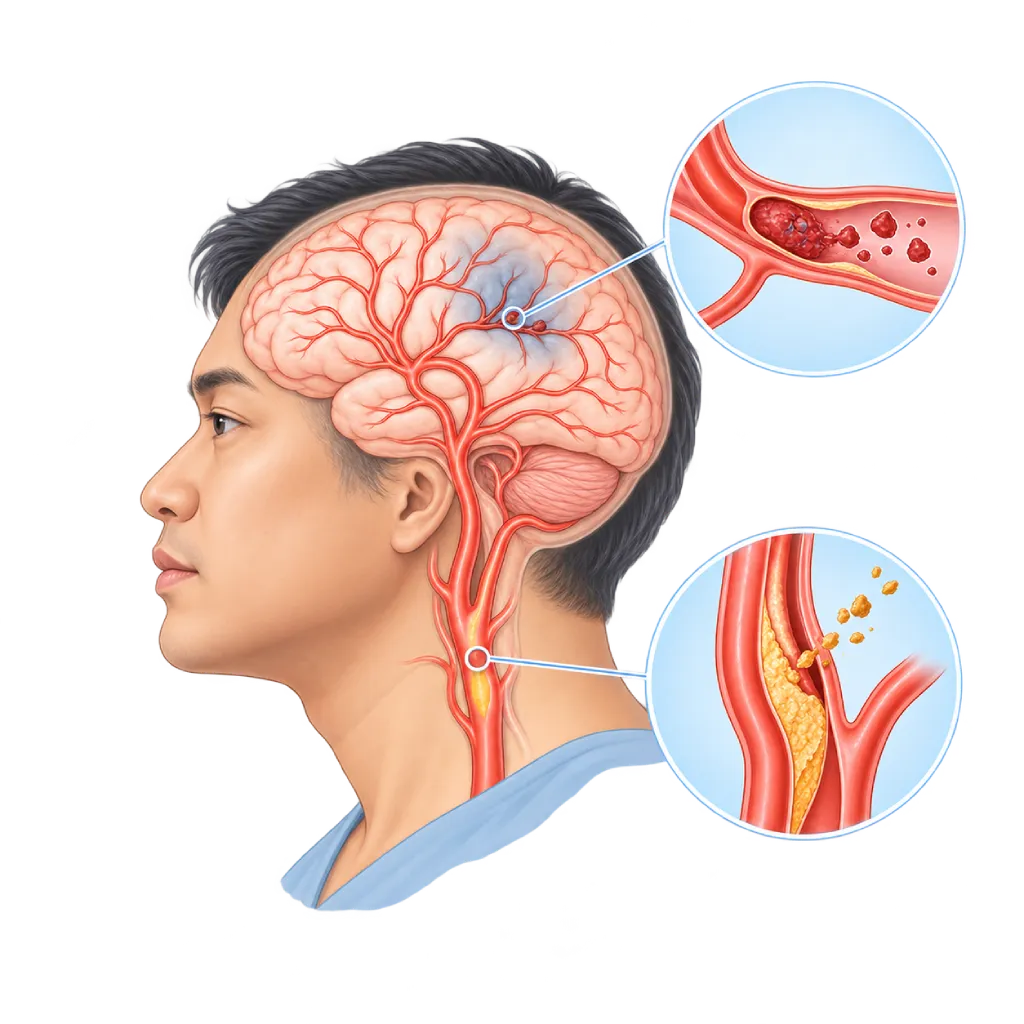
Minor stroke is a term for two closely related conditions. A transient ischemic attack (TIA) happens when blood flow to part of the brain or retina is briefly blocked and the symptoms then go away on their own, usually in less than an hour, with no brain damage on MRI. A minor ischemic stroke is a stroke with mild symptoms that do not interfere much with daily activities, but it has already left a small area of damage in the brain. An overview of stroke is covered on the Stroke page.
Mild Does Not Mean Safe
Brief or mild symptoms often lead people to delay seeing a doctor. In fact, a TIA or minor stroke is a warning sign that a larger blockage may follow, with the risk especially high in the first 48 hours to several days. The EXPRESS study in the United Kingdom showed that prompt testing and treatment lowered the risk of stroke within 90 days by about 80 percent. When symptoms start, no one can be sure whether they will go away or persist, so every stroke symptom is treated as an emergency.
Looking for the Cause, Including the Heart
The causes of TIA and minor stroke are the same as those of ischemic stroke in general: plaque in the carotid arteries or brain arteries, clots from the heart, and blockage of small blood vessels. Atrial fibrillation often comes and goes without symptoms, so the heart rhythm needs to be recorded for several days or longer, as covered on the Atrial Fibrillation page. In young people, doctors also look for an opening in the wall between the upper chambers of the heart, covered on the Patent Foramen Ovale page. Guidelines recommend starting these tests as soon as possible, ideally within the first 24 hours.
Early Treatment
Treatment is chosen based on the cause. If the source is not the heart, the 2021 AHA/ASA guideline recommends two antiplatelet medications for a short period in minor stroke or high-risk TIA, followed by a single medication. If the source is atrial fibrillation, an anticoagulant is used. Carotid artery narrowing that causes symptoms is considered for surgery, ideally within two weeks. Statins, blood pressure medication, and lifestyle changes complete the prevention plan. In a minor stroke with disabling symptoms, such as being unable to speak, clot-dissolving medication can still be considered, as covered on the Ischemic Stroke page.
02 / Understanding the condition
Symptoms to Recognize.
Common Symptoms
Symptoms appear suddenly and may go away within a few minutes. Even if they have gone away, these symptoms are still an emergency sign.
- A briefly drooping face or uneven smile
- Weakness or numbness in the arm or leg on one side
- Slurred speech or difficulty finding words
- Vision in one eye going dark like a curtain coming down, then returning
- Loss of part of the visual field in both eyes
- Spinning dizziness with unsteadiness or double vision
- Difficulty picking up objects with the hand, or uncoordinated movements
03 / Understanding the condition
What Causes This Condition?
- Cholesterol plaque in the carotid or brain arteries that releases small clots or narrows blood flow
- Clots from the heart, especially in atrial fibrillation
- Blockage of small blood vessels deep in the brain due to long-standing hypertension and diabetes
- A clot from a vein that crosses through an opening in the wall between the upper chambers, covered on the Patent Foramen Ovale page
- A tear in the wall of a neck artery (dissection), more common in young people
- Blood clotting disorders or blood vessel inflammation, which are less common
04 / Understanding the condition
Who Is at Higher Risk?
Medical
Hypertension, diabetes, high LDL cholesterol, atrial fibrillation, coronary artery disease, carotid artery narrowing, and a previous TIA or stroke.
Lifestyle
Smoking, lack of physical activity, a high-salt diet, obesity, and excessive alcohol. These factors can be changed, and controlling them lowers the risk of another stroke.
Age
The risk increases with age, especially after 60. The ABCD2 score, which doctors use to estimate risk after a TIA, gives extra points for age 60 and over.
Other
Breathing problems during sleep (sleep apnea), chronic kidney disease, and stimulant drug use also increase the risk of TIA and stroke.
Groups at Higher Risk
- People with Hypertension: High blood pressure is a major risk factor for TIA and stroke, and it is part of the stroke risk score used after a TIA.
- People with Atrial Fibrillation: Clots from the left upper chamber of the heart can cause a TIA. Blood thinners lower the risk of another stroke.
- People with Carotid Artery Narrowing: Plaque in a neck artery that has already caused symptoms can release clots again, especially in the first few weeks.
- People with Diabetes: Diabetes speeds up damage to small and large blood vessels, and it is part of the ABCD2 risk score.
- Older Adults: The risk increases with age, and many older adults have several risk factors at once.
05 / Understanding the condition
How Is It Diagnosed?
Because TIA symptoms have often gone away by the time you arrive at the hospital, doctors rely heavily on what you and your family describe: what symptoms appeared, when they started, how long they lasted, and whether they have happened before. Doctors also consider conditions that can mimic a TIA, such as low blood sugar, migraine with aura, seizures, or fainting. Simple scores such as ABCD2 help estimate risk, but they do not replace testing.
The main tests are a brain MRI, imaging of the blood vessels in the head and neck, an ECG, heart rhythm recording, and blood tests. Guidelines recommend doing these tests as soon as possible, ideally within 24 hours, so preventive treatment can start right away. An echocardiogram is added to look for a source of clots in the heart, especially if no other cause has been found.
A brain MRI with diffusion imaging to see small areas of damage that distinguish a minor stroke from a TIA, even after symptoms have gone away.
A head CT and CT angiography of the head and neck in the emergency room to rule out bleeding and look for narrowing or blockage.
Vascular Ultrasound
Ultrasound of the carotid and vertebral arteries in the neck to look for plaque and narrowing.
Electrocardiogram (ECG)
An immediate ECG in the emergency room to look for atrial fibrillation and signs of other heart disease.
Long-Term Heart Rhythm Monitoring
Rhythm recording over several days to several weeks if the first ECG is normal, to look for atrial fibrillation that comes and goes.
Echocardiography
An echocardiogram to look for clots, valve abnormalities, or a patent foramen ovale as a source of clots.
Blood Sugar Test
Blood sugar, HbA1c, and cholesterol tests to assess risk factors and rule out low blood sugar, which can mimic stroke symptoms.
06 / Understanding the condition
Treatment Options.
Treatment is decided by a doctor after an assessment. The categories below can help you follow the conversation with your doctor.
Prompt Testing and Treatment
Assessment in the emergency room within hours, so the cause is found quickly and preventive medication is started right away.
Short-Term Dual Antiplatelet Therapy
In minor stroke or high-risk TIA that does not come from the heart, two antiplatelet medications are given for several weeks, followed by a single medication. Your doctor decides the type and duration.
Anticoagulants
If the cause is atrial fibrillation or a clot from the heart, blood thinners (anticoagulants) are used long term. Your doctor decides when to start them.
Thrombolysis for Disabling Symptoms
If symptoms are still present and disabling, such as being unable to speak or walk, clot-dissolving medication can be considered within 4.5 hours of symptom onset.
Procedures on the Source of Clots
Carotid endarterectomy or stenting for narrowing that causes symptoms, ideally within two weeks, and patent foramen ovale closure in selected patients.
Statins and Risk Factor Control
Statins, blood pressure medication, blood sugar control, quitting smoking, and staying active to lower the risk of stroke and heart attack.
07 / Understanding the condition
Complications to Watch For.
A Subsequent Severe Stroke
A larger blockage can occur in the first few days if the source has not been treated. This risk goes down with prompt treatment.
Lasting Symptoms
In a minor stroke, some symptoms such as numbness, mild weakness, or difficulty finding words may persist and improve gradually with practice.
Fatigue and Difficulty Concentrating
Many minor stroke survivors tire easily, have trouble concentrating, or feel anxious even though they appear to have recovered. Tell your doctor about these symptoms so you can get help.
Heart Attack
A TIA or minor stroke often signals atherosclerosis in other blood vessels, including the coronary arteries. Controlling risk factors protects the brain and heart at the same time.
Bleeding from Medication
Dual antiplatelet therapy and anticoagulants increase the risk of bleeding, so they are used for the length of time your doctor sets.
08 / Understanding the condition
What Can You Do?
- Take your preventive medication every day as prescribed and do not stop it on your own
- Control your blood pressure according to your doctor's target and measure it regularly at home
- Keep your LDL cholesterol and blood sugar within target
- Quit smoking and limit alcohol
- Stay active for at least 150 minutes per week
- If you have atrial fibrillation, discuss blood thinners with your cardiologist
- Learn the stroke warning signs and go to the emergency room right away if symptoms come back
09 / Understanding the condition
When Should You See a Doctor?
A TIA or minor stroke needs emergency evaluation. If any stroke warning sign appears, call 119 or go to the nearest emergency room right away, even if the symptoms lasted only a few minutes and then went away. Note the time they started, and do not wait until the next day or your next scheduled checkup.
Make an appointment if:
- You had brief stroke symptoms a few weeks ago that have not been checked
- You have just come home after a TIA or minor stroke and need follow-up on the cause and your medications
- Your doctor recommends heart rhythm recording or echocardiography
- Your blood pressure, blood sugar, or cholesterol has not reached the target
10 / Common questions
Questions You May Have.
Frequently asked questions about TIA, minor stroke, and preventing another stroke.
My symptoms went away on their own within a few minutes. Do I still need to go to the emergency room?
Yes. Stroke symptoms that go away on their own are a TIA, a warning sign that a more severe stroke may follow, especially in the first few days. In the emergency room, doctors look for the cause and start preventive medication. Research shows that prompt treatment clearly lowers the risk of another stroke. Do not wait for the symptoms to return or for a scheduled checkup.
What is the difference between a TIA and a minor stroke?
In a TIA, the symptoms go away on their own and an MRI shows no brain damage. In a minor stroke, the symptoms are mild but an MRI shows a small area of damage, and some symptoms may persist. Both are caused by the same kinds of blockages and carry a risk of being followed by a more severe stroke, so their testing and treatment are nearly the same. An MRI helps your doctor tell them apart.
How high is the risk of stroke after a TIA?
The risk differs for each person. In an international registry published in 2016, about 5 percent of patients with a TIA or minor stroke who were treated quickly had a stroke within one year. This figure is lower than in older studies in which patients were not treated right away. The risk is higher if there is carotid artery narrowing, atrial fibrillation, or brain damage on MRI.
Why does my doctor give two antiplatelet medications only for a short time?
The POINT trial and similar studies showed that two antiplatelet medications started right away reduce recurrent stroke in the first few weeks, when the risk is high. If they are continued longer, the risk of bleeding starts to outweigh the benefit. That is why your doctor usually gives them for several weeks and then continues with a single medication. Do not stop, add, or extend medications on your own.
Why is my heart being checked after a TIA?
Some TIAs come from clots that form in the heart, especially in atrial fibrillation. This rhythm often comes and goes without symptoms, so a single ECG can be normal and recording over several days or longer is needed. An echocardiogram looks for clots, valve abnormalities, or a patent foramen ovale. The results determine the medication: an anticoagulant if the source is the heart, an antiplatelet if the source is plaque or small vessels.
Can you fully recover from a minor stroke?
Many people who have had a TIA or minor stroke return to their usual activities. Even so, some experience fatigue, difficulty concentrating, or anxiety for several months, and these symptoms should be reported to the doctor. The next important step is preventing another stroke with regular medication, controlled blood pressure and cholesterol, quitting smoking, and staying active.
Sources and Medical Review
Translated from the Indonesian edition medically reviewed by dr. Emanoel Oepangat, Sp.JP(K).
Sources as cited in the Indonesian edition.
- Kleindorfer DO, Towfighi A, Chaturvedi S, et al. 2021 Guideline for the Prevention of Stroke in Patients With Stroke and Transient Ischemic Attack: A Guideline From the American Heart Association/American Stroke Association. Stroke. 2021;52(7):e364-e467.
- Fonseca AC, Merwick Á, Dennis M, et al. European Stroke Organisation (ESO) guidelines on management of transient ischaemic attack. Eur Stroke J. 2021;6(2):CLXIII-CLXXXVI.
- Amin HP, Madsen TE, Bravata DM, et al. Diagnosis, Workup, Risk Reduction of Transient Ischemic Attack in the Emergency Department Setting: A Scientific Statement From the American Heart Association. Stroke. 2023;54(3):e109-e121.
- Dawson J, Béjot Y, Christensen LM, et al. European Stroke Organisation (ESO) guideline on pharmacological interventions for long-term secondary prevention after ischaemic stroke or transient ischaemic attack. Eur Stroke J. 2022;7(3):I-XLI.
- Amarenco P, Lavallée PC, Labreuche J, et al. One-Year Risk of Stroke after Transient Ischemic Attack or Minor Stroke. N Engl J Med. 2016;374(16):1533-42.
- Johnston SC, Easton JD, Farrant M, et al. Clopidogrel and Aspirin in Acute Ischemic Stroke and High-Risk TIA. N Engl J Med. 2018;379(3):215-25.
- Rothwell PM, Giles MF, Chandratheva A, et al. Effect of urgent treatment of transient ischaemic attack and minor stroke on early recurrent stroke (EXPRESS study): a prospective population-based sequential comparison. Lancet. 2007;370(9596):1432-42.
Doctors Who Treat This Condition

dr. Indah A. Putri, Sp.N, Subsp, NIOO(K), MSc
Neurovascular, Interventional, Otology, Imaging, and Ophthalmology
Clinical focusStroke and Cerebrovascular Disease · Neurosonology
View Profile
dr. Emanoel Oepangat, Sp.JP(K)
Interventional Cardiology
Vascular Diagnostic and Therapeutic Center +1 center
Clinical focusCoronary Intervention · Peripheral Vascular Intervention
View Profile
dr. Suko Adiarto, Sp.JP(K), Ph.D.
Interventional Cardiology
Vascular Diagnostic and Therapeutic Center +1 center
Clinical focusCoronary Intervention · Peripheral Vascular Intervention
View Profile