
Quick answer
What Is Peripheral Vascular Surgery?
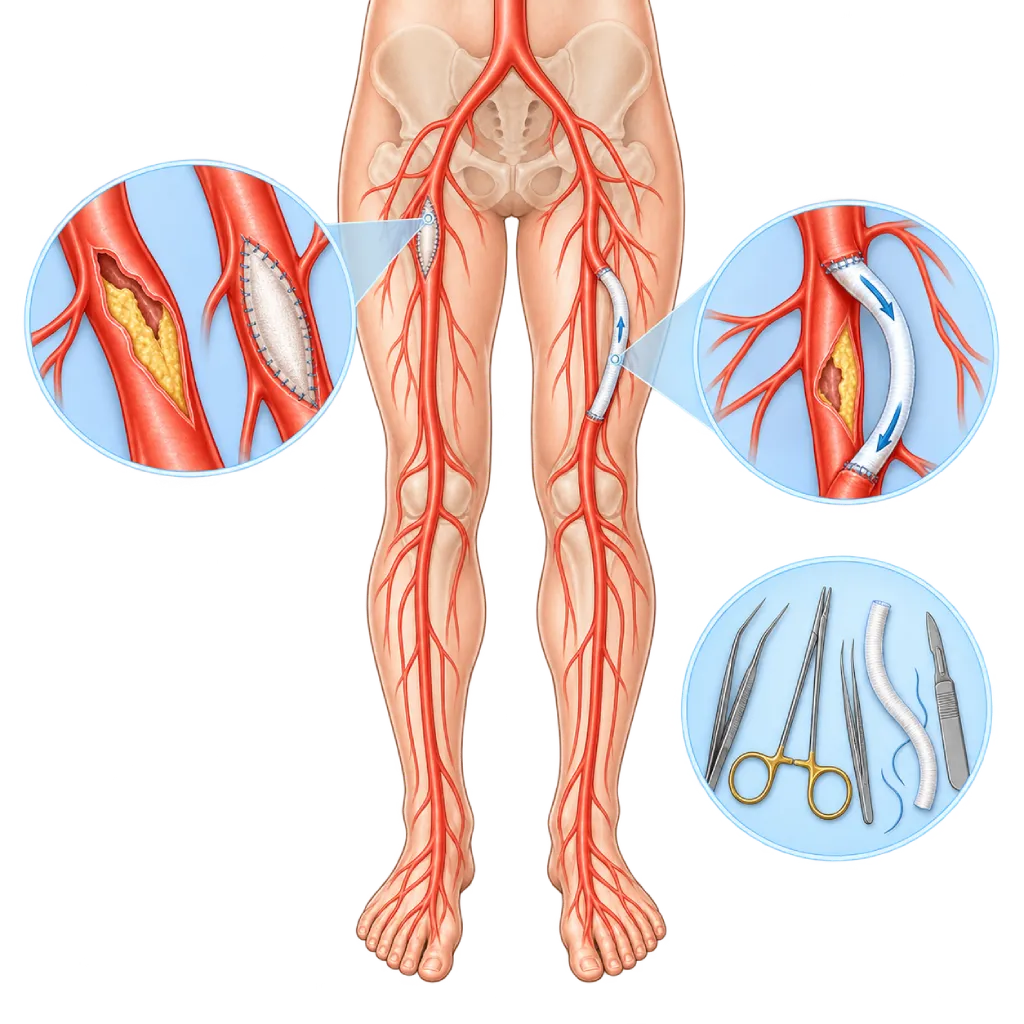
Peripheral vascular surgery is a group of operations on blood vessels outside the heart and brain, mainly in the neck, arms, and legs, to restore blood flow or prevent complications such as stroke and foot wounds. Examples include removing plaque from a neck artery, leg artery bypass, and creating dialysis access. It usually takes 1 to 4 hours.
Sources01 / Understanding the procedure
About Peripheral Vascular Surgery
What Is Peripheral Vascular Surgery
Peripheral blood vessels are the arteries and veins outside the heart and brain, for example in the neck, arms, abdomen, and legs. These vessels can narrow or become blocked by plaque, bulge like a balloon, or, in the case of veins, have leaky valves. Peripheral vascular surgery is a group of operations to repair these problems, with the aim of restoring blood flow, relieving symptoms, and preventing complications such as stroke, foot wounds that are slow to heal, or amputation.
Common Types of Surgery
- Carotid endarterectomy: removal of plaque from the neck artery that supplies blood to the brain, to prevent stroke.
- Leg artery bypass: creation of a new route around a blocked leg artery, which is covered on the Peripheral Bypass Surgery page.
- Groin (femoral) artery endarterectomy: removal of plaque from the artery in the groin, often combined with a balloon or stent.
- Peripheral aneurysm repair: treatment of a widened artery, for example behind the knee, so it does not become blocked or rupture.
- Dialysis access: connecting an artery and a vein in the arm (fistula) or placing an artificial tube (graft) for hemodialysis.
- Varicose vein surgery: tying off and removing leaky veins. Today, varicose veins are more often treated with a catheter, which is covered on the Varicose Vein Ablation page.
Open Surgery and Catheter Procedures
Many narrowed and widened blood vessels can now be treated with a catheter using a balloon, stent, or stent graft, without a large incision, which is covered on the Peripheral Angioplasty page. Open surgery is still needed in certain situations, for example for long blockages, plaque at the branching point of the neck or groin arteries, or when a previous catheter procedure was not successful. In some patients, both are combined in a single procedure (hybrid).
Carotid Endarterectomy to Prevent Stroke
Plaque in the carotid artery, the large artery in the neck, can narrow the flow to the brain or release debris that causes a stroke. Surgery to remove the plaque is usually recommended when the narrowing is fairly severe and has already caused a minor stroke or temporary symptoms, such as weakness on one side of the body or vision problems that resolved on their own. The benefit is greater if it is done within 14 days after the symptoms. For narrowing without symptoms, surgery is considered in selected patients.
Dialysis Access
Patients with kidney failure on hemodialysis need a blood vessel with strong flow that is easy to puncture. The surgeon connects an artery and a vein in the arm, so the vein enlarges and thickens over several weeks. This connection is called an arteriovenous fistula, often called Cimino surgery in Indonesia. If the vein is not suitable, an artificial tube (graft) is used. Dialysis is covered on the Hemodialysis page.
Maintaining the Results of Surgery
Surgery repairs one section of a blood vessel, but the underlying disease, such as atherosclerosis, remains. For this reason, quitting smoking, controlling blood sugar, blood pressure, and cholesterol, taking antiplatelet and cholesterol-lowering medications, and walking regularly are very important. Regular duplex ultrasound helps monitor the connection or bypass.
02 / Understanding the procedure
When Is This Procedure Considered?
A doctor may consider this procedure in the situations below. The decision is always made after a thorough assessment.
- Narrowed Neck Artery with SymptomsA previous minor stroke or temporary symptoms caused by plaque in the carotid artery.
- Foot Wounds That Are Slow to HealOr foot pain at rest due to severely reduced blood flow to the leg.
- Leg Pain When Walking That Limits ActivityStill bothersome despite walking exercise and medication.
- Peripheral Artery AneurysmFor example, widening of the artery behind the knee that may become blocked.
- Need for Dialysis AccessIn kidney failure, for patients already on or about to start hemodialysis.
- Severe Varicose VeinsWith wounds or skin changes, when catheter treatment is not suitable.
Situations to Consider First
- Mild Symptoms That Improve with MedicationFor example, pain when walking that does not interfere with daily activities.
- Mild Narrowing Without SymptomsUsually just monitored and treated with medication and a healthy lifestyle.
- Completely Blocked Neck ArteryCarotid endarterectomy is usually not done for a long-standing total blockage.
- Very High Surgical RiskFor example, severe heart or lung disease; a catheter procedure may be considered.
- Active Infection in the Surgical AreaThe infection needs to be treated first if the situation allows.
03 / Before the procedure
How Should You Prepare?
Preparation depends on the type of surgery and usually starts a few days beforehand.
Blood vessel tests. Duplex ultrasound, CT angiography, or angiography is used to map the blockage or widening. Duplex ultrasound is covered on the Duplex Ultrasound page. Before dialysis access surgery, the blood vessels in the arm are mapped with ultrasound.
General tests. Blood tests, kidney function, blood sugar, and an ECG. Because blood vessel disease often occurs together with coronary artery disease, your heart is also evaluated.
Medications. Tell the team about all the medications you take. Aspirin and cholesterol medications are usually continued, while other blood thinners and diabetes medications may be adjusted according to your doctor's instructions.
Arm for dialysis access. If you will need dialysis, avoid blood draws or IV lines in the arm that will be operated on.
Quitting smoking and fasting. Quitting smoking helps wound healing and protects the results of surgery. You will be asked to fast for several hours before surgery.
Unsure about the preparation instructions? Ask our team before the procedure.
04 / During the procedure
How Is the Procedure Done?
Peripheral vascular surgery is done in the operating room. The type of anesthesia depends on the operation: general, regional, or local anesthesia. It usually takes 1 to 2 hours for dialysis access or carotid endarterectomy, and 2 to 4 hours for a leg bypass.
Exposing the Blood Vessel
The doctor makes an incision over the affected blood vessel, for example on the side of the neck, in the groin, behind the knee, or in the arm. A blood thinner is given, then blood flow is stopped temporarily with clamps.
Repairing the Blood Vessel
The procedure is tailored to the problem: plaque is removed and the artery wall is closed with a patch, a bypass is connected around the blockage, the widened section is replaced or bypassed, or an artery is connected to a vein for dialysis access.
Protecting the Brain During Carotid Surgery
While the neck artery is clamped, blood flow to the brain is monitored. If needed, a small temporary tube is placed to carry blood past the section being operated on.
Checking Blood Flow and Closing the Incision
Blood flow is restored and checked by feeling the pulse, with Doppler, or with angiography. The incision is then stitched closed and you are moved to the recovery room.
05 / Benefits and risks
Benefits and Risks Should Be Discussed Together.
Every medical procedure has benefits and risks. Your doctor will explain both for your situation before the procedure.
Benefits You Can Expect
- Prevents StrokeCarotid endarterectomy lowers the risk of stroke in symptomatic narrowing of the neck artery.
- Helps Save the LegA bypass helps foot wounds heal and lowers the risk of amputation.
- Walking Farther Without PainImproved blood flow relieves leg pain when walking.
- Long-Lasting Dialysis AccessA fistula made from your own vessels gets infected less often than a dialysis catheter.
The benefits of a procedure are not a promise of a cure. Ask how the results will affect your care plan.
Risks You Should Know
- Infection or Poor Wound HealingMore common with groin wounds and in patients with diabetes.
- Bleeding or BruisingDue to blood thinners; sometimes a procedure is needed to stop it.
- Stroke After Carotid SurgeryRare, but can occur during or after neck artery surgery.
- Nerve Problems Around the WoundFor example, a hoarse voice, the tongue slightly deviating to one side, or numbness; usually improves on its own.
- Narrowing or Blockage of the ConnectionCan occur in a bypass or fistula; monitored with regular ultrasound.
- Heart AttackBecause coronary artery disease is often present; the heart is evaluated before surgery.
Risks can differ from person to person. A full explanation and consent are given after an individual assessment.
06 / After the procedure
What Is Recovery Like?
The length of the hospital stay depends on the type of surgery: dialysis access often requires only one day or you can go home the same day, carotid endarterectomy about 1 to 2 days, and a leg bypass several days.
Monitoring. The pulse, color, and temperature of the leg or hand, limb strength and speech after carotid surgery, and the wound are checked regularly.
Wound and activity. Keep the wound clean and dry. Start walking gradually as instructed by the team. After a bypass, the operated leg is often swollen for several weeks; raising your leg while sitting helps.
Dialysis access. A fistula needs several weeks before it can be used. Feel for the vibration (thrill) over the connection every day, and avoid blood pressure measurements, blood draws, or tight watches on that arm.
Medications and follow-up. Antiplatelet and cholesterol-lowering medications are usually taken long term. Regular duplex ultrasound helps assess the results of surgery.
Warning signs. Go to the emergency room right away if you have:
- A drooping face, weakness on one side of the body, slurred speech, or sudden vision problems
- Rapidly growing swelling in the neck, or difficulty breathing or swallowing
- Sudden pain, paleness, coldness, or tingling in the leg or hand
- Loss of the vibration in a dialysis fistula
- Bleeding, fever, or a wound that is red and draining pus
Know the Signs That Need Prompt Care.
Follow the team's guidance on warning signs. If severe or sudden symptoms appear after the procedure, go to the nearest emergency department right away or call Heart Attack Center 1500 258.
07 / Team and support
Doctors and Procedure Support
The doctors below are listed for this procedure. Listed by name, not by ranking.

Dr. dr. Dudy A. Hanafy, Sp.BTKV, Subsp. JD(K), MARS
Adult Cardiac Surgery
Advanced Cardiovascular Surgical Care +1 center
Clinical focusMinimally Invasive Cardiac Surgery · Coronary Artery Bypass Surgery
View Profile
dr. Emanoel Oepangat, Sp.JP(K)
Interventional Cardiology
Vascular Diagnostic and Therapeutic Center +1 center
Clinical focusCoronary Intervention · Peripheral Vascular Intervention
View Profile
dr. Rr. Pasati Lintangella, Sp.BTKV
Thoracic & Cardiovascular Surgery
Advanced Cardiovascular Surgical Care +1 center
Clinical focusAdult Cardiac Surgery · Coronary Artery Bypass Surgery
View ProfileOperating Theatre (Cardiac Operating Room)
An operating room dedicated to heart and blood vessel surgery, where the surgical, anesthesia, perfusion, and nursing teams work…
The availability of technology and test support is confirmed with the team. Technology is chosen according to clinical need.
08 / Common questions
Before You Plan the Procedure.
Frequently asked questions about peripheral vascular surgery.
What is the difference between peripheral vascular surgery and peripheral bypass surgery?
Peripheral vascular surgery is an umbrella term for various operations on blood vessels outside the heart and brain, for example on the neck arteries, for dialysis access, and for widened arteries. Peripheral bypass surgery is one of them: creating a bypass around a blocked leg artery. The details of bypass surgery are covered on the Peripheral Bypass Surgery page.
Is the surgery painful?
During surgery you do not feel pain because you are under anesthesia. Afterward, pain around the wound is usually moderate and can be controlled with pain relievers. Wounds in the groin or leg usually feel more uncomfortable than wounds in the neck or arm. Numbness around the incision is common and gradually improves over several weeks to months.
Do I need general anesthesia?
Not always. A leg bypass is usually done under general anesthesia or regional (spinal) anesthesia. Carotid endarterectomy can be done under general anesthesia or local anesthesia in the neck, so you stay awake and can talk with the team to monitor brain function. Dialysis access often needs only local anesthesia or regional anesthesia in the arm. The anesthesiologist chooses the option based on your condition.
When can I return to my activities?
After dialysis access or carotid endarterectomy, most patients return to light activities within a few days to 2 weeks. After a leg bypass, recovery usually takes 4 to 8 weeks. Walking is recommended from the start and increased gradually. Ask your doctor when you can drive, exercise, and lift heavy objects, because this depends on the type of surgery and the location of the wound.
Why do I still need medication after surgery?
Surgery repairs the affected section of the blood vessel, but atherosclerosis can continue in other blood vessels, including those of the heart and brain. Antiplatelet and cholesterol-lowering medications, along with medications to control blood pressure and blood sugar, help prevent heart attack, stroke, and repeat narrowing. Quitting smoking also strongly affects the long-term results. Do not stop your medications without consulting your doctor.
When can a dialysis fistula be used?
A fistula made by connecting an artery and a vein usually needs about 6 to 12 weeks for the vein to become large and strong enough to be punctured. For this reason, surgery is recommended well before dialysis needs to start. While waiting, squeezing a rubber ball may be recommended as an exercise. An artificial graft can be used sooner, but it is more likely to become blocked and infected than a fistula.
Sources and Medical Review
Translated from the Indonesian edition medically reviewed by dr. Suko Adiarto, Sp.JP(K), Ph.D..
Sources as cited in the Indonesian edition.
- Naylor R, Rantner B, Ancetti S, et al. European Society for Vascular Surgery (ESVS) 2023 Clinical Practice Guidelines on the Management of Atherosclerotic Carotid and Vertebral Artery Disease. Eur J Vasc Endovasc Surg. 2023;65(1):7-111.
- Gornik HL, Aronow HD, Goodney PP, et al. 2024 ACC/AHA/AACVPR/APMA/ABC/SCAI/SVM/SVN/SVS/SIR/VESS Guideline for the Management of Lower Extremity Peripheral Artery Disease. Circulation. 2024;149(24):e1313-e1410.
- Mazzolai L, Teixido-Tura G, Lanzi S, et al. 2024 ESC Guidelines for the management of peripheral arterial and aortic diseases. Eur Heart J. 2024;45(36):3538-3700.
- Conte MS, Bradbury AW, Kolh P, et al. Global vascular guidelines on the management of chronic limb-threatening ischemia. J Vasc Surg. 2019;69(6S):3S-125S.e40.
- Schmidli J, Widmer MK, Basile C, et al. Vascular Access: 2018 Clinical Practice Guidelines of the European Society for Vascular Surgery (ESVS). Eur J Vasc Endovasc Surg. 2018;55(6):757-818.
- Lok CE, Huber TS, Lee T, et al. KDOQI Clinical Practice Guideline for Vascular Access: 2019 Update. Am J Kidney Dis. 2020;75(4 Suppl 2):S1-S164.
- De Maeseneer MG, Kakkos SK, Aherne T, et al. European Society for Vascular Surgery (ESVS) 2022 Clinical Practice Guidelines on the Management of Chronic Venous Disease of the Lower Limbs. Eur J Vasc Endovasc Surg. 2022;63(2):184-267.