
Quick answer
What Is Critical Limb Ischemia?
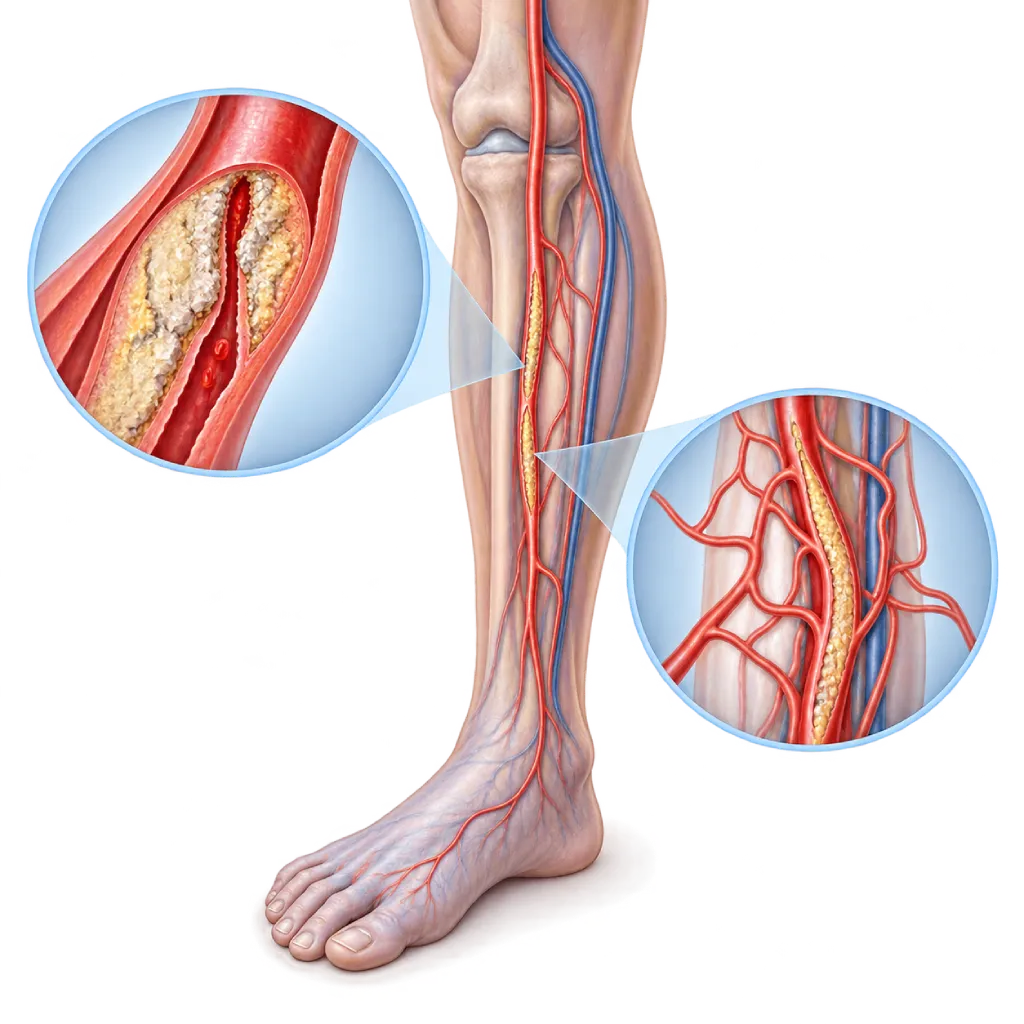
Critical limb ischemia is a severe stage of peripheral artery disease: blood flow to the leg is so reduced that pain at rest, foot wounds that do not heal, or blackened tissue appear. This condition needs prompt treatment by a vascular team.
SourcesSigns That Need Urgent Help
- Foot suddenly cold, pale, or bluish
- Foot suddenly numb, weak, or unable to move
- Blackened tissue that spreads quickly
- A wound with pus, a foul smell, or spreading redness
- Fever, chills, or severe weakness along with a foot wound
- Severe, unbearable pain even after taking pain medicine
If these signs appear, go to the nearest emergency department right away or call Heart Attack Center 1500 258.
01 / Understanding the condition
About Critical Limb Ischemia
Critical limb ischemia, now also called chronic limb-threatening ischemia (CLTI), is an advanced stage of peripheral artery disease, which is covered on the Peripheral Artery Disease page. At this stage, the leg arteries are so severely narrowed or blocked that there is not enough blood for the skin and tissues of the foot, even when you are not moving. Ischemia means the tissue lacks blood and oxygen.
Three Main Signs
International guidelines use this term when any of three conditions lasts more than two weeks because of poor blood flow: foot pain at rest, a wound on the foot or leg that does not heal, or gangrene, meaning dead, blackened tissue. Rest pain is usually felt in the sole and toes, gets worse when lying down at night, and eases when the foot hangs over the edge of the bed, because gravity helps blood flow down. Many patients end up sleeping sitting up, which makes their legs swell.
Different from a Sudden Blockage
Critical limb ischemia develops over weeks to months. If the foot suddenly becomes cold, pale, numb, and very painful within hours, a sudden blockage may have occurred that needs treatment in the emergency room. That situation is covered on the Arterial Embolism page.
Why Diabetes Makes It Hard to Recognize
In people with diabetes, nerve damage can make pain go unnoticed, so a small wound or a toe that changes color becomes the first sign. Diabetes and chronic kidney disease also often affect the small arteries below the knee and make the artery walls stiff with calcium. For this reason, people with diabetes need to check their feet every day.
Goals of Treatment
Treatment aims to relieve pain, heal wounds, and save the leg, while protecting the heart and brain, because people with this condition have a high risk of heart attack and stroke. The 2024 ESC and 2024 ACC/AHA guidelines recommend a rapid assessment by a vascular team working together with wound care, diabetes, and infection teams. In most patients, blood flow needs to be restored through a catheter or bypass surgery. Wounds usually only heal after blood flow to the foot improves.
02 / Understanding the condition
Symptoms to Recognize.
Common Symptoms
In people with diabetes, pain may be vague or not felt at all because of nerve damage, so a wound is often the first sign.
- Constant pain in the sole or toes while resting
- Pain that gets worse when lying down and eases when the foot hangs down
- A wound on the foot, heel, or toe that has not healed for more than two weeks
- Toes that turn pale when raised and dark red when lowered
- Cold, thin, shiny skin on the foot, with loss of leg hair
- No pulse can be felt in the foot
- Swollen feet from often sleeping sitting up
03 / Understanding the condition
What Causes This Condition?
- Severe atherosclerosis blocking the leg arteries in several places at once
- Narrowing of the small arteries below the knee, often in diabetes and chronic kidney disease
- Long-standing, uncontrolled peripheral artery disease, especially with continued smoking
- Re-blockage of an artery, stent, or bypass that was placed earlier
- Buerger disease (thromboangiitis obliterans) in young smokers
- Less common causes, such as inflammation of the artery wall (vasculitis)
04 / Understanding the condition
Who Is at Higher Risk?
Lifestyle
Smoking speeds up artery narrowing and slows wound healing. Physical inactivity and excess weight also worsen the condition of the blood vessels.
Medical
Diabetes, especially when blood sugar has been uncontrolled for a long time, chronic kidney disease including patients on dialysis, high blood pressure, and high cholesterol.
Age
More common at age 65 and older, when plaque has been building up for a long time and coexisting conditions are more frequent.
Other
A history of foot wounds, previous amputation, or procedures on the leg arteries, as well as a habit of putting off having foot wounds checked.
Groups at Higher Risk
- People with Diabetes: Nerve damage and stiff small arteries mean wounds often go unnoticed and heal slowly, so the feet need to be checked every day.
- People with Chronic Kidney Disease: Calcification of the arteries is more common, including in dialysis patients, and wounds tend to be harder to heal.
- People with Peripheral Artery Disease Who Still Smoke: A small proportion of people with claudication progress to the critical stage, and the chance is higher if they keep smoking.
- Older Adults: Older age with coexisting conditions and limited activity makes symptoms easy to miss until a wound appears.
05 / Understanding the condition
How Is It Diagnosed?
The doctor asks how long the pain has lasted and its pattern, and about any history of wounds, diabetes, and smoking, then checks the pulses, skin color and temperature, and the size, depth, and signs of infection of any wound. This assessment often uses the WIfI system (Wound, Ischemia, foot Infection), which combines the severity of the wound, the lack of blood flow, and infection to estimate the threat to the leg.
Measuring blood pressure in the legs is the first step. The Ankle-Brachial Index (ABI) can appear falsely normal when the arteries are stiff, so toe pressure or the Toe-Brachial Index (TBI) is recommended, especially in people with diabetes. Measuring oxygen in the skin and skin perfusion pressure helps assess the chance that a wound will heal.
To plan treatment, the location of blockages is mapped with duplex ultrasound, CT angiography, or catheter angiography. Blood tests assess infection, blood sugar, and kidney function, including before contrast dye is used. Because heart risk is high, the condition of the heart is also assessed before a procedure.
Ankle-Brachial Index (ABI) Test
The first step to assess blood flow to the leg. Results can appear normal when the artery walls are stiff with calcium.
Toe-Brachial Index (TBI) Test
Measures pressure in the big toe; recommended in diabetes and kidney disease because toe arteries rarely calcify.
Transcutaneous Oxygen Pressure (TcPO2)
Measures the oxygen reaching the skin around a wound to estimate the chance of healing.
Skin Perfusion Pressure (SPP)
Assesses blood flow in the small vessels of the foot skin, helping decide whether the artery needs to be opened.
Duplex Ultrasound
Maps the location and length of blockages without radiation, while also assessing leg veins that could be used for bypass.
Peripheral CT Angiography
Images of the arteries from the abdomen to the feet to plan a catheter procedure or surgery.
Peripheral Angiography
Examination of the arteries with a catheter and contrast dye, often done together with angioplasty.
06 / Understanding the condition
Treatment Options.
Treatment is decided by a doctor after an assessment. The categories below can help you follow the conversation with your doctor.
Endovascular Revascularization
Opening the artery through a catheter with a balloon, stent, or atherectomy. Often chosen for short blockages or when surgical risk is high.
Bypass Surgery
Creating a new route around a long blockage, preferably using a vein from your own leg. Covered on the Peripheral Bypass Surgery page.
Wound Care and Infection Control
The wound is cleaned, dead tissue is removed when blood flow allows, pressure on the wound is reduced, and infection is treated with antibiotics.
Medicines to Protect the Blood Vessels
Statins, antiplatelets, and in selected patients anticoagulants, to lower the risk of heart attack, stroke, and re-blockage. Your doctor determines the type and dose.
Pain Control
Pain medicines are adjusted to kidney function and other conditions while waiting for blood flow to be restored.
Diabetes Control and Quitting Smoking
Well-controlled blood sugar and quitting smoking support wound healing and help arteries that have been reopened stay open.
Planned Amputation
A last resort when the leg cannot be saved or infection cannot be controlled, along with rehabilitation and walking aids.
07 / Understanding the condition
Complications to Watch For.
Foot Infection
Wounds with poor blood flow get infected easily, and infection can spread to deeper tissues, even to the bone.
Gangrene
Dead tissue can become dry and black, or wet and infected. Wet gangrene needs urgent treatment.
Amputation
If tissue cannot be saved, part of a toe, the foot, or the leg may need to be removed. Early treatment aims to prevent this.
Sepsis
A severe infection from a foot wound can spread into the bloodstream and require hospital care.
Heart Attack and Stroke
Widespread plaque in the body raises the risk of heart and brain events, so medicines that protect the blood vessels are still needed.
Loss of Independence
Pain, wounds, and long treatment can limit your ability to walk, sleep, and do daily activities.
08 / Understanding the condition
What Can You Do?
- Check your feet every day, including between the toes and the heels, using a mirror if needed.
- Wear well-fitting, closed footwear, including indoors, and do not walk barefoot.
- Do not apply hot compresses or soak your feet in hot water, because skin with poor blood flow blisters easily.
- Stop smoking completely.
- Control your blood sugar, blood pressure, and cholesterol to the targets set by your doctor.
- Get any foot wound checked if it does not improve within a few days.
- Attend regular checkups after a procedure so that re-blockage is detected early.
09 / Understanding the condition
When Should You See a Doctor?
Get checked promptly, within days, if you have peripheral artery disease or diabetes and notice the following signs. Go to the emergency room if your foot suddenly becomes cold, pale, or numb, or if a foot wound comes with fever.
- Foot pain at rest that wakes you up at night
- You need to hang your foot down or sleep sitting up to ease the pain
- A wound on the foot or toe that does not improve within two weeks
- Toes that turn bluish, grayish, or black
- A wound with pus, a foul smell, or spreading redness
Don't Wait in an Emergency.
If symptoms are severe or come on suddenly, go to the nearest emergency department right away or call Heart Attack Center 1500 258, rather than waiting for an appointment.
10 / Common questions
Questions You May Have.
Frequently asked questions about critical limb ischemia.
What is the difference between critical limb ischemia and claudication?
In claudication, pain appears when walking and eases after rest, because blood flow is still adequate when the muscles are at rest. In critical limb ischemia, blood flow is no longer adequate even at rest, causing pain while you are still, wounds that do not heal, or gangrene. This stage needs faster assessment and treatment.
Does critical limb ischemia always end in amputation?
No. With restored blood flow, wound care, and infection control, many legs can be saved. The chances are better when treatment starts before dead tissue spreads. Amputation is only considered by the team when tissue cannot be recovered or infection cannot be controlled, and that decision is discussed with you and your family.
Which is chosen, a catheter procedure or bypass surgery?
There is no single option for all patients. The team weighs the location and length of the blockage, whether there is a good leg vein for bypass, the size of the wound, and the condition of the heart and kidneys. A 2022 trial comparing the two approaches showed that bypass using your own vein gave better results in patients with a suitable vein, while catheter procedures are often chosen for short blockages or high surgical risk.
Why won't my wound heal even though it is being treated?
Wounds need blood that carries oxygen and nutrients to repair tissue. If the leg arteries are blocked, wound care alone is often not enough. That is why a foot wound that does not improve within two weeks needs its blood flow checked, for example with an ABI or toe pressure, especially in people with diabetes and kidney disease.
Can I warm cold feet with hot water or a hot water bottle?
It is better not to. Skin with poor blood flow cannot get rid of heat well, and damaged nerves may not feel the heat, so the skin blisters easily and a new wound forms. Wear clean, loose socks and use a blanket. Cold feet are actually a reason to have your blood flow checked.
What should I do after a procedure to open the artery?
An artery that has been opened can narrow again, so regular checkups are still needed, usually with pulse checks, ABI, or duplex ultrasound. Take your medicines as prescribed, stop smoking, control your blood sugar, and care for the wound until it heals. Report right away if the pain returns, the wound gets worse, or your foot feels colder.
Sources and Medical Review
Translated from the Indonesian edition medically reviewed by dr. Emanoel Oepangat, Sp.JP(K).
Sources as cited in the Indonesian edition.
- Mazzolai L, Teixido-Tura G, Lanzi S, Boc V, Bossone E, Brodmann M, et al. 2024 ESC Guidelines for the management of peripheral arterial and aortic diseases. Eur Heart J. 2024;45(36):3538-700.
- Gornik HL, Aronow HD, Goodney PP, Arya S, Brewster LP, Byrd L, et al. 2024 ACC/AHA/AACVPR/APMA/ABC/SCAI/SVM/SVN/SVS/SIR/VESS Guideline for the Management of Lower Extremity Peripheral Artery Disease: A Report of the American College of Cardiology/American Heart Association Joint Committee on Clinical Practice Guidelines. Circulation. 2024;149(24):e1313-410.
- Conte MS, Bradbury AW, Kolh P, White JV, Dick F, Fitridge R, et al. Global vascular guidelines on the management of chronic limb-threatening ischemia. J Vasc Surg. 2019;69(6S):3S-125S.e40.
- Mills JL Sr, Conte MS, Armstrong DG, Pomposelli FB, Schanzer A, Sidawy AN, et al. The Society for Vascular Surgery Lower Extremity Threatened Limb Classification System: risk stratification based on wound, ischemia, and foot infection (WIfI). J Vasc Surg. 2014;59(1):220-34.
- Farber A, Menard MT, Conte MS, Kaufman JA, Powell RJ, Choudhry NK, et al. Surgery or Endovascular Therapy for Chronic Limb-Threatening Ischemia. N Engl J Med. 2022;387(25):2305-16.
- Fitridge R, Chuter V, Mills J, Hinchliffe R, Azuma N, Behrendt CA, et al. The intersocietal IWGDF, ESVS, SVS guidelines on peripheral artery disease in people with diabetes and a foot ulcer. Diabetes Metab Res Rev. 2024;40(3):e3686.
Doctors Who Treat This Condition

dr. Suko Adiarto, Sp.JP(K), Ph.D.
Interventional Cardiology
Vascular Diagnostic and Therapeutic Center +1 center
Clinical focusCoronary Intervention · Peripheral Vascular Intervention
View Profile
dr. Emanoel Oepangat, Sp.JP(K)
Interventional Cardiology
Vascular Diagnostic and Therapeutic Center +1 center
Clinical focusCoronary Intervention · Peripheral Vascular Intervention
View Profile
dr. Debby C. Soemitha, Sp.PD
Internal Medicine
Clinical focusDiabetes and Diabetes Complications · Obesity and Metabolic Disease
View Profile