
Quick answer
What Is Peripheral Angioplasty?
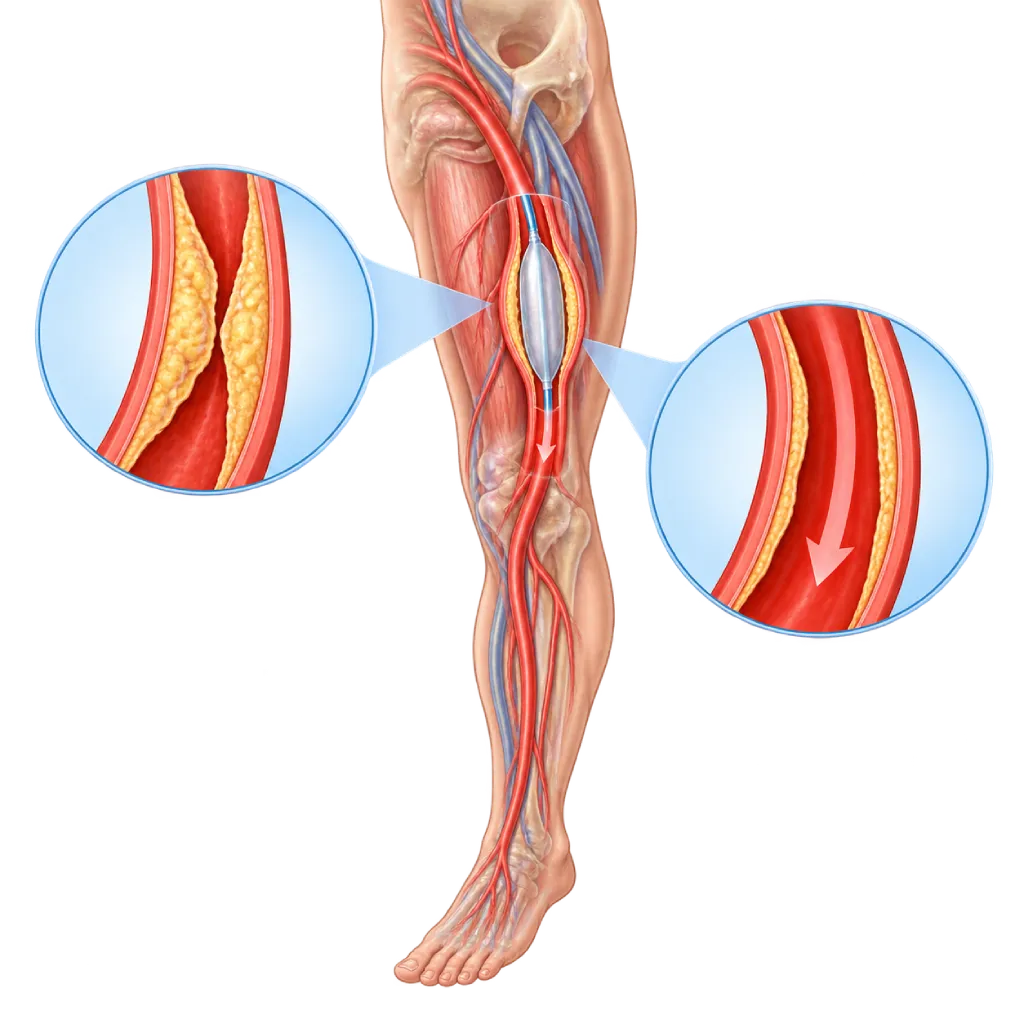
Peripheral angioplasty is a catheter procedure to widen narrowed arteries outside the heart, mainly leg arteries, with a balloon inflated inside the vessel. The balloon may be coated with medication to reduce renarrowing, and a stent is placed if needed. The procedure takes about 1 to 2 hours under local anesthesia.
Sources01 / Understanding the procedure
About Peripheral Angioplasty
What Is Peripheral Angioplasty
Peripheral angioplasty is a procedure to widen arteries outside the heart that are narrowed or blocked, mainly the leg arteries. This narrowing is usually caused by plaque, a buildup of fat, calcium, and tissue in the artery wall, in peripheral artery disease. As a result, the calf muscles and feet do not get enough blood, causing pain when walking or wounds that are slow to heal. The procedure is done through a catheter, a thin tube inserted through a small puncture, without a large incision.
How It Works in Brief
A very thin guidewire is passed through the narrowing. A balloon-tipped catheter is then pushed to the narrowing, and the balloon is inflated for a few minutes so the plaque is pressed against the wall and the artery opening becomes wide again. The balloon is then deflated and pulled out, so nothing is left behind.
Plain Balloons and Drug-Coated Balloons
A plain balloon only widens the artery. A drug-coated balloon carries medication that sticks to the artery wall when the balloon is inflated and slows the growth of scar tissue that causes renarrowing. In the thigh artery and the artery behind the knee, drug-coated balloons reduce renarrowing compared with plain balloons. There was a concern about the safety of the drug paclitaxel on these balloons, but larger follow-up studies did not find an increased risk of death. For very hard calcified plaque, the plaque can be shaved away first, which is covered on the Peripheral Atherectomy page.
When a Stent Is Added
If after widening the artery wall tears, recoils, or is still narrowed, the doctor may place a stent, which is a small metal mesh support. In the pelvic arteries, a stent is often placed right away, while in the arteries below the knee a balloon alone is used more often. Types of stents and their care are covered on the Peripheral Stent Placement page.
Who Needs It
Angioplasty is considered if pain when walking still interferes with your activities even after quitting smoking, taking medication, and following a structured walking program for about 3 months, or if there is pain at rest and foot wounds that threaten the leg. These basic steps are covered on the Peripheral Vascular Disease Management page. For very long blockages, bypass surgery may be an option, which is covered on the Peripheral Bypass Surgery page.
Other Arteries Beyond the Legs
Angioplasty can also be done on the arm arteries or kidney arteries. For kidney artery narrowing caused by plaque, large studies show that widening with a balloon and stent usually gives no additional benefit compared with medication, so it is only considered in certain situations after evaluation by the team.
02 / Understanding the procedure
When Is This Procedure Considered?
A doctor may consider this procedure in the situations below. The decision is always made after a thorough assessment.
- Bothersome Calf Pain When WalkingClaudication that still limits your activities despite treatment and walking exercise.
- Foot Pain at RestEspecially at night, a sign that blood flow to the foot is already severely reduced.
- Foot Wounds That Are Slow to HealWounds or blackened tissue on the foot due to a lack of blood flow.
- Renarrowing After a Previous ProcedureNarrowing again at a previous balloon site or inside a stent that causes symptoms.
- Certain Narrowed Arm or Kidney ArteriesIf they cause symptoms or affect organ function, after evaluation by the team.
Situations to Consider First
- Narrowing Without Bothersome SymptomsUsually treated with medication, quitting smoking, and walking exercise.
- Very Long or Complex BlockageBypass surgery may be more suitable; the options are discussed with the team.
- Severe Allergy to Contrast DyeRequires special medication beforehand or alternative tests and procedures.
- Severely Reduced Kidney FunctionThe amount of contrast is limited and the kidneys are protected with IV fluids.
- Infection or Severe Blood Clotting DisorderTreated first before a planned procedure.
03 / Before the procedure
How Should You Prepare?
Before angioplasty, the doctor assesses the location and severity of the narrowing and your overall health.
Blood vessel tests. An ABI test and duplex ultrasound, then CT angiography or angiography to map the arteries. These are covered on the Ankle-Brachial Index (ABI) Test and Peripheral Angiography pages.
Blood tests. Kidney function, complete blood count, and blood clotting.
Medications. Antiplatelet medications such as aspirin or clopidogrel are usually started before the procedure. Tell the team if you take other blood thinners or diabetes medications such as metformin, or if you have a contrast allergy.
Fasting. You usually do not eat for about 6 hours before the procedure. Drink water as instructed by the team.
Companion. Bring a family member to accompany you and take you home.
Unsure about the preparation instructions? Ask our team before the procedure.
04 / During the procedure
How Is the Procedure Done?
Peripheral angioplasty is done in the catheterization lab under local anesthesia, and a mild sedative may be given. The procedure takes about 1 to 2 hours, longer for long narrowings or those below the knee.
Blood Vessel Access
The skin in the groin is numbed, then a small sheath is inserted into the artery. Sometimes an artery in the arm, wrist, or foot is used.
Mapping the Arteries
Contrast dye is injected and recorded with X-rays to see the location of the narrowing. A blood thinner is given through the sheath.
Crossing and Widening the Narrowing
A guidewire is passed through the narrowing, then the balloon is inflated once or several times. You may feel a brief ache or pressure in the leg.
Checking the Result
Angiography is repeated to confirm that blood flows smoothly down to the foot. If the result is not yet sufficient, the doctor may add a stent.
Closing the Puncture Site
The sheath is removed, then the puncture site is pressed or closed with a special device to prevent bleeding.
05 / Benefits and risks
Benefits and Risks Should Be Discussed Together.
Every medical procedure has benefits and risks. Your doctor will explain both for your situation before the procedure.
Benefits You Can Expect
- No Large IncisionDone through a small puncture in the groin under local anesthesia.
- Longer Walking DistanceCalf pain when walking decreases in many patients with claudication.
- Helps Foot Wounds HealImproved blood flow helps wounds heal and helps save the leg.
- Short RecoveryShorter than after open surgery; you can usually walk the next day.
- Can Be Repeated If NeededRenarrowing can usually be reopened with a catheter.
The benefits of a procedure are not a promise of a cure. Ask how the results will affect your care plan.
Risks You Should Know
- Bruising or Bleeding at the Puncture SiteUsually mild; rarely needs an additional procedure.
- RenarrowingCan occur within months to years; monitored with regular tests.
- Artery Tear or BlockageCan be treated right away with another balloon or a stent.
- Plaque Debris or Clots Traveling to the FootRare; can be removed or dissolved through the catheter right away.
- Kidney Problems from Contrast DyeMore likely if kidney function is already reduced; prevented with IV fluids.
- Allergic Reaction to Contrast DyeUsually mild, such as itching or red spots, and treated with medication.
Risks can differ from person to person. A full explanation and consent are given after an individual assessment.
06 / After the procedure
What Is Recovery Like?
Most patients stay one night, and some can go home the same day.
After the procedure. You lie down for a few hours with your leg straight, while the puncture site, foot pulses, and blood pressure are monitored.
Medications. Take antiplatelet medications as advised, often two types for a period of time and then one type long term, together with a statin. Do not stop them without consulting your doctor.
Activity. Light walking can start the next day. Avoid heavy lifting for about one week, then continue regular walking exercise.
Follow-up. An ABI test or duplex ultrasound is done regularly to monitor for renarrowing. Quitting smoking remains important to maintain the results of the procedure.
Warning signs. Go to the emergency room right away if you have:
- Sudden pain, paleness, coldness, or numbness in the leg or foot
- Bleeding or growing swelling at the puncture site
- Fever, redness, or pus at the puncture site
- Chest pain or shortness of breath
Know the Signs That Need Prompt Care.
Follow the team's guidance on warning signs. If severe or sudden symptoms appear after the procedure, go to the nearest emergency department right away or call Heart Attack Center 1500 258.
07 / Team and support
Doctors and Procedure Support
The doctors below are listed for this procedure. Listed by name, not by ranking.

dr. Emanoel Oepangat, Sp.JP(K)
Interventional Cardiology
Vascular Diagnostic and Therapeutic Center +1 center
Clinical focusCoronary Intervention · Peripheral Vascular Intervention
View Profile
dr. Suko Adiarto, Sp.JP(K), Ph.D.
Interventional Cardiology
Vascular Diagnostic and Therapeutic Center +1 center
Clinical focusCoronary Intervention · Peripheral Vascular Intervention
View ProfileVascular Interventional Suite
A procedure room with X-ray imaging for diagnosing and treating narrowed, blocked, or enlarged blood vessels outside the heart…
The availability of technology and test support is confirmed with the team. Technology is chosen according to clinical need.
08 / Common questions
Before You Plan the Procedure.
Frequently asked questions about peripheral angioplasty.
Does peripheral angioplasty hurt?
The puncture site in the groin is numbed with local anesthesia, so you usually only feel pressure. When the balloon is inflated, your leg may ache or hurt briefly, and this goes away once the balloon is deflated. A mild sedative can be given if you feel anxious. After the procedure, the puncture site may be slightly sore or bruised for a few days.
What is the difference between peripheral angioplasty and peripheral stent placement?
Angioplasty widens the artery with a balloon that is then removed, so nothing is left behind. A stent is a metal mesh support that is placed and stays inside the artery to hold its wall open. Both are often done in a single procedure; a stent is added if the balloon result is not sufficient or the location of the narrowing requires it. This is covered on the Peripheral Stent Placement page.
Are drug-coated balloons safe?
Drug-coated balloons have been studied in thousands of patients. There were reports that raised concerns about the drug paclitaxel, but larger follow-up studies did not find an increased risk of death. The 2024 European and American guidelines still list drug-coated devices as an option for the thigh artery and the artery behind the knee. Your doctor will explain the options that suit you.
How long will I stay in the hospital, and when can I resume activities?
You usually stay one night, and some patients can go home the same day. Light walking can start the next day. Daily activities usually resume within a few days, while heavy lifting and strenuous exercise are avoided for about one week or as instructed by your doctor. Walking exercise is still recommended to maintain the results of the procedure.
Can the narrowing come back?
Yes. Scar tissue can grow at the balloon site so the artery narrows again, usually within a few months to one or two years. The risk is reduced with drug-coated balloons, quitting smoking, taking medications regularly, and regular follow-up visits. If symptoms return, the renarrowing can usually be reopened with a catheter.
Do I still need to take medication after angioplasty?
Yes. Angioplasty opens one narrowing, but plaque in other blood vessels remains. Antiplatelet medications and statins are taken long term to prevent clots, keep the artery open, and lower the risk of heart attack and stroke. Blood pressure and blood sugar also need to be controlled. Do not stop your medications without consulting your doctor.
Sources and Medical Review
Translated from the Indonesian edition medically reviewed by dr. Suko Adiarto, Sp.JP(K), Ph.D..
Sources as cited in the Indonesian edition.
- Mazzolai L, Teixido-Tura G, Lanzi S, et al. 2024 ESC Guidelines for the management of peripheral arterial and aortic diseases. Eur Heart J. 2024;45(36):3538-3700.
- Gornik HL, Aronow HD, Goodney PP, et al. 2024 ACC/AHA/AACVPR/APMA/ABC/SCAI/SVM/SVN/SVS/SIR/VESS Guideline for the Management of Lower Extremity Peripheral Artery Disease. Circulation. 2024;149(24):e1313-e1410.
- Conte MS, Bradbury AW, Kolh P, et al. Global vascular guidelines on the management of chronic limb-threatening ischemia. J Vasc Surg. 2019;69(6S):3S-125S.e40.
- Tepe G, Laird J, Schneider P, et al. Drug-coated balloon versus standard percutaneous transluminal angioplasty for the treatment of superficial femoral and popliteal peripheral artery disease: 12-month results from the IN.PACT SFA randomized trial. Circulation. 2015;131(5):495-502.
- Katsanos K, Spiliopoulos S, Kitrou P, Krokidis M, Karnabatidis D. Risk of death following application of paclitaxel-coated balloons and stents in the femoropopliteal artery of the leg: a systematic review and meta-analysis of randomized controlled trials. J Am Heart Assoc. 2018;7(24):e011245.
- Nordanstig J, James S, Andersson M, et al. Mortality with paclitaxel-coated devices in peripheral artery disease. N Engl J Med. 2020;383(26):2538-2546.
- Cooper CJ, Murphy TP, Cutlip DE, et al. Stenting and medical therapy for atherosclerotic renal-artery stenosis. N Engl J Med. 2014;370(1):13-22.