
Quick answer
What Is Intermittent Claudication?
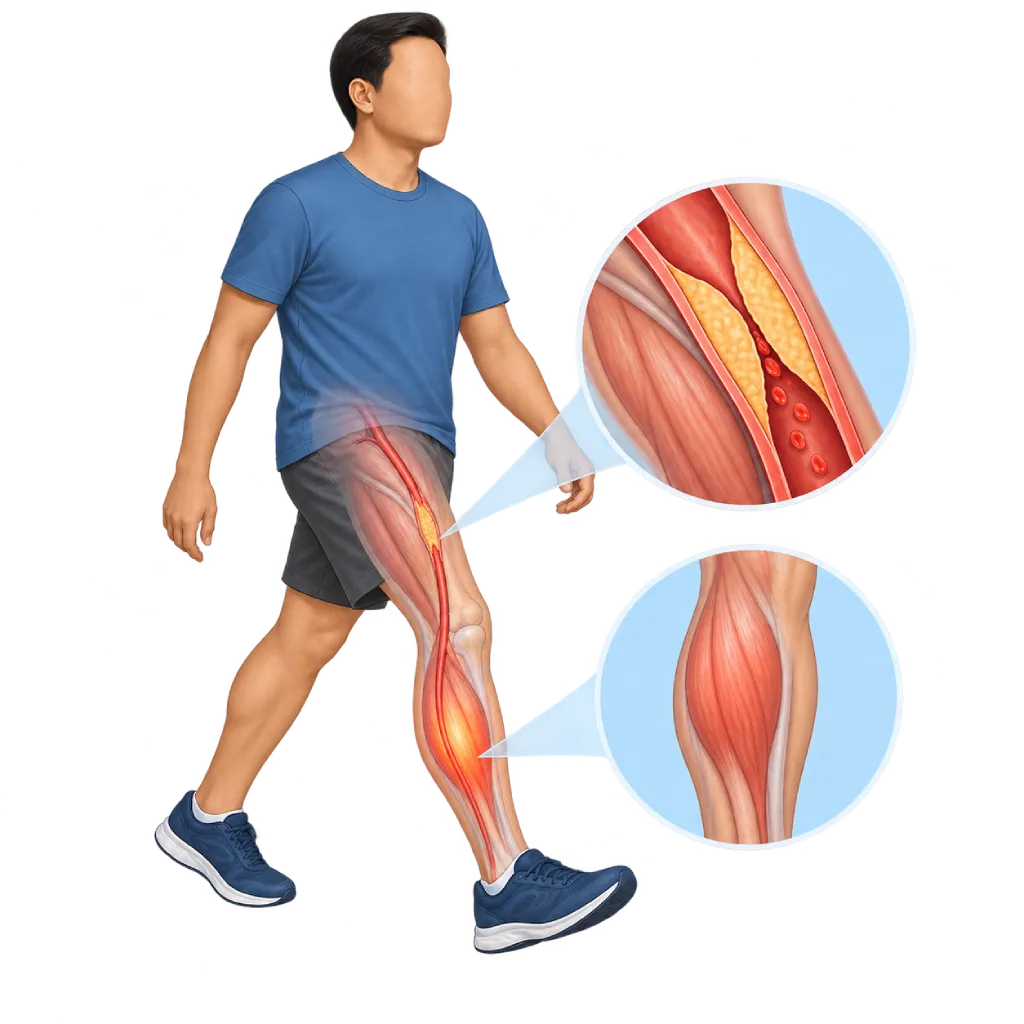
Intermittent claudication is pain, cramping, or aching in the leg muscles that appears when walking and eases after a few minutes of rest. It is a typical symptom of peripheral artery disease and can improve with regular walking exercise.
SourcesSigns That Need Urgent Help
- Leg pain at rest or at night
- The walking distance before pain appears gets shorter quickly
- A wound on the foot or toe that does not heal
- Toes turning bluish or black
- Foot suddenly cold, pale, and very painful
- Foot suddenly numb, weak, or hard to move
If these signs appear, go to the nearest emergency department right away or call Heart Attack Center 1500 258.
01 / Understanding the condition
About Intermittent Claudication
Intermittent claudication comes from the Latin word claudicare, meaning to limp, while intermittent means coming and going. The symptom is pain, cramping, aching, or heaviness in the leg muscles that appears after you walk a certain distance, forces you to stop, and then eases within about 10 minutes of standing still. When you walk again, the pain returns at roughly the same distance.
The Cause Lies in the Arteries
Claudication is a typical symptom of peripheral artery disease, which is covered on the Peripheral Artery Disease page. Atherosclerotic plaque narrows the leg arteries. At rest, blood flow is still adequate, but when the muscles are working their demand rises and the narrowed artery cannot increase the supply. The location of the pain gives a clue to the location of the narrowing: calf pain usually comes from the thigh or knee arteries, while buttock and thigh pain comes from the arteries in the pelvis.
Not Always from the Blood Vessels
Leg pain when walking can also come from narrowing of the spinal canal, joint inflammation, or vein problems. Pain from the spinal nerves usually only eases when you sit down or bend forward, while claudication eases simply by standing still. An Ankle-Brachial Index (ABI) test helps tell them apart.
How It Progresses
In most people, symptoms stay stable for years, and only a small proportion progress to critical limb ischemia, which is covered on the Critical Limb Ischemia page. Worsening is more likely in people who keep smoking or whose diabetes is not controlled. The greater concern is the risk of heart attack and stroke, because the same plaque is often present in the arteries of the heart and brain.
Walking Exercise as the Main Treatment
The 2024 ESC and 2024 ACC/AHA guidelines recommend structured walking exercise, preferably supervised, as the first step along with quitting smoking and medicines that protect the blood vessels. Regular exercise helps the muscles use oxygen more efficiently, improves the function of the inner lining of the blood vessels, and may stimulate the growth of small vessels around the blockage. If after about three months the symptoms still interfere with work or daily activities, your doctor may consider opening the artery through a catheter or surgery.
02 / Understanding the condition
Symptoms to Recognize.
Common Symptoms
- Pain, cramping, or aching in the calf when walking
- Pain in the thigh or buttock when walking fast or uphill
- Symptoms appear after roughly the same walking distance
- Pain eases within a few minutes of standing still
- Legs feel heavy or tire quickly when climbing stairs
- The affected leg is colder or paler than the other side
- Weak pulse on the top of the foot
- Erectile dysfunction in men if the narrowing is in the pelvic arteries
03 / Understanding the condition
What Causes This Condition?
- Atherosclerosis narrowing the arteries in the pelvis, thigh, or behind the knee
- Narrowing of the calf arteries, often in people with diabetes
- Re-narrowing of a stent or bypass that was placed earlier
- Buerger disease (thromboangiitis obliterans) in young smokers, although rare
- Compression of the artery behind the knee by muscle in young people who exercise actively, although rare
04 / Understanding the condition
Who Is at Higher Risk?
Lifestyle
Smoking is very closely linked to claudication, and quitting helps slow the narrowing. Physical inactivity makes the muscles tire faster and the walking distance shorter.
Medical
Diabetes, high blood pressure, high LDL cholesterol, and chronic kidney disease speed up narrowing of the leg arteries.
Age
Symptoms appear more often after age 50 and become more common with age.
Genetic
A family history of heart or blood vessel disease at a young age, including inherited high cholesterol, increases susceptibility.
Groups at Higher Risk
- Smokers and Former Smokers: Smoking damages the inner lining of the leg arteries. Leg pain when walking in smokers needs to be checked, not dismissed as ordinary aching.
- People with Diabetes: Narrowing often affects the calf arteries, and nerve damage can make symptoms feel vague.
- Older Adults: Symptoms are often put down to age or joint pain, when they may actually come from narrowed arteries.
- People with Coronary Artery Disease or Stroke: Plaque in one area of the arteries is often accompanied by plaque in the leg arteries, so symptoms when walking are worth raising with your doctor.
05 / Understanding the condition
How Is It Diagnosed?
The doctor asks where the pain is, how far you can walk before it appears, how long it takes to ease, and whether you need to sit down or can just stand still. The physical examination includes feeling the pulses in the feet, checking skin color and temperature, and examining the nerves and joints to rule out other causes.
The Ankle-Brachial Index (ABI) confirms whether the symptoms come from the arteries. If the resting ABI is normal but the symptoms are typical, the ABI is measured again after you walk on a treadmill or do a simple exercise; a drop in ankle pressure after exercise supports the diagnosis. This walking test also records your walking distance as a baseline for assessing the results of treatment.
Duplex ultrasound or CT angiography is needed when a procedure to open the artery is being considered, not for all patients. Blood tests for cholesterol, blood sugar, and kidney function help plan preventive treatment.
Physical Examination
An interview about the pain pattern and walking distance, feeling the foot pulses, and checking the nerves and joints to rule out other causes.
Ankle-Brachial Index (ABI) Test
Compares blood pressure at the ankle and the arm. A value of 0.90 or less supports peripheral artery disease.
Post-exercise ABI and walking test: the ABI is measured again after walking on a treadmill if the resting ABI is normal, while also recording walking distance as a baseline for treatment.
Toe-Brachial Index (TBI) Test
Used when the foot arteries are stiff from diabetes or kidney disease, making ABI results less reliable.
Duplex Ultrasound
Maps the location and severity of narrowing without radiation, especially when a procedure is being considered.
Peripheral CT Angiography
Images of the arteries from the abdomen to the feet when opening the artery through a catheter or surgery is planned.
Laboratory Tests
Blood tests for cholesterol, blood sugar or HbA1c, and kidney function to assess risk factors and plan treatment.
06 / Understanding the condition
Treatment Options.
Treatment is decided by a doctor after an assessment. The categories below can help you follow the conversation with your doctor.
Structured Walking Exercise
Walk until the pain is moderate, rest until it eases, then continue. Sessions of 30 to 60 minutes, at least three times a week for 12 weeks or longer, preferably supervised.
Quitting Smoking
An important step to slow the narrowing of the arteries. Your doctor can help with counseling and medicines that support quitting.
Medicines to Protect the Blood Vessels
Cholesterol-lowering statins and antiplatelet medicines to lower the risk of heart attack, stroke, and worsening of the leg. Your doctor determines the type and dose.
Medicines to Increase Walking Distance
In some patients, the doctor may prescribe a phosphodiesterase-3 inhibitor to increase walking distance. This medicine is not used in people with heart failure.
Risk Factor Control
Blood pressure, blood sugar, and body weight are controlled to the targets set by your doctor.
Revascularization
Angioplasty, stenting, or bypass surgery is considered if symptoms still limit activity after about three months of exercise and medicines, weighing the benefits and risks.
07 / Understanding the condition
Complications to Watch For.
Reduced Walking Ability
Symptoms lead you to cut back on activity, so the muscles weaken and your walking distance gets shorter.
Heart Attack and Stroke
Plaque in the leg arteries signals plaque in other arteries, so the risk of heart and brain events is higher than in people without claudication.
Critical Limb Ischemia
A small proportion progress to pain at rest, wounds, or gangrene. Covered on the Critical Limb Ischemia page.
Sudden Blockage in the Leg
A clot can suddenly close an already narrowed artery, making the foot suddenly cold, pale, and painful. This needs treatment in the emergency room.
Reduced Quality of Life
Limited walking can interfere with work, social activities, and everyday independence.
08 / Understanding the condition
What Can You Do?
- Stop smoking and avoid secondhand smoke.
- Walk regularly as advised by your doctor, even if symptoms appear.
- Record the distance or time you can walk before pain appears to track your progress.
- Control your blood pressure, blood sugar, and cholesterol to the targets set by your doctor.
- Take your medicines regularly and do not stop them without consulting your doctor.
- Check your feet every day and wear comfortable, well-fitting shoes.
- Choose a diet rich in vegetables, fruit, and fish, and limit saturated fat and salt.
09 / Understanding the condition
When Should You See a Doctor?
Make an appointment with a doctor if pain, cramping, or aching in your legs keeps coming back when you walk and eases with rest. These symptoms need to be checked even if they feel mild, because they can be a sign of peripheral artery disease. Go to the emergency room right away if your foot suddenly becomes cold, pale, numb, or very painful.
- Recurring leg pain when walking that eases when you stand still
- Your walking distance keeps getting shorter
- Symptoms interfere with work or daily activities
- Pain also appears at rest or at night
- A wound on your foot that is slow to heal
Don't Wait in an Emergency.
If symptoms are severe or come on suddenly, go to the nearest emergency department right away or call Heart Attack Center 1500 258, rather than waiting for an appointment.
10 / Common questions
Questions You May Have.
Frequently asked questions about intermittent claudication.
Is claudication the same as an ordinary muscle cramp?
No. Ordinary muscle cramps often come on suddenly, sometimes at rest or at night, and the muscle feels hard for a moment. Claudication appears when walking, usually after roughly the same distance, and then eases within a few minutes after you stand still. A recurring pattern like this should be checked with an ABI.
If walking makes my legs hurt, why am I advised to walk?
Structured walking exercise has been shown to increase the distance you can walk without pain. The method is to walk until the pain is moderate, rest until it eases, then walk again. This pain does not damage the muscles. Exercise helps the muscles use oxygen more efficiently. However, if you have a wound on your foot or pain already appears at rest, ask your doctor first.
How long does it take for walking exercise to show results?
Improvement usually starts to be felt after a few weeks, and the program recommended by guidelines lasts at least 12 weeks, at least three times a week. Supervised programs give better results than simple advice to walk. The benefits last as long as you keep exercising, so make walking a long-term habit.
Do I need a stent?
Not always. Most people with claudication improve with exercise, quitting smoking, and medicines. Procedures such as angioplasty, stenting, or bypass are considered if symptoms still interfere with work or daily activities after about three months of treatment. Procedures do not replace medicines and exercise, because both are still needed to protect the heart and brain.
Can claudication lead to leg amputation?
Rarely. In most people, symptoms stay stable for years. The risk of worsening is higher if you keep smoking or your diabetes is not controlled. What you need to watch for are signs of worsening, such as pain at rest, wounds that do not heal, or toes that change color, because these signs need to be checked right away.
What should I record before seeing the doctor?
Note where the pain is, the distance or time you can walk before it appears, how long it takes to ease, and whether you need to sit down or can just stand still. Also bring a list of your medicines, your recent blood test results, and your history of smoking, diabetes, blood pressure, and heart disease. These notes help your doctor confirm the diagnosis and assess the results of treatment.
Sources and Medical Review
Translated from the Indonesian edition medically reviewed by dr. Suko Adiarto, Sp.JP(K), Ph.D..
Sources as cited in the Indonesian edition.
- Mazzolai L, Teixido-Tura G, Lanzi S, Boc V, Bossone E, Brodmann M, et al. 2024 ESC Guidelines for the management of peripheral arterial and aortic diseases. Eur Heart J. 2024;45(36):3538-700.
- Gornik HL, Aronow HD, Goodney PP, Arya S, Brewster LP, Byrd L, et al. 2024 ACC/AHA/AACVPR/APMA/ABC/SCAI/SVM/SVN/SVS/SIR/VESS Guideline for the Management of Lower Extremity Peripheral Artery Disease: A Report of the American College of Cardiology/American Heart Association Joint Committee on Clinical Practice Guidelines. Circulation. 2024;149(24):e1313-410.
- Nordanstig J, Behrendt CA, Baumgartner I, Belch J, Back M, Fitridge R, et al. European Society for Vascular Surgery (ESVS) 2024 Clinical Practice Guidelines on the Management of Asymptomatic Lower Limb Peripheral Arterial Disease and Intermittent Claudication. Eur J Vasc Endovasc Surg. 2024;67(1):9-96.
- Treat-Jacobson D, McDermott MM, Bronas UG, Campia U, Collins TC, Criqui MH, et al. Optimal Exercise Programs for Patients With Peripheral Artery Disease: A Scientific Statement From the American Heart Association. Circulation. 2019;139(4):e10-33.
- Hageman D, Fokkenrood HJ, Gommans LN, van den Houten MM, Teijink JA. Supervised exercise therapy versus home-based exercise therapy versus walking advice for intermittent claudication. Cochrane Database Syst Rev. 2018;4(4):CD005263.
- Lane R, Harwood A, Watson L, Leng GC. Exercise for intermittent claudication. Cochrane Database Syst Rev. 2017;12(12):CD000990.
Doctors Who Treat This Condition

dr. Suko Adiarto, Sp.JP(K), Ph.D.
Interventional Cardiology
Vascular Diagnostic and Therapeutic Center +1 center
Clinical focusCoronary Intervention · Peripheral Vascular Intervention
View Profile
dr. Emanoel Oepangat, Sp.JP(K)
Interventional Cardiology
Vascular Diagnostic and Therapeutic Center +1 center
Clinical focusCoronary Intervention · Peripheral Vascular Intervention
View Profile
dr. Ayu Amalia U. Putri, Sp.KFR
Physical Medicine & Rehabilitation
Clinical focusCardiac Rehabilitation · Postoperative Rehabilitation
View Profile