
Quick answer
What Is Vascular Disease?
Vascular disease is a general term for disorders of the arteries and veins, mainly outside the heart, such as narrowing, widening, tears, or blood clots, which can disrupt blood flow to the brain, organs, and legs.
SourcesSigns That Need Urgent Help
- Sudden, very severe chest, back, or abdominal pain that is sharp or tearing
- A leg or arm that suddenly becomes cold, pale, numb, and very painful
- Facial drooping, weakness in an arm or leg on one side, or slurred speech
- Sudden shortness of breath or chest pain when breathing in
- One leg that suddenly becomes swollen, warm, red, and painful
- Blackened toes, or a foot wound that quickly worsens and produces pus
If these signs appear, go to the nearest emergency department right away or call Heart Attack Center 1500 258.
01 / Understanding the condition
About Vascular Disease
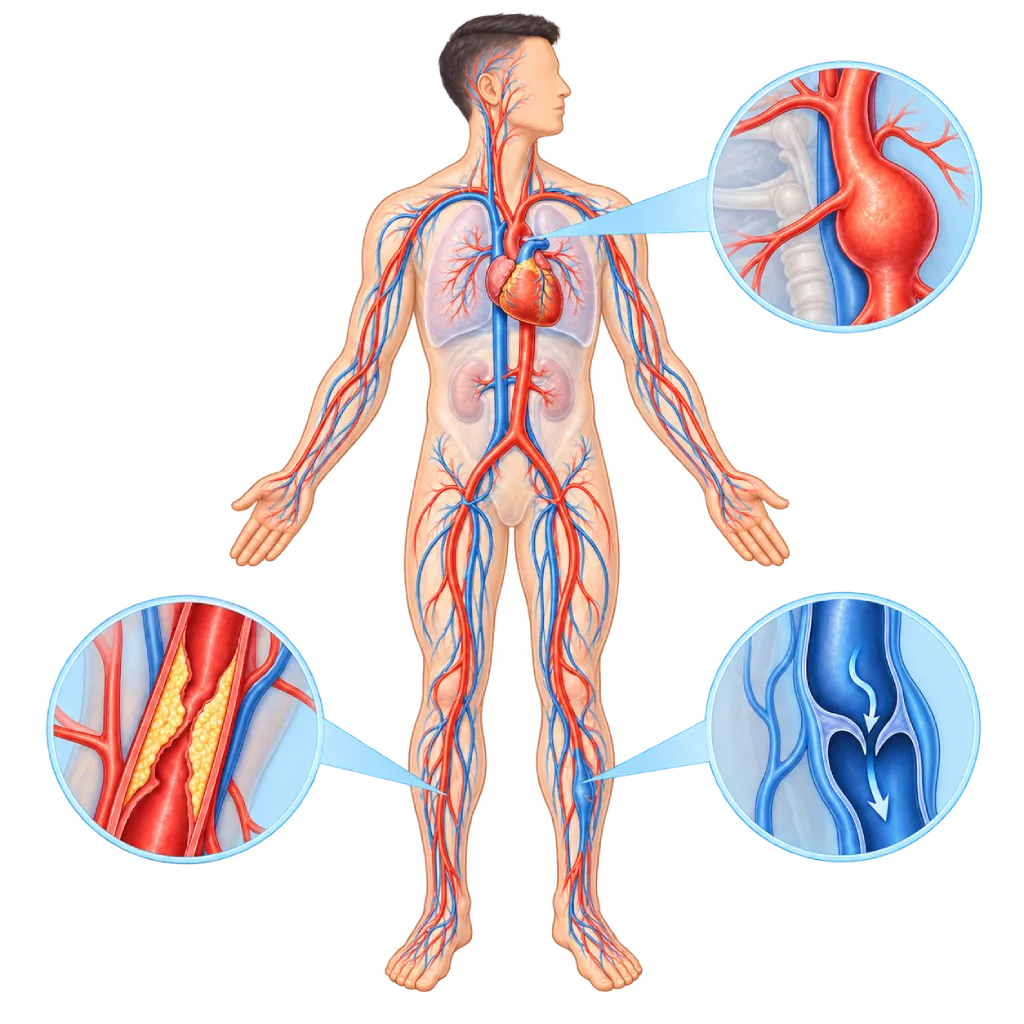
Blood vessels are a network of channels that carry blood to and from every part of the body. Arteries carry oxygen-rich blood from the heart, starting with the aorta, the main artery leaving the heart. Veins carry blood back to the heart, helped by small valves that stop blood from flowing backward. Blood vessel disease, or vascular disease, is a general term for disorders of these channels. This page gives an overview, while each type is covered in more detail on its own page.
Disorders of the Arteries
A common cause is atherosclerosis, the buildup of plaque made of fat, cholesterol, and calcium in the artery walls, which is covered on the Atherosclerosis page. Plaque makes the arteries narrow and stiff. In the legs, this narrowing causes calf pain when walking, which is covered on the Peripheral Artery Disease page. In the neck, plaque in the carotid arteries can trigger a stroke. Arteries can also be suddenly blocked by a clot carried in the bloodstream, which is covered on the Arterial Embolism page, or become inflamed because of an immune disorder, which is covered on the Systemic Vasculitis page.
Disorders of the Aorta
A weakened wall of the aorta or another artery can slowly bulge like a balloon. This widening is called an aneurysm, which is covered on the Aneurysm page. The inner layer of the aortic wall can also tear suddenly, so blood flows between the layers of the wall. This emergency is called aortic dissection, which is covered on the Aortic Dissection page and listed as a type of disease on this page.
Disorders of the Veins
Leaky valves in the leg veins let blood pool, so the veins widen into varicose veins and the legs feel heavy or swollen. A blood clot in a deep vein of the leg can break loose and block a lung artery. These vein disorders are covered on the Venous Disease page.
One System, One Assessment
Arteries throughout the body share the same risk factors: smoking, high blood pressure, high cholesterol, and diabetes. For this reason, people with narrowed leg arteries often also have plaque in the arteries of the heart and brain. The 2024 ESC guidelines recommend assessing vascular disease as a whole, not only in the part that causes symptoms. Many vascular disorders cause no symptoms at first, so needle-free tests such as vascular ultrasound and measuring blood pressure at the ankles help find them earlier.
02 / Understanding the condition
Types and Related Conditions
The following conditions belong to the Vascular Disease group. Open each one for a full explanation.
03 / Understanding the condition
Symptoms to Recognize.
Common Symptoms
Symptoms depend on which blood vessels are affected, and many disorders cause no symptoms at first.
- Pain, cramps, or aching in the calf or thigh when walking that eases with rest
- Legs that feel heavy, achy, or swollen toward the evening
- Leg veins that look widened, bulging, or twisted
- Pale, cold skin on the feet, or brownish skin around the ankles
- Sores on the feet or legs that are slow to heal
- A lump in the abdomen that feels like it is pulsating
04 / Understanding the condition
What Causes This Condition?
- Atherosclerosis: a buildup of plaque made of fat, cholesterol, and calcium that narrows and stiffens the arteries
- Long-standing high blood pressure, which strains and weakens the walls of the arteries and aorta
- Blood clots that form in the veins or in the heart and then block a blood vessel
- Weak or damaged valves in the leg veins, so blood flows backward and pools
- Inflammation of the blood vessel walls (vasculitis), for example due to autoimmune disease
- Inherited connective tissue disorders, such as Marfan syndrome, which make the aortic wall fragile
- Blood vessel injury from accidents, medical procedures, or radiation therapy
05 / Understanding the condition
Who Is at Higher Risk?
Lifestyle
Smoking damages the inner lining of the arteries and speeds up plaque formation. Too little physical activity, excess weight, and sitting or standing for long periods without moving also add to the risk of artery and vein disorders.
Medical
High blood pressure, high LDL cholesterol, diabetes, and chronic kidney disease. Major surgery, long periods of bed rest, cancer, and pregnancy increase the risk of clots in the veins.
Genetic
A family history of aneurysm, aortic dissection, varicose veins, or heart disease at a young age. Inherited disorders of connective tissue or of blood clotting factors also increase susceptibility.
Age
The risk of artery and vein disorders increases with age, especially after 50 to 60, because the vessel walls become stiffer and the vein valves weaken.
Groups at Higher Risk
- Smokers and Former Smokers: Smoking speeds up narrowing of the arteries and is linked to widening of the aorta. The risk falls gradually after quitting.
- People with Diabetes: Diabetes speeds up plaque buildup and often affects the small arteries of the calf, so a foot wound may be the first sign.
- People with Hypertension: Persistently high blood pressure strains the walls of the arteries and aorta and is linked to stroke, aneurysm, and aortic dissection.
- Older Adults: Artery and vein disorders are more common in older age, and the symptoms are often atypical, so they are easily missed.
- People with Coronary Artery Disease or Stroke: Plaque in one area often comes with plaque in other areas, so the leg arteries, neck arteries, and aorta need to be assessed.
06 / Understanding the condition
How Is It Diagnosed?
The examination begins with questions about your symptoms, smoking habits, and your history of blood pressure, cholesterol, diabetes, and vascular disease in your family. The doctor measures blood pressure in both arms, feels the pulses in the neck, abdomen, groin, and feet, and examines the skin, veins, and any sores on the legs.
The next step depends on the suspected area. The Ankle-Brachial Index (ABI) compares blood pressure at the ankle and arm to look for narrowing of the leg arteries. Radiation-free vascular ultrasound assesses narrowing of the neck and leg arteries, widening of the abdominal aorta, leaky vein valves, and clots in the deep veins. CT angiography or MR angiography maps the blood vessels in more detail, especially before a procedure or when an aortic problem is suspected. Blood tests assess cholesterol, blood sugar, and kidney function to plan prevention.
Physical Examination
Questions about your symptoms and risk factors, blood pressure measurement in both arms, checking the pulses, and examination of the skin, veins, and any sores on the legs.
Ankle-Brachial Index (ABI) Test
Compares blood pressure at the ankle and arm to look for narrowing of the leg arteries, without needles.
Vascular Ultrasound
Sound waves and Doppler to assess the neck and leg arteries, widening of the abdominal aorta, leaky vein valves, and clots in the deep veins.
Peripheral CT Angiography
A CT scan with contrast dye to map the arteries from the abdominal aorta to the feet, especially before a procedure to open a blockage.
Vascular Disease Screening
Needle-free tests for people at risk to look for narrowing of the leg arteries, widening of the abdominal aorta, and plaque in the neck arteries.
Laboratory Tests
Blood tests for cholesterol, blood sugar or HbA1c, and kidney function to assess risk factors and plan prevention.
07 / Understanding the condition
Treatment Options.
Treatment is decided by a doctor after an assessment. The categories below can help you follow the conversation with your doctor.
Lifestyle Changes
Quitting smoking, staying active, maintaining a healthy weight, and eating a healthy diet form the basis of treatment for almost all vascular diseases.
Medicines That Protect the Blood Vessels
Statin cholesterol-lowering medicines, antiplatelets, and medicines for blood pressure and blood sugar. The type and dose are determined by your doctor based on your condition.
Blood Thinners
Anticoagulants are used to treat and prevent clots in the veins and in certain other situations. The type and duration of use are determined by your doctor.
Endovascular Therapy
Procedures performed from inside the blood vessel through a small incision in the groin or arm, such as balloon angioplasty, stents, stent grafts, or clot removal.
Vascular Surgery
Bypass surgery, replacing the aorta with an artificial tube, or removing plaque from the neck arteries, when a catheter procedure is not suitable.
Compression Therapy and Vein Treatment
Compression stockings, closing veins with heat through a catheter, or sclerotherapy for varicose veins and other vein disorders.
08 / Understanding the condition
Complications to Watch For.
Stroke
Plaque or clots from the neck arteries can block blood vessels in the brain. Covered on the Stroke page.
Heart Attack
Plaque in the leg arteries and aorta often comes with plaque in the coronary arteries. Covered on the Myocardial Infarction / Heart Attack page.
Leg Wounds and Amputation
Severely reduced blood flow to the legs can cause wounds that are hard to heal and dead tissue. Covered on the Critical Limb Ischemia page.
Aneurysm Rupture
A widened aorta or artery can burst and cause internal bleeding that needs immediate surgery.
Pulmonary Embolism
A clot from a deep vein in the leg can break loose and block a lung artery. Covered on the Pulmonary Embolism page.
Impaired Kidney Function
Narrowing of the kidney arteries or aortic disorders can reduce blood flow to the kidneys and also raise blood pressure.
09 / Understanding the condition
What Can You Do?
- Quit smoking and avoid secondhand smoke.
- Stay active for at least 150 minutes per week, for example by brisk walking.
- Choose a diet rich in vegetables, fruit, nuts, fish, and whole grains, and limit salt and saturated fat.
- Control your blood pressure, cholesterol, and blood sugar according to your doctor's targets.
- When sitting for a long time, for example on long trips, move your ankles and walk around now and then.
- Maintain a healthy weight to reduce the strain on your leg veins.
- Ask about blood vessel tests if you are 65 or older with risk factors, or if a family member has an aortic aneurysm.
10 / Understanding the condition
When Should You See a Doctor?
Make an appointment with a doctor if you have leg symptoms that do not go away, or if you have several risk factors and want your blood vessels checked. If you have sudden, very severe chest or back pain, a leg that suddenly turns cold and pale, sudden shortness of breath, or signs of stroke, call an ambulance (119) right away or go to the nearest emergency room.
- Leg pain when walking that eases with rest
- Swollen or heavy legs, or veins that look bulging
- A sore on the foot that does not improve within two weeks
- Skin on the feet that changes color or feels cold
- Test results showing a widened aorta or narrowing of a neck artery
- You smoke, have diabetes or hypertension, and are over 50
Don't Wait in an Emergency.
If symptoms are severe or come on suddenly, go to the nearest emergency department right away or call Heart Attack Center 1500 258, rather than waiting for an appointment.
11 / Common questions
Questions You May Have.
Frequently asked questions about vascular disease.
What is the difference between vascular disease and heart disease?
Heart disease affects the muscle, valves, rhythm, or coronary arteries of the heart. Vascular disease affects the arteries and veins outside the heart, such as the aorta, neck arteries, leg arteries, and leg veins. The two are linked because they share the same risk factors, so heart and blood vessel specialists usually assess both together.
Are varicose veins a type of vascular disease?
Yes. Varicose veins are widened, twisted leg veins caused by valves inside them that do not close tightly, so blood pools. The majority of varicose veins are not dangerous, but they can cause aching, swelling, skin color changes, or sores if left for years. Varicose veins are covered on the Varicose Veins page, and other vein disorders on the Venous Disease page.
Does vascular disease always cause symptoms?
No. Narrowing of the leg arteries, plaque in the neck arteries, and widening of the aorta often cause no symptoms for years. For this reason, people with risk factors such as smoking, diabetes, high blood pressure, or age 65 and older may be advised to have needle-free tests, such as an ABI and vascular ultrasound, to find them earlier.
Which doctors treat vascular disease?
Usually specialists in heart and blood vessel medicine, including those who focus on vascular disease and catheter procedures. If surgery is needed, thoracic, cardiac, and vascular surgeons are also involved, while disorders of the blood vessels of the brain are treated together with neurologists. In many cases, several doctors work as one team so that the treatment of the arteries, veins, and risk factors is aligned.
Can narrowed blood vessels return to normal?
Plaque that has already formed usually does not disappear completely, but its growth can be slowed and it can become more stable. Quitting smoking, staying active, and medicines that lower cholesterol, blood pressure, and blood sugar reduce the risk of heart attack, stroke, and leg wounds. If the narrowing is already severe and causing symptoms, blood flow can be restored with a catheter procedure or surgery.
Are blood thinners always needed?
Not always, and there are different types. Antiplatelets are generally used for artery narrowing caused by plaque, while anticoagulants are used for clots in the veins and certain other situations. Both classes of medicine can increase the risk of bleeding, so your doctor weighs them according to your disease and condition. Do not start, switch, or stop these medicines without consulting your doctor.
Sources and Medical Review
Translated from the Indonesian edition medically reviewed by dr. Emanoel Oepangat, Sp.JP(K).
Sources as cited in the Indonesian edition.
- Mazzolai L, Teixido-Tura G, Lanzi S, Boc V, Bossone E, Brodmann M, et al. 2024 ESC Guidelines for the management of peripheral arterial and aortic diseases. Eur Heart J. 2024;45(36):3538-700.
- Gornik HL, Aronow HD, Goodney PP, Arya S, Brewster LP, Byrd L, et al. 2024 ACC/AHA/AACVPR/APMA/ABC/SCAI/SVM/SVN/SVS/SIR/VESS Guideline for the Management of Lower Extremity Peripheral Artery Disease: A Report of the American College of Cardiology/American Heart Association Joint Committee on Clinical Practice Guidelines. Circulation. 2024;149(24):e1313-410.
- Isselbacher EM, Preventza O, Hamilton Black J 3rd, Augoustides JG, Beck AW, Bolen MA, et al. 2022 ACC/AHA Guideline for the Diagnosis and Management of Aortic Disease: A Report of the American Heart Association/American College of Cardiology Joint Committee on Clinical Practice Guidelines. Circulation. 2022;146(24):e334-482.
- De Maeseneer MG, Kakkos SK, Aherne T, Baekgaard N, Black S, Blomgren L, et al. European Society for Vascular Surgery (ESVS) 2022 Clinical Practice Guidelines on the Management of Chronic Venous Disease of the Lower Limbs. Eur J Vasc Endovasc Surg. 2022;63(2):184-267.
- Kakkos SK, Gohel M, Baekgaard N, Bauersachs R, Bellmunt-Montoya S, Black SA, et al. European Society for Vascular Surgery (ESVS) 2021 Clinical Practice Guidelines on the Management of Venous Thrombosis. Eur J Vasc Endovasc Surg. 2021;61(1):9-82.
- Naylor R, Rantner B, Ancetti S, de Borst GJ, De Carlo M, Halliday A, et al. European Society for Vascular Surgery (ESVS) 2023 Clinical Practice Guidelines on the Management of Atherosclerotic Carotid and Vertebral Artery Disease. Eur J Vasc Endovasc Surg. 2023;65(1):7-111.
- Visseren FLJ, Mach F, Smulders YM, Carballo D, Koskinas KC, Back M, et al. 2021 ESC Guidelines on cardiovascular disease prevention in clinical practice. Eur Heart J. 2021;42(34):3227-337.
Doctors Who Treat This Condition

dr. Suko Adiarto, Sp.JP(K), Ph.D.
Interventional Cardiology
Vascular Diagnostic and Therapeutic Center +1 center
Clinical focusCoronary Intervention · Peripheral Vascular Intervention
View Profile
dr. Emanoel Oepangat, Sp.JP(K)
Interventional Cardiology
Vascular Diagnostic and Therapeutic Center +1 center
Clinical focusCoronary Intervention · Peripheral Vascular Intervention
View Profile
dr. Widya T. Suwatri, Sp.BTKV, Subsp. JD(K)
Adult Cardiac Surgery
Advanced Cardiovascular Surgical Care +1 center
Clinical focusMinimally Invasive Cardiac Surgery · Coronary Artery Bypass Surgery
View Profile