
Quick answer
What Is Varicose Veins?
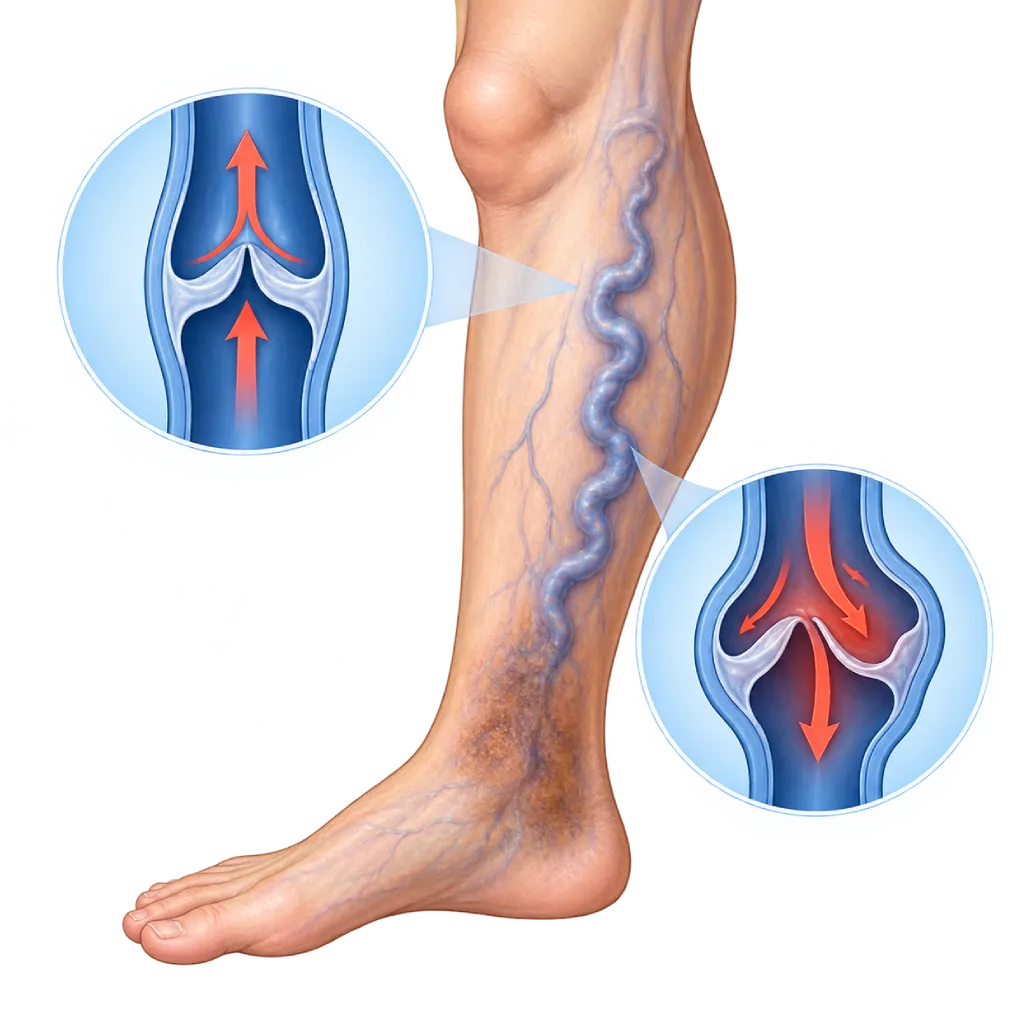
Varicose veins are widened, bulging, twisting veins under the skin of the legs, caused by leaky valves inside them. Symptoms include heavy, achy, and swollen legs, and in some people they can progress to skin changes or wounds.
SourcesSigns That Need Urgent Help
- Bleeding from a varicose vein that does not stop after pressure is applied and the leg is raised
- A varicose vein that suddenly becomes painful, red, and warm and feels hard like a cord
- One leg that suddenly becomes swollen, painful, and tight
- An open wound around the ankle that does not improve within two weeks
- Skin around a wound that becomes redder, swollen, or oozes pus, or comes with fever
- Sudden shortness of breath or chest pain when breathing in
If these signs appear, go to the nearest emergency department right away or call Heart Attack Center 1500 258.
01 / Understanding the condition
About Varicose Veins
Varicose veins are widened, bulging, twisting veins under the skin, usually on the calves and thighs. Veins are the blood vessels that carry blood back to the heart. According to the CEAP classification used in the ESVS 2022 guidelines, a vein is called varicose if its diameter is 3 millimeters or more when standing. Finer vessels, such as red or purple webs on the skin often called spider veins, are an early stage of venous disease but are not varicose veins.
How Varicose Veins Form
Blood in the legs has to flow upward against gravity. This flow is helped by the calf muscles, which pump as you walk, and by one-way valves inside the veins. When the valves weaken and do not close tightly, blood flows back down (reflux) and pools. The pressure in the veins rises, the walls stretch, and the veins look widened. The leak often starts in a saphenous vein, a long surface vein on the inner side of the leg or at the back of the calf.
Related Symptoms
Some people are bothered only by how they look. Others feel heaviness, aching, swelling by late afternoon, night cramps, or itching in their legs. Symptoms usually get worse after standing for a long time and in hot weather, and ease when the legs are raised. The size of varicose veins does not always match how severe the symptoms are.
Part of Chronic Venous Disease
Varicose veins are a form of chronic venous disease and can progress to persistent swelling, darkened or thickened skin around the ankles, and even wounds that are hard to heal (venous ulcers). Doctors grade the stage with the CEAP classification. The condition in which high pressure in the veins has already damaged the skin and tissue is covered on the Chronic Venous Insufficiency page. Varicose veins can also appear after a blood clot damages the valves of the deep veins, which is covered on the Post-Thrombotic Syndrome page.
Treatable Without Major Surgery
Not every varicose vein needs a procedure. If symptoms are bothersome or the skin starts to change, the ESVS 2022 guidelines recommend closing the leaky vein from the inside through a catheter, using laser heat or radiofrequency energy, as the first-choice option. This procedure uses local anesthesia and usually does not require a hospital stay. Sclerotherapy and removal of varicose branches through small incisions complete the treatment. Other types of venous disease are covered on the Venous Disease page.
02 / Understanding the condition
Symptoms to Recognize.
Common Symptoms
- Leg veins that look bulging, twisted, and bluish
- Legs that feel heavy, achy, or tire quickly, especially after standing for a long time
- Ankle swelling by late afternoon that improves after sleep
- Calf muscle cramps at night
- Itching or a burning feeling around widened veins
- Symptoms that ease when your legs are raised or when you walk
- Skin around the ankles that turns brownish or thickens
Symptoms in Adult Women
Hormones and pressure from the uterus during pregnancy affect the veins. In some women, varicose veins come from backward flow in the pelvic veins.
- Varicose veins that appear or worsen during pregnancy, especially in the final trimester
- Varicose veins on the labia, in the groin, or on the back of the thighs
- Heaviness in the legs that worsens before menstruation
- Dull pelvic pain that gets worse after standing for a long time
03 / Understanding the condition
What Causes This Condition?
- Weakened one-way valves in the leg veins that let blood flow back down (reflux)
- Weak vein walls that stretch easily, often influenced by heredity
- High pressure in the leg veins due to prolonged standing, pregnancy, or excess weight
- Damage to the vein valves after deep vein thrombosis (secondary varicose veins)
- Backward flow from the pelvic veins, for example after several pregnancies
- Rare congenital vein abnormalities, such as in Klippel-Trenaunay syndrome
04 / Understanding the condition
Who Is at Higher Risk?
Age
The risk of varicose veins increases with age as the vein walls and valves weaken. Skin changes caused by venous disease are also found more often in older age.
Genetic
A history of varicose veins in a parent or sibling increases your chance of having them, because the strength of the vein walls and valves is influenced by heredity.
Lifestyle
Jobs that require standing or sitting for long periods, lack of physical activity, and excess weight increase the pressure in the leg veins.
Medical
A history of deep vein thrombosis can damage the vein valves and lead to secondary varicose veins. Congenital vein abnormalities, though rare, can also be a cause.
Other
Women have varicose veins more often, especially after several pregnancies. Being tall is also linked to a higher risk.
Groups at Higher Risk
- Women Who Are Pregnant or Have Had Several Pregnancies: Pregnancy hormones relax the vein walls, and the uterus presses on the pelvic veins. The risk of varicose veins rises with the number of pregnancies.
- Workers Who Stand or Sit for Long Periods: For example, retail workers, nurses, teachers, or office workers. The calf muscles rarely work, so blood pools in the legs for longer.
- People with a Family History of Varicose Veins: Weak vein walls and valves tend to run in families, especially if both parents have varicose veins.
- People with Obesity: Excess weight increases the pressure in the abdominal and leg veins and worsens symptoms and skin changes.
- Older Adults: Vein valves and walls weaken with age, so varicose veins and skin changes are found more often in older age.
05 / Understanding the condition
How Is It Diagnosed?
Your doctor will start by asking about your symptoms, pregnancy history, history of blood clots, and family history. Your legs are examined while you stand so the veins fill completely. Your doctor assesses the location and size of the varicose veins, swelling, skin changes, and wounds, and feels the pulses in your feet. These findings are recorded with the CEAP classification, from C0 with no signs to C6 with an open wound.
The main test is venous duplex ultrasound, which is also done while you stand. The ultrasound shows the direction of blood flow, which valves are leaking, and how long the blood flows backward. The ESVS 2022 guidelines recommend this ultrasound before every varicose vein procedure, because the results serve as a map for choosing the treatment approach. The ultrasound also confirms that the deep veins are free of clots. If the pulses in your feet are weak, your doctor checks your arterial blood flow before recommending compression stockings. CT or MR venography is only needed if a blockage or backward flow from the pelvic veins is suspected.
Physical Examination
Examination of the legs while you stand to assess the location of varicose veins, swelling, skin changes, wounds, and the pulses in your feet, recorded with the CEAP classification.
Duplex Ultrasound
The main test. Shows leaky valves and the direction of blood flow, maps the veins before a procedure, and confirms that the deep veins are free of clots.
Ankle-Brachial Index (ABI) Test
Compares blood pressure at the ankle and arm when the pulses in your feet are weak, to make sure compression stockings are safe to wear.
CT or MR venography to map the pelvic and abdominal veins when a blockage or backward flow from the pelvic veins is suspected.
06 / Understanding the condition
Treatment Options.
Treatment is decided by a doctor after an assessment. The categories below can help you follow the conversation with your doctor.
Lifestyle Changes
Regular walking, calf exercises, losing weight, and raising your legs while resting help ease symptoms, although they do not make varicose veins go away.
Compression Stockings
They ease heaviness and swelling and are also worn after procedures. The size and pressure are adjusted by a health professional, and the arterial blood flow in your legs is checked first if there is any doubt.
Venoactive Medicines
A group of medicines your doctor may consider to ease pain, heaviness, and swelling. They do not remove varicose veins; the type and duration are determined by your doctor.
Endovenous Thermal Ablation
Closes a leaky saphenous vein from the inside with laser heat or radiofrequency energy through a catheter, under local anesthesia. The first-choice option according to ESVS 2022. Covered on the Varicose Vein Ablation page.
Non-Thermal Vein Closure
Closes the vein with medical glue (cyanoacrylate) or a combination of a rotating catheter and medicine, without injecting anesthetic fluid along the vein. Considered when thermal ablation is less suitable.
Sclerotherapy
Injection of a liquid or foam medicine into small and medium varicose veins so the veins close and then fade. Also used for varicose veins that come back. Covered on the Sclerotherapy page.
Phlebectomy and Surgery
Varicose branches are removed through small incisions. Surgery to tie off and strip the vein is chosen when catheter-based methods do not suit the shape of your veins.
07 / Understanding the condition
Complications to Watch For.
Superficial Thrombophlebitis
A clot and inflammation inside a varicose vein, making the vein painful, red, and hard. Covered on the Superficial Thrombophlebitis page.
Bleeding from Varicose Veins
Thin varicose veins close to the skin can burst from a minor bump. Press firmly, raise the leg, and go to the emergency room if the bleeding does not stop.
Skin Changes and Venous Eczema
The skin around the ankles can darken, itch, become scaly, or harden because of high vein pressure over a long period.
Venous Ulcer
An open wound around the ankle that heals slowly and tends to come back. Closing the leaky vein early helps the wound heal faster.
Deep Vein Thrombosis (DVT)
Research links varicose veins to a higher risk of clots in the deep veins. Covered on the Deep Vein Thrombosis page.
08 / Understanding the condition
What Can You Do?
- Walk or stay active every day so your calf muscles pump blood upward.
- Break up long periods of sitting or standing by walking briefly or moving your ankles.
- Maintain a healthy weight.
- Raise your legs on a pillow when resting, especially in the late afternoon.
- Wear compression stockings if recommended, for example during pregnancy or if your work involves standing for long periods.
- Care for the skin on your legs with moisturizer and avoid scratching the skin over varicose veins.
- Get checked early if symptoms or skin changes start to appear.
09 / Understanding the condition
When Should You See a Doctor?
Make an appointment with a doctor if your varicose veins cause symptoms, the skin around them starts to change, or you want to know your treatment options. Go to the emergency room right away if a varicose vein bleeds and does not stop after pressure is applied, or if you suddenly become short of breath.
- Your legs feel heavy, painful, or swollen enough to interfere with your activities
- The skin around your ankles darkens, itches, becomes scaly, or hardens
- There is a wound on your leg that does not improve within two weeks
- A varicose vein suddenly becomes painful, red, and hard to the touch
- One leg suddenly becomes swollen and painful
- Varicose veins come back after previous treatment
Don't Wait in an Emergency.
If symptoms are severe or come on suddenly, go to the nearest emergency department right away or call Heart Attack Center 1500 258, rather than waiting for an appointment.
10 / Common questions
Questions You May Have.
Frequently asked questions about varicose veins.
Are varicose veins just a cosmetic problem?
Not always. For some people, varicose veins are only a cosmetic concern. However, they are a sign of leaky vein valves and can cause heaviness, pain, swelling, and skin changes. In a small number of people, the disease progresses to wounds around the ankle. A duplex ultrasound helps your doctor assess how far the blood flow is affected and whether a procedure is needed.
Can compression stockings cure varicose veins?
Compression stockings do not make varicose veins go away, but they help ease heaviness, aching, and swelling by pressing on the veins so blood flows upward more easily. Stockings are also worn after varicose vein procedures and for venous ulcers. Their size and pressure level need to be adjusted by a health professional. If you have leg artery problems or diabetes, your doctor needs to check your arterial blood flow first, because stocking pressure can reduce blood flow to your feet.
Can varicose veins come back after treatment?
Yes. Veins that have been closed or removed usually do not return, but the tendency for valves to weaken remains, so new varicose veins can appear in other veins over time. Long-term studies show that varicose veins come back in some patients, whatever method is used. Regular checkups, staying active, managing your weight, and a repeat ultrasound if symptoms appear help treat new varicose veins early.
What is the difference between varicose veins and fine vessels on the skin, or spider veins?
Varicose veins are veins 3 millimeters or more in diameter that bulge and twist. Spider veins, or telangiectasias, are very fine red or purple vessels less than 1 millimeter in size that look like a web on the skin. Spider veins are usually harmless and can be treated with sclerotherapy or skin laser. However, if they come with symptoms or swelling, your doctor may check for leaks in larger veins.
Can varicose veins be treated during pregnancy?
Varicose veins often appear or worsen during pregnancy because of hormones, increased blood volume, and pressure from the uterus on the pelvic veins. Many pregnancy-related varicose veins shrink within a few months after giving birth. For this reason, procedures such as ablation or sclerotherapy are usually postponed until after delivery and then reassessed. During pregnancy, compression stockings, walking, and raising your legs help ease symptoms. Get checked right away if one leg becomes swollen and painful.
Do varicose veins increase the risk of blood clots?
Varicose veins can lead to superficial thrombophlebitis, a clot with inflammation in a surface vein, which is covered on the Superficial Thrombophlebitis page. Research also links varicose veins to a higher risk of deep vein thrombosis, although a cause-and-effect relationship is not yet certain. For this reason, watch for varicose veins that suddenly become red, painful, and hard, or a leg that suddenly swells, and get checked right away if these signs appear.
Sources and Medical Review
Translated from the Indonesian edition medically reviewed by dr. Emanoel Oepangat, Sp.JP(K).
Sources as cited in the Indonesian edition.
- De Maeseneer MG, Kakkos SK, Aherne T, Baekgaard N, Black S, Blomgren L, et al. European Society for Vascular Surgery (ESVS) 2022 Clinical Practice Guidelines on the Management of Chronic Venous Disease of the Lower Limbs. Eur J Vasc Endovasc Surg. 2022;63(2):184-267.
- Gloviczki P, Lawrence PF, Wasan SM, Meissner MH, Almeida J, Brown KR, et al. The 2022 Society for Vascular Surgery, American Venous Forum, and American Vein and Lymphatic Society clinical practice guidelines for the management of varicose veins of the lower extremities. Part I. Duplex Scanning and Treatment of Superficial Truncal Reflux. J Vasc Surg Venous Lymphat Disord. 2023;11(2):231-61.
- Lurie F, Passman M, Meisner M, Dalsing M, Masuda E, Welch H, et al. The 2020 update of the CEAP classification system and reporting standards. J Vasc Surg Venous Lymphat Disord. 2020;8(3):342-52.
- Gohel MS, Heatley F, Liu X, Bradbury A, Bulbulia R, Cullum N, et al. A Randomized Trial of Early Endovenous Ablation in Venous Ulceration. N Engl J Med. 2018;378(22):2105-14.
- Brittenden J, Cooper D, Dimitrova M, Scotland G, Cotton SC, Elders A, et al. Five-Year Outcomes of a Randomized Trial of Treatments for Varicose Veins. N Engl J Med. 2019;381(10):912-22.
- Chang SL, Huang YL, Lee MC, Hu S, Hsiao YC, Chang SW, et al. Association of Varicose Veins With Incident Venous Thromboembolism and Peripheral Artery Disease. JAMA. 2018;319(8):807-17.
Doctors Who Treat This Condition

dr. Suko Adiarto, Sp.JP(K), Ph.D.
Interventional Cardiology
Vascular Diagnostic and Therapeutic Center +1 center
Clinical focusCoronary Intervention · Peripheral Vascular Intervention
View Profile
dr. Emanoel Oepangat, Sp.JP(K)
Interventional Cardiology
Vascular Diagnostic and Therapeutic Center +1 center
Clinical focusCoronary Intervention · Peripheral Vascular Intervention
View Profile
dr. Puti S. Saus, Sp.JP(K)
Interventional Cardiology
Coronary Intervention Procedures
Clinical focusAcute Coronary Syndrome · Primary Coronary Intervention
View Profile