
Quick answer
What Is Sclerotherapy?
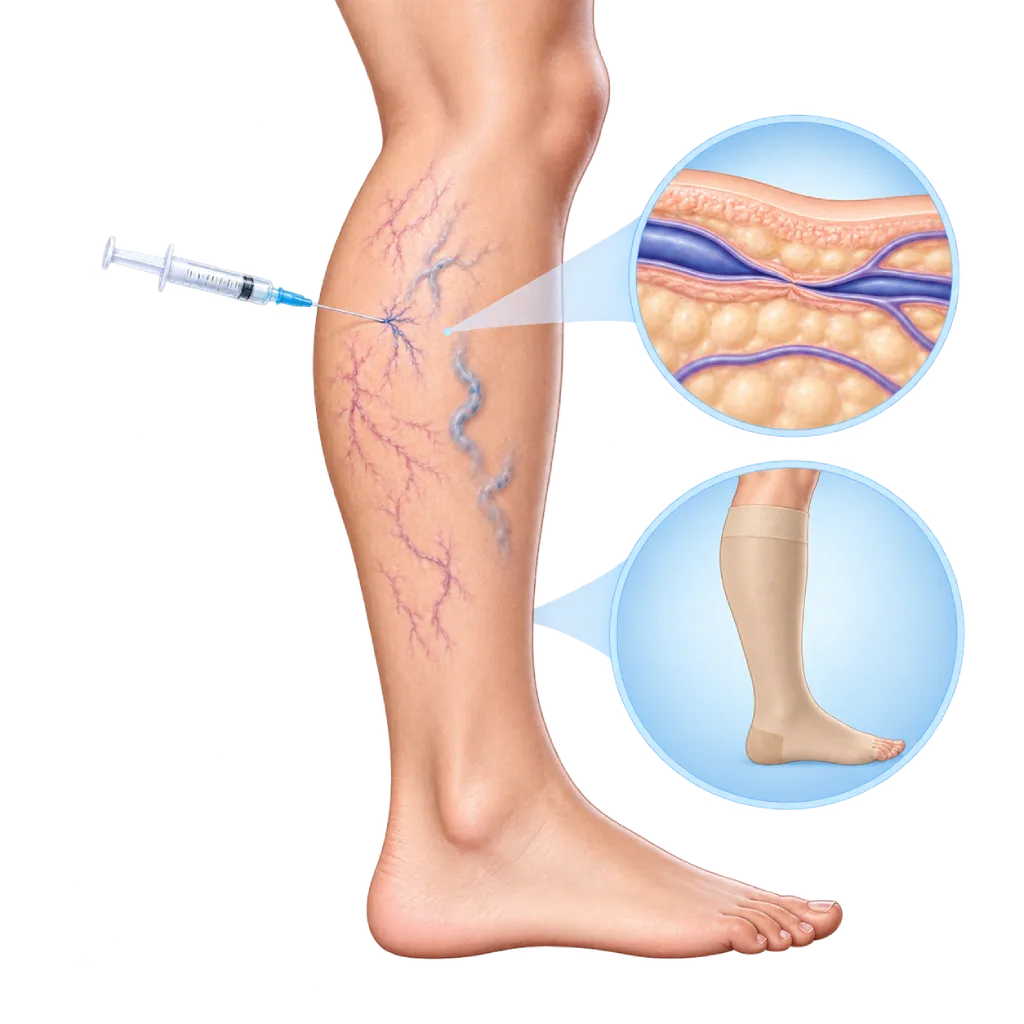
Sclerotherapy is a procedure that injects a special medicine into small, widened veins, such as spider veins and small varicose veins, so the vein walls stick together and close. The body then absorbs the vein, and it fades over a few weeks to months. The procedure takes about 30 minutes without anesthesia, and you can walk home right away.
Sources01 / Understanding the procedure
About Sclerotherapy
What Is Sclerotherapy
Sclerotherapy is a procedure to close small, widened veins by injecting a special medicine, called a sclerosant, directly into the vein. It is used for fine red or purple blood vessels (spider veins), small bluish veins under the skin, and small to medium-sized varicose veins. Sclerotherapy is performed without an incision and without anesthesia.
How It Works in Brief
The sclerosant irritates the inner lining of the vein wall, so the walls swell and stick together, and the vein closes. Over a few weeks to months, the closed vein is absorbed by the body and fades from the surface of the skin. Blood continues to return to the heart through other healthy veins, so blood flow in the leg is not disrupted.
Liquid or Foam
- Liquid: for spider veins and small bluish veins.
- Foam: the medicine is mixed with air into a fine foam so it can fill larger veins. For veins that cannot be seen from the outside, the injection is guided by ultrasound.
Why an Ultrasound Scan Is Needed Beforehand
Varicose veins often stem from leaking valves in the main veins of the leg, which cannot be seen from the outside. If this leak is not treated, varicose veins and spider veins can easily come back. For this reason, before treating varicose veins, the doctor usually checks the blood flow in the veins with ultrasound. This test is covered on the Duplex Ultrasound page.
If a main vein is leaking, treatment usually starts by closing that vein, which is covered on the Varicose Vein Ablation page. Sclerotherapy is then used for the branches and remaining small veins.
Results You Can Expect
Spider veins usually fade within 3 to 6 weeks, while larger veins may take 3 to 4 months. More than one session is often needed. Sclerotherapy closes existing veins but does not prevent new veins from appearing later, so healthy habits and regular follow-up visits remain important.
02 / Understanding the procedure
When Is This Procedure Considered?
A doctor may consider this procedure in the situations below. The decision is always made after a thorough assessment.
- Fine Blood Vessels (Spider Veins)Fine red or purple lines on the skin of the legs.
- Small Bluish Veins Under the SkinAlso called reticular veins.
- Small to Medium Varicose VeinsIncluding varicose branches on the surface of the leg.
- Residual or Recurrent Varicose VeinsAfter ablation or varicose vein surgery.
- Heavy, Aching LegsWhen related to widened veins.
- Certain Main Veins with FoamWhen ablation is not suitable, with ultrasound guidance.
Situations to Consider First
- Allergy to the Sclerosant MedicineA history of allergy to the same medicine.
- Blood Clots in the Deep Veins or LungsClots that are recent or still being treated; the procedure is postponed.
- Infection in the Area to Be InjectedOr a severe infection elsewhere in the body.
- Need for Prolonged Bed RestUnable to walk after the procedure.
- Pregnancy or BreastfeedingUsually postponed until after this period.
- Hole in the Heart Septum That Has Caused SymptomsApplies only to the foam technique; requires the doctor's assessment.
03 / Before the procedure
How Should You Prepare?
No fasting is needed. The following simple preparations help the procedure go smoothly.
Ultrasound scan. For varicose veins, a leg vein ultrasound is usually done before the procedure, on the same day or earlier.
Medication list and health history. Tell your doctor if you take blood thinners, birth control pills, or hormone therapy, have ever had a blood clot, often have migraines with visual disturbances, have a drug allergy, or are pregnant or breastfeeding.
Skin on your legs. Do not apply lotion, cream, or oil to your legs on the day of the procedure.
Compression stockings. Prepare compression stockings in the recommended size, or ask the team whether stockings are provided.
Clothing. Wear loose pants or a loose skirt that is easy to take off and fits over the stockings.
Unsure about the preparation instructions? Ask our team before the procedure.
04 / During the procedure
How Is the Procedure Done?
The procedure takes about 30 minutes per session, depending on the number and size of the veins. You do not need anesthesia and can go home right away.
Assessment and Marking
The doctor examines your legs while you are standing, reviews the ultrasound results, and then marks the veins to be injected.
Injection
You lie down, the skin is cleaned, and the medicine is injected into the vein with a very fine needle. For larger veins, the medicine is injected as a foam under ultrasound guidance. It feels like a small prick, sometimes with brief stinging or cramping.
Compression
After the injections, the injection sites are bandaged or compression stockings are put on right away to help the vein walls stay stuck together.
Walking and Observation
You will be asked to walk for about 10 to 20 minutes and will be observed briefly before going home.
05 / Benefits and risks
Benefits and Risks Should Be Discussed Together.
Every medical procedure has benefits and risks. Your doctor will explain both for your situation before the procedure.
Benefits You Can Expect
- Small Veins FadeSpider veins and small varicose veins gradually disappear from the surface of the skin.
- Reduced Leg SymptomsHeaviness, aching, or pain caused by widened veins can improve.
- No Incision and No AnesthesiaOnly injections with a fine needle.
- Immediate Return to ActivitiesYou can walk home and go to work on the same day.
- Can Be Combined with AblationTo treat branches and remaining veins after the main vein has been closed.
The benefits of a procedure are not a promise of a cure. Ask how the results will affect your care plan.
Risks You Should Know
- Bruising and Mild PainCommon and usually goes away within a few days to weeks.
- Brownish Lines on the SkinFairly common; usually fades within a few months, though some last longer.
- New Fine Vessels Around the AreaSometimes appear and can be treated in a later session.
- Lumps of Trapped BloodCan be removed by the doctor during a follow-up visit.
- Superficial Vein InflammationRedness and pain along the vein; usually improves with medication and compression.
- Rare Side EffectsSmall skin sores, temporary vision disturbances after foam, a clot in a deep vein, or an allergic reaction.
Risks can differ from person to person. A full explanation and consent are given after an individual assessment.
06 / After the procedure
What Is Recovery Like?
The majority of people can return to work and normal activities on the same day.
Keep walking. Walking every day helps blood flow. Avoid sitting or standing still for too long during the initial days.
Wear stockings as advised. For a few days to a few weeks, depending on the size of the injected veins.
Postpone strenuous exercise. Avoid strenuous exercise, hot baths, and saunas for a few days.
Protect your skin from sunlight. Protect the injected skin from direct sunlight for a few weeks to reduce the risk of brownish discoloration.
Follow-up visit. A follow-up visit is usually scheduled a few weeks later to assess the results and plan the next session if needed.
Warning signs. Go to the emergency room right away if you experience:
- A swollen, painful calf that feels warm
- Sudden shortness of breath or chest pain
- Vision problems, weakness on one side of the body, or slurred speech
- A widespread rash, swelling of the face or lips, or difficulty breathing
Contact your doctor if a sore develops or the skin turns black at the injection site.
Know the Signs That Need Prompt Care.
Follow the team's guidance on warning signs. If severe or sudden symptoms appear after the procedure, go to the nearest emergency department right away or call Heart Attack Center 1500 258.
07 / Team and support
Doctors and Procedure Support
The doctors below are listed for this procedure. Listed by name, not by ranking.

dr. Emanoel Oepangat, Sp.JP(K)
Interventional Cardiology
Vascular Diagnostic and Therapeutic Center +1 center
Clinical focusCoronary Intervention · Peripheral Vascular Intervention
View Profile
dr. Suko Adiarto, Sp.JP(K), Ph.D.
Interventional Cardiology
Vascular Diagnostic and Therapeutic Center +1 center
Clinical focusCoronary Intervention · Peripheral Vascular Intervention
View ProfileDoppler Vascular Ultrasound
An ultrasound test of the blood vessels that shows the vessel wall and the blood flow at the same time. Doctors use it to look…
The availability of technology and test support is confirmed with the team. Technology is chosen according to clinical need.
08 / Common questions
Before You Plan the Procedure.
Frequently asked questions about sclerotherapy. Your treatment plan is determined by your doctor after an examination.
Does sclerotherapy hurt?
It is usually not very painful. The needle used is very fine, so it feels like a small prick. Some people feel brief stinging, warmth, or cramping as the medicine goes in. For this reason, sclerotherapy does not require anesthesia. After the procedure, the injection sites may feel slightly sore or bruised for a few days, which usually improves with walking and wearing stockings.
How many sessions are needed?
It depends on the number and size of the veins. Spider veins often require two to three sessions or more, a few weeks apart. Each session can treat several veins at once. At the follow-up visit, the doctor assesses the results, because some veins only fade after a few weeks, and then decides whether another session is needed.
Can varicose veins come back?
The majority of closed veins do not come back, but some can reopen and new veins can appear over time, especially with a family history, pregnancy, or a job that involves a lot of standing. Varicose veins are also more likely to return if leaking valves in the main vein have not been treated. Staying active, maintaining your weight, and regular follow-up visits help preserve the results.
What is the difference between sclerotherapy and varicose vein ablation?
Sclerotherapy closes veins with an injected medicine and is suited to spider veins, small veins, and varicose branches. Varicose vein ablation closes a leaking main vein with heat energy from a laser or radiofrequency waves delivered through a thin catheter. The two are often used together: ablation for the main vein, then sclerotherapy for the branches and remaining small veins. The doctor chooses the approach based on the ultrasound results.
What if I take blood thinners?
In general, sclerotherapy can still be performed and blood thinners do not need to be stopped, because stopping them may actually increase the risk of clots. You may have slightly more bruising. Tell your doctor about all the medications you take, including birth control pills and hormone therapy, because the doctor needs to weigh the risk of blood clots before deciding on the treatment plan.
Can sclerotherapy be done during pregnancy?
It is generally not recommended. Varicose veins that appear during pregnancy often improve on their own within a few months after giving birth, so treatment is usually postponed. During pregnancy, symptoms can be eased with compression stockings, moving your legs often, and raising your legs when resting. After you have given birth and finished breastfeeding, discuss the right timing for the procedure with your doctor.
Sources and Medical Review
Translated from the Indonesian edition medically reviewed by dr. Emanoel Oepangat, Sp.JP(K).
Sources as cited in the Indonesian edition.
- De Maeseneer MG, Kakkos SK, Aherne T, et al. European Society for Vascular Surgery (ESVS) 2022 Clinical Practice Guidelines on the Management of Chronic Venous Disease of the Lower Limbs. Eur J Vasc Endovasc Surg. 2022;63(2):184-267.
- Rabe E, Breu FX, Cavezzi A, et al. European guidelines for sclerotherapy in chronic venous disorders. Phlebology. 2014;29(6):338-354.
- Gloviczki P, Lawrence PF, Wasan SM, et al. The 2023 Society for Vascular Surgery, American Venous Forum, and American Vein and Lymphatic Society clinical practice guidelines for the management of varicose veins of the lower extremities. Part II. J Vasc Surg Venous Lymphat Disord. 2024;12(1):101670.
- Gloviczki P, Lawrence PF, Wasan SM, et al. The 2022 Society for Vascular Surgery, American Venous Forum, and American Vein and Lymphatic Society clinical practice guidelines for the management of varicose veins of the lower extremities. Part I. Duplex scanning and treatment of superficial truncal reflux. J Vasc Surg Venous Lymphat Disord. 2023;11(2):231-261.e6.
- de Ávila Oliveira R, Riera R, Vasconcelos V, Baptista-Silva JCC. Injection sclerotherapy for varicose veins. Cochrane Database Syst Rev. 2021;12:CD001732.
- Brittenden J, Cotton SC, Elders A, et al. A randomized trial comparing treatments for varicose veins. N Engl J Med. 2014;371(13):1218-1227.