
Quick answer
What Is Superficial Thrombophlebitis?
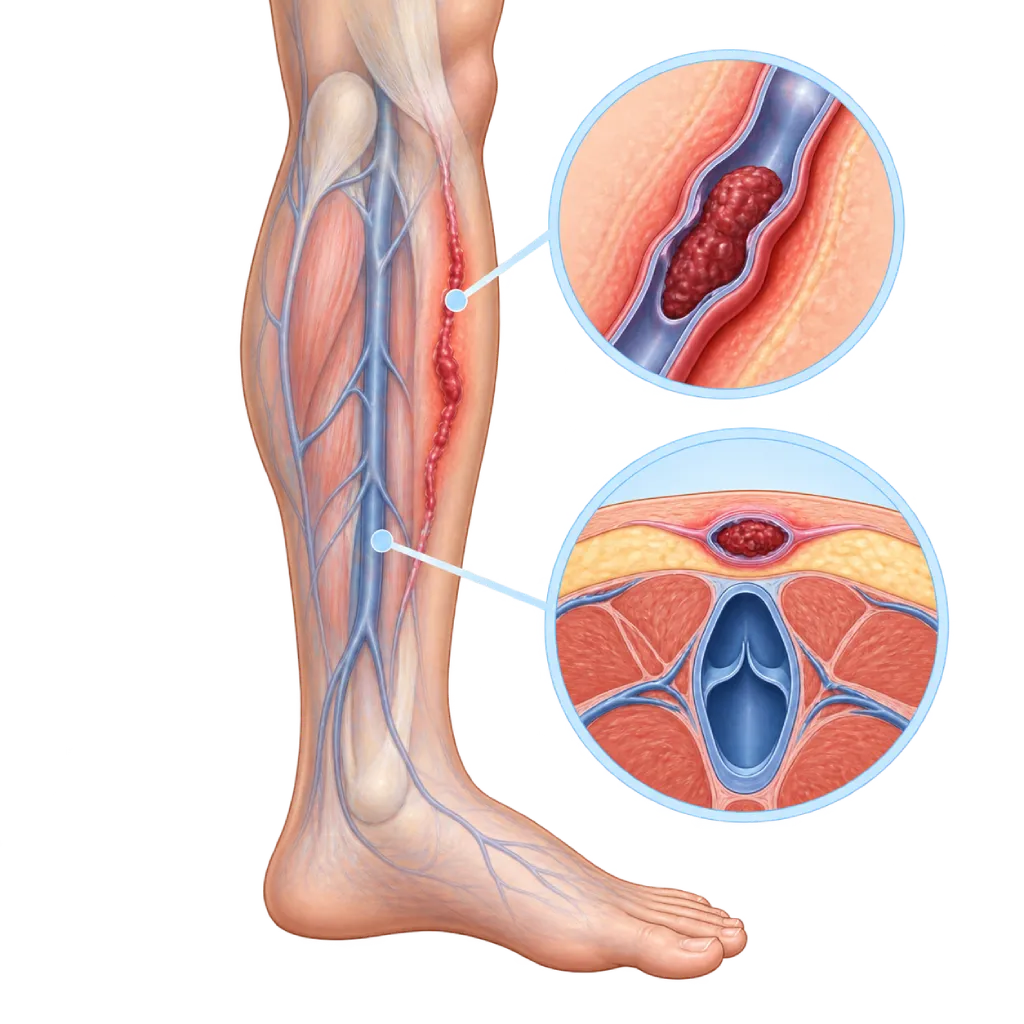
Superficial thrombophlebitis is inflammation of a vein just under the skin with a blood clot inside, so the vein feels painful, red, and hard. It is usually mild, but it needs an ultrasound because the clot can spread to the deep veins.
SourcesSigns That Need Urgent Help
- Redness and pain spreading up toward the groin
- The whole calf or leg becomes swollen and painful
- Sudden shortness of breath or chest pain when breathing in
- Coughing up blood or a very fast heartbeat
- Fever, chills, or pus coming from a former IV site
- Symptoms getting worse despite several days of treatment
If these signs appear, go to the nearest emergency department right away or call Heart Attack Center 1500 258.
01 / Understanding the condition
About Superficial Thrombophlebitis
Superficial thrombophlebitis is inflammation of a surface vein, a vein just under the skin, with a blood clot inside it. Medical guidelines call it superficial vein thrombosis. The affected vein looks red, feels warm and painful, and feels hard like a cord. It usually occurs in the legs, especially in varicose veins, and can also appear in the arm at a former IV or injection site. This condition is fairly common and usually improves within a few weeks with simple treatment.
A Clot That Can Spread
Surface veins are different from deep veins, which lie between the muscles. A clot in a surface vein is less likely to break loose and travel to the lungs. However, the two vein systems are connected, so a clot can spread from a surface vein to a deep vein, especially if it lies near the point where the saphenous vein joins the deep veins in the groin or behind the knee. In the large POST study in France, about a quarter of patients with superficial thrombophlebitis in the leg were found to also have a clot in a deep vein or in the lungs at their first examination. Clots in the deep veins are covered on the Deep Vein Thrombosis page.
Why It Still Needs to Be Checked
For this reason, the 2021 ESVS guidelines recommend a duplex ultrasound for all cases of superficial thrombophlebitis in the legs. The ultrasound measures the length of the clot and its distance to the deep veins, and makes sure the deep veins are free of clots. The results determine the treatment. A short clot far from the deep veins only needs symptom relief. A long clot requires anticoagulant medicine for several weeks, while a clot very close to the deep veins is treated like deep vein thrombosis.
Looking for the Cause
In varicose veins, thrombophlebitis is usually triggered by slow blood flow in the widened veins. If it appears in a vein that looks normal, keeps coming back, or moves from place to place without a clear trigger, the doctor may look for other causes, such as a blood clotting disorder or cancer. Thrombophlebitis that moves from one vein to another within a short time is a situation that needs to be investigated. Once the inflammation settles, the varicose veins that caused it can be treated to reduce the chance of it coming back, as covered on the Varicose Veins page. Other types of vein disease are covered on the Venous Disease page.
02 / Understanding the condition
Symptoms to Recognize.
Common Symptoms
- A vein under the skin that feels hard like a cord and hurts when pressed
- Red, warm skin over the vein
- Pain, soreness, or a burning feeling along the vein
- Mild swelling around the inflamed vein
- Often appears in varicose veins in the calf or inner thigh
- In the arm, appears at a former IV or injection site
- After it settles, brownish skin and a lump may remain for several weeks
03 / Understanding the condition
What Causes This Condition?
- A clot in a varicose vein because of slow blood flow in the widened vein
- Irritation of the vein wall from an IV needle, catheter, or injected medicine
- A blow or injury to a vein in the leg
- Blood that clots more easily because of pregnancy, the hormone estrogen, cancer, or a blood clotting disorder
- Long periods of inactivity, for example after surgery or during illness
- Rare inflammatory blood vessel diseases, such as Behcet's disease or Buerger's disease
04 / Understanding the condition
Who Is at Higher Risk?
Medical
Varicose veins are the main risk factor. A history of blood clots, cancer, blood clotting disorders, autoimmune diseases, and IV lines or catheters also increase the risk.
Lifestyle
Inactivity, sitting for long periods while traveling, and excess weight slow the blood flow in the leg veins.
Age
More common in middle and older age, in line with the increase in varicose veins and other health conditions.
Other
More common in women. Pregnancy, the postpartum period, birth control pills, and hormone therapy containing estrogen increase the tendency to form clots.
Groups at Higher Risk
- People with Varicose Veins: The majority of thrombophlebitis cases in the legs occur in varicose veins, because blood flows slowly in the widened veins.
- Pregnant and Postpartum Women: Hormonal changes and pressure from the womb on the pelvic veins make clots form more easily, including in surface veins.
- Patients Receiving IV Therapy: IV needles or catheters and certain medicines can irritate the wall of the arm veins, especially if they stay in place for a long time.
- People with a History of Blood Clots: A history of deep vein thrombosis or previous thrombophlebitis points to a higher tendency to form clots.
- People with Cancer: Cancer can make blood clot more easily. Recurrent thrombophlebitis without a clear cause is sometimes its first sign.
05 / Understanding the condition
How Is It Diagnosed?
Doctors can usually recognize superficial thrombophlebitis from how it looks: a red, warm, painful vein that feels hard like a cord. The doctor also asks about any history of varicose veins, IV lines, surgery, pregnancy, hormone use, and previous blood clots, and examines both legs.
The 2021 ESVS guidelines recommend a duplex ultrasound for all cases of superficial thrombophlebitis in the legs. The ultrasound measures the length of the clot and its distance to the point where the saphenous vein joins the deep veins in the groin or behind the knee, and checks whether there is a clot in the deep veins. A clot 5 cm or longer, or one 3 cm or less from the deep veins, needs different treatment from a short clot. A D-dimer test is of limited help in this situation. If thrombophlebitis appears in a vein that is not varicose, keeps coming back, or has no clear trigger, the doctor may look for other causes, such as a blood clotting disorder or cancer.
Physical Examination
Looking at and feeling the inflamed vein, and checking for varicose veins, signs of infection at a former IV site, and swelling of the whole leg.
Duplex Ultrasound
Recommended for all thrombophlebitis in the legs: measures the length of the clot and its distance to the deep veins, and makes sure the deep veins are free of clots.
Complete Blood Count (CBC)
Used if there is fever or signs of infection, or as part of the search for a cause when there is no clear trigger.
Antiphospholipid Antibody Test
In thrombophlebitis that keeps coming back or has no trigger, the doctor may test for antiphospholipid antibodies and other clotting disorders.
06 / Understanding the condition
Treatment Options.
Treatment is decided by a doctor after an assessment. The categories below can help you follow the conversation with your doctor.
Compresses and Leg Elevation
Warm or cold compresses and raising the leg while resting help ease the pain. Keep walking as usual.
Nonsteroidal Anti-Inflammatory Drugs
As tablets or a gel applied to the skin, for a short clot far from the deep veins. Your doctor assesses whether they are safe for you, especially if you have stomach or kidney problems.
Short-Term Anticoagulants
For a clot 5 cm or longer in the leg, guidelines recommend anticoagulants for about 45 days. Your doctor decides the type and dose. Covered on the Anticoagulation Therapy and Stroke Prevention page.
Treatment-Dose Anticoagulants
If the clot is 3 cm or less from the point where the saphenous vein joins the deep veins, the doctor treats it like deep vein thrombosis, usually for about three months.
Compression Stockings
These can help ease pain and swelling if they are comfortable to wear. Their size and pressure are adjusted by a health professional.
Treating the Varicose Veins Behind the Clot
After the inflammation settles, ablation or sclerotherapy may be considered to close the varicose veins that cause the recurrences. Covered on the Varicose Vein Ablation page.
IV Removal and Antibiotics for Infection
In thrombophlebitis caused by an IV, the IV needle is removed or moved to another site. Antibiotics are given if there are signs of infection.
07 / Understanding the condition
Complications to Watch For.
Deep Vein Thrombosis (DVT)
The clot can spread from a surface vein to a deep vein, especially if it lies near the groin. Covered on the Deep Vein Thrombosis page.
Pulmonary Embolism
A clot that has spread to a deep vein can break loose and travel to the lungs, causing sudden shortness of breath. Covered on the Pulmonary Embolism page.
Recurrent Thrombophlebitis
It can come back in the same varicose vein or elsewhere, especially if the source is not treated.
Vein Infection (Septic Thrombophlebitis)
Rare, usually at a former IV site, and marked by fever, pus, and spreading redness. It needs antibiotics and sometimes a procedure.
Brownish Marks on the Skin
After the inflammation settles, the skin over the vein may look brownish and a lump may remain for several months before fading.
08 / Understanding the condition
What Can You Do?
- If you have varicose veins, have them checked and treated as your doctor advises.
- Keep moving and walking, especially on long trips or while recovering from illness.
- Maintain a healthy weight.
- When you have an IV in the hospital, tell the nurse if the IV area becomes painful, red, or swollen.
- Wear compression stockings if advised, for example during pregnancy or after varicose vein treatment.
- If you have had a blood clot before, discuss the risks of birth control pills or hormone therapy with your doctor.
09 / Understanding the condition
When Should You See a Doctor?
See a doctor if a vein under your skin is red, painful, and feels hard, especially in the leg. Your doctor will decide whether you need an ultrasound and medicine. Go to the emergency room right away if you have sudden shortness of breath or chest pain.
- A red, painful, hard vein in the leg, especially in the thigh
- Redness spreading toward the groin or the back of the knee
- Swelling of the whole leg
- A former IV site that is painful, red, oozing pus, or accompanied by fever
- Thrombophlebitis that keeps coming back or moves from place to place for no clear reason
- Symptoms that do not improve after one to two weeks
Don't Wait in an Emergency.
If symptoms are severe or come on suddenly, go to the nearest emergency department right away or call Heart Attack Center 1500 258, rather than waiting for an appointment.
10 / Common questions
Questions You May Have.
Frequently asked questions about superficial thrombophlebitis.
What is the difference between superficial thrombophlebitis and deep vein thrombosis?
Superficial thrombophlebitis occurs in a vein just under the skin, so the redness and hardness can be seen and felt. Deep vein thrombosis occurs in a large vein between the muscles and usually makes the whole calf or leg swell without a clear red line. A clot in a deep vein is more likely to break loose and travel to the lungs. Both can happen at the same time, so an ultrasound is needed to confirm.
Is superficial thrombophlebitis dangerous?
Usually not, and it often improves within a few weeks. However, the clot can spread to the deep veins, especially if it is long or near the groin, and in a small number of cases it can break loose and travel to the lungs. That is why an ultrasound assessment is important to decide whether you need blood thinners. Go to the emergency room right away if you have sudden shortness of breath or chest pain.
How long does superficial thrombophlebitis take to heal?
Pain and redness usually ease within one to two weeks. A hard lump and brownish skin color can remain for several weeks to several months before fading. If your doctor prescribes anticoagulants, treatment usually lasts about six weeks. If your symptoms get worse instead, the redness spreads, or your leg becomes swollen, see your doctor again because a repeat ultrasound may be needed.
Can I keep walking and doing my usual activities?
Yes, and it is actually recommended. Walking helps blood flow in the veins and may reduce the chance of the clot spreading. Avoid lying down or sitting still for too long. When resting, raise your leg, and use warm or cold compresses to ease the pain. Compression stockings can also help if they are comfortable to wear. Ask your doctor before returning to strenuous exercise.
Does thrombophlebitis at an IV site need treatment?
Thrombophlebitis caused by an IV is usually mild. The first step is to remove or move the IV needle, then ease the pain with compresses and pain relievers as advised. Symptoms usually improve within a few days. Tell the nurse or doctor right away if you develop fever, pus, or spreading redness, because these may signal an infection that needs antibiotics.
Do my varicose veins need treatment after thrombophlebitis?
If thrombophlebitis appears in a varicose vein, that varicose vein can trigger it to come back. After the inflammation settles, your doctor may consider ablation or sclerotherapy to close the leaky vein, based on the ultrasound results. Your doctor decides the timing of the procedure, usually after the clot and inflammation have improved. Options for treating varicose veins are covered on the Varicose Veins page.
Sources and Medical Review
Translated from the Indonesian edition medically reviewed by dr. Emanoel Oepangat, Sp.JP(K).
Sources as cited in the Indonesian edition.
- Kakkos SK, Gohel M, Baekgaard N, Bauersachs R, Bellmunt-Montoya S, Black SA, et al. European Society for Vascular Surgery (ESVS) 2021 Clinical Practice Guidelines on the Management of Venous Thrombosis. Eur J Vasc Endovasc Surg. 2021;61(1):9-82.
- Stevens SM, Woller SC, Baumann Kreuziger L, Bounameaux H, Doerschug K, Geersing GJ, et al. Antithrombotic Therapy for VTE Disease: Second Update of the CHEST Guideline and Expert Panel Report. Chest. 2021;160(6):e545-608.
- De Maeseneer MG, Kakkos SK, Aherne T, Baekgaard N, Black S, Blomgren L, et al. European Society for Vascular Surgery (ESVS) 2022 Clinical Practice Guidelines on the Management of Chronic Venous Disease of the Lower Limbs. Eur J Vasc Endovasc Surg. 2022;63(2):184-267.
- Decousus H, Quéré I, Presles E, Becker F, Barrellier MT, Chanut M, et al. Superficial venous thrombosis and venous thromboembolism: a large, prospective epidemiologic study. Ann Intern Med. 2010;152(4):218-24.
- Decousus H, Prandoni P, Mismetti P, Bauersachs RM, Boda Z, Brenner B, et al. Fondaparinux for the treatment of superficial-vein thrombosis in the legs. N Engl J Med. 2010;363(13):1222-32.
- Di Nisio M, Wichers IM, Middeldorp S. Treatment for superficial thrombophlebitis of the leg. Cochrane Database Syst Rev. 2018;2(2):CD004982.
Doctors Who Treat This Condition

dr. Suko Adiarto, Sp.JP(K), Ph.D.
Interventional Cardiology
Vascular Diagnostic and Therapeutic Center +1 center
Clinical focusCoronary Intervention · Peripheral Vascular Intervention
View Profile
dr. Emanoel Oepangat, Sp.JP(K)
Interventional Cardiology
Vascular Diagnostic and Therapeutic Center +1 center
Clinical focusCoronary Intervention · Peripheral Vascular Intervention
View Profile
Dr. dr. Dudy A. Hanafy, Sp.BTKV, Subsp. JD(K), MARS
Adult Cardiac Surgery
Advanced Cardiovascular Surgical Care +1 center
Clinical focusMinimally Invasive Cardiac Surgery · Coronary Artery Bypass Surgery
View Profile