
Quick answer
What Is Antiphospholipid Antibody Test?
The antiphospholipid antibody test checks three things in the blood: lupus anticoagulant, anticardiolipin, and anti-beta2-glycoprotein I. These antibodies can make the blood clot easily in both veins and arteries. A positive result must be confirmed with a repeat test 12 weeks or more later, and the results help your doctor choose a blood thinner.
Sources01 / Understanding the procedure
About Antiphospholipid Antibody Test
What Is the Antiphospholipid Antibody Test
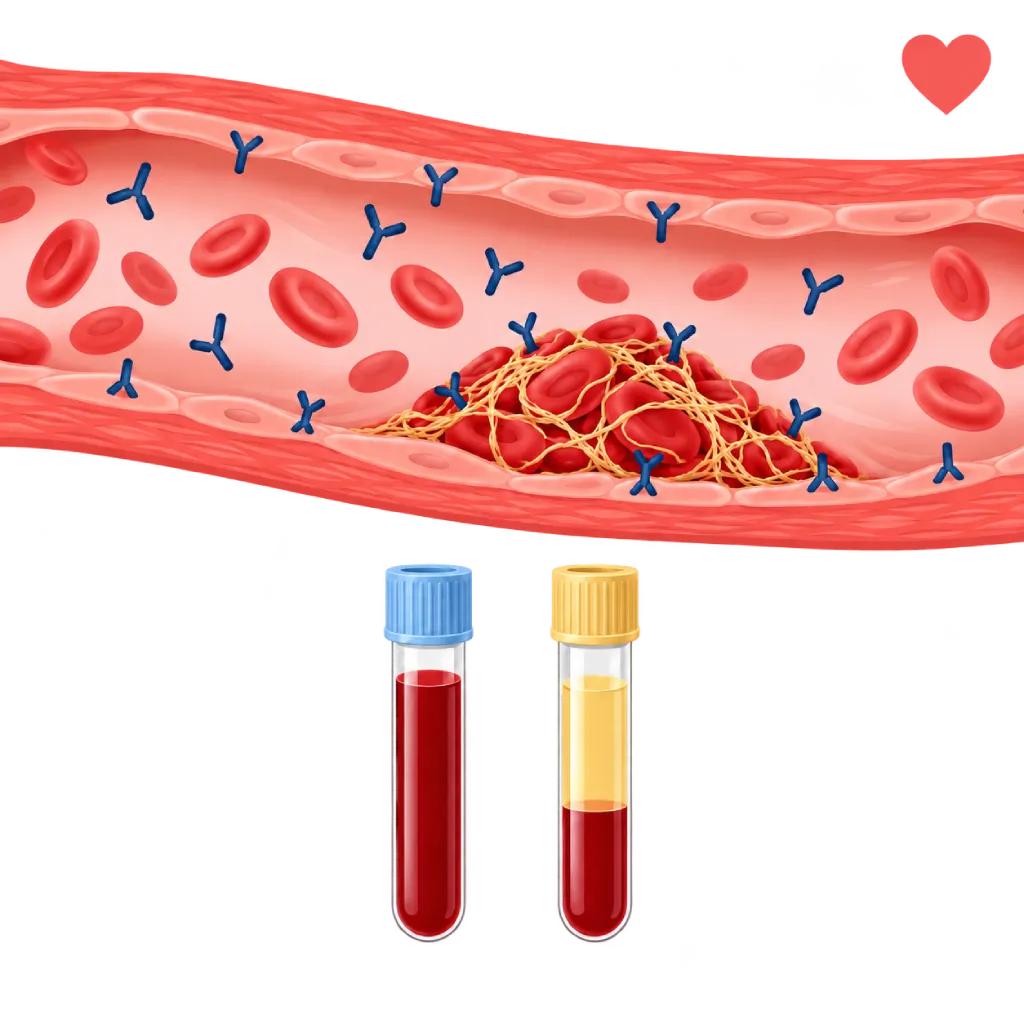
Antiphospholipid antibodies are antibodies that mistakenly attack phospholipids, the fats on the surface of cells, along with the proteins attached to them. As a result, the blood forms clots more easily. When these antibodies persist and are accompanied by blood clots or pregnancy complications, the condition is called antiphospholipid syndrome. This test is used to find these antibodies.
How It Works at a Glance
Blood is drawn into two types of tubes. The blue-top tube contains an anti-clotting agent for the lupus anticoagulant test, which measures how long the blood takes to clot in several special tests. The serum tube is used to measure anticardiolipin and anti-beta2-glycoprotein I levels with antibody methods in the laboratory.
What Is Tested
- Lupus anticoagulant: despite its name, this antibody actually makes the blood clot more easily. This test is very closely linked to the risk of clots.
- Anticardiolipin (IgG and IgM): antibodies against cardiolipin, one type of phospholipid.
- Anti-beta2-glycoprotein I (IgG and IgM): antibodies against a protein that attaches to phospholipids.
Reading the Results
- Negative: the antibodies are not found or their levels are low.
- Positive: the antibodies are found at moderate or high levels. A single positive result is not enough, because infections or medicines can cause temporary antibodies.
- Persistent: a positive result that remains positive on a repeat test 12 weeks or more later.
- Triple positive: when all three tests are positive, the risk of blood clots is higher.
Antiphospholipid syndrome is not diagnosed from blood tests alone, but from persistent results together with a history of blood clots or pregnancy complications.
Antiphospholipid Antibodies and the Heart
Antiphospholipid syndrome can cause clots in the leg veins and the lungs, as well as in the arteries, making it one of the causes of stroke and heart attack at a young age. These antibodies can also thicken the heart valves and are linked to pulmonary hypertension caused by long-standing clots.
The test results help determine the choice of blood thinner. In antiphospholipid syndrome with a history of clots, especially when all three tests are positive, warfarin is generally preferred over newer blood thinners, because the newer medicines more often fail to prevent arterial clots in this group.
02 / Understanding the procedure
When Is This Procedure Considered?
A doctor may consider this procedure in the situations below. The decision is always made after a thorough assessment.
- Blood Clots Without a Clear CauseIn the leg veins, lungs, or unusual locations, especially at a young age.
- Stroke or Heart Attack at a Young AgeEspecially when there are no clear risk factors.
- Recurrent Miscarriage or Pregnancy ComplicationsSuch as severe early preeclampsia or restricted fetal growth.
- Lupus or Other Autoimmune DiseasesThese antibodies are found more often in autoimmune diseases.
- Prolonged aPTT Without a Clear CauseA coagulation test finding that may be caused by lupus anticoagulant.
- Heart Valve Thickening Without InfectionAn echocardiography finding that may be linked to these antibodies.
Situations to Consider First
- Currently Taking Heparin or a DOACThese can interfere with the lupus anticoagulant test. Your doctor will arrange the timing or method of testing.
- Currently Taking WarfarinThe lupus anticoagulant test requires a special method and careful interpretation.
- A Recent Blood ClotLupus anticoagulant results may be less accurate, so the test may be repeated later.
- Infection or FeverThese can cause temporary antibodies. For this reason, a positive result is always repeated.
- Tube Not Completely FilledThe ratio of blood to anti-clotting agent changes, so the sample needs to be taken again.
03 / Before the procedure
How Should You Prepare?
The antiphospholipid antibody test uses a blood sample and does not require fasting.
Blood thinners. Do not stop your medicine on your own. Tell your doctor if you take warfarin, heparin, or a newer blood thinner, because your doctor may adjust the timing of the blood draw or the testing method.
Important information. Tell the staff if you are pregnant, have recently had a blood clot, currently have a fever or infection, or have lupus.
Eating and drinking. Eat and drink as usual, unless another test done at the same time requires fasting.
Previous results. Bring any previous antiphospholipid or coagulation test results, because a positive result needs to be compared with the repeat test.
Unsure about the preparation instructions? Ask our team before the procedure.
04 / During the procedure
How Is the Procedure Done?
The blood draw is usually finished within 10 minutes. Some results take a few days.
Identity and Medication Check
The staff confirm your identity and record any blood thinners you are taking, because this affects how the results are read.
Blood Draw
Blood is drawn from the inner elbow into a blue-top tube and a serum tube. The blue-top tube must be filled to its line so the ratio of blood to anti-clotting agent is correct.
Laboratory Testing
Plasma from the blue-top tube is tested for lupus anticoagulant with several clotting time tests. Serum is tested for anticardiolipin and anti-beta2-glycoprotein I levels.
Repeat Test
If any result is positive, your doctor schedules a repeat test 12 weeks or more later to confirm that the antibodies persist.
05 / Benefits and risks
Benefits and Risks Should Be Discussed Together.
Every medical procedure has benefits and risks. Your doctor will explain both for your situation before the procedure.
Benefits You Can Expect
- Finds the Cause of Blood ClotsHelps explain clots or strokes that occur without a clear cause.
- Guides the Choice of Blood ThinnerThe results help decide whether warfarin is more suitable than newer medicines.
- Guides the Length of TreatmentPersistent antibodies may mean that a blood thinner is needed long term.
- Protects Your Next PregnancyTreatment during pregnancy can be planned earlier.
- A Blood Sample Is EnoughNo procedure is needed other than a blood draw.
The benefits of a procedure are not a promise of a cure. Ask how the results will affect your care plan.
Risks You Should Know
- Minor Pain or BruisingAt the needle site, usually mild and quick to fade.
- Dizziness or Brief FaintingSome people feel dizzy when blood is drawn. Tell the staff so you can lie down.
- Temporary Positive ResultInfections or medicines can cause temporary antibodies, so the test needs to be repeated.
- Infection at the Puncture SiteVery rare because the skin is cleaned and the equipment used is sterile and single-use.
Risks can differ from person to person. A full explanation and consent are given after an individual assessment.
06 / After the procedure
What Is Recovery Like?
There is no recovery period. You can return to your activities right away.
Puncture site. A small bruise is normal. If you take a blood thinner, press on the puncture site a little longer.
If the result is positive. A positive result does not yet mean you have antiphospholipid syndrome. The test is repeated 12 weeks or more later and read together with your history.
If antiphospholipid syndrome is confirmed. Your doctor decides the type and duration of blood thinner treatment. If you take warfarin, your INR is checked routinely. If you are planning a pregnancy, discuss it with your doctor beforehand.
Warning signs. Go to the emergency room right away or contact the medical team if you have:
- Swelling and pain in one leg
- Sudden shortness of breath or chest pain
- Facial drooping, arm or leg weakness, or slurred speech
- Bleeding that is hard to stop while taking a blood thinner
Know the Signs That Need Prompt Care.
Follow the team's guidance on warning signs. If severe or sudden symptoms appear after the procedure, go to the nearest emergency department right away or call Heart Attack Center 1500 258.
07 / Team and support
Doctors and Procedure Support
The doctors below are listed for this procedure. Listed by name, not by ranking.

dr. Debby C. Soemitha, Sp.PD
Internal Medicine
Clinical focusDiabetes and Diabetes Complications · Obesity and Metabolic Disease
View Profile
dr. Indah A. Putri, Sp.N, Subsp, NIOO(K), MSc
Neurovascular, Interventional, Otology, Imaging, and Ophthalmology
Clinical focusStroke and Cerebrovascular Disease · Neurosonology
View Profile
dr. Suko Adiarto, Sp.JP(K), Ph.D.
Interventional Cardiology
Vascular Diagnostic and Therapeutic Center +1 center
Clinical focusCoronary Intervention · Peripheral Vascular Intervention
View Profile08 / Common questions
Before You Plan the Procedure.
Frequently asked questions about the antiphospholipid antibody test. Your doctor will explain what the results mean for your condition.
What is antiphospholipid syndrome?
Antiphospholipid syndrome is an autoimmune disease in which the body makes antibodies that make the blood clot easily. This can result in clots in the leg veins or lungs, stroke, heart attack, or recurrent miscarriage. The disease can occur on its own or together with another autoimmune disease such as lupus.
Does a positive result mean I definitely have antiphospholipid syndrome?
No. Antiphospholipid antibodies can appear temporarily because of infections or certain medicines, and a small proportion of healthy people have them without ever developing a clot. The diagnosis is made when the result stays positive on a repeat test 12 weeks or more later and there is a history of blood clots or pregnancy complications.
Why must the test be repeated after 12 weeks?
Antibodies that appear because of an infection or a medicine usually disappear within a few weeks. Antibodies that persist for more than 12 weeks are more closely linked to the risk of blood clots. With a repeat test, your doctor can tell the two apart before deciding on long-term treatment with a blood thinner.
Should I stop taking my blood thinner before the test?
Do not stop your medicine on your own, because the risk of blood clots can increase. Heparin and newer blood thinners can interfere with the lupus anticoagulant test, while the anticardiolipin and anti-beta2-glycoprotein I tests are not affected. Your doctor will arrange a suitable time for the blood draw or a suitable testing method.
Why do the results of this test affect the choice of blood thinner?
Studies show that in high-risk antiphospholipid syndrome, especially when all three tests are positive, newer blood thinners more often fail to prevent arterial clots than warfarin. For this reason, warfarin with INR monitoring is generally preferred for this group, and your doctor decides which option is right for you.
How are antiphospholipid antibodies linked to stroke and heart attack?
Antiphospholipid antibodies can trigger clots in the arteries of the brain and heart, not only in the veins. For this reason, antiphospholipid syndrome is one of the causes doctors look for in a stroke or heart attack at a young age without clear risk factors. These antibodies can also cause the heart valves to thicken.
Sources and Medical Review
Translated from the Indonesian edition medically reviewed by dr. Debby C. Soemitha, Sp.PD.
Sources as cited in the Indonesian edition.
- Barbhaiya M, Zuily S, Naden R, et al. The 2023 ACR/EULAR antiphospholipid syndrome classification criteria. Arthritis Rheumatol. 2023;75(10):1687-1702.
- Miyakis S, Lockshin MD, Atsumi T, et al. International consensus statement on an update of the classification criteria for definite antiphospholipid syndrome (APS). J Thromb Haemost. 2006;4(2):295-306.
- Devreese KMJ, de Groot PG, de Laat B, et al. Guidance from the Scientific and Standardization Committee for lupus anticoagulant/antiphospholipid antibodies of the International Society on Thrombosis and Haemostasis: update of the guidelines for lupus anticoagulant detection and interpretation. J Thromb Haemost. 2020;18(11):2828-2839.
- Tektonidou MG, Andreoli L, Limper M, et al. EULAR recommendations for the management of antiphospholipid syndrome in adults. Ann Rheum Dis. 2019;78(10):1296-1304.
- Pengo V, Denas G, Zoppellaro G, et al. Rivaroxaban vs warfarin in high-risk patients with antiphospholipid syndrome. Blood. 2018;132(13):1365-1371.