
Quick answer
What Is Deep Vein Thrombosis?
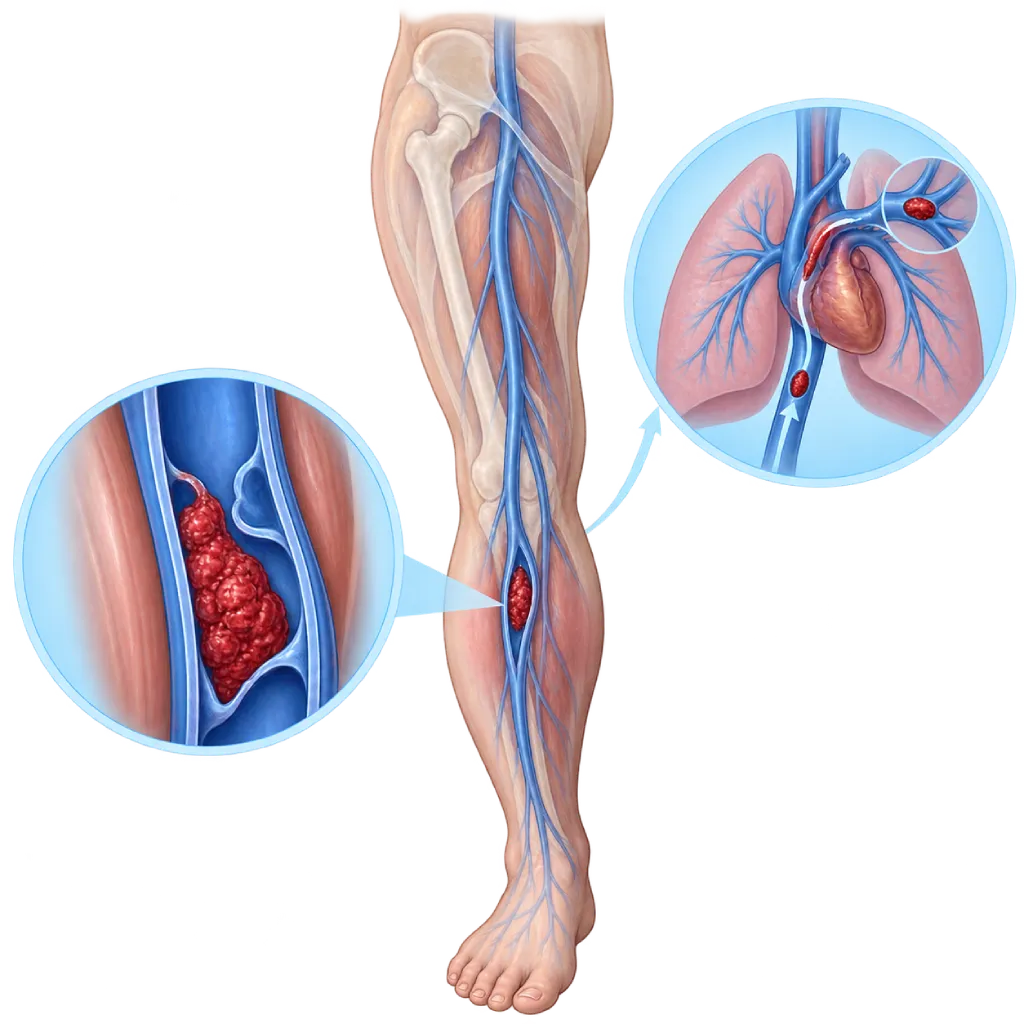
Deep vein thrombosis is a blood clot in a deep vein, usually in the calf, thigh, or pelvis. The clot makes the leg swollen and painful, can break off and travel to the lungs, and needs prompt treatment with blood thinners.
SourcesSigns That Need Urgent Help
- Shortness of breath that comes on suddenly
- Sharp chest pain that gets worse when breathing in or coughing
- Coughing up blood
- A very fast heartbeat
- Fainting, severe dizziness, or nearly fainting
- The whole leg is very swollen, bluish or pale, cold, and very painful
If these signs appear, go to the nearest emergency department right away or call Heart Attack Center 1500 258.
01 / Understanding the condition
About Deep Vein Thrombosis
Deep vein thrombosis (DVT, called trombosis vena dalam in Indonesian) is a blood clot that forms in a deep vein, meaning a large vein that runs between the muscles. Clots usually appear in the calf, thigh, or pelvis, and less often in the arm. The clot blocks blood flow back to the heart, so the leg becomes swollen and painful. In some people, the clot causes no symptoms at all.
Part of the Same Process as Pulmonary Embolism
If part of the clot breaks off, it is carried by the bloodstream through the heart and blocks a blood vessel in the lungs. This is called pulmonary embolism and is an emergency, covered on the Pulmonary Embolism page. Because both come from the same process, doctors group them together as venous thromboembolism. Clots in the thigh and pelvic veins are more likely to break off than small clots in the calf.
Why Clots Form
Three things promote clot formation: slowed blood flow, for example when lying down or sitting for a long time; damage to the vein wall, for example after surgery or injury; and blood that clots more easily, for example because of cancer, pregnancy, or the hormone estrogen. In some people, a clot appears without a clear trigger. Doctors distinguish clots with a temporary trigger from clots without a trigger because this affects how long treatment lasts.
Consistent Treatment
Anticoagulant medicines (blood thinners) keep the clot from growing and prevent new clots, while the body slowly breaks down the existing clot. Treatment lasts at least three months, and longer in some people. The 2021 ESVS guidelines recommend that patients keep moving and walking after the medicine is started, rather than staying in bed. Procedures to remove the clot or place a filter are used only in certain situations.
Long-Term Effects
Some people have lasting symptoms such as a heavy, swollen leg and skin changes after a clot, covered on the Post-Thrombotic Syndrome page. Clots can also come back, especially if the trigger persists. Regular checkups help your doctor decide when the medicine can be stopped safely. While taking anticoagulants, report signs of bleeding such as bleeding gums, reddish urine, or black stools. Other types of vein disease are covered on the Venous Disease page.
02 / Understanding the condition
Symptoms to Recognize.
Common Symptoms
- Swelling in one leg, calf, or thigh
- Pain or tightness in the calf that gets worse when standing or walking
- Leg skin that feels warm and looks red or bluish
- Veins on the surface of the leg that look more visible
- The affected calf looks larger than the other calf
- Swelling and pain in one arm, if the clot is in an arm vein
- Some people have no symptoms at all
Symptoms in Adult Women
The risk of clots is higher during pregnancy and until about six weeks after childbirth. Swelling in both legs is common during pregnancy; swelling on one side needs to be checked.
- Swelling and pain in one leg during pregnancy, more often the left leg
- Swelling of the whole leg with pain in the lower back, buttocks, or groin
- A swollen, painful leg in the weeks after childbirth or a cesarean section
- Leg swelling and pain while using birth control pills or hormone therapy containing estrogen
03 / Understanding the condition
What Causes This Condition?
- Slowed blood flow in the veins, for example from lying down for a long time, serious illness, or sitting for long periods while traveling
- Damage to the vein wall from surgery, a broken bone, injury, or a catheter inside the vein
- Blood that clots more easily, for example because of cancer, pregnancy, or the hormone estrogen
- Inherited blood clotting disorders or antiphospholipid syndrome
- Compression of the left pelvic vein by the artery above it, covered on the May-Thurner Syndrome page
- In some people, a clot appears without a clear trigger
04 / Understanding the condition
Who Is at Higher Risk?
Medical
Major surgery, especially hip and knee bone surgery, hospitalization, broken bones and casts, cancer and its treatment, heart failure, severe infection, inflammatory bowel disease, and a previous blood clot.
Lifestyle
Sitting for a long time without moving, for example on trips longer than four hours, inactivity, excess body weight, and smoking increase the tendency to form clots.
Genetic
Inherited blood clotting disorders such as factor V Leiden, prothrombin gene mutation, or deficiency of protein C, protein S, and antithrombin, as well as a history of blood clots in close family members.
Age
Risk rises gradually with age and is much higher in older adults, especially with other illnesses or bed rest.
Other
Pregnancy until about six weeks after childbirth, birth control pills or hormone therapy containing estrogen, and catheters placed in large veins.
Groups at Higher Risk
- Post-Surgery and Hospitalized Patients: Bed rest and tissue injury during surgery slow blood flow in the veins. Your doctor assesses whether you need medicine or a device to prevent clots.
- People with Cancer: Cancer and some of its treatments make blood clot more easily. The choice and duration of anticoagulants are tailored to the type of cancer and the risk of bleeding.
- Pregnant and Postpartum Women: The risk of clots increases from early pregnancy until about six weeks after childbirth, especially after a cesarean section.
- People with a History of Blood Clots: A previous clot, especially one without a clear trigger, signals a risk of recurrence. Your doctor weighs the need for long-term anticoagulants.
- Older Adults: Older age, other illnesses, and reduced movement make the risk of clots higher, while the symptoms are sometimes less typical.
05 / Understanding the condition
How Is It Diagnosed?
Symptoms of deep vein thrombosis are similar to other problems, such as a muscle injury, a cyst behind the knee, or a skin infection. That is why doctors do not make the diagnosis from a physical examination alone. Your doctor first estimates how likely a clot is using a clinical score, such as the Wells score, based on swelling, pain, and any history of surgery, cancer, or bed rest.
If the likelihood is low, a D-dimer test is done. A normal result nearly rules out a clot, while a high result does not confirm one, because D-dimer also rises after surgery, during pregnancy, and with cancer, infection, and older age. If the likelihood is high or the D-dimer is raised, the next test is duplex ultrasound: a vein that cannot be compressed with the ultrasound probe indicates a clot. If the first ultrasound is normal but suspicion remains high, the ultrasound may be repeated in about one week. Clots in the pelvic or abdominal veins are assessed with CT or MR venography. Before choosing a medicine, your doctor checks a complete blood count, kidney function, and liver function.
Physical Examination
Assesses swelling, tenderness, skin color, and calf circumference, then estimates the clinical likelihood of a clot with a score such as the Wells score.
D-Dimer Test
When the clinical likelihood is low, a normal result can rule out a clot. A high result does not confirm a clot and needs to be followed by ultrasound.
Duplex Ultrasound
The main test, without radiation. A vein that cannot be compressed with the ultrasound probe indicates a clot; the test can be repeated if the first result is uncertain.
CT or MR venography when a clot is suspected in the pelvic veins or the large veins of the abdomen, which are hard to assess with ultrasound.
Laboratory Tests
Complete blood count, kidney function, and liver function before choosing an anticoagulant and to assess the risk of bleeding.
Antiphospholipid Antibody Test
In selected cases, such as a clot without a trigger at a young age or a history of repeated miscarriages, because the result affects the choice of medicine.
06 / Understanding the condition
Treatment Options.
Treatment is decided by a doctor after an assessment. The categories below can help you follow the conversation with your doctor.
Anticoagulant Medicines
Blood thinners in the form of direct oral anticoagulant tablets, heparin injections, or warfarin, for at least three months. Your doctor determines the type and duration. Covered on the Anticoagulation Therapy and Stroke Prevention page.
Early Mobilization and Walking
After the medicine is started, walking is recommended over staying in bed. Movement helps relieve swelling and pain without increasing the risk of the clot breaking off.
Compression Stockings
These can relieve leg pain and swelling after a clot. Your doctor decides when to start wearing them and for how long, based on your symptoms.
Monitoring with Repeat Ultrasound
For a small clot only in the calf veins with mild symptoms, your doctor may choose a repeat ultrasound within one to two weeks before deciding on medicine.
Catheter Thrombolysis or Thrombectomy
Dissolving or removing the clot through a catheter, for selected patients with an extensive clot in the thigh and pelvic veins or a threatened leg. Covered on the Thrombectomy page.
Vena Cava Filter
A small filter in the large vein of the abdomen, used only when anticoagulants cannot be given, and removed again when possible. Covered on the Vena Cava Filter Placement page.
07 / Understanding the condition
Complications to Watch For.
Pulmonary Embolism
The clot breaks off and blocks a lung artery, causing sudden shortness of breath and chest pain. It needs treatment in the emergency room. Covered on the Pulmonary Embolism page.
Post-Thrombotic Syndrome
Long-term symptoms such as a heavy, swollen leg and skin changes because the vein valves are damaged. Covered on the Post-Thrombotic Syndrome page.
Recurrent Thrombosis
Clots can appear again in the same leg or the other one, especially if the trigger persists or the medicine is stopped too soon.
Bleeding from Blood Thinners
Anticoagulants increase the risk of bleeding. Your doctor weighs the benefits and risks, and you need to report any sign of bleeding.
Extensive Vein Blockage That Threatens the Leg
In rare cases, the clot blocks nearly all the veins of the leg, so the leg becomes very swollen, bluish, and painful. It needs urgent treatment in the emergency room.
Chronic Thromboembolic Pulmonary Hypertension
In a small number of people after pulmonary embolism, leftover clots block the lung arteries over the long term. Covered on the Chronic Thromboembolic Pulmonary Hypertension page.
08 / Understanding the condition
What Can You Do?
- Move and walk as soon as possible after surgery or illness, as directed by your medical team.
- On trips longer than four hours, stand up and walk regularly, move your ankles, and drink enough fluids.
- If you are going to have surgery or be hospitalized, ask your doctor whether you need medicine or a device to prevent clots.
- Maintain a healthy weight and quit smoking.
- Discuss your clot risk with your doctor before using birth control pills or hormone therapy, especially if you have had a clot before.
- If you are taking anticoagulants, take them on schedule and do not stop them on your own.
09 / Understanding the condition
When Should You See a Doctor?
Get checked the same day if one leg or arm becomes swollen and painful without a clear cause, especially if you have recently had surgery, been hospitalized, taken a long trip, are pregnant, or have recently given birth. Go to the emergency room right away if you develop sudden shortness of breath, chest pain, or coughing up blood.
- Swelling and pain in one calf, thigh, or arm
- A leg that feels warm or looks red or bluish
- Leg symptoms after surgery, a cast, a hospital stay, or a long trip
- Swelling or pain that gets worse despite taking anticoagulants
- Bleeding gums, repeated nosebleeds, reddish urine, or black stools while taking anticoagulants
- Shortness of breath, chest pain, or coughing up blood: go straight to the emergency room
Don't Wait in an Emergency.
If symptoms are severe or come on suddenly, go to the nearest emergency department right away or call Heart Attack Center 1500 258, rather than waiting for an appointment.
10 / Common questions
Questions You May Have.
Frequently asked questions about deep vein thrombosis.
How long do I need to take blood thinners?
Usually for at least three months. If the clot was triggered by a clear temporary cause, such as major surgery, the medicine can often be stopped after that period. If the clot appeared without a trigger or the trigger persists, such as cancer, your doctor may recommend longer treatment after weighing the risk of bleeding. Do not stop or change your medicine on your own, and bring your medicine list to every checkup.
Do I have to stay in bed so the clot does not break off?
No. The 2021 ESVS guidelines recommend that patients keep moving and walking after blood thinners are started. Research shows that walking does not increase the risk of pulmonary embolism and helps pain and swelling ease faster. Raise your leg when sitting or lying down. If your leg is very swollen or painful, ask your doctor how much activity is safe for you.
Can a blood clot in a vein go away?
Blood thinners do not dissolve the clot right away, but they keep it from growing and prevent new clots. Meanwhile, the body slowly breaks down the clot over several weeks to months. In some people, leftover clot or scar tissue remains and can be seen on ultrasound. This leftover does not always mean treatment has failed; your doctor assesses it together with your symptoms.
Can deep vein thrombosis happen again?
Yes. The risk of recurrence is lower if the clot was triggered by a temporary cause, such as surgery, and higher if it appeared without a clear trigger or the trigger persists. The risk also rises after the medicine is stopped. That is why your doctor weighs the length of treatment for each person. You can help by staying active, maintaining your weight, and telling your doctor about your clot history whenever you are going to have surgery or be hospitalized.
Can I fly after having deep vein thrombosis?
Generally yes, once your condition is stable and you are taking blood thinners regularly, but ask your doctor first, especially in the first few weeks. During trips longer than four hours, stand up and walk regularly, move your ankles, drink enough fluids, and choose an aisle seat. Your doctor may recommend compression stockings. Seek help right away if you develop shortness of breath or chest pain.
Do I need a test for blood clotting disorders?
Not everyone does. Testing for inherited clotting disorders is not recommended routinely because it often does not change treatment. Your doctor may consider it in certain situations, such as a clot without a trigger at a young age, a clot in an unusual location, or a strong family history of clots. Antiphospholipid antibody testing is important in selected cases because the result affects which medicine is chosen.
Sources and Medical Review
Translated from the Indonesian edition medically reviewed by dr. Emanoel Oepangat, Sp.JP(K).
Sources as cited in the Indonesian edition.
- Kakkos SK, Gohel M, Baekgaard N, Bauersachs R, Bellmunt-Montoya S, Black SA, et al. European Society for Vascular Surgery (ESVS) 2021 Clinical Practice Guidelines on the Management of Venous Thrombosis. Eur J Vasc Endovasc Surg. 2021;61(1):9-82.
- Stevens SM, Woller SC, Baumann Kreuziger L, Bounameaux H, Doerschug K, Geersing GJ, et al. Antithrombotic Therapy for VTE Disease: Second Update of the CHEST Guideline and Expert Panel Report. Chest. 2021;160(6):e545-608.
- Ortel TL, Neumann I, Ageno W, Beyth R, Clark NP, Cuker A, et al. American Society of Hematology 2020 guidelines for management of venous thromboembolism: treatment of deep vein thrombosis and pulmonary embolism. Blood Adv. 2020;4(19):4693-738.
- Lim W, Le Gal G, Bates SM, Righini M, Haramati LB, Lang E, et al. American Society of Hematology 2018 guidelines for management of venous thromboembolism: diagnosis of venous thromboembolism. Blood Adv. 2018;2(22):3226-56.
- Konstantinides SV, Meyer G, Becattini C, Bueno H, Geersing GJ, Harjola VP, et al. 2019 ESC Guidelines for the diagnosis and management of acute pulmonary embolism developed in collaboration with the European Respiratory Society (ERS). Eur Heart J. 2020;41(4):543-603.
- Vedantham S, Goldhaber SZ, Julian JA, Kahn SR, Jaff MR, Cohen DJ, et al. Pharmacomechanical Catheter-Directed Thrombolysis for Deep-Vein Thrombosis. N Engl J Med. 2017;377(23):2240-52.
Doctors Who Treat This Condition

dr. Suko Adiarto, Sp.JP(K), Ph.D.
Interventional Cardiology
Vascular Diagnostic and Therapeutic Center +1 center
Clinical focusCoronary Intervention · Peripheral Vascular Intervention
View Profile
dr. Emanoel Oepangat, Sp.JP(K)
Interventional Cardiology
Vascular Diagnostic and Therapeutic Center +1 center
Clinical focusCoronary Intervention · Peripheral Vascular Intervention
View Profile
Dr. med. dr. Denio A. Ridjab, Sp.JP(K)
Interventional Cardiology
Coronary Intervention Procedures +2 centers
Clinical focusInterventional Cardiology · Coronary Artery Disease
View Profile