
Quick answer
What Is Venous Disease?
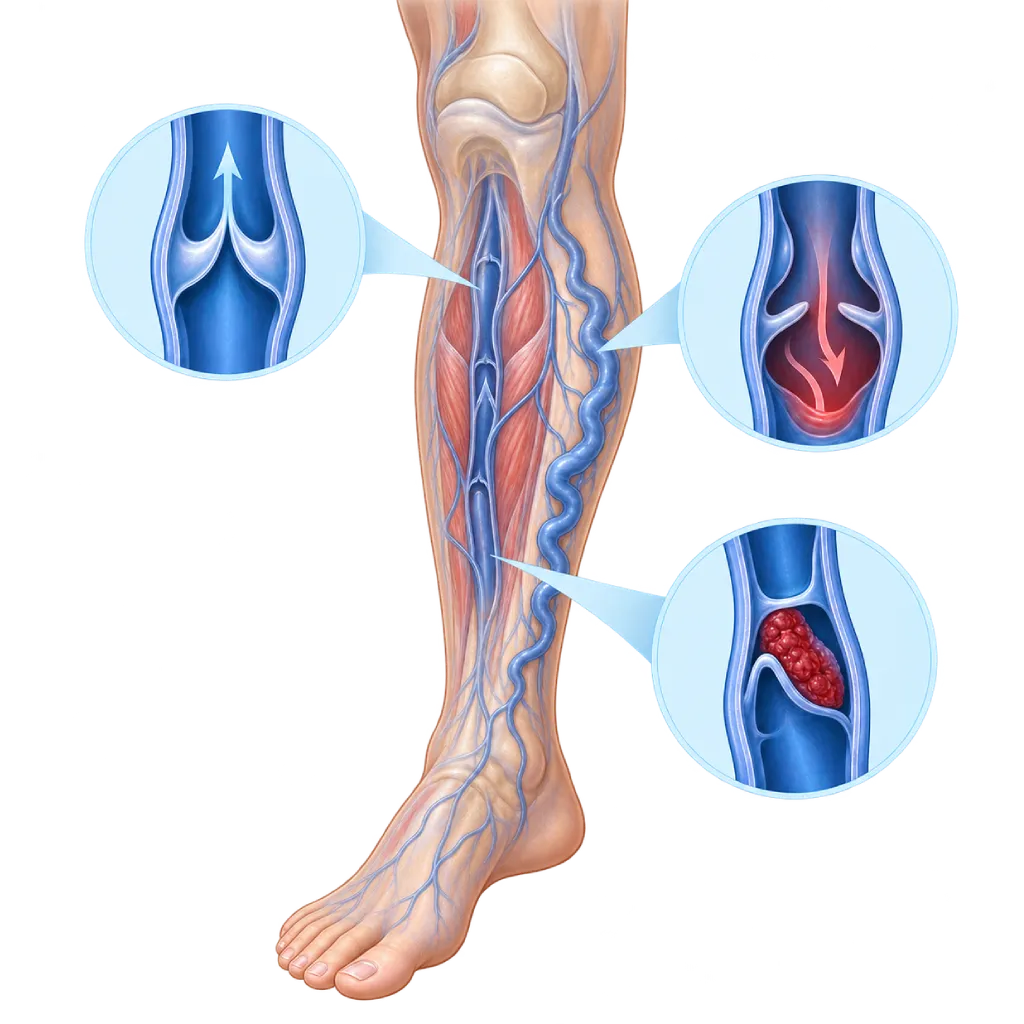
Venous disease is a problem in the veins, the blood vessels that carry blood back to the heart, caused either by leaky vein valves or by blood clots. Examples include varicose veins, chronic venous insufficiency, and deep vein thrombosis.
SourcesSigns That Need Urgent Help
- One leg that is suddenly swollen, painful, and warm
- Sudden shortness of breath with no clear cause
- Chest pain that gets worse when you breathe in
- Coughing up blood, or palpitations with dizziness
- A varicose vein that bursts and bleeds
- A leg wound with pus, spreading redness, or fever
If these signs appear, go to the nearest emergency department right away or call Heart Attack Center 1500 258.
01 / Understanding the condition
About Venous Disease
Veins are the blood vessels that carry blood from the whole body back to the heart. In the legs, blood has to flow upward against gravity. This is helped by the calf muscles, which pump every time you walk, and by one-way valves inside the veins that keep blood from flowing back down. Venous disease occurs when these valves leak, the vein walls weaken, or blood flow is blocked by a clot or by compression from outside.
Two Main Groups
The first group is chronic venous disease, which develops slowly over many years. Leaky valves cause blood to pool in the leg veins, so the pressure inside them rises. This can lead to fine visible vessels in the skin, varicose veins, swelling, skin discoloration, and eventually wounds that are hard to heal. Doctors grade the stage with the CEAP system, from C0 with no signs to C6 with an active ulcer.
The second group is venous thrombosis, a blood clot inside a vein. A clot in a surface vein is called superficial thrombophlebitis. A clot in a deep vein of the leg, pelvis, or arm is called deep vein thrombosis. Part of such a clot can break loose and block the blood vessels of the lungs, which is covered on the Pulmonary Embolism page.
Types Covered Separately
Varicose veins are widened, twisting surface veins, covered on the Varicose Veins page. When swelling, skin changes, or wounds appear, the condition is called chronic venous insufficiency. Deep vein thrombosis, superficial thrombophlebitis, and post-thrombotic syndrome (long-term symptoms after a clot in a deep vein) each have their own page. There are also rarer conditions: May-Thurner syndrome, in which the left pelvic vein is compressed by an artery crossing in front of it, and Klippel-Trenaunay syndrome, a congenital blood vessel abnormality that makes one leg larger.
Why It Matters
Venous disease is very common and is found more often with age. For many people the symptoms are mild, such as legs that feel heavy or achy by late afternoon. Without care, however, some cases progress to persistent swelling and wounds around the ankle that interfere with daily activities. A clot in a deep vein also needs to be recognized quickly because it can block the blood vessels of the lungs.
Venous disease can usually be controlled. The ESVS 2022 guidelines on chronic venous disease and the ESVS 2021 guidelines on venous thrombosis recommend a step-by-step approach: staying active and using compression, medicines suited to the type of disease, then catheter-based procedures or surgery when needed.
02 / Understanding the condition
Types and Related Conditions
The following conditions belong to the Venous Disease group. Open each one for a full explanation.
03 / Understanding the condition
Symptoms to Recognize.
Common Symptoms
- Legs that feel heavy, achy, or tired, especially by late afternoon
- Ankle swelling that improves after raising your legs
- Veins that look bulging, twisted, or bluish
- Fine reddish or bluish vessels on the skin of the legs
- Calf cramps at night
- Itching or a burning feeling on the skin around widened veins
- Darkened or thickened skin around the ankles
Symptoms in Adult Women
Pregnancy, hormones, and pressure from the uterus on the pelvic veins can bring on or worsen vein symptoms.
- Varicose veins that appear or worsen during pregnancy
- Varicose veins around the genitals, buttocks, or inner thighs
- Dull pelvic pain that gets worse after standing for a long time
- Swelling of one leg during pregnancy or after giving birth, which needs to be checked right away
04 / Understanding the condition
What Causes This Condition?
- Weak or leaky vein valves that let blood flow backward and pool in the legs
- Weakened, widened vein walls, often linked to family history
- Blood clots in the veins due to slow blood flow, injury to the vein wall, or blood that clots easily
- Damage to the deep vein valves after deep vein thrombosis
- Compression of a vein from outside, for example the left pelvic vein being pressed by an artery crossing in front of it
- Blood vessels that formed abnormally before birth
- A calf muscle pump that rarely works because of prolonged sitting, prolonged standing, or bed rest
05 / Understanding the condition
Who Is at Higher Risk?
Age
The risk of chronic venous disease and venous thrombosis rises with age, as the vein walls and valves change and activity tends to decrease.
Genetic
A history of varicose veins in a parent or sibling increases susceptibility. Inherited conditions that make blood clot easily, such as factor V Leiden or protein C, protein S, and antithrombin deficiency, increase the risk of thrombosis.
Lifestyle
Jobs that keep you standing or sitting for long periods, lack of physical activity, excess weight, and smoking. Long trips of more than four hours without moving also increase the risk of clots.
Medical
A history of venous thrombosis, major surgery, bone fractures, cancer, heart failure, antiphospholipid syndrome, and hospital stays with prolonged bed rest.
Other
Pregnancy and the period after giving birth, use of birth control pills or hormone therapy that contains estrogen, and female sex for chronic venous disease.
Groups at Higher Risk
- Workers Who Stand or Sit for Long Periods: Retail workers, nurses, teachers, drivers, and office workers have vein problems more often because their calf muscle pump rarely works.
- Pregnant Women and New Mothers: Blood volume and hormones increase, the uterus presses on the pelvic veins, and the risk of clots stays higher in the early weeks after giving birth.
- Older Adults: Aging vein valves and reduced activity make swelling, skin changes, and blood clots more common.
- Patients After Surgery or in the Hospital: Bed rest, major surgery, and bone fractures slow the flow of blood in the veins, so your doctor will assess the need for clot prevention.
- People with Cancer: Cancer and some of its treatments make blood clot more easily, so swelling of one leg needs to be checked right away.
06 / Understanding the condition
How Is It Diagnosed?
Diagnosis begins with questions about your symptoms, how long you have had them, your history of blood clots, pregnancy, and surgery, and the medicines you take. Your doctor examines both legs while you stand to look for varicose veins, swelling, skin discoloration, and wounds, then determines the CEAP stage.
The main test is duplex ultrasound, an ultrasound that shows images of the veins along with the direction and speed of blood flow. It uses no radiation and no needles, and it can show leaky valves, blockages, and blood clots. If deep vein thrombosis is suspected, your doctor first assesses the clinical likelihood, then uses a D-dimer test and compression ultrasound.
If the problem is thought to be in the pelvic or abdominal veins, your doctor may order CT venography or MR venography. Catheter venography and ultrasound from inside the vessel (IVUS) are usually done together with a planned procedure. In certain cases, blood tests help look for causes of blood that clots easily.
Physical Examination
Examination of the legs while you stand to look for varicose veins, swelling, skin changes, and wounds, as the basis for determining the CEAP stage.
Duplex Ultrasound
Shows the vein structure, direction of blood flow, leaky valves, blockages, and blood clots, without radiation or needles.
D-Dimer Test
Helps rule out deep vein thrombosis when the clinical likelihood is low or moderate. A high result needs to be confirmed with ultrasound.
CT venography or MR venography to assess the veins in the pelvis and abdomen, for example when compression or blockage of the iliac vein is suspected.
Venography with a catheter and contrast dye, often together with ultrasound from inside the vessel (IVUS), usually when a procedure is being planned.
Laboratory Tests
Blood tests to check a complete blood count and kidney function, and in certain cases a tendency for blood to clot easily, before medicines are chosen.
07 / Understanding the condition
Treatment Options.
Treatment is decided by a doctor after an assessment. The categories below can help you follow the conversation with your doctor.
Active Lifestyle and Leg Elevation
Regular walking and calf exercises strengthen the muscle pump. Raising your legs while resting and managing your weight help reduce swelling.
Compression Stockings
Stockings with graduated pressure help blood flow upward and reduce swelling and aching. Their size and pressure level are determined by your doctor after your arterial blood flow has been assessed.
Venoactive Medicines
A group of medicines that can ease aching, heaviness, and swelling in chronic venous disease. They do not remove varicose veins; your doctor will decide whether you need them.
Anticoagulant Medicines
Blood thinners are the foundation of treatment for deep vein thrombosis and pulmonary embolism. The type and duration are determined by your doctor based on the cause and your risk of bleeding.
Vein Closure Procedures
Heat ablation through a catheter, medical glue, or foam sclerotherapy to close leaky surface veins, usually under local anesthesia.
Procedures for Thigh and Pelvic Veins
In certain cases, a large clot is removed through a catheter, or a narrowed pelvic vein is widened and fitted with a stent. The decision is made by the vascular team.
Wound Care
Venous ulcers are treated with dressings and compression, along with treatment of the source of the vein leak, so they heal faster and are less likely to come back.
08 / Understanding the condition
Complications to Watch For.
Pulmonary Embolism
Part of a clot from a deep vein breaks loose and blocks the blood vessels of the lungs, which requires treatment in the emergency room. Covered on the Pulmonary Embolism page.
Post-Thrombotic Syndrome
Long-term swelling, pain, and skin changes after deep vein thrombosis because the vein valves are damaged. Covered on the Post-Thrombotic Syndrome page.
Venous Ulcer (Leg Wound)
An open wound around the ankle that heals slowly and tends to come back, caused by high vein pressure over a long period.
Skin Infection (Cellulitis)
Swollen, fragile skin is more easily infected by bacteria, with spreading redness, pain, warmth, and fever.
Bleeding from Varicose Veins
Varicose veins close to the skin surface can burst from a minor bump. Raise the leg, press on the wound, then seek help right away.
09 / Understanding the condition
What Can You Do?
- Walk or stay active every day so your calf muscles pump blood.
- When sitting for a long time, move your ankles and stand or walk briefly every one to two hours.
- Maintain a healthy weight and quit smoking.
- Raise your legs higher than your heart when resting if your feet often swell.
- Wear compression stockings if your doctor recommends them, for example if your job involves standing for long periods.
- Drink enough water during long trips.
- Before surgery or during a hospital stay, ask your doctor about preventing blood clots.
- Tell your doctor about any history of blood clots before using birth control pills or hormone therapy.
10 / Understanding the condition
When Should You See a Doctor?
Make an appointment with a doctor if leg symptoms persist, interfere with your activities, or seem different from usual. Getting checked early helps prevent skin changes and wounds. Go to the emergency room right away if one leg suddenly becomes swollen and painful, or if you suddenly develop shortness of breath or chest pain.
- Legs often feel heavy, achy, or crampy, especially by late afternoon
- Ankle swelling that does not go away after sleep
- Varicose veins that grow larger, become painful, or turn hard and red
- Skin around the ankles that darkens, thickens, or itches
- A leg wound that does not improve within two weeks
- You have had a blood clot and are planning a pregnancy, surgery, or hormone medicines
Don't Wait in an Emergency.
If symptoms are severe or come on suddenly, go to the nearest emergency department right away or call Heart Attack Center 1500 258, rather than waiting for an appointment.
11 / Common questions
Questions You May Have.
Frequently asked questions about venous disease.
What is the difference between venous disease and arterial disease in the legs?
Arteries carry oxygen-rich blood from the heart to the body, while veins carry blood back to the heart. Arterial disease in the legs usually causes calf pain when walking that eases when you stop, along with cold, pale feet. Venous disease more often causes heaviness, swelling later in the day, varicose veins, and darkened skin around the ankles. Both can occur together, so your doctor checks for both.
Are varicose veins just a cosmetic problem?
Not always. For some people, varicose veins are only a cosmetic concern. However, they can also cause aching, cramps, and swelling, and in some people they progress to skin changes or wounds around the ankle. A duplex ultrasound helps your doctor assess how much the valves are leaking and decide whether a procedure is needed or monitoring is enough.
Can anyone wear compression stockings?
No. Compression stockings help in many venous diseases, but the pressure must be right. In people with severe narrowing of the leg arteries, stockings that are too tight can reduce blood flow to the feet. For this reason, your doctor usually feels the pulses in your feet or checks the ABI first, then decides the size and pressure level. Put the stockings on in the morning before your legs swell.
How can I tell whether leg swelling comes from the veins or from the heart or kidneys?
Swelling from vein problems is usually worse at the ankles, gets worse later in the day, and improves after raising your legs or after sleep. Swelling from heart failure, kidney disease, or liver disease usually affects both legs and may come with shortness of breath, trouble breathing when lying down, or changes in urination. Sudden swelling of one leg needs to be checked right away because it can signal a blood clot.
Is long-distance air travel dangerous for the veins?
Sitting for more than four hours slightly increases the risk of a clot in a deep vein, especially if you have had a clot before, recently had surgery, are pregnant, or have cancer. Move your ankles while seated, walk around briefly when possible, and drink enough water. If your risk is high, ask your doctor before traveling whether you need compression stockings or other prevention.
Can venous disease be cured completely?
Vein valves that are already damaged cannot return to normal on their own, but the symptoms can be controlled. Leaky surface veins can be closed with a procedure, and blood clots are usually treated with blood thinners. New varicose veins can still appear years later, so an active lifestyle, a healthy weight, and regular checkups are still recommended.
Sources and Medical Review
Translated from the Indonesian edition medically reviewed by dr. Emanoel Oepangat, Sp.JP(K).
Sources as cited in the Indonesian edition.
- De Maeseneer MG, Kakkos SK, Aherne T, Baekgaard N, Black S, Blomgren L, et al. European Society for Vascular Surgery (ESVS) 2022 Clinical Practice Guidelines on the Management of Chronic Venous Disease of the Lower Limbs. Eur J Vasc Endovasc Surg. 2022;63(2):184-267.
- Kakkos SK, Gohel M, Baekgaard N, Bauersachs R, Bellmunt-Montoya S, Black SA, et al. European Society for Vascular Surgery (ESVS) 2021 Clinical Practice Guidelines on the Management of Venous Thrombosis. Eur J Vasc Endovasc Surg. 2021;61(1):9-82.
- Lurie F, Passman M, Meisner M, Dalsing M, Masuda E, Welch H, et al. The 2020 update of the CEAP classification system and reporting standards. J Vasc Surg Venous Lymphat Disord. 2020;8(3):342-52.
- Konstantinides SV, Meyer G, Becattini C, Bueno H, Geersing GJ, Harjola VP, et al. 2019 ESC Guidelines for the diagnosis and management of acute pulmonary embolism developed in collaboration with the European Respiratory Society (ERS). Eur Heart J. 2020;41(4):543-603.
- Ortel TL, Neumann I, Ageno W, Beyth R, Clark NP, Cuker A, et al. American Society of Hematology 2020 guidelines for management of venous thromboembolism: treatment of deep vein thrombosis and pulmonary embolism. Blood Adv. 2020;4(19):4693-738.
- Salim S, Machin M, Patterson BO, Onida S, Davies AH. Global Epidemiology of Chronic Venous Disease: A Systematic Review With Pooled Prevalence Analysis. Ann Surg. 2021;274(6):971-6.
Doctors Who Treat This Condition

dr. Suko Adiarto, Sp.JP(K), Ph.D.
Interventional Cardiology
Vascular Diagnostic and Therapeutic Center +1 center
Clinical focusCoronary Intervention · Peripheral Vascular Intervention
View Profile
dr. Emanoel Oepangat, Sp.JP(K)
Interventional Cardiology
Vascular Diagnostic and Therapeutic Center +1 center
Clinical focusCoronary Intervention · Peripheral Vascular Intervention
View Profile