
Quick answer
What Is Vascular Ehlers-Danlos Syndrome?
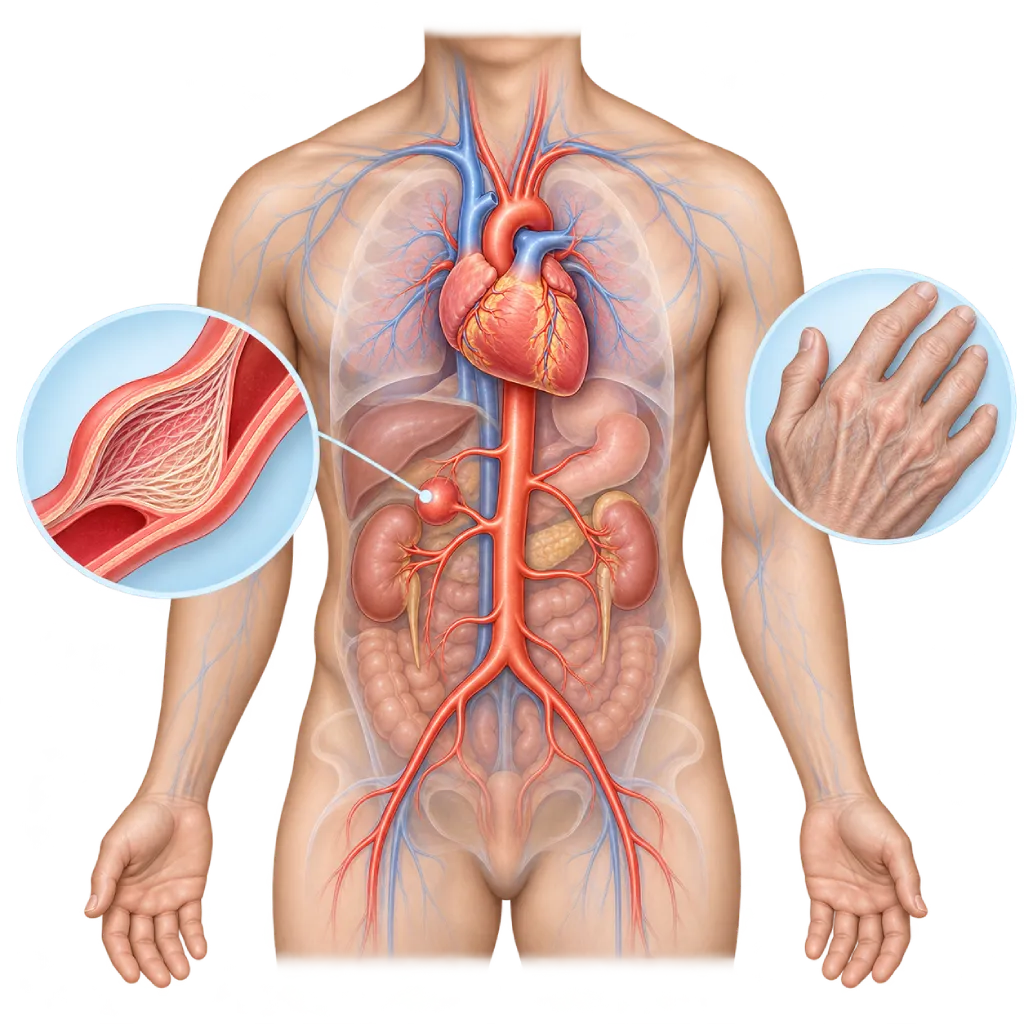
Vascular Ehlers-Danlos syndrome is an inherited disorder of type III collagen caused by a change in the COL3A1 gene. The walls of the arteries, intestines, and uterus become fragile and can tear, often without any prior widening.
SourcesSigns That Need Urgent Help
- Sudden, severe pain in the abdomen, flank, or back
- Sudden chest pain or shortness of breath
- A sudden severe headache, a drooping face, or weakness on one side of the body
- A red, bulging eye with a whooshing sound in the head
- Dizziness, paleness, cold sweats, or fainting with no clear cause
- Severe abdominal pain or bleeding during pregnancy or after giving birth
If these signs appear, go to the nearest emergency department right away or call Heart Attack Center 1500 258.
01 / Understanding the condition
About Vascular Ehlers-Danlos Syndrome
Ehlers-Danlos syndromes (EDS) are a group of inherited connective tissue disorders. The 2017 international classification recognizes 13 types, and the vascular type is one of the rare ones, estimated to affect 1 in 50,000 to 200,000 people. Unlike other types, which mainly cause very flexible joints, the vascular type mainly affects the blood vessels and hollow organs. It is caused by a change in the COL3A1 gene, which makes type III collagen, a protein that strengthens the walls of the arteries, intestines, and uterus.
Why the Blood Vessels Are Fragile
Type III collagen that is lacking or abnormal makes the artery walls thin and easy to tear. A tear can happen without any prior widening, especially in medium-sized arteries in the abdomen, neck, arms, and legs. The aorta can also widen or tear. Widening of the aorta is covered on the Aortic Aneurysm page, while a tear in the aortic wall is covered on the Aortic Dissection page. Besides the blood vessels, the colon can tear, the uterus can tear during pregnancy, and a lung can suddenly collapse.
Features That Can Be Recognized
The skin is thin and translucent, so the veins on the chest and abdomen are clearly visible. People with the condition bruise easily, and some have characteristic facial features: a thin nose and lips, hollow cheeks, and eyes that appear prominent. The skin of the hands and feet may look older than the person's age. The small finger joints are often flexible, but the large joints usually are not. These features can be subtle, so many people are diagnosed only after a first complication or after a family member is diagnosed.
Living with Vascular EDS
There is no cure yet, but preventive steps can reduce the risk. The 2024 European Society of Cardiology (ESC) guidelines and the 2022 American College of Cardiology/American Heart Association (ACC/AHA) guidelines recommend blood pressure control, monitoring of the blood vessels with tests that need no incision, and a specific type of beta blocker that reduced artery tears in research. Unnecessary invasive procedures are avoided because the tissue tears easily. People with the condition are advised to carry a medical alert card and to make an emergency plan with their doctor, so the emergency room team can quickly recognize the situation if sudden severe pain appears.
02 / Understanding the condition
Symptoms to Recognize.
Common Symptoms
These features can be subtle. Some people are diagnosed only after a first complication or after a family member is diagnosed.
- Thin, translucent skin with clearly visible veins on the chest and abdomen
- Bruising easily, even without a significant bump
- A thin nose and lips, hollow cheeks, and eyes that appear prominent
- Skin on the hands and feet that looks older than your age
- Very flexible finger joints
- Varicose veins that appear at a young age
- Gums that recede or bleed easily
03 / Understanding the condition
What Causes This Condition?
- A change in the COL3A1 gene, which makes type III collagen, a protein that strengthens the walls of the arteries, intestines, and uterus
- Inherited in an autosomal dominant pattern, with a 50% chance for each child of an affected person
- About half of cases arise from a new gene change with no family history
- In a small number of cases, certain changes in the COL1A1 gene cause a similar picture
04 / Understanding the condition
Who Is at Higher Risk?
Genetic
Having a parent or sibling with vascular EDS. The type of COL3A1 gene change affects how severe the disease is, and certain changes are associated with earlier complications.
Medical
Pregnancy, childbirth, high blood pressure, and invasive procedures such as artery punctures, catheterization, or bowel endoscopy can trigger tears in the fragile tissue.
Lifestyle
Contact sports, heavy weightlifting, smoking, and activities that cause impacts or spikes in blood pressure should be avoided.
Groups at Higher Risk
- Family Members of People with Vascular EDS: Each child of an affected person has a 50% chance of inheriting the gene change, so counseling and genetic testing are recommended for close family members.
- Women Planning a Pregnancy: Pregnancy increases the risk of tears in the uterus and arteries, so counseling and planning with an experienced team are needed.
- Young Adults with an Unexplained Artery or Intestinal Tear: An artery tear, colon tear, or collapsed lung at a young age should prompt consideration of COL3A1 genetic testing.
05 / Understanding the condition
How Is It Diagnosed?
Doctors suspect vascular EDS when there is an artery tear, a tear of the colon, or a tear of the uterus during pregnancy at a young age with no clear cause, especially if it comes with thin skin, easy bruising, or a similar family history. The 2017 international classification criteria use these clues, but the diagnosis is confirmed by a genetic test that finds a change in the COL3A1 gene.
After diagnosis, the blood vessels are mapped with tests that need no incision, such as Doppler ultrasound, CT angiography, or MR angiography, to look for widening or tears that do not yet cause symptoms. Catheter angiography is avoided except for treatment procedures, because puncturing an artery carries a risk of tearing or bleeding. Echocardiography assesses the aortic root and the valves. Close family members are advised to have counseling and the same genetic test.
Physical Examination
The doctor looks for thin skin, bruises, facial features, and flexible finger joints, and asks about any family history of artery tears, intestinal tears, or collapsed lungs.
A COL3A1 genetic test from a blood sample to confirm the diagnosis and identify the type of gene change, which is then used to test family members.
Vascular Ultrasound
Doppler ultrasound assesses the arteries in the neck, abdomen, and legs without needles or radiation, so it is safe for repeated monitoring.
CT angiography or MR angiography with contrast given through an IV maps the arteries from the head to the pelvis without inserting a catheter into an artery.
Echocardiography
Assesses the size of the aortic root and heart valve function without an invasive procedure.
06 / Understanding the condition
Treatment Options.
Treatment is decided by a doctor after an assessment. The categories below can help you follow the conversation with your doctor.
A Specific Type of Beta Blocker
One type of beta blocker was shown in a clinical trial to reduce artery tears. Your doctor decides which medicine is suitable and how to start it.
Blood Pressure Control
Blood pressure is kept within the normal range to reduce the strain on the fragile artery walls.
Blood Vessel Monitoring Without Incisions
Regular Doppler ultrasound, CT angiography, or MR angiography to follow widening or tears that do not yet cause symptoms.
Careful Management of Tears
If an artery tears, the doctor chooses an approach with lower risk, such as close monitoring without surgery, a catheter procedure to close off the vessel, or surgery with special techniques.
Pregnancy Planning
Counseling before pregnancy, followed by monitoring by an experienced obstetric and cardiology team, including planning how and where the delivery will take place.
Genetic Counseling and a Medical Alert Card
Helps families understand how the condition is inherited, decide who needs genetic testing, and prepare information for the emergency team.
07 / Understanding the condition
Complications to Watch For.
Tears in Medium-Sized Arteries
Arteries in the abdomen, neck, arms, or legs can tear or form a bulge, often without earlier warning signs, and need emergency care.
Aortic Widening and Tears
The aorta can widen, or the layers of its wall can tear. A tear in the aortic wall is covered on the Aortic Dissection page.
Colon Rupture
Mainly in the lower part of the colon (sigmoid colon), causing sudden severe abdominal pain and requiring surgery.
Uterine Rupture and Childbirth Complications
Pregnancy increases the risk of tears in the uterus and arteries, especially in the period around and after delivery.
Carotid-Cavernous Fistula
An abnormal connection between the carotid artery and the blood vessels behind the eye, causing a red, bulging eye and a whooshing sound in the head.
Collapsed Lung and Bleeding in the Chest Cavity
A lung can suddenly collapse or the chest cavity can fill with blood, marked by chest pain and shortness of breath.
08 / Understanding the condition
What Can You Do?
- Carry a medical alert card or bracelet at all times
- Take your vessel-protecting medicine and blood pressure medicine as directed by your doctor
- Avoid contact sports, heavy weightlifting, and activities with a risk of impact
- Tell every doctor, dentist, and emergency room staff member about your diagnosis before any procedure
- Discuss pregnancy plans with your medical team before becoming pregnant
- Do not smoke, and keep your blood pressure within the normal range
- Prevent constipation with enough fiber and fluids, because straining hard increases pressure on the intestines
- Encourage close family members to have counseling and genetic testing
09 / Understanding the condition
When Should You See a Doctor?
See a doctor if you or a family member has the following features. If you have already been diagnosed and sudden severe pain appears in your abdomen, chest, back, or head, go to the emergency room right away and show your medical alert card.
- Thin skin with clearly visible veins and easy bruising
- An artery tear, intestinal tear, or collapsed lung at a young age with no clear cause
- A family history of artery tears or sudden death at a young age
- A parent or sibling diagnosed with vascular EDS
- Plans for pregnancy in a woman with the condition
Don't Wait in an Emergency.
If symptoms are severe or come on suddenly, go to the nearest emergency department right away or call Heart Attack Center 1500 258, rather than waiting for an appointment.
10 / Common questions
Questions You May Have.
Frequently asked questions about vascular Ehlers-Danlos syndrome.
How is vascular EDS different from other types of EDS?
More common types of EDS, such as the hypermobile type, mainly cause very flexible joints, joint pain, and stretchy skin. The vascular type is different because it mainly affects the walls of the arteries, intestines, and uterus, which can tear. The large joints are usually not very flexible, and the skin is thin but not very stretchy. Because the risks are different, genetic testing is needed to confirm which type of EDS a person has.
Why are doctors careful with invasive procedures?
The tissue in vascular EDS tears easily. Puncturing an artery for catheterization, bowel endoscopy, or surgery can cause tears or bleeding that is hard to stop. For this reason, doctors choose tests without incisions, such as ultrasound, CT, or MRI, and only perform invasive procedures when the benefit is clearly greater than the risk. If a procedure is needed, the team uses special techniques and is prepared to manage bleeding.
Are there medicines that can help?
There is no medicine yet that repairs collagen, but several steps can reduce the risk of tears. The BBEST clinical trial showed that one type of beta blocker reduced artery tears, so guidelines recommend considering this medicine. Blood pressure control is also important. Your doctor decides the type of medicine and how to start it based on your condition. Do not stop your medicine without talking to your doctor.
Can women with vascular EDS become pregnant?
Pregnancy carries a high risk in vascular EDS because the uterus and arteries can tear, especially in the period around and after delivery. The decision to become pregnant should be made after counseling with a cardiologist, an obstetrician, and a genetic counselor. If you choose to become pregnant, the pregnancy is monitored by an experienced team with a delivery plan prepared from the start, including readiness to manage bleeding.
What should I prepare for an emergency?
Carry a medical alert card or bracelet that states your diagnosis of vascular EDS, the gene involved, the medicines you take, and your doctor's phone number. Also keep a summary letter from your doctor that explains the risk of artery and intestinal tears and the recommended tests, such as CT with contrast given through an IV. This information helps the emergency room team recognize your condition quickly so treatment is not delayed.
Does my family need to be tested?
Yes, it is recommended. Vascular EDS is inherited in an autosomal dominant pattern, so the parents, siblings, and children of an affected person may carry the same gene change even if they have no symptoms. Once the COL3A1 gene change has been found, close family members can have counseling and targeted genetic testing. Family members who carry the gene change can begin monitoring and preventive steps earlier.
Sources and Medical Review
Translated from the Indonesian edition medically reviewed by dr. Khaira U. Yusrie, Sp.PD-KGEH.
Sources as cited in the Indonesian edition.
- Malfait F, Francomano C, Byers P, Belmont J, Berglund B, Black J, et al. The 2017 international classification of the Ehlers-Danlos syndromes. Am J Med Genet C Semin Med Genet. 2017;175(1):8-26.
- Byers PH, Belmont J, Black J, De Backer J, Frank M, Jeunemaitre X, et al. Diagnosis, natural history, and management in vascular Ehlers-Danlos syndrome. Am J Med Genet C Semin Med Genet. 2017;175(1):40-7.
- Pepin M, Schwarze U, Superti-Furga A, Byers PH. Clinical and genetic features of Ehlers-Danlos syndrome type IV, the vascular type. N Engl J Med. 2000;342(10):673-80.
- Ong KT, Perdu J, De Backer J, Bozec E, Collignon P, Emmerich J, et al. Effect of celiprolol on prevention of cardiovascular events in vascular Ehlers-Danlos syndrome: a prospective randomised, open, blinded-endpoints trial. Lancet. 2010;376(9751):1476-84.
- Frank M, Albuisson J, Ranque B, Golmard L, Mazzella JM, Bal-Theoleyre L, et al. The type of variants at the COL3A1 gene associates with the phenotype and severity of vascular Ehlers-Danlos syndrome. Eur J Hum Genet. 2015;23(12):1657-64.
- Mazzolai L, Teixido-Tura G, Lanzi S, Boc V, Bossone E, Brodmann M, et al. 2024 ESC Guidelines for the management of peripheral arterial and aortic diseases. Eur Heart J. 2024;45(36):3538-700.
- Isselbacher EM, Preventza O, Hamilton Black J 3rd, Augoustides JG, Beck AW, Bolen MA, et al. 2022 ACC/AHA Guideline for the Diagnosis and Management of Aortic Disease: A Report of the American Heart Association/American College of Cardiology Joint Committee on Clinical Practice Guidelines. Circulation. 2022;146(24):e334-482.
Doctors Who Treat This Condition

dr. Suko Adiarto, Sp.JP(K), Ph.D.
Interventional Cardiology
Vascular Diagnostic and Therapeutic Center +1 center
Clinical focusCoronary Intervention · Peripheral Vascular Intervention
View Profile
dr. Emanoel Oepangat, Sp.JP(K)
Interventional Cardiology
Vascular Diagnostic and Therapeutic Center +1 center
Clinical focusCoronary Intervention · Peripheral Vascular Intervention
View Profile
dr. Khaira U. Yusrie, Sp.PD-KGEH
Gastroenterology & Hepatology
Clinical focusInternal Medicine · Gastroenterology and Hepatology
View Profile