
Quick answer
What Is Cardiogenic Pulmonary Edema?
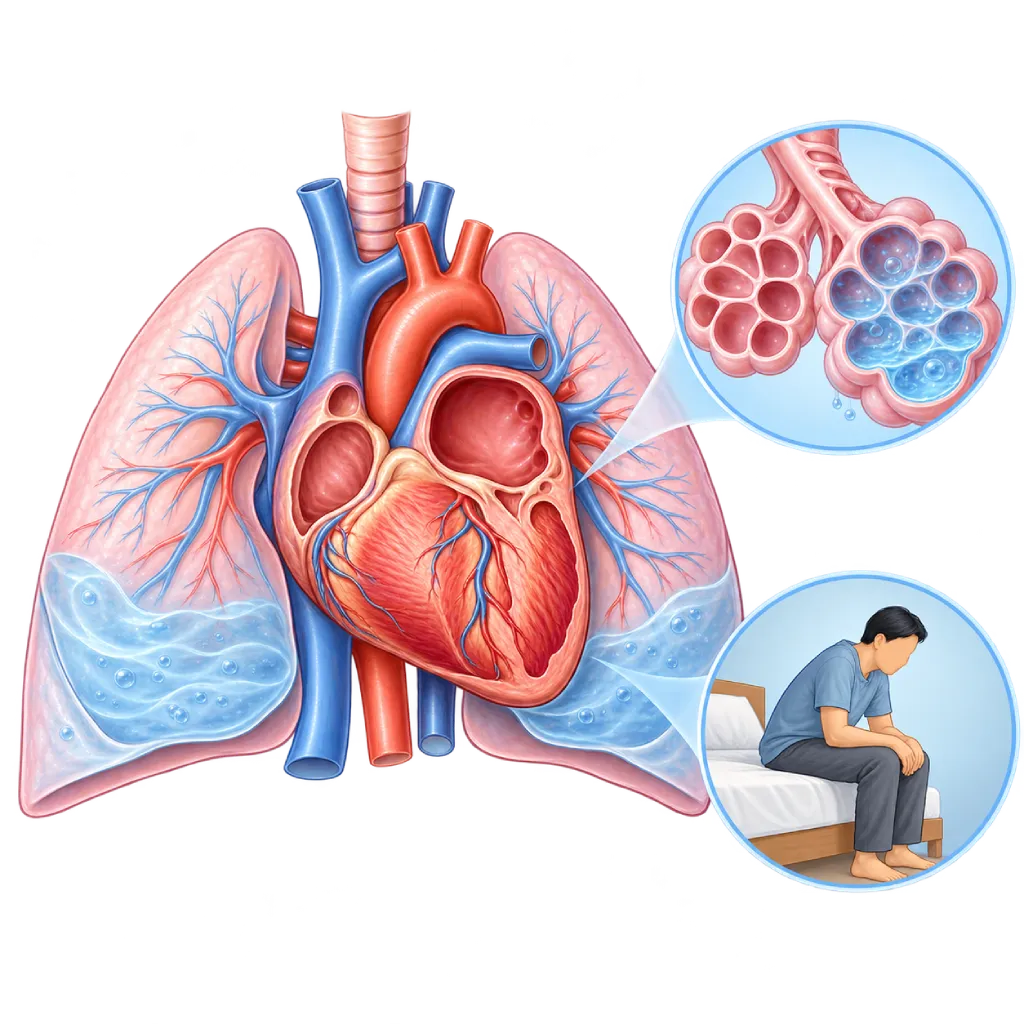
Cardiogenic pulmonary edema is a buildup of fluid in the air sacs of the lungs because pressure in the left side of the heart rises, causing severe shortness of breath. It is an emergency and needs to be treated right away in the emergency room.
Sources01 / Understanding the condition
About Cardiogenic Pulmonary Edema
The lungs contain millions of tiny air sacs (alveoli) where oxygen passes into the blood. Blood from the lungs flows into the left atrium and left ventricle of the heart to be pumped to the rest of the body. When the left side of the heart cannot pass blood along smoothly, pressure in the blood vessels of the lungs rises. Fluid then seeps out of the vessels, first into the tissue between the air sacs, and then into the air sacs themselves.
As a result, the lungs become wet and stiff, so breathing feels very hard, like drowning. The word cardiogenic means the cause comes from the heart. This sets it apart from pulmonary edema caused by damage to the blood vessels of the lungs from severe infection, injury, or other causes, covered on the Noncardiogenic Pulmonary Edema page.
Common Triggers
Cardiogenic pulmonary edema is one form of acute heart failure, covered on the Acute Heart Failure page. Triggers include a sudden, very high spike in blood pressure, a heart attack, atrial fibrillation or another very fast rhythm disorder, a severely narrowed or leaking valve, and chronic heart failure that worsens because of missed medicines, too much salt, or infection. In severe kidney disease, fluid overload can also play a role.
The Form That Appears Suddenly
In some patients, especially those with very high blood pressure, breathlessness develops within minutes, often at night while lying down. The patient wakes up, has to sit upright, breathes noisily, and may cough up white or pink frothy sputum. In other patients, fluid builds up more slowly over several days, along with swelling and weight gain.
Treatment and Recovery
In the emergency room, the patient is seated upright, given oxygen if levels are low, and, if needed, fitted with a pressurized mask (noninvasive ventilation) that helps push fluid out of the air sacs. Diuretics given through an IV and medicines that widen the blood vessels lower the pressure in the lungs. At the same time, the doctor looks for and treats the trigger. With prompt treatment, breathlessness often improves within a few hours. After going home, long-term heart failure treatment and close follow-up help prevent it from coming back.
02 / Understanding the condition
Symptoms to Recognize.
Common Symptoms
- Severe shortness of breath that comes on quickly, within minutes to hours
- Breathlessness that gets worse when lying down, so you have to sit upright
- Waking up at night short of breath
- Fast, noisy breathing, like wheezing or crackling
- Coughing up white or pink frothy sputum
- Restlessness, anxiety, and cold sweats
- A feeling of pressure or heaviness in the chest
Symptoms in Older Adults
In older adults, pulmonary edema may show up as confusion or severe weakness, with less obvious breathlessness.
- Confusion or restlessness that appears suddenly
- Fast, shallow breathing even while lying still
- Severe weakness and difficulty holding a conversation
- Weight gain and leg swelling over the previous few days
03 / Understanding the condition
What Causes This Condition?
- A sudden, very high spike in blood pressure (hypertensive crisis)
- A heart attack or acute coronary syndrome that suddenly weakens the heart's pumping
- Worsening chronic heart failure, for example from missed medicines or too much salt and fluid
- A very fast rhythm disorder, such as atrial fibrillation with a fast heart rate
- A severely narrowed or leaking mitral or aortic valve, including a leak that appears suddenly
- Cardiomyopathy or inflammation of the heart muscle (myocarditis)
- Severe kidney disease or narrowing of the kidney arteries that raises fluid levels and blood pressure
04 / Understanding the condition
Who Is at Higher Risk?
Medical
A history of heart failure, uncontrolled hypertension, coronary artery disease, severe valve disease, atrial fibrillation, diabetes, and chronic kidney disease increase the chance of cardiogenic pulmonary edema.
Lifestyle
A high-salt diet, drinking too much fluid when you have been advised to limit fluids, drinking too much alcohol, and not taking heart or blood pressure medicines regularly are common triggers.
Age
It is more common in older age, especially in people with high blood pressure and a thickened, stiff heart muscle.
Other
Infections such as pneumonia, NSAID pain relievers, pregnancy in women with heart disease, and too much IV fluid can trigger a recurrence.
Groups at Higher Risk
- People with Heart Failure: Most cases occur in people who already have heart failure, especially after a previous hospital stay.
- People with Uncontrolled Hypertension: A spike in blood pressure can trigger sudden pulmonary edema, especially when the heart muscle is thickened and stiff.
- People with Severe Valve Disease: A severely narrowed or leaking valve makes pressure in the lungs rise easily, for example during an irregular rhythm or during pregnancy.
- People with Chronic Kidney Disease: Kidneys that are less able to remove fluid make it easier for excess fluid to build up in the lungs.
- Patients After a Heart Attack: Damage to the heart muscle can weaken its pumping, so fluid backs up into the lungs more easily.
05 / Understanding the condition
How Is It Diagnosed?
In cardiogenic pulmonary edema, testing and treatment happen at the same time. The emergency team immediately checks oxygen level, blood pressure, pulse, and breathing rate, then listens to the lungs for crackles. Breathing support does not wait for the full test results.
An ECG is done in the first few minutes to look for a heart attack or rhythm disorder. A chest X-ray or lung ultrasound shows fluid in the lungs, and an NT-proBNP or BNP test helps confirm that the breathlessness comes from the heart, not the lungs. Troponin, kidney function, electrolytes, and blood gases complete the assessment. Echocardiography assesses the heart's pumping and valves to find the cause. If the trigger is a heart attack, coronary angiography is done as soon as possible.
Physical Examination
Checks breathing rate, oxygen level, blood pressure, crackles in the lungs, and bulging neck veins.
Electrocardiogram (ECG)
Done right away to look for a heart attack or rhythm disorder that triggered the pulmonary edema.
Chest X-Ray
Shows fluid in the lungs, congestion of the lung blood vessels, fluid in the pleural space, and heart size.
NT-proBNP and BNP Test
Helps confirm that the breathlessness comes from the heart; a normal level makes a heart cause unlikely.
Echocardiography
Assesses pumping strength, the valves, and pressures in the heart to find the cause, urgently if the condition is unstable or valve damage is suspected.
Cardiac Troponin Test
Looks for heart muscle damage when a heart attack is suspected as the trigger.
Bedside lung ultrasound and blood gas analysis help assess how much fluid is in the lungs and how severely oxygen exchange is affected.
06 / Understanding the condition
Treatment Options.
Treatment is decided by a doctor after an assessment. The categories below can help you follow the conversation with your doctor.
Sitting Upright and Oxygen
The patient is seated upright with the legs hanging down, and oxygen is given if the blood oxygen level is low.
Noninvasive Ventilation
A pressurized mask (CPAP or BiPAP) helps open the air sacs and speeds up breathing recovery; a small number of patients need a breathing machine through a tube.
Fluid-Removing Medicines
Diuretics given through an IV remove excess fluid. The doctor monitors urine output, electrolytes, and kidney function to adjust the dose.
Medicines That Widen Blood Vessels
Nitrates are used mainly when blood pressure is high, to quickly lower the pressure in the lungs and the strain on the heart.
Treating the Trigger
Opening a blocked coronary artery, controlling the heart rhythm, lowering blood pressure, or treating a damaged valve.
Preventing Recurrence
Once you are stable, long-term heart failure medicines are started or adjusted, along with education on salt, fluids, and weight monitoring.
07 / Understanding the condition
Complications to Watch For.
Respiratory Failure
A severe drop in oxygen levels may require a breathing machine through a tube in the intensive care unit.
Cardiogenic Shock
If the heart's pumping is very weak, blood flow to the organs drops and intensive care is needed. Covered on the Cardiogenic Shock page.
Heart Rhythm Disorders
Lack of oxygen and strain on the heart can trigger atrial fibrillation or dangerous ventricular rhythms, so the rhythm is monitored continuously.
Kidney Function Problems
Reduced blood flow and diuretic treatment can affect the kidneys and electrolytes, so both are closely monitored.
Recurrence and Hospital Readmission
Pulmonary edema can come back if its trigger is not controlled, especially in the first months after leaving the hospital.
08 / Understanding the condition
What Can You Do?
- Take your heart and blood pressure medicines on schedule, and do not stop them on your own
- Weigh yourself every morning and call your doctor if you gain 2 kg or more in 3 days
- Limit salt, and follow a fluid limit if your doctor recommends one
- Check your blood pressure at home regularly if you have hypertension
- Ask your doctor before using pain relievers, herbal remedies, or supplements
- Get influenza and pneumococcal vaccines as your doctor recommends
- Come for a checkup one to two weeks after leaving the hospital
09 / Understanding the condition
When Should You See a Doctor?
Cardiogenic pulmonary edema is a medical emergency. If you or someone near you suddenly becomes very short of breath, cannot lie down, or coughs up frothy sputum, call 119 or go to the nearest emergency room right away. While waiting, help the person sit upright and do not let them lie flat. If breathlessness increases slowly over several days without severe signs, contact your doctor and get checked the same day.
- Severe shortness of breath at rest, or having to sleep sitting up
- White or pink frothy sputum
- Bluish lips, or cold and sweaty skin
- Chest pain or a very fast heartbeat
- Weight gain of 2 kg or more in 3 days with worsening breathlessness
10 / Common questions
Questions You May Have.
Frequently asked questions about cardiogenic pulmonary edema.
How is cardiogenic pulmonary edema different from pneumonia or asthma?
All three can cause breathlessness and noisy breathing. In cardiogenic pulmonary edema, the fluid comes from raised pressure in the heart, often with a history of heart disease, breathlessness when lying down, and frothy sputum. Pneumonia usually comes with fever and thick sputum, while asthma is related to narrowing of the airways. Doctors tell them apart with a physical examination, chest X-ray, NT-proBNP test, and echocardiography.
What can family members do while waiting for help?
Call 119 or take the person to the nearest emergency room right away; do not wait for the breathlessness to improve on its own. Help the person sit upright, ideally with the legs hanging down, and loosen tight clothing. Do not give large amounts of food or drink. Prepare a list of current medicines and previous heart test results to hand to the emergency team.
Can cardiogenic pulmonary edema be cured?
With prompt treatment, fluid in the lungs usually decreases within a few hours to days, and most patients can go home once their condition is stable. However, the underlying heart cause, such as heart failure, hypertension, or valve disease, still needs long-term treatment. Without controlling the cause, pulmonary edema can come back. Regular checkups and taking medicines as advised help prevent this.
Why does breathlessness feel worse when lying down?
When you lie down, more blood from the legs and abdomen returns to the heart and lungs. In a left heart that is already under strain, this extra blood raises the pressure in the blood vessels of the lungs, so more fluid seeps into the air sacs. That is why people with this condition often wake up at night and feel relief when sitting upright. This is an important sign to tell your doctor about.
Will the pressurized mask or breathing machine be needed for a long time?
A pressurized mask (noninvasive ventilation) is usually used for a few hours until breathlessness and oxygen levels improve. It helps open air sacs filled with fluid while the medicines take effect. Only a small number of patients need a breathing machine through a tube in the intensive care unit, usually when consciousness drops or oxygen levels stay low. The team will explain the options based on the patient's condition.
How can I prevent pulmonary edema from coming back?
Take your medicines on schedule, especially heart failure and blood pressure medicines. Weigh yourself every morning and call your doctor if you gain 2 kg or more in 3 days. Limit salt and follow the advice on fluid limits. Check your blood pressure at home if you have hypertension, and come for a checkup one to two weeks after leaving the hospital.
Sources and Medical Review
Translated from the Indonesian edition medically reviewed by dr. Santi R. Dewayanti, Sp.P.
Sources as cited in the Indonesian edition.
- McDonagh TA, Metra M, Adamo M, Gardner RS, Baumbach A, Böhm M, et al. 2021 ESC Guidelines for the diagnosis and treatment of acute and chronic heart failure. Eur Heart J. 2021;42(36):3599-3726.
- McDonagh TA, Metra M, Adamo M, Gardner RS, Baumbach A, Böhm M, et al. 2023 Focused Update of the 2021 ESC Guidelines for the diagnosis and treatment of acute and chronic heart failure. Eur Heart J. 2023;44(37):3627-3639.
- Heidenreich PA, Bozkurt B, Aguilar D, Allen LA, Byun JJ, Colvin MM, et al. 2022 AHA/ACC/HFSA Guideline for the Management of Heart Failure: A Report of the American College of Cardiology/American Heart Association Joint Committee on Clinical Practice Guidelines. Circulation. 2022;145(18):e895-e1032.
- Arrigo M, Jessup M, Mullens W, Reza N, Shah AM, Sliwa K, et al. Acute heart failure. Nat Rev Dis Primers. 2020;6(1):16.
- Gray A, Goodacre S, Newby DE, Masson M, Sampson F, Nicholl J; 3CPO Trialists. Noninvasive Ventilation in Acute Cardiogenic Pulmonary Edema. N Engl J Med. 2008;359(2):142-151.
- Masip J, Peacock WF, Price S, Cullen L, Martin-Sanchez FJ, Seferovic P, et al. Indications and practical approach to non-invasive ventilation in acute heart failure. Eur Heart J. 2018;39(1):17-25.
- Mullens W, Damman K, Harjola VP, Mebazaa A, Brunner-La Rocca HP, Martens P, et al. The use of diuretics in heart failure with congestion: a position statement from the Heart Failure Association of the European Society of Cardiology. Eur J Heart Fail. 2019;21(2):137-155.
Doctors Who Treat This Condition

dr. Siska S. Danny, Sp.JP(K)
Interventional Cardiology
Coronary Intervention Procedures
Clinical focusPCI for Acute Coronary Syndrome · Primary Coronary Intervention
View Profile
dr. Santi R. Dewayanti, Sp.P
Pulmonology
Clinical focusLung and Respiratory Disease · Asthma and COPD
View Profile
dr. Sri Diniharini, Sp.JP(K)
Echocardiography & Cardiovascular Imaging
Cardiovascular Diagnostic Center +1 center
Clinical focusAdvanced Echocardiography · Transesophageal Echocardiography
View Profile