
Quick answer
What Is Hemodialysis?
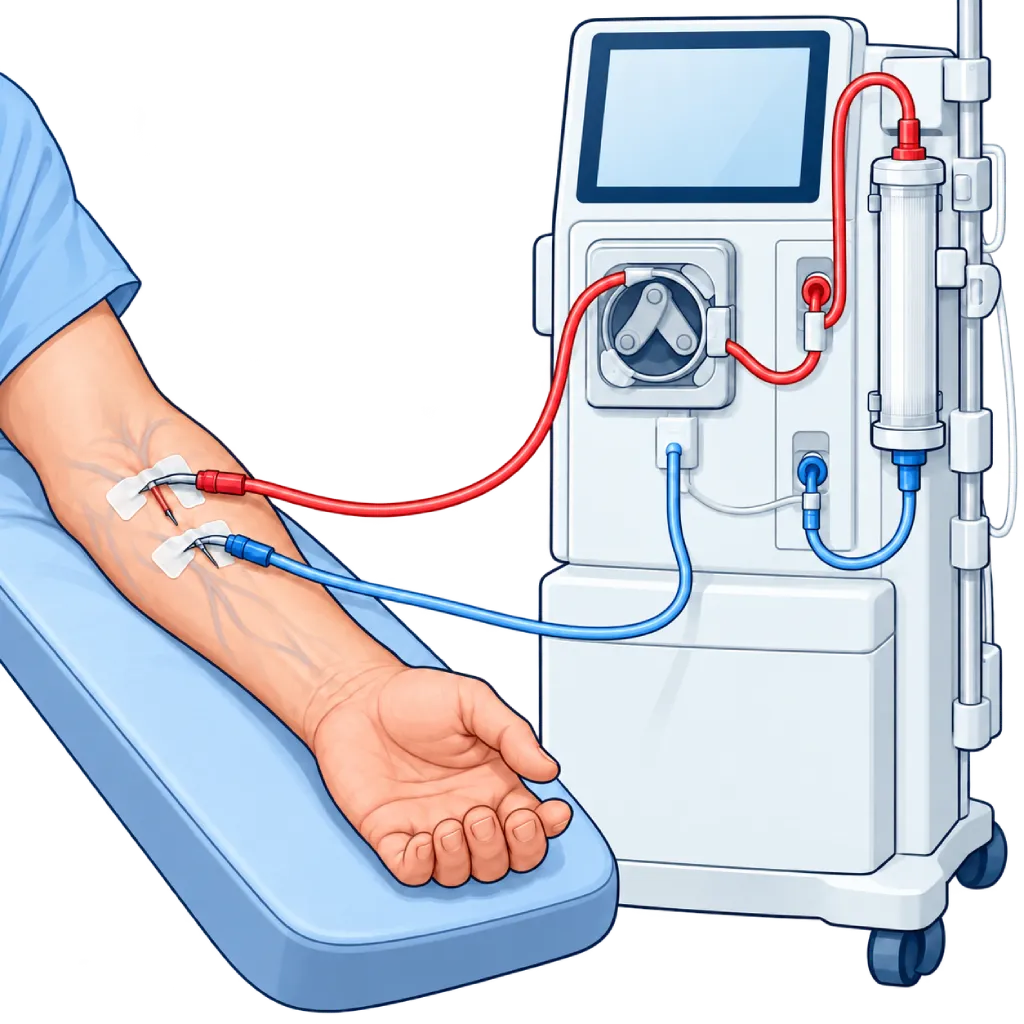
Hemodialysis is blood cleaning with a machine. Blood is pumped from a blood vessel to an artificial kidney (dialyzer), which filters out toxins and excess fluid, and is then returned to the body. It is usually done 2 to 3 times a week, about 4 hours per session, in a dialysis unit monitored by trained staff.
Sources01 / Understanding the procedure
About Hemodialysis
What Is Hemodialysis
When the kidneys can no longer filter the blood, toxins, salt, and fluid build up in the body. Hemodialysis takes over part of the kidneys' work with a machine. Blood is pumped out of the body to an artificial kidney (dialyzer), a tube containing thousands of fine filtering fibers. There, toxins and excess fluid pass into the dialysis fluid, and the cleaned blood is returned to the body.
Vascular Access
For blood to flow to the machine quickly enough, a special vascular access is needed. The access should be prepared well before dialysis begins.
- AV fistula: an artery and a vein in the arm are joined in a minor operation, so the vein grows larger and strong enough for needle insertion. A fistula takes a few weeks to a few months before it is ready to use, but it lasts longer and gets infected less often than a graft or catheter.
- AV graft: a synthetic tube that connects an artery and a vein, chosen when the blood vessels are too small for a fistula. A graft can usually be used sooner.
- Dialysis catheter: a tube placed in a large blood vessel in the neck or groin. It is used when dialysis must start right away or other access is not yet ready, and it carries a higher risk of infection.
Hemodialysis and the Heart
Kidney disease and heart disease affect each other, and heart disease is a major cause of health problems in dialysis patients. Hemodialysis removes excess fluid that strains the heart, but removing fluid too quickly can lower blood pressure and trigger heart rhythm disturbances. For this reason, in heart patients, the amount of fluid removed and the blood pressure are carefully set and monitored. In critically ill patients in the intensive care unit with unstable blood pressure, doctors may use continuous dialysis, which works slowly throughout the day.
Schedule and Daily Life
Hemodialysis is usually done 2 to 3 times a week, about 4 hours per session, in a dialysis unit. Between sessions, you need to limit fluids, salt, and foods high in potassium and phosphorus as advised. Many patients continue to work and stay active with a regular dialysis schedule.
02 / Understanding the procedure
When Is This Procedure Considered?
A doctor may consider this procedure in the situations below. The decision is always made after a thorough assessment.
- End-Stage Kidney FailureKidney function has declined so severely that toxins and fluid can no longer be removed properly, and kidney replacement therapy is needed.
- Acute Kidney Failure with ComplicationsFor example, very high blood potassium, overly acidic blood, or symptoms from toxin buildup that do not respond to medicines.
- Fluid Overload That Strains the HeartSwelling and shortness of breath from fluid in the lungs that do not improve with medicines, in patients with kidney problems.
- Heart Failure with Severe Kidney ImpairmentWhen medicines can no longer remove the fluid, hemodialysis or continuous dialysis may be considered after evaluation by the heart and kidney team.
- Poisoning with Certain SubstancesSome toxins and drug overdoses can be removed from the blood with hemodialysis.
Situations to Consider First
- Very Low Blood Pressure or ShockStandard hemodialysis can lower blood pressure further. Continuous dialysis in the intensive care unit is often more suitable.
- No Adequate Vascular Access YetAccess needs to be prepared beforehand. In urgent situations, a temporary dialysis catheter is placed.
- Active Bleeding or Clotting DisordersThe anti-clotting medicine used during dialysis needs to be adjusted or replaced with another method.
- Infection at the Access SiteRedness, pus, or fever from the access or catheter needs to be treated beforehand.
- Option of Care Without DialysisFor some older patients with many illnesses, care without dialysis can be discussed with the family and the doctor.
03 / Before the procedure
How Should You Prepare?
Preparation includes creating a vascular access and getting ready before each session. The team will give you written instructions.
Prepare the access early. If dialysis is planned, a fistula should be created a few months beforehand so it has time to mature.
Protect the access arm. Do not have blood drawn, an IV line placed, or blood pressure measured on the arm that is being prepared for a fistula or already has one.
Medicines. Take your medicines as instructed. Some blood pressure medicines may be postponed before a session so your blood pressure does not drop too low. Do not change your medicines without your doctor's guidance.
Limit fluids and salt. A large weight gain between sessions means a lot of fluid has to be removed, which makes the session harder on the heart.
Clothing and things to bring. Wear a top with sleeves that roll up easily, and bring a light blanket, something to read, or a companion for the roughly 4 hours.
Access hygiene. Wash your access arm with soap and water before the session, or keep the catheter dressing dry.
Unsure about the preparation instructions? Ask our team before the procedure.
04 / During the procedure
How Is the Procedure Done?
A hemodialysis session takes place in a dialysis unit under the supervision of nurses and doctors, and usually lasts about 4 hours.
Before the Session
The nurse weighs you, measures your blood pressure, pulse, and temperature, and then checks your access. The weight gained since the previous session is used to decide how much fluid will be removed.
Inserting the Needles or Connecting the Catheter
With a fistula or graft, two needles are inserted: one to carry blood to the machine and one to return it. With a catheter, the tubing is connected directly to the machine without needles.
Filtering the Blood
A pump moves the blood through the dialyzer and back into the body. An anti-clotting medicine is given so the blood does not clot in the tubing. The machine also removes excess fluid gradually.
Monitoring During the Session
Your blood pressure is checked regularly. Tell the nurse if you feel dizzy or nauseated, or have cramps, palpitations, or chest pain, so the rate of fluid removal can be adjusted.
Ending the Session
The blood in the tubing is returned to your body, the needles are removed, and the puncture sites are pressed until the bleeding stops. Your weight and blood pressure are measured again before you go home.
05 / Benefits and risks
Benefits and Risks Should Be Discussed Together.
Every medical procedure has benefits and risks. Your doctor will explain both for your situation before the procedure.
Benefits You Can Expect
- Removes Toxins and Excess FluidTakes over part of the kidneys' work, easing symptoms caused by the buildup of toxins and fluid.
- Controls Potassium and Blood AcidityPotassium levels that are too high can disturb the heart's rhythm; dialysis helps keep them at a safe level.
- Relieves Shortness of Breath and SwellingExcess fluid that strains the heart and lungs is removed gradually in each session.
- Monitored by Trained StaffEvery session takes place in a dialysis unit with monitoring of blood pressure and symptoms.
- Can Be Started Right AwayIn an emergency, dialysis can be started through a temporary catheter while permanent access is being prepared.
The benefits of a procedure are not a promise of a cure. Ask how the results will affect your care plan.
Risks You Should Know
- Drop in Blood Pressure During DialysisA common problem, with symptoms such as dizziness, nausea, or weakness. The nurse will adjust fluid removal and provide treatment.
- Muscle CrampsOften occur toward the end of a session, especially when a lot of fluid is removed.
- Heart Rhythm DisturbancesChanges in fluid and potassium levels can trigger rhythm disturbances, especially in patients with heart disease.
- Access InfectionMore common with catheters than with fistulas. Good hygiene and access care reduce the risk.
- Narrowing or Blockage of the AccessA fistula or graft can narrow or become blocked, so it sometimes needs to be widened through a catheter or repaired.
- Fatigue After a SessionFeeling tired for a few hours after dialysis is fairly common. Talk to your doctor if it is severe.
Risks can differ from person to person. A full explanation and consent are given after an individual assessment.
06 / After the procedure
What Is Recovery Like?
After the session, you can go home and do light activities. Feeling tired for a few hours after dialysis is quite common and usually improves with rest.
Caring for a fistula. Feel for the fistula's vibration every day. Do not sleep on your access arm, wear a tight watch or bracelet, or lift heavy objects with that arm.
Caring for a catheter. Keep the dressing dry and clean, and do not open the catheter caps yourself.
Eating and drinking. Follow your daily fluid limit and the eating plan from your dietitian, especially for salt, potassium, and phosphorus.
Medicines and routine tests. Take your medicines as prescribed, such as phosphate binders and medicines for anemia, and have regular blood tests to assess whether your dialysis is adequate.
Warning signs. Contact the dialysis unit or go to the emergency room right away if you have:
- Loss of the vibration you normally feel in the fistula
- Bleeding from a puncture site that does not stop
- Fever, chills, or redness and pus at the access or catheter
- Shortness of breath, swelling, or rapid weight gain between sessions
- Chest pain, a racing heart, or feeling very weak
Know the Signs That Need Prompt Care.
Follow the team's guidance on warning signs. If severe or sudden symptoms appear after the procedure, go to the nearest emergency department right away or call Heart Attack Center 1500 258.
07 / Team and support
Doctors and Procedure Support
The doctors below are listed for this procedure. Listed by name, not by ranking.

Dr. dr. Dafsah A. Juzar, Sp.JP(K)
Interventional Cardiology
Coronary Intervention Procedures +1 center
Clinical focusComplex Coronary Intervention · Cardiac Catheterization
View Profile
dr. Debby C. Soemitha, Sp.PD
Internal Medicine
Clinical focusDiabetes and Diabetes Complications · Obesity and Metabolic Disease
View Profile
dr. Emanoel Oepangat, Sp.JP(K)
Interventional Cardiology
Vascular Diagnostic and Therapeutic Center +1 center
Clinical focusCoronary Intervention · Peripheral Vascular Intervention
View Profile08 / Common questions
Before You Plan the Procedure.
Frequently asked questions from patients and families about hemodialysis. Your dialysis plan is decided together with your doctor after an evaluation.
How long does hemodialysis take, and how often is it done?
Usually 2 to 3 times a week, about 4 hours per session. The schedule and length are adjusted to your remaining kidney function, body weight, blood test results, and heart condition. Add time for preparation before and checks after the session, so one visit usually takes about 5 hours.
Does hemodialysis hurt?
What you feel is mainly the needle insertion into the fistula or graft at the start of the session. A numbing cream can be used to reduce the pain. During filtering, the majority of patients feel nothing, although dizziness or cramps sometimes occur and should be reported to the nurse right away.
What is the difference between a fistula, a graft, and a catheter?
A fistula is a direct connection between an artery and a vein in the arm; it lasts longer and gets infected less often than the other options, but it needs time to mature. A graft uses a synthetic tube and can be used sooner. A catheter is placed in a large blood vessel in the neck or groin and can be used right away, but its risk of infection is higher.
Is hemodialysis safe for people with heart disease?
It can be, with careful management. Removing fluid too quickly can lower blood pressure and strain the heart, so the amount of fluid removed and your blood pressure are closely monitored. Limiting weight gain between sessions helps a great deal. In certain situations, your doctor may choose a slower form of dialysis.
What do I need to watch in what I eat and drink?
You usually need to limit fluids, salt, and foods high in potassium and phosphorus, while making sure you get enough protein. The exact amounts differ for each patient, depending on remaining kidney function and blood test results. A dietitian will help you plan meals that suit your habits.
Can hemodialysis be stopped?
In acute kidney failure, kidney function sometimes recovers, so dialysis can be stopped. In end-stage kidney failure, dialysis is usually needed on an ongoing basis, unless you have a kidney transplant. Do not skip sessions without your doctor's guidance, because toxins, potassium, and fluid can build up quickly.
Sources and Medical Review
Translated from the Indonesian edition medically reviewed by dr. Emanoel Oepangat, Sp.JP(K).
Sources as cited in the Indonesian edition.
- Daugirdas JT, Depner TA, Inrig J, et al. KDOQI Clinical Practice Guideline for Hemodialysis Adequacy: 2015 Update. Am J Kidney Dis. 2015;66(5):884-930.
- Lok CE, Huber TS, Lee T, et al. KDOQI Clinical Practice Guideline for Vascular Access: 2019 Update. Am J Kidney Dis. 2020;75(4 Suppl 2):S1-S164.
- Flythe JE, Chang TI, Gallagher MP, et al. Blood pressure and volume management in dialysis: conclusions from a Kidney Disease: Improving Global Outcomes (KDIGO) Controversies Conference. Kidney Int. 2020;97(5):861-876.
- Sarnak MJ, Amann K, Bangalore S, et al. Chronic Kidney Disease and Coronary Artery Disease: JACC State-of-the-Art Review. J Am Coll Cardiol. 2019;74(14):1823-1838.