
Quick answer
What Is Right Heart Catheterization?
Right heart catheterization is a test using a thin catheter inserted through a vein in the neck, arm, or groin to the right heart and pulmonary artery. It measures heart and lung pressures and the amount of blood the heart pumps, mainly to confirm pulmonary hypertension. It takes about 30 minutes to 1 hour.
Sources01 / Understanding the procedure
About Right Heart Catheterization
What Is Right Heart Catheterization
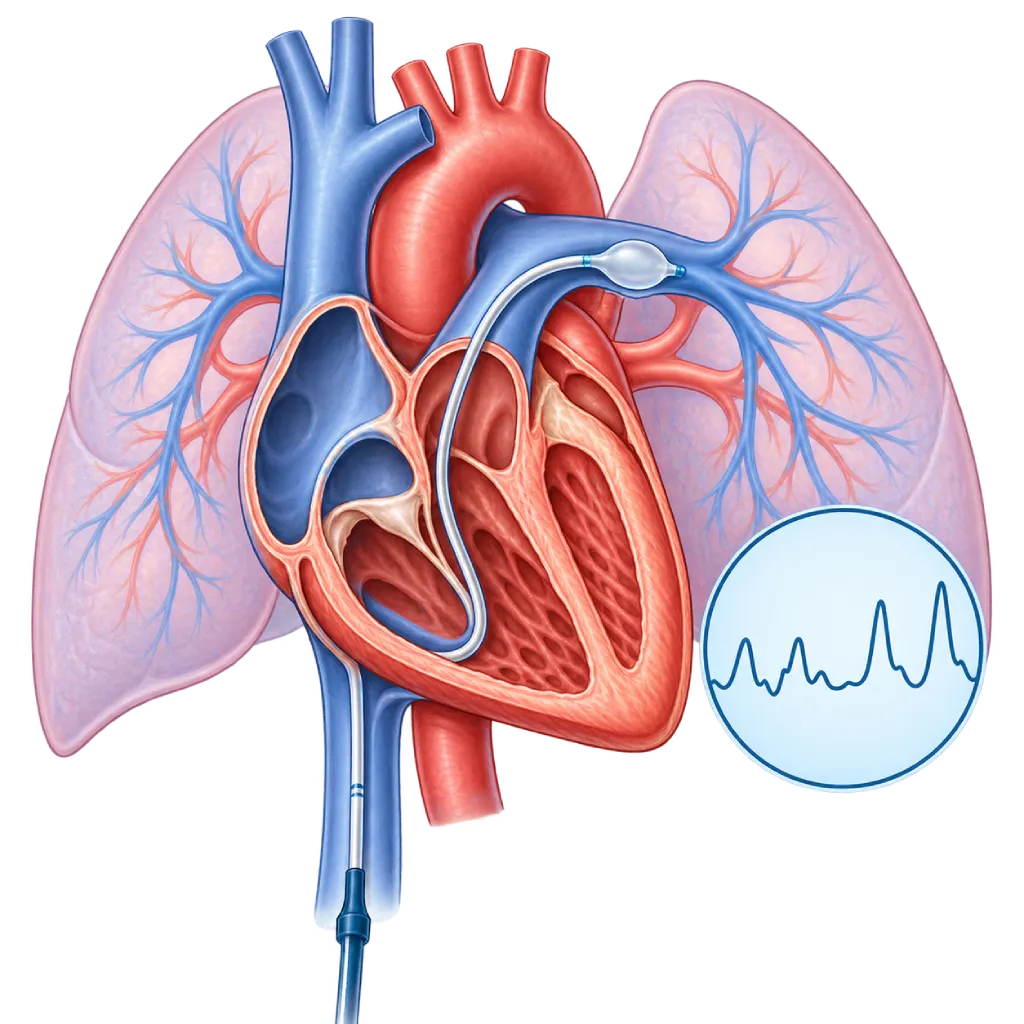
The right side of the heart receives blood from the whole body and pumps it to the lungs to pick up oxygen. Right heart catheterization is a test that directly measures the pressures along this pathway. A thin catheter with a small balloon at its tip is inserted through a vein and then carried by the blood flow through the right atrium and right ventricle into the pulmonary artery. This type of catheter is often called a Swan-Ganz catheter.
What Is Measured
The doctor records the pressures in the right atrium, right ventricle, and pulmonary artery. When the balloon is briefly inflated in a branch of the pulmonary artery, the wedge pressure is recorded, which reflects the pressure in the left atrium. The amount of blood the heart pumps each minute, called cardiac output, is used to calculate the resistance of the lung blood vessels. Blood samples from several chambers are also checked for oxygen levels to look for leaks between the heart chambers.
Confirming Pulmonary Hypertension
Echocardiography can estimate lung pressure, but the diagnosis of pulmonary hypertension is confirmed with right heart catheterization. According to the 2022 ESC/ERS guidelines, pulmonary hypertension is diagnosed when the mean pulmonary artery pressure at rest is more than 20 mmHg. The wedge pressure and lung vessel resistance help distinguish whether the cause lies in the lung blood vessels themselves or results from left heart disease, which determines the choice of medication. This condition is covered on the Pulmonary Hypertension page.
Lung Vessel Response Test
In certain types of pulmonary arterial hypertension, the doctor may give an inhaled medication that widens the lung blood vessels during the test, such as nitric oxide, and then measure the pressures again. Patients whose pressure drops considerably may be suitable for treatment with calcium channel blockers.
Other Uses
Right heart catheterization is also used to assess severe heart failure, including in candidates for a heart transplant or a mechanical heart pump, which is covered on the Heart Transplant page. This test helps assess leaks between the heart chambers in congenital heart disease and the effect of valve disease on the lungs, and helps distinguish a stiff sac around the heart (pericardium) from a stiff heart muscle. In intensive care, the catheter can be left in place for several days to monitor heart pressures continuously.
Part of Cardiac Catheterization
Right heart catheterization is one part of cardiac catheterization, which is covered on the Cardiac Catheterization page. This test can be done on its own or together with left heart catheterization and coronary angiography. For long-standing blockages in the lung blood vessels, the test is often combined with imaging of the pulmonary arteries using contrast dye, which is covered on the Pulmonary Angiography page.
02 / Understanding the procedure
When Is This Procedure Considered?
A doctor may consider this procedure in the situations below. The decision is always made after a thorough assessment.
- Suspected Pulmonary HypertensionTo confirm the diagnosis when echocardiography shows high lung pressure.
- Determining the Type and Treatment of Pulmonary HypertensionTo distinguish a cause in the lung blood vessels from left heart disease, and to assess the response to medication.
- Severe Heart FailureTo assess filling pressures and cardiac output, including in candidates for a transplant or a heart pump.
- Congenital Heart DiseaseTo measure leaks between the heart chambers and lung pressure before a closure procedure or surgery.
- Unexplained Shortness of BreathWhen other tests have not explained the symptoms, sometimes with measurements taken during exercise.
- Monitoring in Cardiogenic ShockHelps guide fluids and medications that strengthen the heartbeat when the heart cannot pump enough blood.
Situations to Consider First
- Blood Clot or Tumor in the Right HeartThe catheter can dislodge a clot or tissue; the doctor checks for this first with echocardiography.
- Mechanical Valve on the Right Side of the HeartThe catheter is not passed through an artificial metal tricuspid or pulmonary valve.
- Active Infection in the Right Heart or at the Puncture SiteAnother access site is chosen, or the procedure is postponed until the infection is under control.
- Severe Blood Clotting DisordersThese need to be corrected first; access through an arm vein can reduce the risk of bleeding.
- Certain Electrical Conduction Disorders of the HeartThe catheter can trigger a very slow heartbeat, so the team prepares a temporary pacemaker.
03 / Before the procedure
How Should You Prepare?
Right heart catheterization is usually planned. The team will give you written instructions and explain whether the test will be done together with left heart catheterization.
Tests before the procedure. Blood tests, including blood clotting and kidney function, an ECG, and a recent echocardiogram. Bring the results of previous lung and heart tests.
Medications you are taking. Bring a list of all your medications. Blood thinners, diabetes medications, and diuretics (water pills) may need to be adjusted. Pulmonary hypertension medications are usually continued. Do not change any medication without your doctor's instructions.
Fasting. Follow the fasting instructions from the team, usually for a few hours before the procedure.
Allergies and medical history. Tell the team if you are allergic to medications, latex, or contrast dye, have had surgery on your neck, or have a pacemaker.
Companion. Arrange for someone to take you home, because you are advised not to drive on the day of the procedure.
Unsure about the preparation instructions? Ask our team before the procedure.
04 / During the procedure
How Is the Procedure Done?
The test is performed in the catheterization laboratory by a cardiologist. You stay awake under local anesthesia, and a mild sedative can be given if needed. The procedure usually takes 30 minutes to 1 hour, longer if it includes a medication test or measurements during exercise.
Choosing the Access Site
The doctor uses ultrasound to find a vein in the neck, the inner arm at the elbow, or the groin. After the skin is numbed, a short tube is inserted into that vein.
Guiding the Catheter
A catheter with a small balloon at its tip is advanced slowly under X-ray guidance through the right atrium and right ventricle into the pulmonary artery. As the catheter passes through the right ventricle, you may feel brief palpitations.
Measuring Pressure and Oxygen
Pressure is recorded in each chamber, including the wedge pressure while the balloon is briefly inflated. Blood samples are taken to check their oxygen levels, and cardiac output is calculated using an injection of cold fluid or from the oxygen levels.
Additional Tests When Needed
In some patients, the measurements are repeated after inhaling a medication that widens the lung blood vessels, after receiving fluids, or while pedaling a bicycle on the procedure table.
Finishing and Closing the Access Site
The catheter and tube are removed, and the puncture site is pressed for a few minutes and covered with a bandage. A vein puncture usually stops bleeding quickly.
05 / Benefits and risks
Benefits and Risks Should Be Discussed Together.
Every medical procedure has benefits and risks. Your doctor will explain both for your situation before the procedure.
Benefits You Can Expect
- Lung Pressure Measured DirectlyConfirms a diagnosis of pulmonary hypertension, which echocardiography can only estimate.
- Clearer Treatment DirectionDistinguishes the type of pulmonary hypertension and assesses whether certain medications suit you.
- Usually Without Contrast DyePressure measurements do not require contrast dye, so the test is easier on the kidneys.
- Quick RecoveryA vein puncture usually heals quickly, and most patients go home on the same day.
The benefits of a procedure are not a promise of a cure. Ask how the results will affect your care plan.
Risks You Should Know
- Bruising or Bleeding at the Puncture SiteUsually mild; the risk is lower because the vein is located with ultrasound guidance.
- Brief Rhythm DisturbancesExtra heartbeats as the catheter passes through the right ventricle, which usually stop once the catheter moves on.
- Drop in Blood Pressure or Brief FaintingDue to a nerve reaction or a test medication, and usually resolves quickly with fluids and lying down.
- Air Leak in the Lung LiningVery rare and only with access through the neck (pneumothorax); it can cause shortness of breath and is treated by the team.
- Pulmonary Artery InjuryVery rare but serious, especially when lung pressure is very high; it can cause coughing up blood.
Risks can differ from person to person. A full explanation and consent are given after an individual assessment.
06 / After the procedure
What Is Recovery Like?
Because the catheter enters through a vein, which has low pressure, recovery is usually quick. Most patients are monitored for 1 to a few hours and then go home on the same day.
Puncture site. Keep the bandage dry for one day. A small bruise on the neck, arm, or groin is normal and fades within a few days.
Activity. Most people can resume light activities the next day. If the groin was used, avoid lifting heavy objects for a few days.
Results and follow-up visit. The pressure readings are visible right away during the procedure. Your doctor discusses what the results mean and the treatment plan at your follow-up visit, often together with the results of other tests.
Warning signs to watch for. Go to the emergency room right away if you have:
- Worsening shortness of breath or chest pain
- A racing heartbeat or fainting
- Bleeding or swelling that grows at the puncture site
- Coughing up blood
- Fever, or a puncture site that is red and oozing pus
Know the Signs That Need Prompt Care.
Follow the team's guidance on warning signs. If severe or sudden symptoms appear after the procedure, go to the nearest emergency department right away or call Heart Attack Center 1500 258.
07 / Team and support
Doctors and Procedure Support
The doctors below are listed for this procedure. Listed by name, not by ranking.

Dr. dr. Dafsah A. Juzar, Sp.JP(K)
Interventional Cardiology
Coronary Intervention Procedures +1 center
Clinical focusComplex Coronary Intervention · Cardiac Catheterization
View Profile
dr. Santi R. Dewayanti, Sp.P
Pulmonology
Clinical focusLung and Respiratory Disease · Asthma and COPD
View Profile
dr. Siska S. Danny, Sp.JP(K)
Interventional Cardiology
Coronary Intervention Procedures
Clinical focusPCI for Acute Coronary Syndrome · Primary Coronary Intervention
View ProfileCatheterization Laboratory (Cath Lab)
A dedicated procedure room for cardiac catheterization, coronary angiography, stent placement, and other catheter-based heart…
The availability of technology and test support is confirmed with the team. Technology is chosen according to clinical need.
08 / Common questions
Before You Plan the Procedure.
Frequently asked questions about right heart catheterization and measuring lung pressure.
Does right heart catheterization hurt?
The skin at the puncture site is numbed with local anesthesia, so you usually feel only brief pressure. You cannot feel the catheter moving inside the heart, although brief palpitations sometimes occur as it passes through the right ventricle. If the neck is used, your face will be covered with a sterile drape and your head turned slightly. You can still talk with the team during the procedure.
Why is catheterization needed if I have already had an echocardiogram?
Echocardiography estimates lung pressure from the speed of blood flow, so the number can be higher or lower than the actual value. Right heart catheterization measures pressure directly, as well as cardiac output and lung vessel resistance, which cannot be measured with echocardiography. These numbers are needed to confirm pulmonary hypertension and choose its medication.
How is it different from the cardiac catheterization people usually know?
The catheterization people usually know is left heart catheterization through an artery to image the coronary arteries with contrast dye. Right heart catheterization goes through a vein, usually without contrast dye, and focuses on pressure and blood flow in the right side of the heart and the lungs. Both can be done in one procedure when the doctor needs to assess the left and right sides of the heart.
How safe is this test?
In a large study of more than 7,000 procedures in patients with pulmonary hypertension, serious complications occurred in about 1 in 100 procedures, and the majority could be managed. Death occurred in fewer than 1 in 1,000 procedures. More common problems are bruising at the puncture site, brief palpitations, or mild fainting.
Do I need to stay overnight?
Usually not. Most patients are monitored for a few hours and then go home on the same day. A hospital stay is needed if the test is done together with another procedure, your heart condition is severe, or the catheter needs to be left in place for monitoring in the intensive care unit. The team will tell you the plan before the procedure.
Does this test need to be repeated?
In pulmonary hypertension, right heart catheterization may be repeated to assess the response to treatment, especially if symptoms worsen or treatment is about to be changed. In heart transplant candidates, the test is also repeated periodically while waiting. Your doctor weighs the need based on your symptoms and other test results, such as echocardiography and the NT-proBNP blood test.
Sources and Medical Review
Translated from the Indonesian edition medically reviewed by dr. Siska S. Danny, Sp.JP(K).
Sources as cited in the Indonesian edition.
- Humbert M, Kovacs G, Hoeper MM, et al. 2022 ESC/ERS Guidelines for the diagnosis and treatment of pulmonary hypertension. Eur Heart J. 2022;43(38):3618-3731.
- Simonneau G, Montani D, Celermajer DS, et al. Haemodynamic definitions and updated clinical classification of pulmonary hypertension. Eur Respir J. 2019;53(1):1801913.
- Hoeper MM, Lee SH, Voswinckel R, et al. Complications of right heart catheterization procedures in patients with pulmonary hypertension in experienced centers. J Am Coll Cardiol. 2006;48(12):2546-2552.
- Rosenkranz S, Preston IR. Right heart catheterisation: best practice and pitfalls in pulmonary hypertension. Eur Respir Rev. 2015;24(138):642-652.
- Callan P, Clark AL. Right heart catheterisation: indications and interpretation. Heart. 2016;102(2):147-157.
- McDonagh TA, Metra M, Adamo M, et al. 2021 ESC Guidelines for the diagnosis and treatment of acute and chronic heart failure. Eur Heart J. 2021;42(36):3599-3726.