
Quick answer
What Is Systemic Sclerosis?
Systemic sclerosis is an autoimmune disease that makes the skin and internal organs thick and stiff. Besides the skin, it can affect the lungs, heart, blood vessels, kidneys, and digestive tract, so it needs regular monitoring.
SourcesSigns That Need Urgent Help
- A severe headache, blurred vision, or a sudden rise in blood pressure
- A clear drop in urine output or rapidly increasing swelling
- Shortness of breath at rest or that gets worse over a few days
- Chest pain, irregular palpitations, or fainting
- Fingertips that turn black, are very painful, or stay cold
If these signs appear, go to the nearest emergency department right away or call Heart Attack Center 1500 258.
01 / Understanding the condition
About Systemic Sclerosis
Systemic sclerosis, also called systemic scleroderma, is an autoimmune disease: the immune system mistakenly attacks the body's own tissues. Three processes happen at the same time: damage to the small blood vessels, inflammation, and a buildup of connective tissue (fibrosis) that makes tissues thick and stiff. The disease affects women more often, usually begins between the ages of 30 and 50, and is not contagious.
There are two main forms. In the limited form, skin thickening is only on the fingers, hands, forearms, and face, and the disease progresses slowly over many years. In the diffuse form, skin thickening is more widespread, reaching the upper arms, chest, or abdomen, and internal organs are affected more quickly in the early years.
Effects on the Blood Vessels
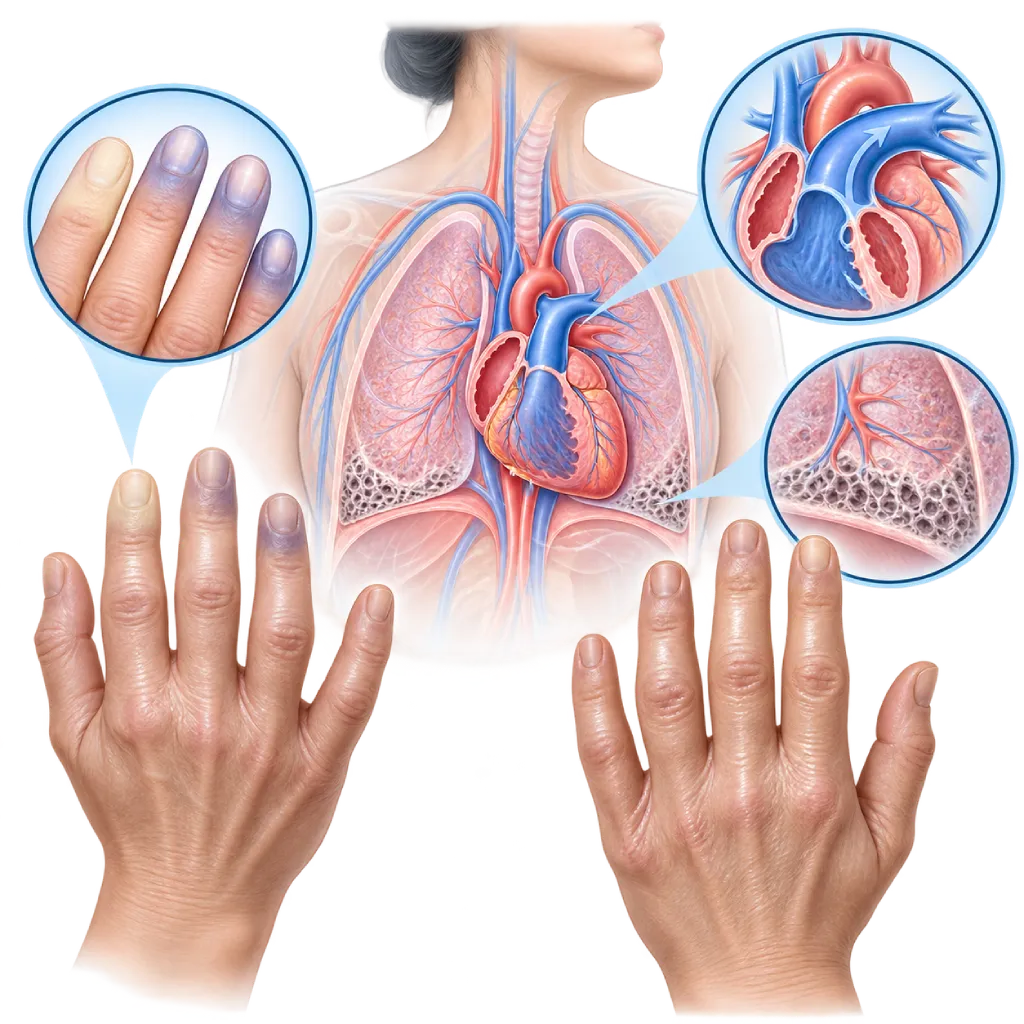
A common early symptom is Raynaud's phenomenon: the fingers or toes turn pale, then bluish, then red in the cold or during stress, because the small blood vessels narrow too much. Some people develop small sores on the fingertips that are slow to heal. The same damage to small blood vessels also occurs in the lungs, heart, and kidneys.
Effects on the Lungs
The lungs are internal organs that are often affected. Interstitial lung disease, in which lung tissue thickens and hardens, causes shortness of breath and a dry cough. Pulmonary hypertension, which is high pressure in the blood vessels of the lungs, makes the right ventricle of the heart work harder. Both can develop without symptoms at first, so guidelines recommend regular lung function tests and heart screening. Pulmonary hypertension is covered on the Pulmonary Hypertension page.
Effects on the Heart
Fine scar tissue can form in the heart muscle and interfere with the muscle's ability to relax and pump. This can lead to rhythm disturbances, electrical conduction problems, fluid in the sac around the heart, or heart failure. Heart involvement often goes unnoticed until an advanced stage, so an ECG and echocardiography are part of routine monitoring.
Other Organs and Treatment
The esophagus and intestines are often affected, causing heartburn, difficulty swallowing, bloating, or diarrhea. Scleroderma renal crisis is a rare but urgent complication: blood pressure rises suddenly and kidney function drops quickly. It is more common in early diffuse disease and with the use of high-dose corticosteroids.
Systemic sclerosis cannot be cured yet, but many of its symptoms and much of the organ damage can be slowed. Treatment is tailored to the organs affected and involves several doctors, such as an internist or rheumatologist, a pulmonologist, and a cardiologist.
02 / Understanding the condition
Symptoms to Recognize.
Common Symptoms
- Fingers that turn pale, bluish, then red in the cold or during stress (Raynaud's phenomenon)
- Thick, tight, shiny skin on the fingers, hands, or face
- Sausage-like swollen fingers, especially early in the disease
- Small sores on the fingertips that heal slowly
- Shortness of breath during activity and a dry cough
- Heartburn, difficulty swallowing, or a bloated stomach
- Pain or stiffness in the joints and muscles
- Prolonged fatigue
03 / Understanding the condition
What Causes This Condition?
- The immune system attacks the body's own tissues; the trigger is not yet fully known
- Damage to the inner lining of the small blood vessels, reducing blood flow to the tissues
- Connective tissue cells (fibroblasts) produce too much collagen, so the skin and organs thicken
- A genetic tendency that increases susceptibility, although the disease is rarely passed down directly
- Certain environmental exposures, such as silica dust or organic solvents, are thought to play a role
04 / Understanding the condition
Who Is at Higher Risk?
Age
It usually begins between the ages of 30 and 50, although it can appear at any age, including in children and older adults.
Genetic
A family history of autoimmune disease slightly increases the risk, but systemic sclerosis is rarely passed directly from parent to child.
Medical
Other autoimmune diseases can occur at the same time. In people who have already been diagnosed, the diffuse form and certain antibodies, such as anti-Scl-70 or anti-RNA polymerase III, are associated with a higher risk of lung or kidney involvement.
Lifestyle
Smoking worsens the narrowing of the small blood vessels and the fingertip sores, and adds to the burden on the lungs.
Other
Women are affected several times more often than men. Long-term workplace exposure to silica dust or organic solvents is also associated with a higher risk.
Groups at Higher Risk
- Women Aged 30 to 50: The group diagnosed more often. Raynaud's phenomenon that first appears at this age needs further evaluation.
- People with Raynaud's Phenomenon and Positive Antibodies: Raynaud's phenomenon with a positive ANA or nailfold capillary abnormalities can be an early sign of scleroderma and needs monitoring.
- Workers Exposed to Silica or Solvents: Long-term workplace exposure, such as in mining, construction, or the chemical industry, is associated with a higher risk.
- People with Diffuse Scleroderma: At higher risk of interstitial lung disease, heart involvement, and renal crisis in the early years of the disease.
05 / Understanding the condition
How Is It Diagnosed?
The diagnosis is made from a combination of symptoms, a physical examination, and blood tests. The doctor assesses skin thickening, Raynaud's phenomenon, fingertip sores, and the small blood vessels at the base of the nails. An ANA test and scleroderma-specific antibody tests help confirm the diagnosis and estimate which organs are at risk. The 2013 ACR/EULAR classification criteria are used as a guide.
After diagnosis, testing focuses on the internal organs because their involvement often causes no symptoms. Lung function tests and high-resolution CT assess the lungs. An ECG, Holter monitoring, echocardiography, and an NT-proBNP test assess the heart and screen for pulmonary hypertension; if the results are suspicious, right heart catheterization is used to confirm it. Cardiac MRI can help detect inflammation or scar tissue in the heart muscle. Blood pressure, kidney function, and urine are checked regularly, and some of these tests are repeated every year.
Antinuclear Antibody Test (ANA Test)
A screening test for autoimmune antibodies. If it is positive, it is followed by tests for scleroderma-specific antibodies, such as anticentromere, anti-Scl-70, and anti-RNA polymerase III.
Nailfold capillaroscopy: the small blood vessels at the base of the nails are viewed under special magnification to look for capillary patterns typical of scleroderma.
Lung Function Test (Spirometry)
Measures lung capacity and the lungs' ability to take up oxygen (DLCO); repeated regularly to detect interstitial lung disease and pulmonary hypertension.
A high-resolution chest CT scan to detect interstitial lung disease early, recommended at the time of diagnosis.
Echocardiography
Regular screening, usually every year, to estimate the pressure in the blood vessels of the lungs and assess the function of the ventricles, the valves, and the sac around the heart.
NT-proBNP and BNP Test
A marker of strain on the heart, used together with lung function tests and echocardiography to screen for pulmonary hypertension.
Right Heart Catheterization
Directly measures the pressure in the pulmonary artery to confirm pulmonary hypertension when screening results are suspicious.
06 / Understanding the condition
Treatment Options.
Treatment is decided by a doctor after an assessment. The categories below can help you follow the conversation with your doctor.
Immune-Modulating Medicines
Immunosuppressants and certain biologic medicines are used when active skin or lung disease is getting worse. The type and duration are determined by the doctor based on the organs affected.
Antifibrotic Medicines
For interstitial lung disease that keeps progressing, the doctor may add an antifibrotic medicine to slow the decline in lung function.
Pulmonary Hypertension Therapy
Special medicines that widen the blood vessels of the lungs, often in combination, are given after the diagnosis is confirmed by right heart catheterization.
Protecting the Blood Vessels of the Fingers
Keeping the hands warm, along with calcium channel blockers or other medicines that widen the blood vessels, to reduce Raynaud's attacks and finger sores.
Blood Pressure and Kidney Control
ACE inhibitors are the main choice for scleroderma renal crisis. Blood pressure should be monitored regularly at home.
Heart and Rhythm Management
Heart failure medicines, antiarrhythmic medicines, or a pacemaker and ICD are considered if there are pumping or rhythm problems, in line with cardiology guidelines.
Digestive Therapy and Rehabilitation
Medicines that reduce stomach acid, diet adjustments, physical therapy, and hand exercises help maintain daily function.
07 / Understanding the condition
Complications to Watch For.
Interstitial Lung Disease
Lung tissue thickens and stiffens, so breathing becomes increasingly short. If it keeps progressing, oxygen levels can drop and the right side of the heart also becomes strained.
Pulmonary Hypertension
High pressure in the blood vessels of the lungs makes the right ventricle work hard and weaken over time. Early detection opens up treatment options sooner.
Rhythm Disorders and Heart Failure
Scar tissue in the heart muscle can trigger palpitations, heart block, or reduced pumping function. Some people need medicines or a pacemaker.
Scleroderma Renal Crisis
Blood pressure rises suddenly along with a decline in kidney function. This needs prompt treatment in the hospital with blood pressure medicines called ACE inhibitors.
Fingertip Sores
Greatly reduced blood flow can cause sores that are hard to heal, infection, or tissue damage at the fingertips.
Digestive Problems
Acid reflux, difficulty swallowing, bloating, or poor absorption of nutrients can lead to weight loss and malnutrition.
08 / Understanding the condition
What Can You Do?
- Keep your hands and feet warm; wear gloves in cold weather or cold rooms
- Quit smoking to protect the blood vessels in your fingers and your lungs
- Follow the schedule for lung function tests and echocardiography even if you have no symptoms
- Measure your blood pressure at home regularly, especially if you have the diffuse form
- Eat small portions, avoid eating close to bedtime, and raise your head when lying down
- Care for your skin with moisturizer and protect your fingers from injury
- Do not start or stop medicines, including corticosteroids, without your doctor's guidance
09 / Understanding the condition
When Should You See a Doctor?
See a doctor if your fingers often turn pale or blue in the cold, especially if this comes with swollen fingers, thickening skin, or joint pain. If you have already been diagnosed with systemic sclerosis, report new symptoms such as shorter breath, tiring easily, palpitations, or leg swelling, even if they are mild, because lung and heart involvement often goes unnoticed at first.
Go to the emergency room right away if you have:
- A severe headache, blurred vision, or a sharp rise in your home blood pressure readings
- A clear drop in urine output over one to two days
- Shortness of breath at rest, chest pain, or fainting
- Fingertips that turn black, are very painful, and feel cold
Don't Wait in an Emergency.
If symptoms are severe or come on suddenly, go to the nearest emergency department right away or call Heart Attack Center 1500 258, rather than waiting for an appointment.
10 / Common questions
Questions You May Have.
Frequently asked questions about systemic sclerosis and its effects on the heart and lungs.
Is systemic sclerosis contagious?
No. Systemic sclerosis is an autoimmune disease, meaning the immune system attacks the body's own tissues. It does not spread through touch, food, or the air. The exact cause is not yet known, but it is thought to involve a genetic tendency and triggers from the environment. Family members and coworkers can interact as usual, and their support helps people with the disease cope with long-term treatment.
What is the difference between localized scleroderma and systemic sclerosis?
Localized scleroderma, or morphea, affects only the skin and the tissue beneath it, without attacking internal organs. Systemic sclerosis affects the skin as well as the blood vessels and internal organs, such as the lungs, heart, kidneys, and digestive tract. For this reason, systemic sclerosis requires regular organ checks. Doctors tell the two apart by the skin pattern, Raynaud's phenomenon, antibody tests, and an examination of the nailfold capillaries.
Why do I need an echocardiogram every year if I am not short of breath?
Pulmonary hypertension and heart involvement in scleroderma often develop without symptoms. By the time shortness of breath appears, the pressure in the lungs may already be quite high. Guidelines recommend regular screening with echocardiography, lung function tests, and an NT-proBNP blood test so changes are found earlier. If the results are suspicious, your doctor will recommend right heart catheterization to confirm the diagnosis before starting specific therapy.
Can systemic sclerosis be cured?
There is currently no medicine that cures systemic sclerosis. However, treatment can slow skin thickening, preserve lung function, control pulmonary hypertension, and prevent finger sores. In some people, skin thickening decreases after a few years. Regular monitoring and treatment that starts earlier give a greater chance of preserving organ function and quality of life.
What is scleroderma renal crisis?
Scleroderma renal crisis is a condition in which blood pressure rises suddenly and kidney function drops quickly. It is rare, but it is more common in the diffuse form during the early years and can be triggered by high-dose corticosteroids. Its signs include a severe headache, blurred vision, or reduced urine output. It needs prompt treatment in the hospital, usually with medicines called ACE inhibitors.
Can people with systemic sclerosis become pregnant?
Many people with systemic sclerosis can become pregnant with planning. Pregnancy should be planned when the disease is stable, and some medicines need to be changed before pregnancy because they can harm the baby. Pregnancy is not recommended if there is severe pulmonary hypertension or heart or kidney problems that are not under control. Discuss your pregnancy plans with your treating doctor early on.
Sources and Medical Review
Translated from the Indonesian edition medically reviewed by dr. Khaira U. Yusrie, Sp.PD-KGEH.
Sources as cited in the Indonesian edition.
- Volkmann ER, Andreasson K, Smith V. Systemic sclerosis. Lancet. 2023;401(10373):304-318.
- Del Galdo F, Lescoat A, Conaghan PG, et al. EULAR recommendations for the treatment of systemic sclerosis: 2023 update. Ann Rheum Dis. 2025;84(1):29-40.
- Humbert M, Kovacs G, Hoeper MM, et al. 2022 ESC/ERS Guidelines for the diagnosis and treatment of pulmonary hypertension. Eur Heart J. 2022;43(38):3618-3731.
- Hoffmann-Vold AM, Maher TM, Philpot EE, et al. The identification and management of interstitial lung disease in systemic sclerosis: evidence-based European consensus statements. Lancet Rheumatol. 2020;2(2):e71-e83.
- Bruni C, Ross L. Cardiac involvement in systemic sclerosis: Getting to the heart of the matter. Best Pract Res Clin Rheumatol. 2021;35(3):101668.
- van den Hoogen F, Khanna D, Fransen J, et al. 2013 classification criteria for systemic sclerosis: an American College of Rheumatology/European League Against Rheumatism collaborative initiative. Ann Rheum Dis. 2013;72(11):1747-1755.
Doctors Who Treat This Condition

dr. Khaira U. Yusrie, Sp.PD-KGEH
Gastroenterology & Hepatology
Clinical focusInternal Medicine · Gastroenterology and Hepatology
View Profile
dr. Santi R. Dewayanti, Sp.P
Pulmonology
Clinical focusLung and Respiratory Disease · Asthma and COPD
View Profile
dr. BRM Ario S. Kuncoro, Sp.JP(K)
Echocardiography & Cardiovascular Imaging
Cardiovascular Diagnostic Center +2 centers
Clinical focusAdvanced and 3D Echocardiography · Transesophageal Echocardiography
View Profile