
Quick answer
What Is Lung Function Test?
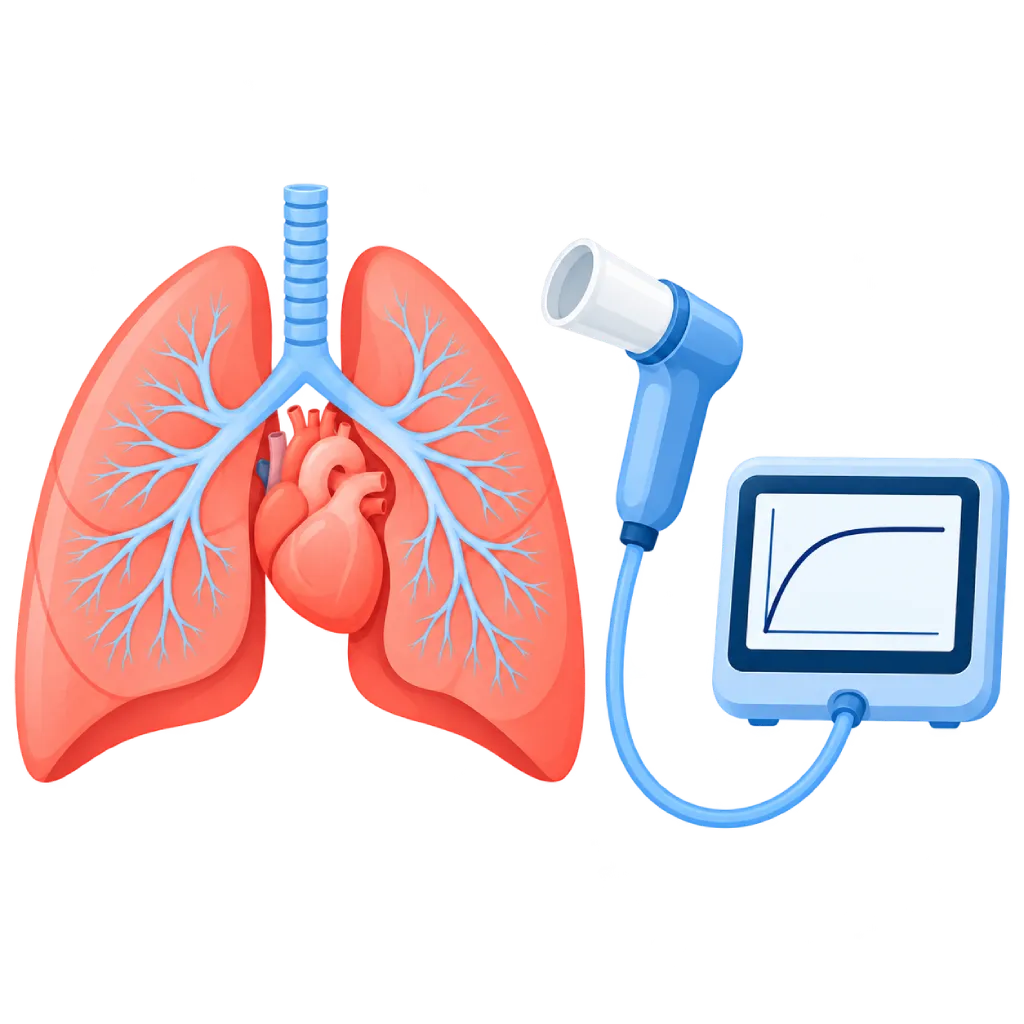
Spirometry is a lung function test in which you take a deep breath and then blow into a device as hard and as fast as you can. It measures how much air you can blow out and how quickly, helping identify asthma, COPD, or restricted lung expansion, and distinguish lung-related from heart-related breathlessness.
Sources01 / Understanding the procedure
About Lung Function Test
What Is Spirometry
Spirometry is a commonly used lung function test. You are asked to breathe in as deeply as you can, then blow as hard and as fast as you can into a mouthpiece connected to a spirometer. The device records the amount and speed of the air you blow out, then compares them with normal values for your age, sex, and height.
How It Works at a Glance
As you blow, the device measures the airflow moment by moment and displays it as a curve. From this curve, it calculates how much air comes out in total and how much comes out within 1 second of starting to blow. The blow is repeated several times until consistent results are obtained.
What Is Measured
- FVC (forced vital capacity): the total amount of air you can blow out after breathing in as deeply as you can.
- FEV1: the amount of air blown out within 1 second of starting to blow.
- FEV1/FVC ratio: the comparison of the two, to see whether the airways are narrowed.
If needed, the test can be complemented by measuring diffusing capacity (DLCO), which is the ability of the lungs to transfer oxygen into the blood.
Reading the Result Patterns
- Normal: values are within the expected range.
- Obstructive: a low FEV1/FVC ratio because the airways are narrowed, as in asthma and COPD. For a COPD diagnosis, a ratio below 0.7 after a reliever medication is used as the threshold.
- Possible restrictive: a low FVC with a normal ratio, for example because the lungs are stiff or the chest has difficulty expanding. This pattern needs to be confirmed with lung volume testing.
If the test is repeated after a reliever medication (bronchodilator) and the results improve substantially, the airway narrowing is reversible, as is often found in asthma.
Lung Function and the Heart
Shortness of breath can come from the lungs, the heart, or both. Spirometry helps your doctor sort out the cause. COPD and heart failure are often found together, and excess fluid in the lungs can change the results, so the test should be done when your heart condition is stable. Spirometry results also help in choosing medications, because COPD is generally not a barrier to using beta blockers that act selectively on the heart. Lung function tests are also part of the workup for pulmonary hypertension and the preparation for heart surgery.
02 / Understanding the procedure
When Is This Procedure Considered?
A doctor may consider this procedure in the situations below. The decision is always made after a thorough assessment.
- Shortness of Breath with an Unclear CauseHelps distinguish whether the cause is the lungs, the heart, or both.
- Persistent Cough, Wheezing, or a Smoking HistoryTo look for asthma or COPD.
- Heart Failure with Suspected Lung DiseaseTo look for COPD, which often accompanies heart failure, once the condition is stable.
- Pulmonary Hypertension WorkupTo look for lung disease as a cause of high pressure in the blood vessels of the lungs.
- Before Heart SurgeryTo assess lung function and estimate the risk of breathing problems after surgery.
- Taking Medications That Can Affect the LungsFor example, long-term amiodarone, at the doctor's discretion.
Situations to Consider First
- Heart Attack Within the Past WeekForceful blowing adds strain on the heart, so the test is postponed.
- Unstable Heart Failure or Rhythm DisordersThe test is done once the heart condition is under control.
- Very High or Very Low Blood PressureThe test is postponed until blood pressure is more stable.
- Large Aortic or Brain AneurysmThe pressure from forceful blowing can be dangerous, so the doctor needs to weigh this carefully.
- Recent Eye, Chest, or Abdominal SurgeryForceful blowing can interfere with the healing of surgical wounds.
- Contagious Respiratory InfectionThe test is postponed until you recover, to protect other patients and staff.
03 / Before the procedure
How Should You Prepare?
Spirometry does not require fasting, but some preparation helps make the results more accurate.
Smoking and eating. Do not smoke for at least one hour before the test, and avoid eating a large meal in the two hours beforehand.
Activity and clothing. Avoid strenuous exercise before the test, and wear loose clothing that does not press on your chest and abdomen.
Inhaler medications. If the test is for diagnosis, your doctor may ask you to delay your reliever or certain inhalers for a few hours beforehand. Follow the instructions given, and keep taking your heart medications as usual.
Important information. Tell the staff if you have recently had a heart attack, chest pain, or surgery, or if you have ever fainted while coughing hard.
Unsure about the preparation instructions? Ask our team before the procedure.
04 / During the procedure
How Is the Procedure Done?
The test usually takes 20 to 30 minutes, and it may take longer if it is followed by a test after a reliever medication.
Measuring Height and Weight
Your height and weight are measured because they are used to calculate the normal values that apply to you.
Position and Nose Clip
You sit upright, then a soft clip is placed on your nose so all the air goes out through your mouth into a single-use mouthpiece.
Blowing Hard
Breathe in as deeply as you can, seal your lips around the mouthpiece, then blow as hard and as fast as you can until no air is left. The staff will coach you, and the blow is repeated at least three times.
Test After a Reliever Medication
If requested, you inhale a reliever medication from an inhaler, wait about 10 to 15 minutes, then blow again to see whether the results improve.
05 / Benefits and risks
Benefits and Risks Should Be Discussed Together.
Every medical procedure has benefits and risks. Your doctor will explain both for your situation before the procedure.
Benefits You Can Expect
- No Needles and No RadiationIt only requires blowing into a device.
- Helps Sort Out the Cause of BreathlessnessIt distinguishes breathlessness caused by the lungs from breathlessness caused by the heart.
- Detects Asthma and COPDLung disease can be treated earlier, so breathlessness is reduced.
- Helps Choose MedicationsTest results help your doctor choose suitable heart and lung medications.
- Assesses Readiness for SurgeryIt helps estimate the risk of breathing problems after heart surgery.
The benefits of a procedure are not a promise of a cure. Ask how the results will affect your care plan.
Risks You Should Know
- Brief Dizziness or TirednessCaused by repeated forceful blowing. The staff give you time to rest between blows.
- Brief Coughing or BreathlessnessUsually mild and quick to improve.
- Chest PainRare. The test is stopped and the doctor assesses you if chest pain occurs.
- Less Accurate ResultsIf you do not blow with full effort, the results may look worse than they really are, so the blow is repeated.
Risks can differ from person to person. A full explanation and consent are given after an individual assessment.
06 / After the procedure
What Is Recovery Like?
There is no recovery period. You can return to your activities right away.
After blowing. Brief dizziness, tiredness, or coughing is normal. Sit for a while until you feel comfortable.
After a reliever medication. You may feel a slight pounding heartbeat or slightly shaky hands, which usually go away on their own.
Results. Your doctor reviews the results together with your symptoms, heart tests, and chest X-ray if available.
Warning signs. Tell the staff right away or go to the emergency room if you have:
- Chest pain during or after the test
- Shortness of breath that does not improve with rest
- A very fast or irregular heartbeat
- Fainting or nearly fainting
Know the Signs That Need Prompt Care.
Follow the team's guidance on warning signs. If severe or sudden symptoms appear after the procedure, go to the nearest emergency department right away or call Heart Attack Center 1500 258.
07 / Team and support
Doctors and Procedure Support
The doctors below are listed for this procedure. Listed by name, not by ranking.

Dr. med. dr. Denio A. Ridjab, Sp.JP(K)
Interventional Cardiology
Coronary Intervention Procedures +2 centers
Clinical focusInterventional Cardiology · Coronary Artery Disease
View Profile
Dr. dr. Dudy A. Hanafy, Sp.BTKV, Subsp. JD(K), MARS
Adult Cardiac Surgery
Advanced Cardiovascular Surgical Care +1 center
Clinical focusMinimally Invasive Cardiac Surgery · Coronary Artery Bypass Surgery
View Profile
dr. Santi R. Dewayanti, Sp.P
Pulmonology
Clinical focusLung and Respiratory Disease · Asthma and COPD
View Profile08 / Common questions
Before You Plan the Procedure.
Frequently asked questions about lung function tests, or spirometry. Your doctor will explain what the results mean for your condition.
What does spirometry measure?
Spirometry measures the total amount of air you can blow out after a deep breath (FVC), the amount of air blown out within 1 second of starting to blow (FEV1), and the ratio between the two. From these three values, your doctor can see whether your airways are narrowed, whether your lungs have difficulty expanding, or whether your lung function is still normal.
Is this test painful?
No. Spirometry does not use needles or anesthesia, and it only requires blowing into a mouthpiece. However, forceful blowing repeated several times can make you tired or slightly dizzy, or cause a brief cough. The staff give you time to rest between blows and will stop the test if you feel uncomfortable.
How does the doctor tell whether breathlessness comes from the heart or the lungs?
Your doctor combines several tests. Spirometry shows whether there is airway narrowing or a problem with lung expansion. Echocardiography and the NT-proBNP blood test assess heart function, while a chest X-ray looks for fluid in the lungs. In some patients, breathlessness comes from both, so both need to be treated.
Why is the test repeated after a reliever medication?
A reliever medication widens the airways. If spirometry results improve substantially after the medication, the airway narrowing is reversible, as is often found in asthma. If the results barely change, the narrowing tends to be persistent, as in COPD. This difference helps your doctor determine the diagnosis and treatment.
Can I take my medications before the test?
Keep taking your heart medications and other regular medications as usual. For reliever medications or inhalers, your doctor may ask you to delay them for a few hours before the test so the results are not masked by the effect of the medication. Follow the instructions given, and bring your inhaler when you come to the hospital.
Why do heart patients need a lung function test?
Lung disease and heart disease often occur together and cause similar symptoms, especially shortness of breath. Lung function test results help your doctor choose safe medications, assess the cause of pulmonary hypertension, and estimate the risk of breathing problems before heart surgery, so treatment can be planned more precisely.
Sources and Medical Review
Translated from the Indonesian edition medically reviewed by dr. Santi R. Dewayanti, Sp.P.
Sources as cited in the Indonesian edition.
- Graham BL, Steenbruggen I, Miller MR, et al. Standardization of spirometry 2019 update: an official American Thoracic Society and European Respiratory Society technical statement. Am J Respir Crit Care Med. 2019;200(8):e70-e88.
- Stanojevic S, Kaminsky DA, Miller MR, et al. ERS/ATS technical standard on interpretive strategies for routine lung function tests. Eur Respir J. 2022;60(1):2101499.
- Agustí A, Celli BR, Criner GJ, et al. Global Initiative for Chronic Obstructive Lung Disease 2023 report: GOLD executive summary. Eur Respir J. 2023;61(4):2300239.
- McDonagh TA, Metra M, Adamo M, et al. 2021 ESC Guidelines for the diagnosis and treatment of acute and chronic heart failure. Eur Heart J. 2021;42(36):3599-3726.
- Humbert M, Kovacs G, Hoeper MM, et al. 2022 ESC/ERS Guidelines for the diagnosis and treatment of pulmonary hypertension. Eur Heart J. 2022;43(38):3618-3731.