
Quick answer
What Is Spontaneous Coronary Artery Dissection?
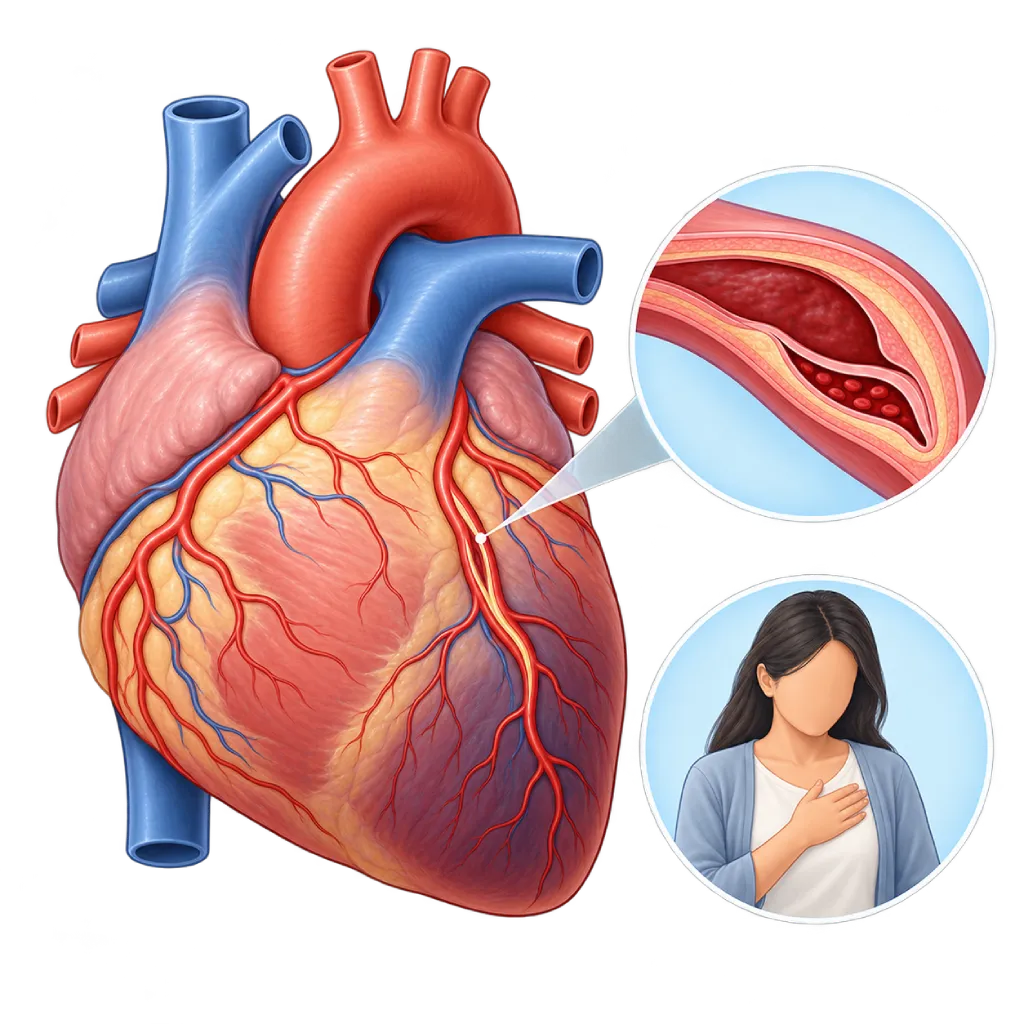
Spontaneous coronary artery dissection (SCAD) is a tear or bleeding inside the wall of a coronary artery that narrows blood flow to the heart without being caused by plaque. SCAD triggers a heart attack and is more common in women, including around the time of pregnancy.
Sources01 / Understanding the condition
About Spontaneous Coronary Artery Dissection
Spontaneous coronary artery dissection, abbreviated as SCAD, occurs when the wall of a coronary artery suddenly splits from the inside. Blood enters the space between the layers of the wall and forms a pool (hematoma) that presses on the blood channel from the outside. Blood flow to the heart muscle is then reduced or stopped, causing a heart attack. It is called spontaneous because it is not triggered by a chest injury or a medical procedure.
Different from a Heart Attack Caused by Plaque
A typical heart attack occurs when a cholesterol plaque cracks and is then blocked by a clot, as covered on the Myocardial Infarction / Heart Attack page. SCAD is not related to plaque. People with SCAD often do not have the usual heart risk factors: they do not smoke, have normal blood pressure and cholesterol, and are physically active. Because of this, the symptoms are sometimes mistaken for an anxiety attack or a stomach problem, when in fact they need to be treated as an emergency. The symptoms and first aid are the same as for other heart attacks, so you and your family do not need to tell them apart at home.
Who Gets It
About 9 out of 10 people with SCAD are women, usually in their 40s to 50s. In women aged 50 and under, SCAD is an important cause of heart attacks. SCAD is also one of the main causes of heart attacks related to pregnancy, especially in the first weeks after giving birth. Many people with SCAD also have fibromuscular dysplasia, a disorder of the walls of medium-sized arteries that can affect the blood vessels of the kidneys, neck, or legs. A short-term trigger, such as severe emotional stress or very strenuous physical activity, often comes before the event.
It Can Usually Heal
The good news is that in most patients, the torn artery wall heals on its own within a few weeks to months. For this reason, if the condition is stable and blood flow is still adequate, doctors usually choose medication and close monitoring rather than placing a stent. In a small number of patients, the tear extends or completely blocks the artery, so a stent or, less often, bypass surgery is needed. After going home, SCAD survivors still need follow-up because there is a risk of recurrence, and they need support to return to their activities and to cope with the anxiety that often appears after the event.
02 / Understanding the condition
Symptoms to Recognize.
Common Symptoms
- Sudden pain, heaviness, or pressure in the chest
- Pain spreading to the arm, shoulder, neck, jaw, or back
- Shortness of breath
- Cold sweat, nausea, or vomiting
- Dizziness, sudden weakness, or feeling faint
- A pounding or irregular heartbeat
Symptoms in Adult Women
Most people with SCAD are women without clear heart risk factors, so the following symptoms are easily mistaken for anxiety or a stomach problem.
- Chest pain during pregnancy or in the weeks after giving birth
- Chest pain after severe emotional stress or very strenuous exercise
- Pain in the upper back, neck, or jaw without clear chest pain
- Shortness of breath or extreme tiredness that comes on suddenly
- Nausea or discomfort in the upper abdomen with a cold sweat
03 / Understanding the condition
What Causes This Condition?
- Bleeding inside the wall of a coronary artery (hematoma) that presses on the blood channel from the outside
- A small tear in the inner layer of the artery that lets blood enter the space between the layers of the wall
- A more fragile artery wall, for example in fibromuscular dysplasia
- Hormonal and blood vessel changes during pregnancy and after giving birth
- Short-term triggers such as severe emotional stress, lifting very heavy weights, straining, vomiting, or forceful coughing
- Inherited connective tissue diseases, such as the one covered on the Marfan Syndrome page.
04 / Understanding the condition
Who Is at Higher Risk?
Age
Usually occurs in women in their 40s to 50s, although it can happen from a young age to old age and also in men.
Medical
Fibromuscular dysplasia, high blood pressure, migraine, and systemic inflammatory diseases are associated with SCAD. High blood pressure also raises the risk of recurrence.
Genetic
Inherited connective tissue diseases such as Marfan syndrome, vascular Ehlers-Danlos syndrome, and Loeys-Dietz syndrome, as well as a family history of SCAD or artery tears.
Other
Pregnancy, especially the first weeks after giving birth, a history of several births, and the use of external hormones such as fertility treatment or hormone therapy.
Lifestyle
Very strenuous exercise or very heavy weightlifting, severe emotional stress, and stimulants such as cocaine and amphetamines can be short-term triggers.
Groups at Higher Risk
- Women Aged 40 to 60 Years: Most people with SCAD fall within this age range, often without the usual heart risk factors.
- Pregnant and Postpartum Women: SCAD is one of the main causes of heart attacks related to pregnancy, especially in the first weeks after giving birth.
- People with Fibromuscular Dysplasia: This artery wall disorder is often found in SCAD survivors and should be looked for with blood vessel imaging.
- People with Inherited Connective Tissue Diseases: Marfan syndrome, vascular Ehlers-Danlos syndrome, and Loeys-Dietz syndrome make the artery walls more fragile.
- SCAD Survivors: The risk of recurrence remains for years, so follow-up, medication, and activity adjustments are needed.
05 / Understanding the condition
How Is It Diagnosed?
In the emergency room, SCAD is first handled like any other heart attack: an ECG within 10 minutes, a troponin test, and care to stabilize the condition. Because people with SCAD are often women who appear healthy, doctors need to stay alert so that the symptoms are not dismissed as anxiety or a stomach problem.
The diagnosis is confirmed with coronary angiography. SCAD usually appears as a long, smooth narrowing, unlike the short, irregular narrowing caused by plaque. If the picture is still unclear, the doctor can look at the artery wall from the inside with OCT or IVUS, carefully, because the wall is fragile at this stage. CT coronary angiography is not enough to confirm SCAD, but it is sometimes used to monitor the healing of a tear in the larger parts of the artery.
Once the condition is stable, expert statements recommend examining the other blood vessels with CT or MR angiography to look for fibromuscular dysplasia, aneurysms, or tears in other arteries.
Electrocardiogram (ECG)
Recorded within 10 minutes of the patient being seen by medical staff, to look for signs of a heart attack and decide whether immediate treatment is needed.
Cardiac Troponin Test
A troponin blood test to confirm heart muscle damage, repeated 1 to 2 hours later if the first result is unclear.
Coronary Angiography
The main test to confirm SCAD. The tear usually appears as a long, smooth narrowing, unlike narrowing caused by plaque.
Optical Coherence Tomography (OCT)
Looks at the artery wall from the inside when angiography is unclear. It is done carefully because the torn wall is fragile.
Echocardiography
An ultrasound of the heart to assess pumping strength and the parts of the heart wall that are affected.
CT or MR angiography from head to pelvis once the condition is stable, to look for fibromuscular dysplasia, aneurysms, or tears in other arteries.
06 / Understanding the condition
Treatment Options.
Treatment is decided by a doctor after an assessment. The categories below can help you follow the conversation with your doctor.
Conservative Care and Monitoring
If the condition is stable and blood flow is still adequate, doctors usually choose medication and monitoring in the hospital for several days, because the majority of tears heal on their own.
Beta Blocker Medication
Reduces the strain on the artery wall. A Canadian cohort showed that beta blocker use was associated with a lower risk of recurrence. The type and dose are determined by the doctor.
Antiplatelet Medication
Aspirin is often given to prevent clots in the torn section. The combination and duration are determined by the doctor because research evidence is still limited.
Stent Placement When Blood Flow Is Blocked
Chosen when ischemia continues, the artery is blocked, or the condition is unstable. The procedure is more difficult on a torn wall, so it is often guided by imaging from inside the vessel.
Coronary Bypass Surgery
Rarely needed, for example when the tear affects the left main coronary artery or several arteries and cannot be treated with a catheter.
Tailored Cardiac Rehabilitation
Gradual, supervised exercise is safe for SCAD survivors and helps restore fitness and self-confidence. The intensity is adjusted to avoid very heavy exertion.
07 / Understanding the condition
Complications to Watch For.
Heart Muscle Damage
Muscle that goes without blood for a long time can be permanently damaged. The extent depends on the artery affected and how quickly treatment is given.
Heart Rhythm Disorders
Heart muscle that lacks blood can trigger an irregular rhythm, including ventricular rhythms that require an immediate electric shock.
Weakened Heart Pump
If the tear affects a large artery, the heart's pumping can weaken to the point of heart failure or shock, which is covered on the Cardiogenic Shock page.
Recurrent SCAD
Some survivors have a new tear within a few years, sometimes in another artery. Well-controlled blood pressure and taking medication regularly help lower the risk.
Anxiety and Depression
Fear of recurrence, anxiety, and prolonged sadness are common in SCAD survivors. Counseling and cardiac rehabilitation help recovery.
08 / Understanding the condition
What Can You Do?
- Know the signs of a heart attack even if you feel you are not at risk, and go to the emergency room right away if they appear.
- After SCAD, take your medication as prescribed, including a beta blocker if your doctor prescribes one.
- Control your blood pressure to the target set by your doctor.
- Avoid lifting very heavy weights, prolonged straining, and very high-intensity competitive sports.
- Discuss pregnancy plans, contraception, and hormone therapy with your cardiologist and obstetrician.
- Avoid stimulants such as cocaine and amphetamines.
- Manage stress and seek support if you feel anxious or sad for a long time.
09 / Understanding the condition
When Should You See a Doctor?
Chest pain or pressure needs to be checked right away in the emergency room, even if you are young, feel healthy, are pregnant, or have recently given birth. Call an ambulance (119) or ask someone else to take you, and do not drive yourself. Tell the staff if you have had SCAD before.
Make an appointment with a cardiologist if:
- You have just been discharged after SCAD treatment and need follow-up, medication adjustment, or cardiac rehabilitation.
- You are a SCAD survivor and are planning a pregnancy or need to choose contraception.
- You have been diagnosed with fibromuscular dysplasia or a connective tissue disease and have never had your heart checked.
- You develop anxiety, trouble sleeping, or prolonged sadness after the event.
10 / Common questions
Questions You May Have.
Frequently asked questions about spontaneous coronary artery dissection (SCAD).
Why is SCAD more common in women?
The exact cause is not yet fully understood. Female hormones are thought to affect the strength of the artery wall, which explains the link with pregnancy, the period after giving birth, and hormone therapy. Artery wall disorders such as fibromuscular dysplasia are also more common in women. Men can still have SCAD, often after very strenuous physical activity.
How is SCAD different from a typical heart attack?
In a typical heart attack, a cholesterol plaque cracks and is then blocked by a clot. In SCAD, the wall of the coronary artery splits or bleeds within its layers and then presses on the blood channel from the outside. The symptoms are the same, so both are treated as emergencies. The difference lies in the treatment that follows: SCAD is more often treated without a stent because the torn wall can usually heal on its own.
Can a tear in a coronary artery heal on its own?
In most patients, yes. Follow-up imaging shows that the tear and the pool of blood in the wall usually shrink and the artery returns to normal within a few weeks to months. For this reason, if blood flow is still adequate and the condition is stable, the doctor chooses medication and close monitoring. You will usually stay in the hospital for a few days to make sure the tear does not extend.
Can I get pregnant after having SCAD?
Pregnancy after SCAD carries a risk of recurrence because of hormonal changes and the strain on the blood vessels during pregnancy and childbirth. Experts generally advise against another pregnancy, or planning one only after in-depth counseling with a cardiologist and an obstetrician. This is a very personal decision, so talk about it openly, including which contraception options are safe for you.
What exercise is safe after SCAD?
Light to moderate aerobic exercise, such as brisk walking, leisurely cycling, or swimming, is generally safe and beneficial. What you should avoid is lifting very heavy weights, exercises that make you hold your breath while straining, and very high-intensity competitive sports. A cardiac rehabilitation program helps determine the right amount of exercise for you.
Can SCAD come back?
Yes. Long-term studies show that some survivors have SCAD again within a few years, sometimes in a different artery. This risk can be lowered by controlling blood pressure, taking medication such as beta blockers if prescribed, and avoiding triggers such as very heavy physical exertion. If chest pain returns, go to the emergency room right away and do not wait.
Sources and Medical Review
Translated from the Indonesian edition medically reviewed by Dr. dr. Dafsah A. Juzar, Sp.JP(K).
Sources as cited in the Indonesian edition.
- Hayes SN, Kim ESH, Saw J, Adlam D, Arslanian-Engoren C, Economy KE, et al. Spontaneous Coronary Artery Dissection: Current State of the Science: A Scientific Statement From the American Heart Association. Circulation. 2018;137(19):e523-57.
- Adlam D, Alfonso F, Maas A, Vrints C; Writing Committee. European Society of Cardiology, acute cardiovascular care association, SCAD study group: a position paper on spontaneous coronary artery dissection. Eur Heart J. 2018;39(36):3353-68.
- Hayes SN, Tweet MS, Adlam D, Kim ESH, Gulati R, Price JE, et al. Spontaneous Coronary Artery Dissection: JACC State-of-the-Art Review. J Am Coll Cardiol. 2020;76(8):961-84.
- Tweet MS, Hayes SN, Codsi E, Gulati R, Rose CH, Best PJM. Spontaneous Coronary Artery Dissection Associated With Pregnancy. J Am Coll Cardiol. 2017;70(4):426-35.
- Saw J, Humphries K, Aymong E, Sedlak T, Prakash R, Starovoytov A, et al. Spontaneous Coronary Artery Dissection: Clinical Outcomes and Risk of Recurrence. J Am Coll Cardiol. 2017;70(9):1148-58.
- Saw J, Starovoytov A, Humphries K, Sheth T, So D, Minhas K, et al. Canadian spontaneous coronary artery dissection cohort study: in-hospital and 30-day outcomes. Eur Heart J. 2019;40(15):1188-97.
- Byrne RA, Rossello X, Coughlan JJ, Barbato E, Berry C, Chieffo A, et al. 2023 ESC Guidelines for the management of acute coronary syndromes. Eur Heart J. 2023;44(38):3720-826.
Doctors Who Treat This Condition

Dr. dr. Dafsah A. Juzar, Sp.JP(K)
Interventional Cardiology
Coronary Intervention Procedures +1 center
Clinical focusComplex Coronary Intervention · Cardiac Catheterization
View Profile
dr. Puti S. Saus, Sp.JP(K)
Interventional Cardiology
Coronary Intervention Procedures
Clinical focusAcute Coronary Syndrome · Primary Coronary Intervention
View Profile
Dr. med. dr. Denio A. Ridjab, Sp.JP(K)
Interventional Cardiology
Coronary Intervention Procedures +2 centers
Clinical focusInterventional Cardiology · Coronary Artery Disease
View Profile