
Quick answer
What Is Renal Denervation?
Renal denervation is a catheter procedure to reduce the activity of the nerves around the kidney arteries that help raise blood pressure. It is an add-on option for hypertension that remains uncontrolled despite several medications, or when medications cannot be tolerated, and is decided together with your doctor. It takes about 1 to 2 hours.
Sources01 / Understanding the procedure
About Renal Denervation
What Is Renal Denervation
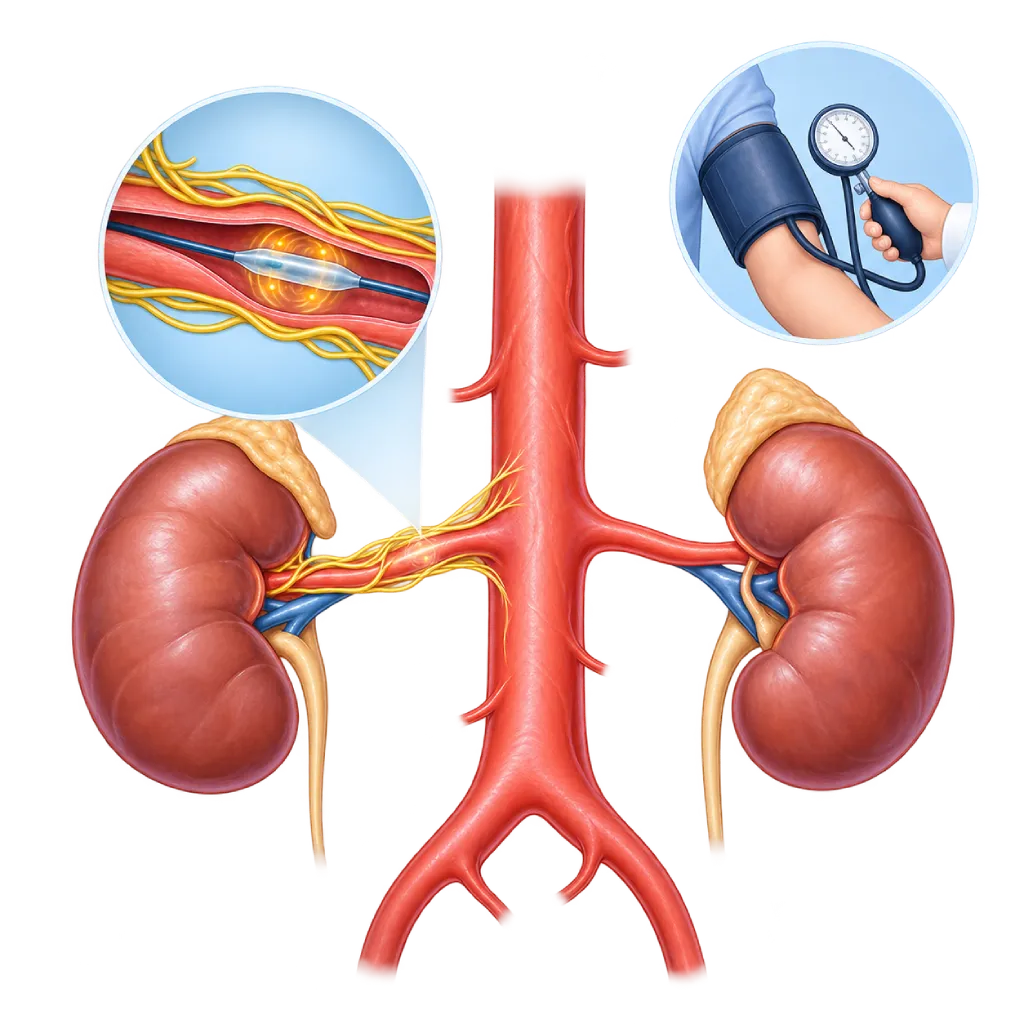
Around the kidney arteries is a network of sympathetic nerves, the part of the nervous system that controls the heart and blood vessels without you being aware of it. These nerves carry signals from the brain to the kidneys and from the kidneys to the brain. When they are overactive, the kidneys retain salt and water, hormones that narrow blood vessels increase, and blood pressure rises. Renal denervation is a catheter procedure to reduce the activity of some of these nerves so that blood pressure goes down.
How It Works in Brief
A special catheter is inserted through a blood vessel in the groin up to the right and left kidney arteries. From inside the artery, the catheter delivers radiofrequency or ultrasound energy to several points around the wall, reducing the function of the surrounding nerves. The artery stays open and no device is left inside the body.
Who May Consider It
The 2023 and 2024 European guidelines place renal denervation as an add-on option, not a replacement for medication. It may be considered if blood pressure stays high despite a combination of medications, usually three types including a diuretic at tolerated doses, or if medications cause severe side effects. The requirements are that high blood pressure has been confirmed with home measurements or 24-hour monitoring, other causes have been looked for, and kidney function is still reasonably good. The decision is made together after you receive an explanation of the benefits and risks.
How Much Benefit to Expect
Studies comparing the procedure with a sham procedure show an average drop in systolic (upper) blood pressure of about 4 to 7 mmHg more than in the comparison group, and the effect lasted up to about 3 years in follow-up. The response varies from person to person: in some it drops considerably, in others it barely changes, and there is no way yet to predict it accurately before the procedure. Most patients still need to take medication afterward.
Not a Replacement for Lifestyle and Medication
Reducing salt, physical activity, and medication remain the foundation of treatment, which is covered on the Hypertension Management page. Renal denervation has not yet been directly proven to reduce heart attacks or strokes, because long-term studies are still ongoing.
Tests Before the Procedure
The doctor confirms that your blood pressure is truly high outside the clinic, checks whether you take your medications regularly, looks for causes of secondary hypertension, and checks your kidney function. The shape and size of the kidney arteries are assessed with CT angiography or MR angiography. 24-hour monitoring is covered on the Ambulatory Blood Pressure Monitoring page.
02 / Understanding the procedure
When Is This Procedure Considered?
A doctor may consider this procedure in the situations below. The decision is always made after a thorough assessment.
- Resistant HypertensionBlood pressure stays high despite taking three or more types of medication, including a diuretic.
- Intolerable Medication Side EffectsThe necessary medications cause severe symptoms, so they cannot be continued.
- Uncontrolled Hypertension with High Heart RiskIn selected patients who choose this procedure after discussing it with their doctor.
- High Blood Pressure Confirmed Outside the ClinicConfirmed with 24-hour monitoring or home measurements, not only in the clinic.
Situations to Consider First
- Severely Reduced Kidney FunctionA kidney filtration rate below 40 mL/min/1.73 m2; its benefits and safety have not been studied enough.
- Unsuitable Kidney Artery AnatomyFor example, arteries that are too small, narrowed, or have had a stent placed.
- Treatable Secondary HypertensionFor example, a hormonal disorder or kidney artery narrowing; the cause is treated first.
- High Blood Pressure Only in the ClinicWhite coat hypertension does not require this procedure.
- PregnancyProcedures with X-rays and contrast dye are postponed; blood pressure is treated with safe medications.
03 / Before the procedure
How Should You Prepare?
Preparation starts several weeks beforehand to make sure this procedure is right for you.
Confirming your blood pressure. 24-hour blood pressure monitoring or a record of home measurements, which is covered on the Home Blood Pressure Monitoring page.
Looking for other causes. Hormone tests, kidney function tests, and if needed a test for breathing problems during sleep.
Kidney artery imaging. CT angiography or MR angiography to assess the size and shape of the kidney arteries.
Medications. Continue your blood pressure medications as usual unless your doctor tells you otherwise. Tell the team if you take blood thinners or metformin, or if you have a contrast allergy.
Fasting. You usually do not eat for about 6 hours before the procedure.
Unsure about the preparation instructions? Ask our team before the procedure.
04 / During the procedure
How Is the Procedure Done?
Renal denervation is done in the catheterization lab and takes about 1 to 2 hours. The puncture site is numbed with local anesthesia, and you are given a sedative and pain reliever through an IV because the energy delivery can cause brief pain in the abdomen or flank.
Blood Vessel Access
A small sheath is inserted into the artery in the groin, sometimes at the wrist.
Mapping the Kidney Arteries
The catheter is guided to the kidney arteries, then contrast dye is injected to see their size and branches. A blood thinner is given during the procedure.
Delivering Energy
The denervation catheter is positioned in the right and left kidney arteries, including their branches when suitable, then radiofrequency or ultrasound energy is delivered to several points around the artery wall.
Final Check
Angiography is repeated to confirm that the kidney arteries are still in good condition, then the sheath is removed and the puncture site is closed.
05 / Benefits and risks
Benefits and Risks Should Be Discussed Together.
Every medical procedure has benefits and risks. Your doctor will explain both for your situation before the procedure.
Benefits You Can Expect
- Additional Blood Pressure ReductionWorks alongside medication, with an average reduction of a few mmHg.
- Round-the-Clock EffectThe reduction is seen on 24-hour monitoring, without depending on your medication schedule.
- No Large Incision or Device Left BehindDone through a small puncture, and no device is left inside the body.
- Short RecoveryYou can usually go home the next day and resume light activity within a few days.
The benefits of a procedure are not a promise of a cure. Ask how the results will affect your care plan.
Risks You Should Know
- Bruising or Bleeding at the Puncture SiteUsually mild; rarely needs an additional procedure.
- Abdominal or Flank Pain During the ProcedureFelt when the energy is delivered; prevented with pain relievers and sedatives.
- Kidney Artery Damage or NarrowingRare; monitored and can be treated with a catheter if it occurs.
- Kidney Problems from Contrast DyeMore likely if kidney function is already reduced; prevented with IV fluids.
- Blood Pressure Not Dropping as ExpectedThe response varies from person to person; your doctor continues to adjust your medications.
- Blood Pressure Too LowCan cause dizziness if medication doses have not been adjusted; monitor your blood pressure at home.
Risks can differ from person to person. A full explanation and consent are given after an individual assessment.
06 / After the procedure
What Is Recovery Like?
You usually stay one night for monitoring.
After the procedure. You lie down for a few hours while the puncture site and blood pressure are monitored.
Blood pressure medications. Keep taking them as usual. The drop in blood pressure usually appears gradually over several weeks to months, and your doctor adjusts your medications based on the monitoring results.
Home monitoring. Record your blood pressure regularly and bring the record to your follow-up visits.
Follow-up. Usually a few weeks after the procedure, then at about 3 to 6 months with 24-hour monitoring and kidney function tests.
Activity. Light activity is fine after you go home. Avoid heavy lifting for a few days.
Warning signs. Go to the emergency room right away if you have:
- Bleeding or growing swelling at the puncture site
- A pale, cold, or tingly leg on the side of the puncture
- Severe pain in the abdomen, flank, or back
- Severe dizziness or fainting, especially when standing up
- Blood pressure of 180/120 mmHg or higher with a severe headache, chest pain, shortness of breath, or weakness on one side of the body
Know the Signs That Need Prompt Care.
Follow the team's guidance on warning signs. If severe or sudden symptoms appear after the procedure, go to the nearest emergency department right away or call Heart Attack Center 1500 258.
07 / Team and support
Doctors and Procedure Support
The doctors below are listed for this procedure. Listed by name, not by ranking.

Dr. dr. Dafsah A. Juzar, Sp.JP(K)
Interventional Cardiology
Coronary Intervention Procedures +1 center
Clinical focusComplex Coronary Intervention · Cardiac Catheterization
View Profile
Dr. dr. Faris Basalamah, Sp.JP(K)
Interventional Cardiology
Coronary Intervention Procedures +1 center
Clinical focusComplex Coronary Intervention · Cardiac Electrophysiology
View Profile
dr. Siska S. Danny, Sp.JP(K)
Interventional Cardiology
Coronary Intervention Procedures
Clinical focusPCI for Acute Coronary Syndrome · Primary Coronary Intervention
View Profile08 / Common questions
Before You Plan the Procedure.
Frequently asked questions about renal denervation.
Can I stop taking my medications after renal denervation?
Usually not. Renal denervation is an add-on treatment, and most patients still need medication afterward. In some patients, the number or dose of medications can be reduced if blood pressure goes down. This decision is made by the doctor based on monitoring results, not by the patient alone. Do not stop or reduce your medications without consulting your doctor.
Will my blood pressure definitely go down after the procedure?
Not always. On average, the drop in systolic (upper) blood pressure is about 4 to 7 mmHg greater than with a comparison procedure, but the response varies from person to person. In some patients it drops considerably, while in others it barely changes. The drop usually appears gradually over several weeks to months, so the result is assessed with 24-hour monitoring a few months after the procedure.
Does renal denervation hurt?
The puncture site is numbed with local anesthesia. When the energy is delivered, you may feel pain in the abdomen, flank, or back for a few seconds. For this reason, you are given a sedative and pain reliever through an IV throughout the procedure. After the procedure, mild pain at the puncture site or flank may be felt for one to two days.
Does this procedure damage the kidneys?
Studies lasting up to several years have not shown a greater decline in kidney function compared with the comparison group, and narrowing of the kidney arteries after the procedure is rare. Contrast dye can strain the kidneys, especially if their function is already reduced, so the amount is limited. Kidney function is checked before the procedure and at follow-up visits.
What is the difference between renal denervation and adding more medication?
Medications work as long as they are taken regularly, and their doses are easy to adjust. Renal denervation is a one-time procedure with a lasting effect, so it does not depend on a medication schedule. Guidelines place medication and lifestyle as the main steps, and denervation as an add-on option if blood pressure stays high or medications cannot be tolerated. The choice is made with your doctor after discussing the benefits and risks.
When can I return to my activities?
You usually go home the next day. Light activities such as walking and office work can be done within one to two days. Avoid heavy lifting and strenuous exercise for about one week, especially if the puncture was in the groin. Follow the team's instructions on caring for the puncture site and the blood pressure follow-up schedule.
Sources and Medical Review
Translated from the Indonesian edition medically reviewed by Dr. dr. Faris Basalamah, Sp.JP(K).
Sources as cited in the Indonesian edition.
- McEvoy JW, McCarthy CP, Bruno RM, et al. 2024 ESC Guidelines for the management of elevated blood pressure and hypertension. Eur Heart J. 2024;45(38):3912-4018.
- Mancia G, Kreutz R, Brunström M, et al. 2023 ESH Guidelines for the management of arterial hypertension. J Hypertens. 2023;41(12):1874-2071.
- Barbato E, Azizi M, Schmieder RE, et al. Renal denervation in the management of hypertension in adults. A clinical consensus statement of the ESC Council on Hypertension and the European Association of Percutaneous Cardiovascular Interventions (EAPCI). Eur Heart J. 2023;44(15):1313-1330.
- Böhm M, Kario K, Kandzari DE, et al. Efficacy of catheter-based renal denervation in the absence of antihypertensive medications (SPYRAL HTN-OFF MED Pivotal): a multicentre, randomised, sham-controlled trial. Lancet. 2020;395(10234):1444-1451.
- Mahfoud F, Kandzari DE, Kario K, et al. Long-term efficacy and safety of renal denervation in the presence of antihypertensive drugs (SPYRAL HTN-ON MED): a randomised, sham-controlled trial. Lancet. 2022;399(10333):1401-1410.
- Azizi M, Sanghvi K, Saxena M, et al. Ultrasound renal denervation for hypertension resistant to a triple medication pill (RADIANCE-HTN TRIO): a randomised, multicentre, single-blind, sham-controlled trial. Lancet. 2021;397(10293):2476-2486.
- Azizi M, Saxena M, Wang Y, et al. Endovascular ultrasound renal denervation to treat hypertension: the RADIANCE II randomized clinical trial. JAMA. 2023;329(8):651-661.