
Quick answer
What Is Resistant Hypertension?
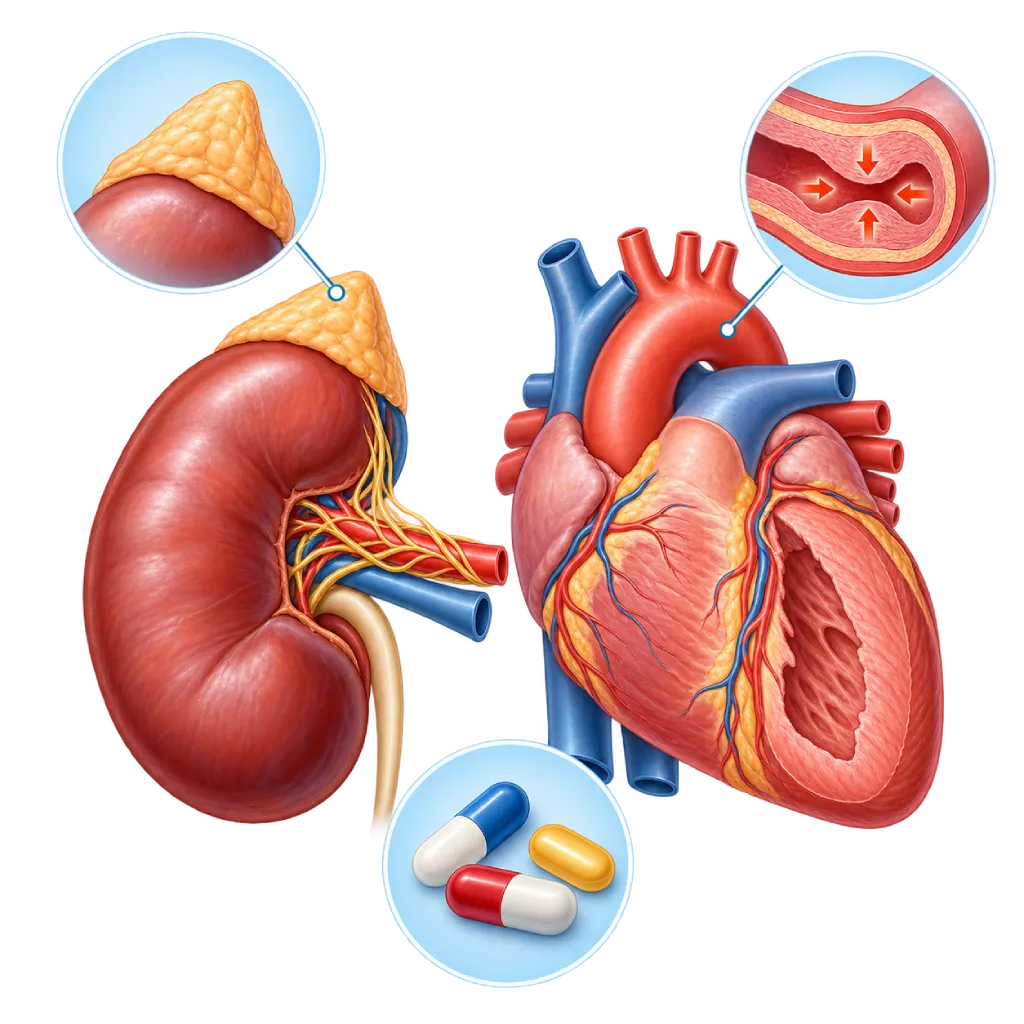
Resistant hypertension is blood pressure that stays at 140/90 mmHg or higher despite lifestyle changes and three medicines at adequate doses, including a diuretic, after the measurements and medication adherence have been confirmed.
SourcesSigns That Need Urgent Help
- Chest pain or a feeling of pressure in the chest
- Severe shortness of breath or a cough with foamy sputum
- Facial drooping, weakness of the arm or leg on one side, or slurred speech
- Sudden severe headache with vomiting or confusion
- Sudden blurred vision or loss of vision
- Seizures or reduced consciousness
If these signs appear, go to the nearest emergency department right away or call Heart Attack Center 1500 258.
01 / Understanding the condition
About Resistant Hypertension
Resistant hypertension means your blood pressure has not come down below 140/90 mmHg even though you have made lifestyle changes and are taking three types of blood pressure medicines at the maximum doses you can tolerate. According to the 2024 ESC and 2023 ESH guidelines, the three medicines should ideally consist of an ACE inhibitor or ARB, a calcium channel blocker, and a diuretic. The diagnosis can only be made after the results are confirmed with home measurements or 24-hour monitoring and medication adherence has been assessed.
True Resistance and Pseudoresistance
In many cases, blood pressure that seems hard to lower turns out to be pseudoresistance. Causes include a cuff that is too small, the white coat effect when measured at the clinic, medicines not taken regularly, doses that are not yet adequate, or the use of other medicines that raise blood pressure, such as nonsteroidal anti-inflammatory drugs and decongestants. Once these factors are ruled out, true resistant hypertension is estimated to affect fewer than 1 in 10 people being treated for hypertension.
Common Causes
In resistant hypertension, the body often retains excess salt and fluid. High salt intake, excess weight, chronic kidney disease, and obstructive sleep apnea often play a part. Secondary causes are also found more often, especially primary aldosteronism, in which the adrenal glands produce too much of the hormone aldosterone. This hormone retains salt and causes potassium loss, so some people with it have low blood potassium. The search for these causes is covered on the Secondary Hypertension page.
Why It Needs Serious Attention
Blood pressure that stays uncontrolled for a long time is more often accompanied by thickening of the heart muscle, protein in the urine, and declining kidney function. For this reason, resistant hypertension is associated with a higher risk of stroke, heart attack, and heart failure. The good news is that a targeted evaluation often finds things that can be corrected.
Treatment Approach
Treatment begins by correcting what can be changed: how blood pressure is measured, adherence, salt intake, and medicines that raise blood pressure. If blood pressure is still high, guidelines recommend adding a fourth medicine, usually spironolactone, with monitoring of potassium and kidney function. For some people, renal denervation through a catheter may be considered after a discussion with the doctor. Hypertension that remains uncontrolled on five or more medicines, including spironolactone, is called refractory hypertension and needs further evaluation. An overview of hypertension is covered on the Hypertension page.
02 / Understanding the condition
Symptoms to Recognize.
Common Symptoms
Resistant hypertension often causes no symptoms. Some of the signs below may point to an underlying cause.
- Blood pressure stays high despite taking three types of medicine
- Often no symptoms at all
- Headache or a heavy feeling in the back of the neck
- Loud snoring, pauses in breathing during sleep, and daytime sleepiness
- Weakness, muscle cramps, or frequent urination, which may signal low potassium
- Shortness of breath during activity or swollen legs
03 / Understanding the condition
What Causes This Condition?
- Medicines not taken regularly or doses that are not yet adequate, a common cause of pseudoresistance
- Incorrect measurement, for example a cuff that is too small, or the white coat effect at the clinic
- High salt intake and a body that retains excess fluid
- Excess weight and obstructive sleep apnea
- Chronic kidney disease
- Primary aldosteronism and other secondary causes, such as narrowing of the kidney arteries
- Medicines or substances that raise blood pressure: nonsteroidal anti-inflammatory drugs, decongestants, birth control pills, corticosteroids, and alcohol
04 / Understanding the condition
Who Is at Higher Risk?
Lifestyle
High salt intake, excess weight, physical inactivity, and drinking alcohol make blood pressure medicines work less effectively.
Medical
Chronic kidney disease, diabetes, obstructive sleep apnea, primary aldosteronism, and existing thickening of the heart muscle or heart disease.
Age
More common over age 60, because the arteries are stiffer and coexisting conditions are more frequent.
Other
Very high blood pressure at the time of diagnosis, a complicated medication schedule, and use of over-the-counter medicines or traditional herbal remedies that affect blood pressure.
Groups at Higher Risk
- People with Chronic Kidney Disease: Impaired kidneys have trouble removing salt and fluid, so blood pressure is harder to control.
- People with Diabetes: Diabetes is often accompanied by kidney and blood vessel damage that makes blood pressure hard to lower.
- People with Obesity: Excess weight is linked to salt retention, hormone activation, and obstructive sleep apnea.
- People Who Snore Loudly: Loud snoring with pauses in breathing during sleep can signal sleep apnea, a cause often found in resistant hypertension.
- People Over Age 60: Stiff arteries and coexisting conditions make blood pressure harder to control at this age.
05 / Understanding the condition
How Is It Diagnosed?
Before resistant hypertension is diagnosed, the doctor confirms three things. Measurements must be taken correctly, and high readings must also be seen outside the clinic, through home measurements or 24-hour monitoring. The medicines must actually be taken every day at adequate doses. There must be no medicines, herbal remedies, or habits that counteract the treatment.
If blood pressure stays high, the doctor looks for secondary causes, especially primary aldosteronism, kidney disease, narrowing of the kidney arteries, and obstructive sleep apnea. Blood tests, urine tests, and imaging are chosen based on the clues found. Echocardiography and urine tests also assess how much the heart and kidneys have already been affected, so the treatment plan can be more targeted.
Ambulatory Blood Pressure Monitoring
Confirms that blood pressure is truly high throughout the day and night and rules out the white coat effect before resistant hypertension is diagnosed.
Home Blood Pressure Monitoring
Morning and evening readings over 7 days help assess the results of each medication change.
Assessment of medication adherence through an interview, pill counts, or simplifying the medication schedule, because missed doses are a common cause.
Laboratory Tests
Potassium, sodium, kidney function, and the aldosterone-to-renin ratio to look for primary aldosteronism and kidney disease.
Urine Protein Test
Looks for albumin in the urine as a sign of kidney and blood vessel damage.
Echocardiography
Assesses thickening of the left heart muscle and pumping function as effects of long-standing high blood pressure.
A sleep study (polysomnography) if there is loud snoring or daytime sleepiness, to confirm obstructive sleep apnea.
06 / Understanding the condition
Treatment Options.
Treatment is decided by a doctor after an assessment. The categories below can help you follow the conversation with your doctor.
Correcting Modifiable Factors
Reducing salt, losing weight, limiting alcohol, treating sleep apnea, and stopping medicines that raise blood pressure together with your doctor.
Simplifying and Adjusting Medicines
The three main medicines are combined into fewer tablets, doses are increased up to the tolerated limit, and the type of diuretic is adjusted to kidney function.
Adding Spironolactone
This mineralocorticoid antagonist is the preferred choice for a fourth medicine. Potassium and kidney function are checked regularly. If it is not suitable, the doctor chooses another medicine, such as a beta blocker or an alpha blocker.
Treating Secondary Causes
For example, specific medicines or surgery for primary aldosteronism, and a CPAP breathing device for obstructive sleep apnea.
Renal Denervation
A catheter procedure to calm the nerves around the kidney arteries. It may be considered in selected people with adequate kidney function. Covered on the Renal Denervation page.
Regular Monitoring
Home measurements and routine checkups help assess the results of each treatment change.
07 / Understanding the condition
Complications to Watch For.
Stroke
Blood pressure that stays uncontrolled for a long time raises the risk of a blocked or ruptured blood vessel in the brain.
Heart Attack
High blood pressure speeds up plaque buildup in the coronary arteries and increases the workload of the heart muscle.
Heart Muscle Thickening and Heart Failure
The left ventricle thickens and stiffens, then may weaken. Covered on the Heart Failure page.
Chronic Kidney Disease
Small blood vessels in the kidneys are slowly damaged, while impaired kidneys make blood pressure even harder to lower.
Hypertensive Crisis
Blood pressure can surge to 180/120 mmHg or higher and suddenly damage organs. Covered on the Hypertensive Crisis page.
08 / Understanding the condition
What Can You Do?
- Take your medicines every day on schedule; use reminders or a weekly pill box
- Limit salt to about 5 grams per day and watch for hidden salt in processed foods
- Bring all your medicines, including over-the-counter medicines, supplements, and herbal remedies, to every checkup
- Avoid nonsteroidal anti-inflammatory drugs and decongestants unless your doctor advises them
- Measure your blood pressure at home with a validated upper-arm device and record the results
- Get checked if you snore loudly or often feel sleepy during the day
- Maintain a healthy weight, stay active, and limit alcohol
09 / Understanding the condition
When Should You See a Doctor?
Talk to your doctor if your blood pressure has not reached its target after several months of treatment. Make an appointment if:
- Your average home blood pressure stays at 135/85 mmHg or higher despite taking three types of medicine
- You often forget to take your medicines or feel your medication schedule is too complicated
- You develop weakness, muscle cramps, or a low blood potassium result
- You snore loudly or often feel sleepy during the day
- You have side effects after a new medicine is added
Go to the emergency room right away if your blood pressure is 180/120 mmHg or higher with chest pain, shortness of breath, weakness on one side of the body, slurred speech, or vision problems.
Don't Wait in an Emergency.
If symptoms are severe or come on suddenly, go to the nearest emergency department right away or call Heart Attack Center 1500 258, rather than waiting for an appointment.
10 / Common questions
Questions You May Have.
Frequently asked questions about resistant hypertension, or blood pressure that is hard to lower.
Does resistant hypertension mean the medicines do not work?
Not always. In many cases, blood pressure that seems hard to lower turns out to be caused by how it is measured, the white coat effect, missed doses, doses that are not yet adequate, or high salt intake. Once these are corrected, most patients can reach their target. If blood pressure stays high, your doctor looks for hidden causes and adds medicines that work in a different way.
Why does my doctor ask me to measure my blood pressure at home or over 24 hours?
Clinic readings can be higher than everyday readings because of tension during the examination. Home measurements over 7 days or 24-hour monitoring show whether your blood pressure is truly uncontrolled. Monitoring over 24 hours also shows your blood pressure during sleep. Without this step, you might be given more medicines than you need.
What role does salt play in resistant hypertension?
In resistant hypertension, the body tends to retain excess salt and fluid. High salt intake works against the medicines, especially diuretics. Reducing salt to about 5 grams per day, including hidden salt in soy sauce, other sauces, instant noodles, and packaged foods, can lower blood pressure and help the medicines work better. A dietitian can help you plan suitable meals.
Can renal denervation replace medicines?
No. Studies show that renal denervation lowers blood pressure by an average of a few mmHg, so most patients still need medicines after the procedure. It is considered for selected patients after other causes have been ruled out and when kidney function is adequate. The decision is made together with your doctor after discussing the benefits and risks. Covered on the Renal Denervation page.
Is spironolactone safe?
Spironolactone is generally tolerated, but it can raise potassium and affect kidney function, so blood tests are needed a few weeks after starting it and regularly afterward. In men, it sometimes causes painful breast enlargement. If side effects occur, your doctor can replace it with another medicine. Do not stop or add medicines without your doctor's advice.
What is the difference between resistant hypertension and secondary hypertension?
Resistant hypertension describes blood pressure that is hard to lower with three medicines, whatever the cause. Secondary hypertension describes high blood pressure caused by another disease, for example primary aldosteronism or kidney disease. The two often overlap: secondary causes are found more often in resistant hypertension, so searching for them is part of the evaluation. Covered on the Secondary Hypertension page.
Sources and Medical Review
Translated from the Indonesian edition medically reviewed by Dr. dr. Faris Basalamah, Sp.JP(K).
Sources as cited in the Indonesian edition.
- McEvoy JW, McCarthy CP, Bruno RM, et al. 2024 ESC Guidelines for the management of elevated blood pressure and hypertension. Eur Heart J. 2024;45(38):3912-4018.
- Mancia G, Kreutz R, Brunström M, et al. 2023 ESH Guidelines for the management of arterial hypertension The Task Force for the management of arterial hypertension of the European Society of Hypertension: Endorsed by the International Society of Hypertension (ISH) and the European Renal Association (ERA). J Hypertens. 2023;41(12):1874-2071.
- Carey RM, Calhoun DA, Bakris GL, et al. Resistant Hypertension: Detection, Evaluation, and Management: A Scientific Statement From the American Heart Association. Hypertension. 2018;72(5):e53-e90.
- Williams B, MacDonald TM, Morant S, et al. Spironolactone versus placebo, bisoprolol, and doxazosin to determine the optimal treatment for drug-resistant hypertension (PATHWAY-2): a randomised, double-blind, crossover trial. Lancet. 2015;386(10008):2059-2068.
- Barbato E, Azizi M, Schmieder RE, et al. Renal denervation in the management of hypertension in adults. A clinical consensus statement of the ESC Council on Hypertension and the European Association of Percutaneous Cardiovascular Interventions (EAPCI). Eur Heart J. 2023;44(15):1313-1330.
- Azizi M, Sanghvi K, Saxena M, et al. Ultrasound renal denervation for hypertension resistant to a triple medication pill (RADIANCE-HTN TRIO): a randomised, multicentre, single-blind, sham-controlled trial. Lancet. 2021;397(10293):2476-2486.
Doctors Who Treat This Condition

Dr. dr. Faris Basalamah, Sp.JP(K)
Interventional Cardiology
Coronary Intervention Procedures +1 center
Clinical focusComplex Coronary Intervention · Cardiac Electrophysiology
View Profile
dr. Siska S. Danny, Sp.JP(K)
Interventional Cardiology
Coronary Intervention Procedures
Clinical focusPCI for Acute Coronary Syndrome · Primary Coronary Intervention
View Profile
dr. Debby C. Soemitha, Sp.PD
Internal Medicine
Clinical focusDiabetes and Diabetes Complications · Obesity and Metabolic Disease
View Profile