
Quick answer
What Is Home Blood Pressure Monitoring?
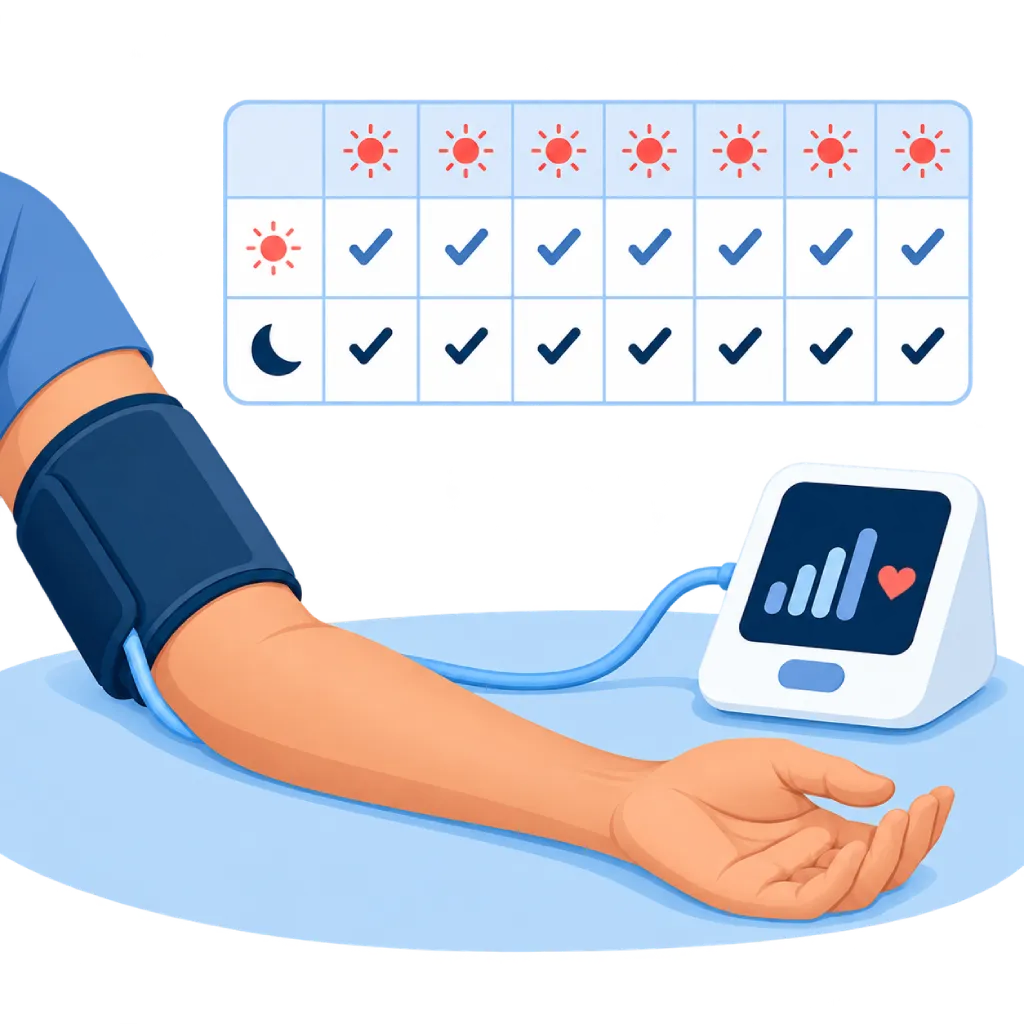
Home blood pressure monitoring means measuring your own blood pressure with a validated automatic upper-arm device, usually twice every morning and evening for 7 days before a follow-up visit. The average helps your doctor confirm hypertension, identify white coat or masked hypertension, and assess treatment results.
Sources01 / Understanding the procedure
About Home Blood Pressure Monitoring
What Is Home Blood Pressure Monitoring
Home blood pressure monitoring is a way of measuring your own blood pressure on a standard schedule and with a standard technique, then reviewing the results with your doctor. Because it is measured many times in everyday settings, the results often reflect your true blood pressure better than a single measurement in the doctor's office.
How It Works at a Glance
An automatic device inflates the cuff on your upper arm until blood flow in the arm artery stops briefly, then slowly deflates it. A sensor in the device reads the vibrations of the artery wall as blood flows again, then calculates the systolic pressure, diastolic pressure, and pulse rate. The average of many measurements over several days is much more reliable than a single number.
What It Is Used For
- Confirming a diagnosis of hypertension: European guidelines recommend measurement outside the doctor's office, at home or with a 24-hour device, before hypertension is confirmed.
- Identifying white coat hypertension: blood pressure is high when checked at the clinic but normal at home.
- Identifying masked hypertension: blood pressure is normal at the clinic but high at home.
- Monitoring treatment: it helps your doctor adjust medications and keep your blood pressure under control over the long term.
What Home Readings Mean
The threshold for blood pressure at home is lower than at the clinic. An average of 135/85 mmHg or higher at home is equivalent to 140/90 mmHg at the clinic and points to hypertension. Your target is set by your doctor based on your age and health condition. If a picture of your blood pressure during sleep is needed, your doctor may recommend 24-hour ambulatory blood pressure monitoring.
02 / Understanding the procedure
When Is This Procedure Considered?
A doctor may consider this procedure in the situations below. The decision is always made after a thorough assessment.
- Suspected HypertensionTo confirm the diagnosis before treatment starts.
- Suspected White Coat HypertensionBlood pressure is high only when checked at the clinic.
- Suspected Masked HypertensionBlood pressure is normal at the clinic, but there are signs of organ damage or a high risk.
- Taking Blood Pressure MedicationTo assess whether the target is reached and help your doctor adjust the dose.
- Hard-to-Control HypertensionTo confirm that blood pressure is truly uncontrolled before adding further therapy.
- High Blood Pressure During PregnancyWith a device validated for pregnancy, as directed by your doctor.
Situations to Consider First
- Atrial Fibrillation or Irregular HeartbeatAutomatic device readings may be less accurate; your doctor may ask for more measurements.
- Very Large or Very Small ArmsA cuff of the right size is needed for accurate results.
- Becoming Anxious When MeasuringMeasuring too often can increase anxiety; follow the recommended schedule.
- Difficulty Using the Device AloneAsk a family member for help, or your doctor may choose 24-hour monitoring.
03 / Before the procedure
How Should You Prepare?
Before you start, make sure your device and measurement method are correct.
Choose a device. Use an automatic device with an upper-arm cuff that has been clinically validated. Wrist or finger devices are generally not recommended.
Cuff size. Measure the circumference of your upper arm, then choose a cuff that fits. A cuff that is too small makes readings look higher.
Bring the device to your follow-up visit. Your doctor or nurse can compare your device with the clinic's device and check how you measure.
30 minutes before measuring. Avoid coffee, smoking, and exercise, and empty your bladder beforehand.
Unsure about the preparation instructions? Ask our team before the procedure.
04 / During the procedure
How Is the Procedure Done?
Each measurement session takes about 10 minutes, including 5 minutes of rest. Measure every morning and evening for 7 days before your follow-up visit, or for at least 3 days if 7 days is not possible.
Sit Quietly for 5 Minutes
Sit in a chair with back support, with your feet flat on the floor and your legs uncrossed, in a quiet room. Do not talk or hold your phone during the rest period and the measurement.
Fit the Cuff Correctly
Place the cuff directly on the skin of your upper arm, about 2 to 3 cm above the crease of your elbow. Rest your arm on a table so the cuff is at heart level.
Measure Twice, Morning and Evening
Measure in the morning before taking your medications and before breakfast, and in the evening. At each session, take two readings about 1 minute apart.
Record and Bring Your Results
Record all results exactly as they are, with the date and time, or save them in the device's memory. Your doctor will calculate the average, usually excluding the readings from day 1.
05 / Benefits and risks
Benefits and Risks Should Be Discussed Together.
Every medical procedure has benefits and risks. Your doctor will explain both for your situation before the procedure.
Benefits You Can Expect
- Better Reflects Everyday LifeMany measurements at home are more reliable than a single number at the clinic.
- Identifies White Coat and Masked HypertensionIt prevents unnecessary treatment or treatment that would otherwise be missed.
- Helps Control Blood PressureEspecially when combined with follow-up from the healthcare team.
- Involves You in Your TreatmentYou can see for yourself the effect of medications and lifestyle changes.
- Simple and SafeAll you need is a validated device and the correct technique.
The benefits of a procedure are not a promise of a cure. Ask how the results will affect your care plan.
Risks You Should Know
- Inaccurate Results Due to Technique or DeviceA cuff of the wrong size or an incorrect sitting position changes the results.
- AnxietySome people become anxious if they measure too often.
- Changing Medications on Your OwnThis can be dangerous; discuss the results with your doctor.
- Arm DiscomfortMild and brief while the cuff inflates.
Risks can differ from person to person. A full explanation and consent are given after an individual assessment.
06 / After the procedure
What Is Recovery Like?
There is no recovery period. The cuff sometimes leaves a light pressure mark on your arm that fades on its own.
Do not change your medication dose on your own. Bring your records to your follow-up visit so your doctor can assess and adjust your treatment.
If the numbers are very high. If your blood pressure is 180/120 mmHg or higher without symptoms, rest for 5 minutes and measure again, and contact your doctor if it stays high. Go to the emergency room right away if a reading that high comes with:
- Chest pain or shortness of breath
- Severe headache, blurred vision, or confusion
- Weakness or numbness on one side of the body, or difficulty speaking
- Severe dizziness or fainting
Know the Signs That Need Prompt Care.
Follow the team's guidance on warning signs. If severe or sudden symptoms appear after the procedure, go to the nearest emergency department right away or call Heart Attack Center 1500 258.
07 / Team and support
Doctors and Procedure Support
The doctors below are listed for this procedure. Listed by name, not by ranking.

Dr. med. dr. Denio A. Ridjab, Sp.JP(K)
Interventional Cardiology
Coronary Intervention Procedures +2 centers
Clinical focusInterventional Cardiology · Coronary Artery Disease
View Profile
Dr. dr. Faris Basalamah, Sp.JP(K)
Interventional Cardiology
Coronary Intervention Procedures +1 center
Clinical focusComplex Coronary Intervention · Cardiac Electrophysiology
View Profile
dr. Siska S. Danny, Sp.JP(K)
Interventional Cardiology
Coronary Intervention Procedures
Clinical focusPCI for Acute Coronary Syndrome · Primary Coronary Intervention
View Profile08 / Common questions
Before You Plan the Procedure.
Frequently asked questions about home blood pressure monitoring. Your doctor will explain what the results mean for your condition.
What kind of device should I use?
Choose an automatic device with an upper-arm cuff that has been clinically validated, with a cuff size that fits your arm circumference. A device that stores results in its memory makes record keeping easier. Wrist or finger devices are generally less accurate. Bring your device to your follow-up visit so it can be compared with the clinic's device.
Why is my blood pressure at home different from at the clinic?
Many people feel tense during a checkup, so their blood pressure rises at the clinic, which is called the white coat effect. On the other hand, some people actually have higher readings at home because of work stress or smoking. Because the settings differ, the normal threshold at home is also lower: an average below 135/85 mmHg.
How often should I measure?
For a diagnosis or before a follow-up visit, measure twice every morning and evening for 7 days, or for at least 3 days. Once your blood pressure is under control, your doctor usually only asks for monitoring on certain days. Measuring too often outside the schedule does not improve accuracy and can make you anxious.
Can I repeat a high reading until it is normal?
No. Record all results exactly as they are, including high ones, because your doctor needs an honest picture. Repeating until the number is normal makes the average inaccurate. Readings from day 1 are usually not counted because they tend to be higher. If the number is very high, rest for 5 minutes, measure again, then contact your doctor.
What if I have atrial fibrillation?
With an irregular heart rhythm, automatic devices may give less accurate results. Your doctor may ask you to measure three times at each session and use the average, or choose a device that has been tested for atrial fibrillation. If the results are doubtful, 24-hour monitoring or measurement at the clinic can help.
Can home monitoring replace visits to the doctor?
No. Home monitoring complements your follow-up visits, but it does not replace them. Your doctor still needs to assess your symptoms, check organs affected by hypertension such as the heart and kidneys, and adjust your medications. Your blood pressure records make your doctor's decisions more precise and help keep your blood pressure under control over the long term.
Sources and Medical Review
Translated from the Indonesian edition medically reviewed by Dr. med. dr. Denio A. Ridjab, Sp.JP(K).
Sources as cited in the Indonesian edition.
- McEvoy JW, McCarthy CP, Bruno RM, et al. 2024 ESC Guidelines for the management of elevated blood pressure and hypertension. Eur Heart J. 2024;45(38):3912-4018.
- Stergiou GS, Palatini P, Parati G, et al. 2021 European Society of Hypertension practice guidelines for office and out-of-office blood pressure measurement. J Hypertens. 2021;39(7):1293-1302.
- Shimbo D, Artinian NT, Basile JN, et al. Self-measured blood pressure monitoring at home: a joint policy statement from the American Heart Association and American Medical Association. Circulation. 2020;142(4):e42-e63.
- Tucker KL, Sheppard JP, Stevens R, et al. Self-monitoring of blood pressure in hypertension: a systematic review and individual patient data meta-analysis. PLoS Med. 2017;14(9):e1002389.