
Quick answer
What Is Postprandial Hypotension?
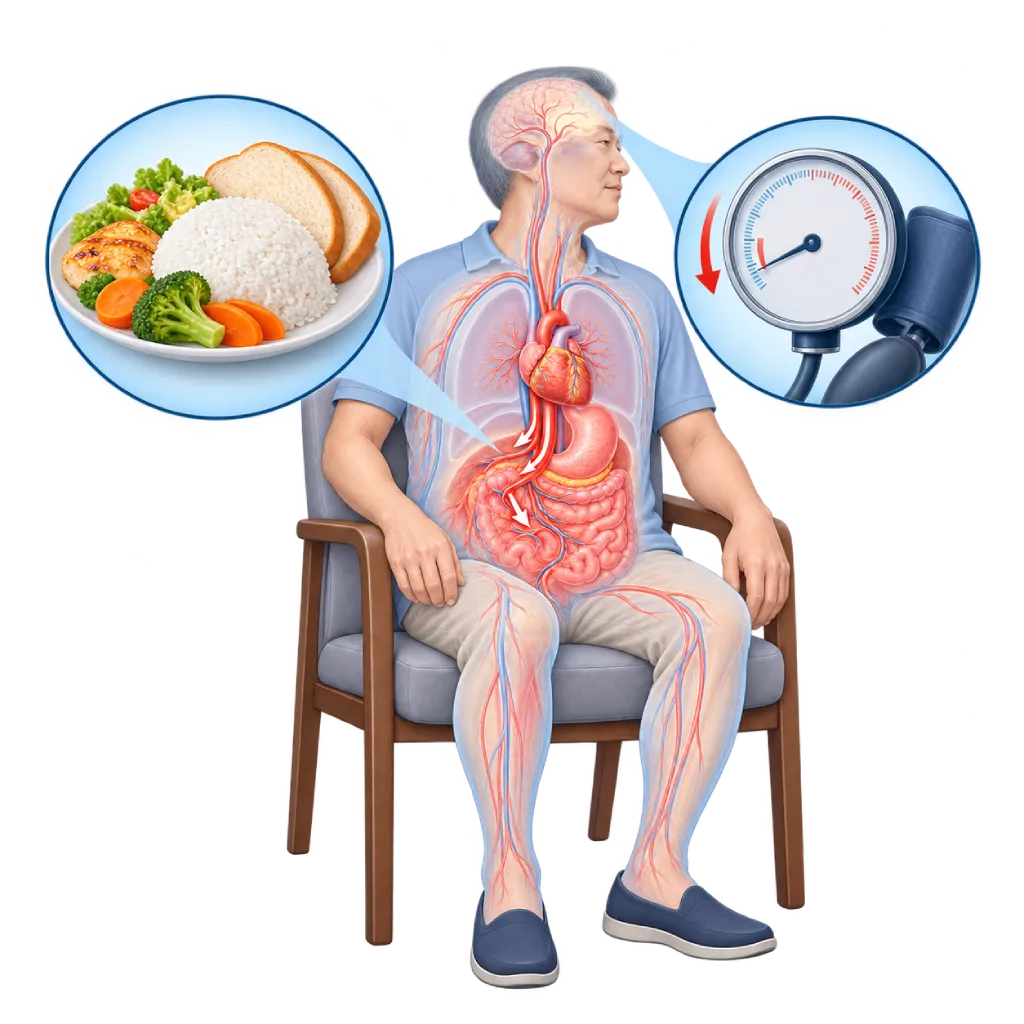
Postprandial hypotension is a drop in blood pressure within two hours after eating, of at least 20 mmHg in the upper (systolic) number. It is common in older adults and can cause dizziness, severe sleepiness, falls, or fainting after meals.
SourcesSigns That Need Urgent Help
- Fainting with chest pain, shortness of breath, or palpitations
- Chest pain or pressure in the chest after eating
- Slurred speech, facial drooping, or weakness on one side of the body
- Not regaining consciousness quickly or being hard to wake after fainting
- A head injury from a fall
If these signs appear, go to the nearest emergency department right away or call Heart Attack Center 1500 258.
01 / Understanding the condition
About Postprandial Hypotension
After eating, the body sends a lot of blood to the stomach and intestines to digest food. In healthy people, the heart beats slightly faster and the blood vessels in other parts of the body narrow, so blood pressure stays stable. In postprandial hypotension, this adjustment is not enough. Blood pressure drops, usually starting about 15 minutes after eating, reaches its low point about 30 to 60 minutes after eating, and then recovers within two hours.
Doctors call it postprandial hypotension when systolic pressure drops by 20 mmHg or more within two hours after eating, or falls below 90 mmHg when it was 100 mmHg or more before eating.
Who Gets It
This condition is rare in healthy young people. Studies have found postprandial hypotension in about a quarter to a third of older adults in nursing homes, and even more often in people with long-standing diabetes, Parkinson's disease, and other disorders of the autonomic nervous system. Many people with it also have orthostatic hypotension, so dizziness comes on more easily when they stand up after eating. The drop after eating can also happen while you remain seated, so older adults may appear to doze off or seem dazed in their chair.
Why Food Matters
Foods high in carbohydrates, especially sugar and refined flour, trigger a larger drop in blood pressure than fat or protein. Large portions and foods that move quickly from the stomach into the intestines also make the drop worse. Alcohol taken with meals, and blood pressure medicines taken just before eating, can add to the effect.
Symptoms are often vague: severe sleepiness, weakness, or dizziness after eating, sometimes seen only as a fall or brief confusion. This is why the complaint is easily dismissed as simply feeling full. In people with coronary artery disease, a drop in blood pressure after eating can also trigger chest pain.
The good news is that treatment usually starts with simple steps: eating smaller portions, cutting back on sugar and refined flour, drinking water before meals if it is not restricted, resting for a while after eating, and having your doctor adjust when you take your medicines. Postprandial hypotension is one type of hypotension, which is covered on the Hypotension page.
02 / Understanding the condition
Symptoms to Recognize.
Common Symptoms
- Dizziness or light-headedness within two hours after eating
- Feeling very sleepy or very weak after eating
- Blurred or darkening vision when standing up after eating
- Nausea or sweating after eating
- Brief confusion or difficulty concentrating after eating
- Falling while walking after eating
- Nearly fainting or fainting after eating
03 / Understanding the condition
What Causes This Condition?
- A large flow of blood to the intestines after eating without enough narrowing of other blood vessels
- Reflexes that regulate blood pressure slowing down with age
- Damage to the autonomic nerves from long-standing diabetes
- Nervous system diseases such as Parkinson's disease and multiple system atrophy
- Large portions of food high in sugar and refined flour eaten at one time
- Blood pressure medicines or diuretics taken shortly before meals
- Alcohol taken with meals
04 / Understanding the condition
Who Is at Higher Risk?
Age
Risk increases with older age, especially over 65, and in older adults living in nursing homes or long-term care.
Medical
Long-standing diabetes, Parkinson's disease, other autonomic nervous system disorders, hypertension, and pre-existing orthostatic hypotension.
Lifestyle
Eating large portions, foods high in sugar and refined flour, drinking alcohol with meals, and standing up or walking right after eating.
Other
Taking blood pressure medicines, diuretics, or nitrates just before or together with meals.
Groups at Higher Risk
- Older Adults: The reflexes that regulate blood pressure slow down, so the drop after eating is larger and lasts longer.
- People with Long-Standing Diabetes: Autonomic nerve damage and changes in how fast the stomach empties can increase the drop in blood pressure after eating.
- People with Parkinson's Disease: This disease often comes with autonomic nerve disorders, so low blood pressure after eating and when standing happens more easily.
- Older Adults in Nursing Homes or Long-Term Care: Many residents take several medicines and have chronic diseases, so they need to be observed after meals.
05 / Understanding the condition
How Is It Diagnosed?
Your doctor starts by asking when the symptoms appear, the type and size of your meals, when you take your medicines, and about other illnesses. The way to confirm it is to measure blood pressure before eating, then every 15 to 30 minutes for two hours after eating. These measurements can be done at the clinic, at home with a validated device, or with 24-hour blood pressure monitoring along with a record of mealtimes.
Because postprandial hypotension often occurs together with orthostatic hypotension, blood pressure is also measured lying down and standing. An ECG and blood tests, including blood sugar, help look for contributing conditions and rule out other causes of fainting.
Home Blood Pressure Monitoring
Blood pressure is measured before eating, then every 15 to 30 minutes for two hours after eating, and recorded along with any symptoms.
Ambulatory Blood Pressure Monitoring
Automatic measurements over 24 hours with a record of mealtimes, to see drops after lunch and dinner.
Physical Examination
Blood pressure measurements lying down and standing, to look for orthostatic hypotension, which often occurs alongside it.
Blood Sugar Test
A blood sugar test to look for diabetes or uncontrolled blood sugar, which is linked to autonomic nerve disorders.
Electrocardiogram (ECG)
A recording of the heart rhythm to rule out rhythm disorders as the cause of fainting after eating.
06 / Understanding the condition
Treatment Options.
Treatment is decided by a doctor after an assessment. The categories below can help you follow the conversation with your doctor.
Adjusting Eating Habits
Eating smaller portions more often, cutting back on sugar and refined flour, choosing complex carbohydrates, and avoiding alcohol with meals.
Drinking Water Before Meals
Drinking water before eating can reduce the drop in blood pressure. The amount is determined by your doctor, especially if you limit fluids because of heart failure or kidney disease.
Resting After Meals
Sitting or lying down for about 30 to 60 minutes after eating and postponing long walks or standing for long periods.
Adjusting Medicine Timing
Your doctor may move your blood pressure medicines so they are not taken just before meals. Do not change the schedule yourself.
Medicines from Your Doctor
If other steps are not enough, your doctor may consider a class of medicine that slows sugar absorption or reduces blood flow to the intestines, based on your situation.
07 / Understanding the condition
Complications to Watch For.
Falls and Fractures
Dizziness and weakness after eating can make older adults fall, especially when walking to the bathroom or to bed.
Fainting
A large enough drop in blood pressure can cause a brief loss of consciousness, covered on the Syncope page.
Chest Pain and Reduced Blood Flow to the Brain
In people with coronary artery disease or narrowed blood vessels in the brain, a drop in blood pressure can trigger chest pain or stroke symptoms.
08 / Understanding the condition
What Can You Do?
- Eat small portions five to six times a day instead of two to three large ones.
- Cut back on foods high in sugar and refined flour; choose complex carbohydrates, vegetables, and protein-rich dishes.
- Drink water before meals if you have no fluid restriction.
- Sit and rest after eating before walking or standing for long periods.
- Avoid drinking alcohol with meals.
- Ask your doctor about the right time to take blood pressure medicines in relation to your meals.
09 / Understanding the condition
When Should You See a Doctor?
Feeling slightly sleepy after a large meal is normal. See a doctor if your symptoms after eating feel severe, keep coming back, or put you at risk.
- Dizziness, darkening vision, or nearly fainting within two hours after eating
- Having fallen or fainted after eating
- An older family member seems confused or very weak after eating
- Symptoms started after you began taking blood pressure medicine
- You have diabetes or Parkinson's disease and also often feel dizzy when standing up
- Go to the emergency room right away if you have chest pain, shortness of breath, slurred speech, or weakness on one side of the body
Don't Wait in an Emergency.
If symptoms are severe or come on suddenly, go to the nearest emergency department right away or call Heart Attack Center 1500 258, rather than waiting for an appointment.
10 / Common questions
Questions You May Have.
Frequently asked questions about postprandial hypotension.
Does feeling sleepy after eating mean postprandial hypotension?
Not always. Mild sleepiness after a large meal happens to many people and is usually normal. Postprandial hypotension should be suspected when sleepiness comes with dizziness, darkening vision, severe weakness, falls, or fainting, especially in older adults. Measuring blood pressure before eating, then every 15 to 30 minutes after eating, helps your doctor confirm it.
Which foods should I cut back on?
Foods and drinks high in sugar and refined flour, such as large portions of white rice, white bread, cakes, and sweet drinks, trigger a larger drop in blood pressure. Choose small portions with vegetables, protein-rich dishes, and complex carbohydrates. If you have diabetes or kidney problems, plan your diet together with your doctor or a dietitian.
Why is drinking water before meals recommended?
Water taken before a meal adds fluid to the blood vessels and triggers a reflex that narrows them, so the drop in blood pressure after eating is smaller. This method is simple, but it is not suitable for everyone. People with heart failure or kidney disease who must limit fluids should first ask their doctor about a safe amount.
Can I walk right after eating?
If you often feel dizzy after eating, it is better to sit or lie down for about half an hour to an hour before walking or standing for long periods. When you stand up, do it slowly and make sure there is something to hold on to nearby. Older adults should ask someone to accompany them to the bathroom after meals. Once symptoms are under control, light activity can be resumed as your doctor advises.
Should I stop my blood pressure medicine?
No, do not stop it on your own. Blood pressure medicine is still needed to protect your heart, brain, and kidneys. Your doctor may adjust the timing so it does not coincide with meals, switch the type of medicine, or change the dose. Bring a record of your blood pressure before and after meals to your checkups so your doctor can assess the pattern of the drop.
Is postprandial hypotension related to diabetes?
Yes. Long-standing diabetes can damage the autonomic nerves that regulate blood pressure and change how fast the stomach empties. As a result, the drop in blood pressure after eating can be larger. Well-controlled blood sugar helps protect the nerves, and your doctor can adjust your diet and medicines so that both blood sugar and blood pressure stay under control.
Sources and Medical Review
Translated from the Indonesian edition medically reviewed by dr. Juweni Joe, Sp.GK.
Sources as cited in the Indonesian edition.
- Jansen RW, Lipsitz LA. Postprandial hypotension: epidemiology, pathophysiology, and clinical management. Ann Intern Med. 1995;122(4):286-295.
- Trahair LG, Horowitz M, Jones KL. Postprandial hypotension: a systematic review. J Am Med Dir Assoc. 2014;15(6):394-409.
- Pavelić A, Krbot Skorić M, Crnošija L, Habek M. Postprandial hypotension in neurological disorders: systematic review and meta-analysis. Clin Auton Res. 2017;27(4):263-271.
- Luciano GL, Brennan MJ, Rothberg MB. Postprandial hypotension. Am J Med. 2010;123(3):281.e1-281.e6.
- Brignole M, Moya A, de Lange FJ, Deharo JC, Elliott PM, Fanciulli A, et al. 2018 ESC Guidelines for the diagnosis and management of syncope. Eur Heart J. 2018;39(21):1883-1948.
- Kaufmann H, Norcliffe-Kaufmann L, Palma JA. Baroreflex dysfunction. N Engl J Med. 2020;382(2):163-178.
Doctors Who Treat This Condition

dr. Debby C. Soemitha, Sp.PD
Internal Medicine
Clinical focusDiabetes and Diabetes Complications · Obesity and Metabolic Disease
View Profile
dr. Indah A. Putri, Sp.N, Subsp, NIOO(K), MSc
Neurovascular, Interventional, Otology, Imaging, and Ophthalmology
Clinical focusStroke and Cerebrovascular Disease · Neurosonology
View Profile
dr. Juweni Joe, Sp.GK
Clinical Nutrition
Clinical focusMedical Nutrition Intervention · Nutrition for Cardiovascular Patients
View Profile