
Quick answer
What Is Atrial Septal Defect (ASD) Closure?
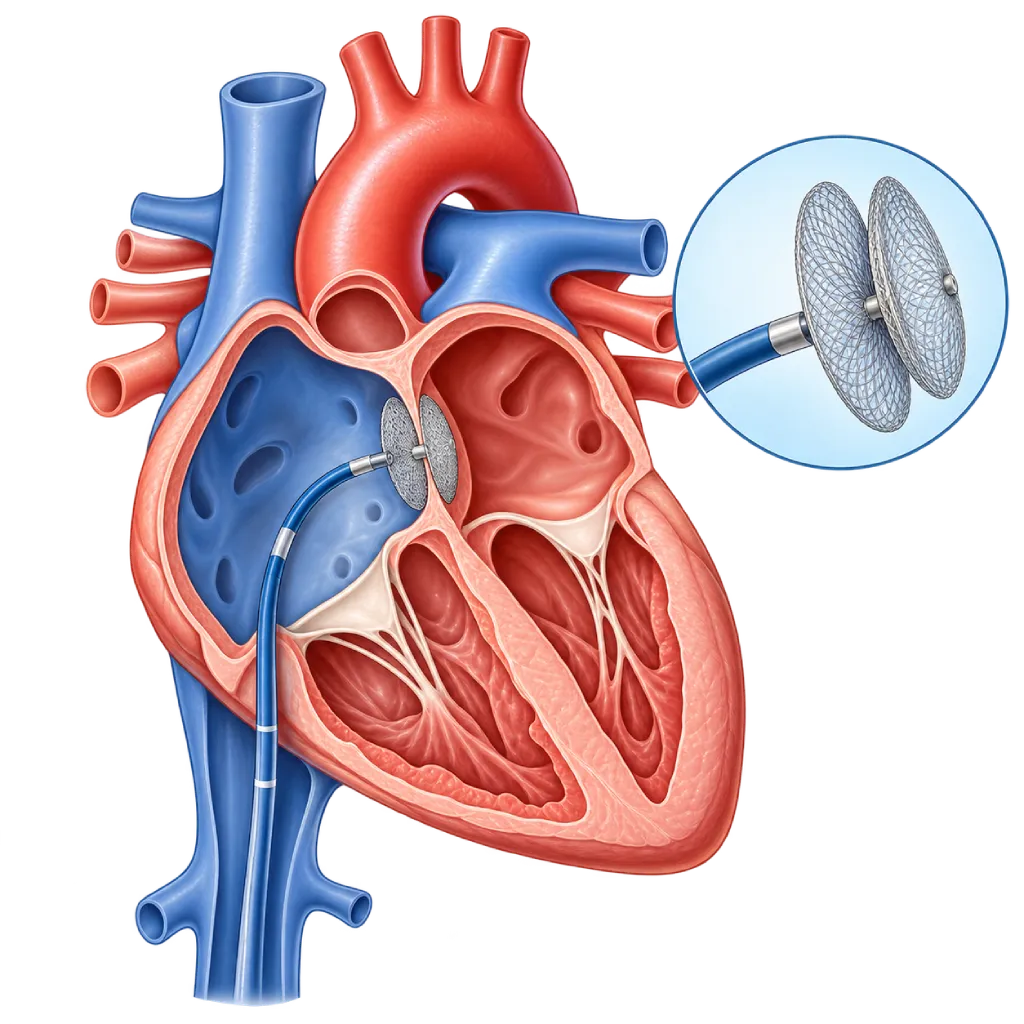
Atrial septal defect (ASD) closure is a procedure to close a hole in the wall between the heart's right and left upper chambers. This hole lets blood leak to the right side, straining the right heart and lungs. In a secundum ASD, the hole is usually closed through a catheter with a two-disc device in 1 to 2 hours.
Sources01 / Understanding the procedure
About Atrial Septal Defect (ASD) Closure
What Is Atrial Septal Defect Closure
An atrial septal defect (ASD) is a hole in the wall (septum) that separates the right and left upper chambers of the heart (atria). Because the pressure in the left atrium is slightly higher, some oxygen-rich blood leaks into the right atrium and is then pumped back to the lungs. Over time, the right side of the heart enlarges and the lung blood vessels receive too much flow. ASD closure aims to stop this leak. An overview of closing other holes in the heart is covered on the Heart Defect Closure page.
Types of ASD and How They Are Closed
A commonly found type is the secundum ASD, a hole in the middle part of the septum. If the rim around it is adequate and the size is suitable, this hole can be closed through a catheter. Other types, such as primum, sinus venosus, and coronary sinus ASDs, lie close to a valve or to where blood vessels enter the heart, so they need to be closed with surgery, covered on the Congenital Heart Surgery page. Surgery is also chosen when a secundum ASD is too large or its rim is too small.
An ASD is different from a patent foramen ovale (PFO), a flap-like opening that does not cause the right heart to enlarge. This is covered on the Patent Foramen Ovale page.
How the Closure Device Works
An ASD closure device is made of flexible metal mesh shaped into two discs joined by a central part. The device is inserted folded inside a catheter, then opened so that one disc sits in the left atrium and the other in the right atrium, clamping the edge of the hole. Within a few months, a layer of heart tissue grows over the device.
When an ASD Needs to Be Closed
A small ASD, less than about 5 millimeters, often causes no problems and may close on its own in babies. Closure is recommended when the right heart enlarges because of the leak, even without symptoms, as long as the pressure in the lung blood vessels is not yet too high. Closure is also considered if there has been a stroke caused by a clot passing through the hole. In children, planned closure is usually done before school age.
ASD in Adults
Many ASDs are only found in adulthood, because the symptoms develop slowly: tiring easily, shortness of breath during activity, or palpitations from atrial fibrillation. Closure in adulthood, including after age 60, can still improve exercise tolerance and reduce the strain on the right heart. If the lung pressure is suspected to be high, the doctor measures it with right heart catheterization, covered on the Right Heart Catheterization page.
02 / Understanding the procedure
When Is This Procedure Considered?
A doctor may consider this procedure in the situations below. The decision is always made after a thorough assessment.
- Enlarged Right HeartThe right atrium and right ventricle are enlarged because of the leak, even without symptoms.
- Excess Blood Flow to the LungsBlood flow to the lungs is about one and a half times or more the flow to the body.
- Shortness of Breath or Tiring EasilyReduced exercise tolerance during activity because of strain on the right heart.
- Stroke from a Clot Crossing the HoleA clot from a vein that crosses through the hole and travels to the brain (paradoxical embolism).
- Secundum ASD with an Adequate RimA requirement for catheter closure; other types of ASD are closed with surgery.
Situations to Consider First
- Very High Lung PressureIf resistance in the lung blood vessels is already high or blood flows in reverse from right to left, closure can be harmful.
- ASD Not of the Secundum TypePrimum, sinus venosus, and coronary sinus defects cannot be closed through a catheter; surgery becomes the option.
- Hole Too Large or Rim Too SmallThe device cannot sit stably, so the hole is closed with surgery.
- Clot in the Heart or Active InfectionA planned procedure is postponed until the clot is gone or the infection is resolved.
- Stiff Left Ventricle in Older AdultsThe doctor may first run a test with a balloon, because closure in this situation can trigger shortness of breath.
03 / Before the procedure
How Should You Prepare?
ASD closure is usually a planned procedure. The team will give you written instructions based on age and the procedure plan.
Tests before the procedure. Echocardiography, ECG, chest X-ray, and blood tests. In adults, an echocardiogram through the esophagus (TEE) is done to measure the hole and its rim.
Fasting. Follow the fasting schedule from the anesthesia team. For children, the time limits for milk and water are explained separately.
Medicines. Your doctor may ask you to start taking aspirin a few days before the procedure. Tell the team if you take blood thinners.
Allergies. Tell the team about any allergy to medicines, contrast dye, or nickel, because closure devices usually contain nickel.
Dental health. Complete any needed dental treatment before the procedure to reduce the risk of infection.
Preparing your child. Explain what will happen in simple words. Parents can stay with their child until the anesthesia takes effect.
Unsure about the preparation instructions? Ask our team before the procedure.
04 / During the procedure
How Is the Procedure Done?
ASD closure is done in the catheterization lab and takes about 1 to 2 hours. Children usually receive general anesthesia. Adults may receive general anesthesia when the procedure is guided by TEE, or a sedative with local anesthesia when it is guided by echocardiography from inside the heart.
Inserting the Catheter
The doctor punctures a vein in the groin and inserts a thin tube up to the right atrium. A blood thinner is given during the procedure.
Measuring the Hole
The pressures in the heart and lungs are measured. The size of the hole and its rim are assessed with echocardiography, sometimes with a sizing balloon, to choose the device size.
Placing the Device
The left disc is opened in the left atrium and pulled against the septum, then the right disc is opened in the right atrium. The position and seal of the device are checked before it is released from its delivery cable.
Completing the Procedure
The catheter is removed, and the puncture site is pressed or closed with a small stitch until the bleeding stops.
05 / Benefits and risks
Benefits and Risks Should Be Discussed Together.
Every medical procedure has benefits and risks. Your doctor will explain both for your situation before the procedure.
Benefits You Can Expect
- Right Heart Shrinks BackOnce the leak stops, the size of the right heart usually improves within a few months.
- No Cut in the ChestThe device is inserted through a blood vessel in the groin, leaving just a small puncture mark.
- Short RecoveryPatients usually go home the next day and return to light activity within a few days.
- Better Exercise ToleranceMany adult patients feel less shortness of breath and tiredness after closure.
The benefits of a procedure are not a promise of a cure. Ask how the results will affect your care plan.
Risks You Should Know
- Device Moving Out of PlaceRare; the device can usually be retrieved through a catheter, and occasionally surgery is needed.
- Heart Rhythm DisordersPalpitations or an irregular rhythm, often temporary in the first few weeks.
- Erosion of the Heart WallVery rarely, the edge of the device wears into the heart wall; chest pain or fainting needs to be checked right away.
- Migraine-Like HeadachesMay appear in the first few months and usually improve, sometimes with an adjustment of antiplatelet medicines.
- Problems at the Puncture SiteBruising, bleeding, or a lump in the groin, usually mild.
- Clot on the DeviceRare; prevented with antiplatelet medicines for about the first 6 months.
Risks can differ from person to person. A full explanation and consent are given after an individual assessment.
06 / After the procedure
What Is Recovery Like?
Most patients go home the next day, after an echocardiogram confirms the device position.
First day. Lie with your legs straight for a few hours. The team monitors your heart rhythm and the puncture site.
Antiplatelet medicines. Aspirin is usually taken for about 6 months, sometimes together with another antiplatelet medicine in adults. Do not stop your medicines without your doctor's guidance.
Activity. Light activity, school, and office work can resume within a few days. Strenuous exercise and contact sports are postponed for about one month or as advised.
Infection prevention. For the first 6 months, tell your dentist that you recently had a device placed, because preventive antibiotics may be needed.
Follow-up visits. Echocardiography is done regularly, for example at 1, 6, and 12 months, then as advised.
Warning signs. Go to the emergency room right away if you or your child has:
- Chest pain, especially if it is sharp or spreads to the back
- Fainting, shortness of breath, or severe weakness
- A very fast or irregular heartbeat
- Growing swelling or bleeding in the groin
- Facial drooping, weakness on one side of the body, or slurred speech
Know the Signs That Need Prompt Care.
Follow the team's guidance on warning signs. If severe or sudden symptoms appear after the procedure, go to the nearest emergency department right away or call Heart Attack Center 1500 258.
07 / Team and support
Doctors and Procedure Support
The doctors below are listed for this procedure. Listed by name, not by ranking.

dr. BRM Ario S. Kuncoro, Sp.JP(K)
Echocardiography & Cardiovascular Imaging
Cardiovascular Diagnostic Center +2 centers
Clinical focusAdvanced and 3D Echocardiography · Transesophageal Echocardiography
View Profile
dr. Radityo Prakoso, Sp.JP(K)
Pediatrics & Congenital Heart Disease
Congenital and Structural Heart Center
Clinical focusPediatric Cardiology Consultation · Congenital Heart Disease Care
View Profile
dr. Salomo Purba, Sp.BTKV, Subsp.JPK(K)
Pediatric and Congenital Heart Surgery
Congenital and Structural Heart Center +2 centers
Clinical focusPediatric Heart Surgery · Congenital Heart Defect Surgery
View ProfileCatheterization Laboratory (Cath Lab)
A dedicated procedure room for cardiac catheterization, coronary angiography, stent placement, and other catheter-based heart…
The availability of technology and test support is confirmed with the team. Technology is chosen according to clinical need.
08 / Common questions
Before You Plan the Procedure.
Questions patients and parents often ask about atrial septal defect (ASD) closure.
Can an ASD close on its own?
A small ASD found in a baby, especially one less than about 5 millimeters, often gets smaller or closes on its own in the first few years. A larger ASD, or one that is still present after about age 2 to 3, rarely closes on its own. The doctor will monitor it with echocardiography and recommend closure if the right heart starts to enlarge.
At what age should a child's ASD be closed?
If the ASD strains the right heart, planned closure is usually done at about age 2 to 5, before the child starts school. At this age, a child's body is usually large enough for a catheter procedure. Earlier closure is considered if the child is short of breath, has frequent lung infections, or is not growing well. The doctor will discuss the right timing with you.
Do adults or older people still need ASD closure?
Yes, if the right heart is enlarged and the lung pressure is not yet too high. Closure in adulthood, including after age 60, can reduce shortness of breath and improve exercise tolerance. Existing rhythm disorders may still need treatment. In some older adults, the doctor first runs a test with a balloon to make sure the left heart can handle the extra flow.
Is an ASD closure device safe in the long term?
ASD closure devices have been used for more than twenty years, with good long-term results in the majority of patients. Heart tissue grows over the device within a few months, and it does not need to be replaced. Serious complications such as erosion of the heart wall are very rare, but regular follow-up visits remain important. Get checked right away if chest pain or fainting occurs.
What is the difference between catheter and surgical ASD closure?
Catheter closure uses a device inserted from the groin, with no cut in the chest, and patients usually go home the next day. It is only for secundum ASDs with a suitable size and rim. Surgery closes the hole with stitches or a patch using a heart-lung machine, requires a hospital stay of about one week, and is used for other types of ASD.
When can I return to work or exercise?
Most patients can return to office work or school within a few days. Avoid heavy lifting and contact sports for about one month, or as your doctor advises. After that, the majority of patients can exercise as usual. Discuss plans for competitive sports with your cardiologist at your follow-up visit.
Sources and Medical Review
Translated from the Indonesian edition medically reviewed by dr. Radityo Prakoso, Sp.JP(K).
Sources as cited in the Indonesian edition.
- Baumgartner H, De Backer J, Babu-Narayan SV, et al. 2020 ESC Guidelines for the management of adult congenital heart disease. Eur Heart J. 2021;42(6):563-645.
- Stout KK, Daniels CJ, Aboulhosn JA, et al. 2018 AHA/ACC Guideline for the Management of Adults With Congenital Heart Disease: A Report of the American College of Cardiology/American Heart Association Task Force on Clinical Practice Guidelines. Circulation. 2019;139(14):e698-e800.
- Du ZD, Hijazi ZM, Kleinman CS, et al. Comparison between transcatheter and surgical closure of secundum atrial septal defect in children and adults: results of a multicenter nonrandomized trial. J Am Coll Cardiol. 2002;39(11):1836-1844.
- Webb G, Gatzoulis MA. Atrial septal defects in the adult: recent progress and overview. Circulation. 2006;114(15):1645-1653.
- Delgado V, Ajmone Marsan N, de Waha S, et al. 2023 ESC Guidelines for the management of endocarditis. Eur Heart J. 2023;44(39):3948-4042.