
Quick answer
What Is Hybrid Heart Procedure?
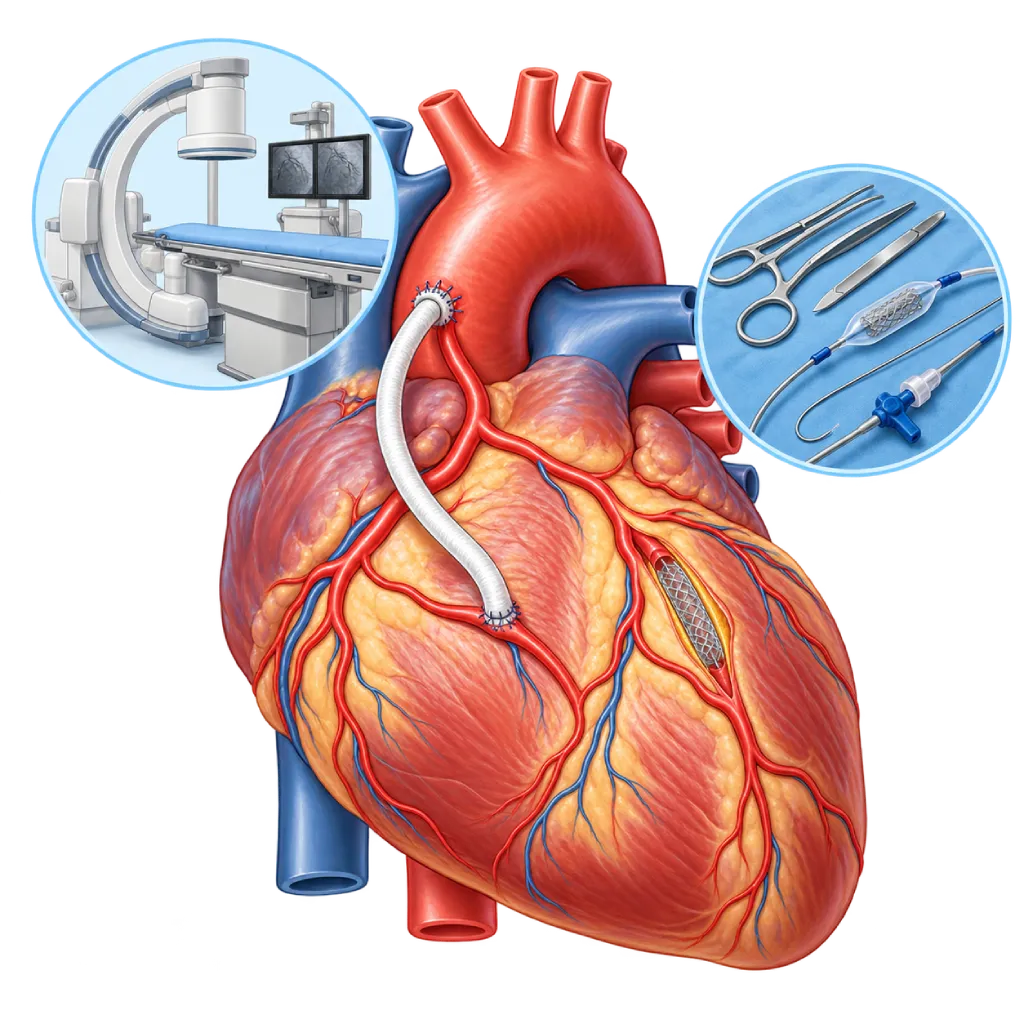
A hybrid heart procedure combines heart surgery and a catheter procedure in one plan, for example bypass of the left anterior descending artery through a small incision plus stent placement in other arteries. Both can be done in one session or in stages. The surgical part usually takes about 3 to 5 hours under general anesthesia.
Sources01 / Understanding the procedure
About Hybrid Heart Procedure
What Is a Hybrid Heart Procedure
A hybrid heart procedure is a treatment plan that combines heart surgery with catheter procedures for one patient. The part better suited to surgery is done by the cardiac surgeon, while the part better suited to catheter treatment is done by the interventional cardiologist. The two procedures can be performed in one session in a hybrid operating room, an operating room that can also be used for X-ray angiography, or in two stages a few days to weeks apart.
Hybrid Coronary Revascularization
A widely known form is hybrid coronary revascularization for narrowings in several coronary arteries, the vessels that carry blood to the heart muscle. The left anterior descending artery, which supplies a large part of the heart muscle, is connected to an arterial graft from behind the breastbone through a small incision between the left ribs. The other coronary arteries are opened with stents through a catheter. The aim is to combine a long-lasting arterial graft with a lighter recovery than bypass through the middle of the chest. Details of each are covered on the Coronary Artery Bypass Grafting (CABG) and Coronary Angioplasty pages.
Order of Procedures
If surgery is done first, the graft can be checked with angiography during stent placement, and dual antiplatelet therapy is started after the surgical bleeding risk has passed. If the stent is placed first, for example during a heart attack involving an artery other than the left anterior descending artery, surgery follows later while antiplatelet medication is continued. In a single session in a hybrid operating room, both are performed one after the other under one anesthetic. The team chooses the order based on your condition.
Hybrid Procedures for Valves and the Aorta
A similar approach is used for other diseases. In valve disease accompanied by coronary narrowing, the valve can be operated on while the coronary arteries are opened with stents, or the other way around. In aortic arch disease, the branch vessels to the neck and head can first be rerouted with surgery, and a stent graft is then placed through a catheter. These procedures are covered on the Aortic Surgery page and on the Aortic Stent Graft Placement (Endovascular Aortic Repair) page.
Evidence and Its Place in Guidelines
Studies in selected patients show that death and heart attack rates after hybrid coronary revascularization are comparable to conventional bypass, with less need for transfusion and a hospital stay that can be shorter. However, randomized trials are still small, and arteries treated with stents are more likely to need repeat procedures. The 2018 ESC guidelines on revascularization state that this approach may be considered in certain patients at experienced centers, not as a routine option. The decision is always made by the heart team together with you.
02 / Understanding the procedure
When Is This Procedure Considered?
A doctor may consider this procedure in the situations below. The decision is always made after a thorough assessment.
- Coronary Disease in Several VesselsThe left anterior descending artery receives an arterial graft, while the other arteries are opened with stents.
- High Risk for Surgery Through the Middle of the ChestFor example, a heavily calcified aorta, advanced age with frailty, or severe lung disease.
- Limited Graft VesselsThe leg veins cannot be used, making it difficult to prepare grafts for many arteries.
- Valve and Coronary Disease TogetherThe valve is treated with surgery, while the coronary narrowing is opened with a stent, or the other way around.
- Aortic Arch DiseaseThe branch vessels to the neck are rerouted with surgery, and a stent graft is then placed through a catheter.
Situations to Consider First
- Left Anterior Descending Artery Not Suitable for a Small IncisionThe artery is too small, embedded in the heart muscle, or extensively diseased, so conventional bypass is more suitable.
- Other Arteries Not Suitable for StentsVery complex blockages in the other arteries make full bypass surgery the more suitable option.
- Unable to Take Dual Antiplatelet TherapyThis medication is needed after a stent and increases the risk of bleeding around the time of surgery.
- Adhesions or Abnormalities of the Left ChestA history of surgery or radiation to the left chest makes a small incision between the ribs difficult.
03 / Before the procedure
How Should You Prepare?
A hybrid procedure is planned jointly by the cardiac surgeon and the interventional cardiologist. The team explains the order of procedures and how to prepare.
Tests. Coronary angiography, echocardiography, blood tests including kidney function, a chest X-ray, lung function tests, and if needed a CT scan of the aorta.
Medications. The plan for antiplatelet medications and blood thinners is set according to the order of procedures. Follow the team's instructions carefully and do not stop any medication on your own.
Allergies and kidneys. Tell the team if you have ever had an allergy to contrast dye or have kidney disease.
Day of the procedure. Follow the fasting instructions, shower with antiseptic soap, and remove jewelry.
Consent and companion. The doctor explains the benefits, risks, and the possibility of switching to surgery through the middle of the chest. Arrange for family members to accompany you during your hospital stay.
Unsure about the preparation instructions? Ask our team before the procedure.
04 / During the procedure
How Is the Procedure Done?
A hybrid procedure is performed by the cardiac surgery team and the interventional cardiology team, in one session in a hybrid operating room or in two stages. The surgical part uses general anesthesia and usually takes 3 to 5 hours. When done separately, the catheter part uses local anesthesia and takes about 1 to 2 hours.
The Surgical Part
The artery behind the breastbone is freed and then connected to the left anterior descending artery through a small incision between the left ribs, usually on a beating heart.
The Catheter Part
A catheter is inserted through the wrist or groin. The other coronary arteries are opened with a balloon and stent, and the newly placed graft can be checked with angiography.
Confirming the Result
Flow in the graft and stents is assessed. If the result is not satisfactory, corrections can be made in the same session.
Monitoring After the Procedure
You are moved to the intensive care unit (ICU) for monitoring, and then to the ward.
05 / Benefits and risks
Benefits and Risks Should Be Discussed Together.
Every medical procedure has benefits and risks. Your doctor will explain both for your situation before the procedure.
Benefits You Can Expect
- Combines the Strengths of Two ApproachesA long-lasting arterial graft for the main artery is combined with stents for the other arteries.
- Without Dividing the BreastboneIn hybrid coronary revascularization, the bypass is usually done through a small incision between the ribs.
- Lighter Recovery in Some PatientsTransfusion needs and hospital stay can be lower than with bypass through the middle of the chest.
- One Plan for Complex DiseaseThe surgical and cardiology teams plan the order of procedures together based on your condition.
The benefits of a procedure are not a promise of a cure. Ask how the results will affect your care plan.
Risks You Should Know
- BleedingDual antiplatelet therapy around the time of surgery increases the risk of bleeding; the order of procedures is planned to reduce it.
- Combined Risks of Surgery and CatheterizationThese include rhythm disturbances, wound infection, and injury at the puncture site.
- Kidney Problems from ContrastContrast dye can temporarily reduce kidney function, especially if you have kidney disease.
- Renarrowing or Repeat ProceduresArteries treated with stents can narrow again, so repeat procedures are more frequent than with conventional bypass.
- Stroke or Heart AttackRare, but can occur during or after the procedure; the team monitors you closely.
- Switching to Surgery Through the Middle of the ChestIf access is limited or problems arise, the surgeon can divide the breastbone for safety.
Risks can differ from person to person. A full explanation and consent are given after an individual assessment.
06 / After the procedure
What Is Recovery Like?
Recovery follows both the surgical part and the catheter part. How long it takes differs from person to person.
In the hospital. Usually about one day in the ICU, with a total hospital stay of about 4 to 7 days. If done in stages, there is an additional short hospital stay for the next stage.
Dual antiplatelet therapy. Taken for several months after the stent is placed. Do not stop it without your cardiologist's instructions.
Wound and activity. Pain between the ribs can be felt for a few weeks. Keep the wound clean, start walking gradually, and ask when you can drive and work.
Rehabilitation and lifestyle. Join a cardiac rehabilitation program, take your cholesterol medication, and control your risk factors.
Warning signs to watch for. Contact the medical team or go to the emergency room right away if you experience:
- Chest pain, shortness of breath, or an irregular pounding heartbeat
- Fever, or a wound that is red, swollen, or filled with pus
- Bleeding or a growing lump at the puncture site
- Black stools, vomiting blood, or widespread bruising
- Facial drooping, weakness on one side of the body, or slurred speech
Know the Signs That Need Prompt Care.
Follow the team's guidance on warning signs. If severe or sudden symptoms appear after the procedure, go to the nearest emergency department right away or call Heart Attack Center 1500 258.
07 / Team and support
Doctors and Procedure Support
The doctors below are listed for this procedure. Listed by name, not by ranking.

Dr. dr. Dafsah A. Juzar, Sp.JP(K)
Interventional Cardiology
Coronary Intervention Procedures +1 center
Clinical focusComplex Coronary Intervention · Cardiac Catheterization
View Profile
Dr. dr. Dudy A. Hanafy, Sp.BTKV, Subsp. JD(K), MARS
Adult Cardiac Surgery
Advanced Cardiovascular Surgical Care +1 center
Clinical focusMinimally Invasive Cardiac Surgery · Coronary Artery Bypass Surgery
View Profile
dr. Widya T. Suwatri, Sp.BTKV, Subsp. JD(K)
Adult Cardiac Surgery
Advanced Cardiovascular Surgical Care +1 center
Clinical focusMinimally Invasive Cardiac Surgery · Coronary Artery Bypass Surgery
View ProfileOperating Theatre (Cardiac Operating Room)
An operating room dedicated to heart and blood vessel surgery, where the surgical, anesthesia, perfusion, and nursing teams work…
Minimally Invasive Cardiac Surgery (MICS) Technology
A way of performing heart surgery through a small incision between the ribs or through part of the breastbone, using long-shafted…
The availability of technology and test support is confirmed with the team. Technology is chosen according to clinical need.
08 / Common questions
Before You Plan the Procedure.
Questions patients and families often ask about hybrid heart procedures.
How is a hybrid procedure different from conventional bypass surgery?
In conventional bypass surgery, all the narrowed arteries receive grafts through an incision in the middle of the chest. In a hybrid procedure, only the left anterior descending artery receives a graft through a small incision between the ribs, while the other arteries are opened with stents through a catheter. The aim is to reduce the burden of surgery while still using a long-lasting arterial graft.
Are both procedures done on the same day?
They can be. In a hybrid operating room, surgery and stent placement can be performed one after the other under one anesthetic. Another option is to do them in stages, a few days to a few weeks apart, with either surgery or the stent first. The team chooses the approach and order based on the condition of your arteries, your bleeding risk, and your overall health.
Who is suitable for a hybrid procedure?
Usually patients with narrowings in several coronary arteries, when the left anterior descending artery is suitable for a graft through a small incision and the other arteries are suitable for stents. This approach is also considered when surgery through the middle of the chest carries a high risk, for example because of a heavily calcified aorta or lung disease. The assessment is done by the heart team.
Are the results as good as conventional bypass surgery?
In selected patients, studies show comparable rates of death and heart attack, with a recovery that can be lighter. However, randomized trials are still small, and arteries treated with stents may need repeat procedures more often. For this reason, guidelines position it as an option for certain patients, not a routine option.
How long will I stay in the hospital?
Usually about one day in the ICU and about 4 to 7 days in total, depending on your condition and whether the procedures are done in one session or in stages. If done in stages, the catheter stage may require an additional short hospital stay. The team will explain the expected length of stay before the procedure.
Why do I need to take two antiplatelet medications?
After a stent is placed, two antiplatelet medications prevent clots inside the stent while the lining of the artery wall grows to cover it. Because these medications also increase the risk of bleeding during surgery, the order of procedures and the timing for starting the medications are planned carefully by the team. Do not stop or change your medications without your cardiologist's instructions.
Sources and Medical Review
Translated from the Indonesian edition medically reviewed by dr. Widya T. Suwatri, Sp.BTKV, Subsp. JD(K).
Sources as cited in the Indonesian edition.
- Neumann FJ, Sousa-Uva M, Ahlsson A, et al. 2018 ESC/EACTS Guidelines on myocardial revascularization. Eur Heart J. 2019;40(2):87-165.
- Puskas JD, Halkos ME, DeRose JJ, et al. Hybrid Coronary Revascularization for the Treatment of Multivessel Coronary Artery Disease: A Multicenter Observational Study. J Am Coll Cardiol. 2016;68(4):356-365.
- Tajstra M, Hrapkowicz T, Hawranek M, et al. Hybrid Coronary Revascularization in Selected Patients With Multivessel Disease: 5-Year Clinical Outcomes of the Prospective Randomized Pilot Study. JACC Cardiovasc Interv. 2018;11(9):847-852.
- Harskamp RE, Bagai A, Halkos ME, et al. Clinical outcomes after hybrid coronary revascularization versus coronary artery bypass surgery: a meta-analysis of 1,190 patients. Am Heart J. 2014;167(4):585-592.
- Czerny M, Schmidli J, Adler S, et al. Current options and recommendations for the treatment of thoracic aortic pathologies involving the aortic arch: an expert consensus document of the European Association for Cardio-Thoracic surgery (EACTS) and the European Society for Vascular Surgery (ESVS). Eur J Cardiothorac Surg. 2019;55(1):133-162.
- Kaneko T, Davidson MJ. Use of the Hybrid Operating Room in Cardiovascular Medicine. Circulation. 2014;130(11):910-917.